

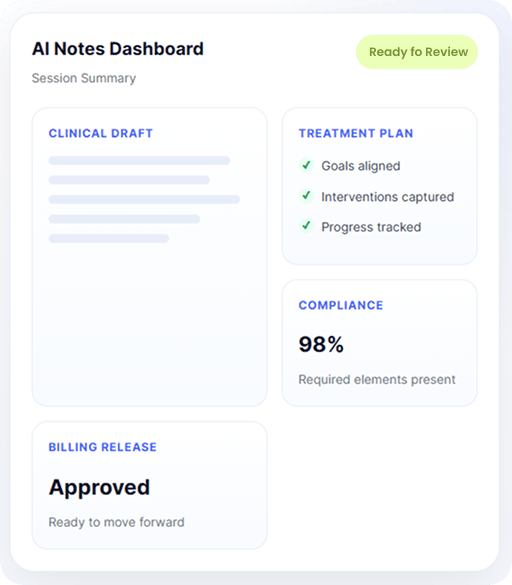
- Presenting problem identified
- Functional impairment documented
- Service is reasonable and necessary
- Treatment is expected to improve condition
AI Notes for Behavioral Health
Spend Less Time Writing Notes.
Spend More Time With Clients
Behavioral health providers face increasing documentation requirements while
trying to maintain quality care. Progress notes, treatment plans, assessments,
supervision documentation, and compliance requirements can consume hours
every week. DENmaar AI Notes helps clinicians complete documentation faster
while maintaining clinical accuracy and professional oversight.

Behavioral Health Focused

Clinical Accuracy & Oversight

Billing Workflow Ready

Reduce Documentation Time
Clinicians save hours each week on documentations.

Improve Note Consistency
AI-powered drafts improve quality and consistency.

Support Compliance Workflows
Build-in guidance for required documentation elements

Connect Notes to billing
Seamless integration with billing and operational workflows.
SUPPORTED DOCUMENTATION
Built Specifically for Behavioral Health
Unlike generic AI scribes, DENmaar AI Notes is designed for behavioral health workflows and
documentation requirements.
Individual Therapy
Family Therapy
Group Therapy
Substance Use Treatment
Case Management
Medication Management
Crisis Intervention
Clinical Supervision
Treatment Plans
Assessments and Reviews
AI NOTES WORKFLOW
How It Works
From captured session details to reviewed, billable documentation.

Record or Capture
Session Information
Patient check-in and
visit completed.

AI Generates a
Clinical Draft
AI Notes generate
structured documentation.

Review and Approve
Claim is created and
scrubbed for accuracy.

Release for Billing
Claim submitted to
the payer
DESIGNED FOR COMPLIANCE
Clinical Documentation with Compliance in Mind
AI Notes helps behavioral health providers document medical necessity, align treatment goals, identify
interventions, and support supervisor review workflows.
Compliance Support
Medical necessity documentation
Goal and treatment plan alignment
Intervention identification
Progress tracking
Required behavioral health documentation elements
Supervisor review workflows
Complete
Medical Necessity Documentation
Documentation supports the medical necessity of services provided and reflects the client’s ongoing treatment needs.
Evidence in Note
Aligned
Goal & Treatment Plan Alignment
Clinical documentation connects session content to active treatment goals and supports continuity across the plan of care.
Evidence in Note
- Active treatment goal referenced
- Session objectives tied to treatment plan
- Interventions support documented goals
- Progress linked back to care plan
Verified
Intervention Identification
Notes clearly identify the therapeutic interventions used during the session and how they relate to the client’s needs.
Evidence in Note
- Therapeutic intervention documented
- Intervention matched to presenting concerns
- Clinician actions clearly described
- Modality or technique identified where appropriate
Reviewed
Progress Tracking
Session documentation captures the client’s response to treatment and tracks change over time to support clinical decision-making.
Evidence in Note
- Client response to intervention documented
- Progress toward goals addressed
- Barriers or setbacks identified
- Ongoing symptoms or improvements noted
Included
Required Documentation Elements
Behavioral health notes include the core documentation elements needed for completeness, consistency, and payer readiness.
Evidence in Note
- Session date, duration, and service type included
- Relevant clinical observations documented
- Risk, safety, or notable concerns addressed when applicable
- Required note structure completed for the encounter
Available
Supervisor Review Workflow
Documentation can support internal review and approval workflows, helping supervisors monitor quality, accuracy, and compliance.
Evidence in Note
- Draft available for supervisor review
- Revisions or feedback can be incorporated
- Approval status is clearly tracked
- Final documentation is released after sign-off
MORE THAN A SCRIBE
Documentation Connected to the Rest of Your Workflow
Documentation can connect directly to scheduling, treatment plans, assessments, billing workflows, claims validation,
and provider productivity reporting.

Scheduling

Assessments

Claims Validation

DENmaar AI
Notes
Notes

Treatment Plans

Billing Workflows

Productivity Reporting
WHY ORGANIZATIONS CHOOSE DENMAAR
Built for Behavioral Health Teams and Organizations
DENmaar AI Notes is designed to support real-world clinical documentation and operational workflows.

Behavioral Health Focused
Customizable behavioral health workflows including therapy, psychiatry, substance use treatment, and multidisciplinary care models.

Scheduling & Operational Workflows
Integrated scheduling designed to support provider productivity, patient flow, authorization tracking, and claims readiness.

Supervisor Workflows
Built-in workflow logic designed to improve claim accuracy before submission through integrated operational checks and billing intelligence.

Eligibility & Insurance Verification
Integrated eligibility workflows designed to support Medicaid, commercial insurance, carve-outs, and behavioral health payer complexity.

Patient Engagement
Patient portal, intake workflows, secure communication, reminders, and measurement-based care tools.

Request an
AI Notes Trial
See how DENmaar AI Notes can help your clinicians reduce documentation time while improving
Request a demonstration or pilot program today.
Request Information
TESTIMONIALS
WHAT OUR CLIENTS SAY
On behalf of everyone at Meadowlark Counseling Services, I want to extend our sincere thanks for the continued improvements you and your team have made to the DENMaar EMR platform. We have been consistently impressed with both the functionality and user-friendly design of the system, which has made a meaningful difference in our day-to-day operations. The intuitive layout and ease of use have allowed our staff to spend less time navigating the system and more time focusing on client care. The regular updates and enhancements reflect your commitment to meeting the evolving needs of providers in the behavioral health and substance use treatment fields. We genuinely look forward to the new features introduced each month and appreciate how responsive the platform has been to the demands of clinical workflows. We have been so pleased with our experience that we’ve taken the opportunity to recommend DENMaar to other professionals in Pennsylvania who are working in the SUD field. Thank you again for your ongoing support and partnership. We are grateful to be working with a company that truly understands the needs of its users. KIndly, Becky Parks on behalf of the entire team at Meadowlark Counseling Services
I referred one of my colleagues Dr Aaron to you he is just starting g his psychology private practice and looking at where to start. I told him hands down you guys are the best billers and have a great EMR and team. He said he reached out just wanted to let you know!
FANTASTIC job keeping things rolling along with any and all of our billing concerns as well as responding to other issues which may well have been out of your wheelhouse. We are VERY grateful to have you and the crew in our corner.
I appreciate you all so much and DENmaar has been such a blessing Donna to our overall operations and success as an expanding company—allowing us to ultimately operate more efficiently, get our claims paid more consistently, ad stay on top of the critical credentialing piece, among other things. Teamwork does in fact, make the dream work. I’ll loop Chris/Isabella in on this message thread too, as I want All of your team to be aware of how much we appreciate our working relationship with DENmaar
Thank you for your diligence!! I appreciate it so much. Thank you Edwina…
Thank you so much Amy! I will be referring to DENmaar as often as I am asked about credentialing services.
Our Latest Blogs
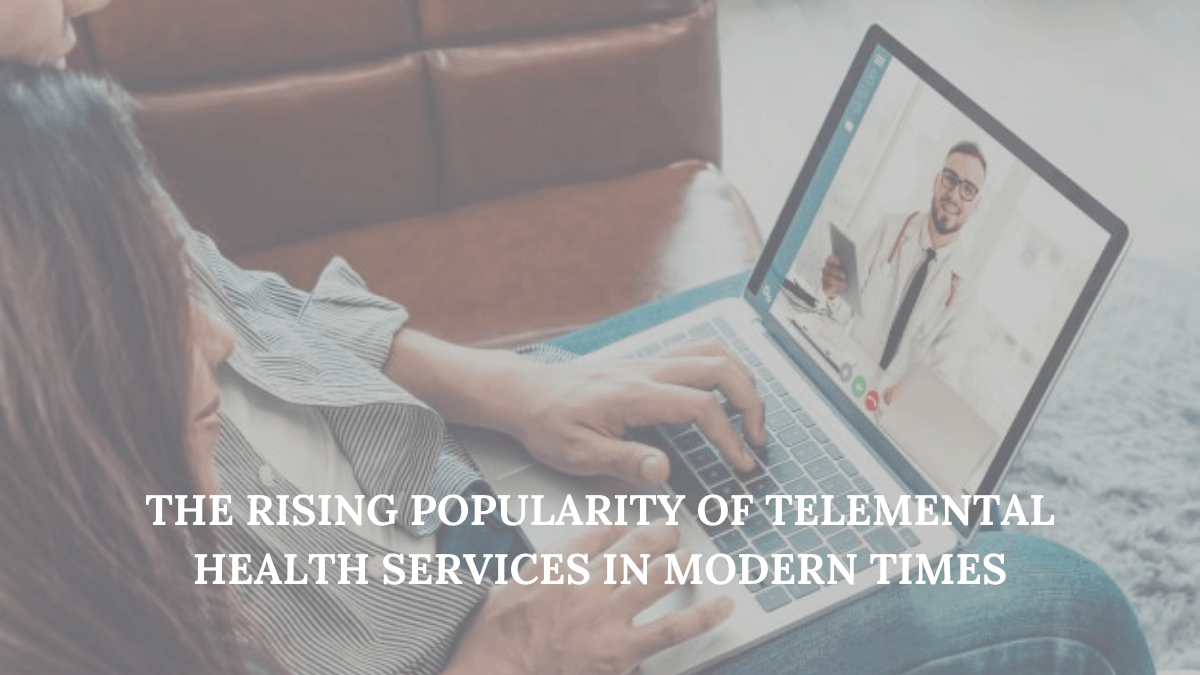
The Rising Popularity of Telemental Health Services in Modern Times
What constitutes the best medical billing software for mental health services? Is it an excellent user interface? Or Is it the ability to perform all tasks like scheduling, appointment booking, tracking payments, and billing automatically? Ask this question to a mental health practitioner, and the answer would be all of the above.
And why not? Why not have software that is not only easy to use but also relieves doctors and practitioners from the hassles of everyday billing and payments.
Keeping this frustration in mind, DENmaar set on a journey to bring the mental health industry a medical billing software that would work to rid mental health practitioners of their payment-related hassles. Our billing software comes with an easy to comprehend user interface that would fit right in with your daily medical choirs.
With a hard-earned reputation, DENmaar specializes in professional and facility billing for insurance claims and patient responsibility. Our clients receive our RCM and Mobile apps to easily create charges, which we later submit to insurance and bill patients. All associated expenses are included when used with our insurance billing services.
DENmaar’s fully automated and highly advanced software was developed to bring our clients the benefits of both professional and institutional billing. State of the art insurance claims processing will keep organizations and providers ahead of the game with automated eligibility verification, claims status updates, claims rejections and denial resolution processes.
Our system also allows for the tracking of your claim status. If due to some unfortunate circumstances, your claim does get rejected and denied, then our experts are at your service to take the necessary actions needed for the approval of your claim.
What makes DENmaar’s Medical Billing Software Special.
Improved Patient Payment System
DENpay is HiPAA compliant and integrates a Virtual Terminal within our RCM to create a conveniently seamless way for patients to make their payments. For providers, it automates the entire payment tracking system and reconciling patient payments. Patients can safely store credit cards and balances automatically billed. Other payment options include emailing a blind statement requesting payment or making a payment with our patient apps. Statements may also be mailed by clicking a button, no printing or stuffing envelopes. How much does this patient payment system cost our clients? $0 It is included as a complimentary feature when using our insurance billing services.
Claim Issues Resolved
Claims which have been denied and rejected are immediately followed up on by DENmaar’s team. We leave no room for such claim issues to occur. Each account has a dedicated Claims Resolution Specialist, a Credentialing Specialist, and an Onboarding Specialist to handle adding insurance panels for billing. That is why DENmaar has a very high first-time claim submission pass through. Payments come in a timely. This allows for cash flows to be maximized, thus making an organization witness its highest revenue generation period.
Staff Claim Tools
All of our software modules, provider and patient apps include Intake and Assessment forms, Telehealth, Electronic Prescription and EMR, Scheduling, Eligibility Verification. Service accounts may use any or all of our features, we provide it as a complimentary product. Our system is cloud based, making transitioning to our platform a breeze.
Choosing DENmaar
DENmaar has been working in the behavioral health industry since 2008 and understands the challenges of a practitioner engaged in within the specialty. Our medical billing software was designed and constructed keeping mental health medical billing in mind. By utilizing our own proprietary RCM system for claims processing we ensure continual advancement in this important financial area. The additional clinical tool for both therapists and medical doctors is a unique feature not typically found in a therapy notes product. We believe we are positioned well now and in the future and would like to take hard working mental health providers with us as we work together to serve the needs of an increasingly needed medical service.
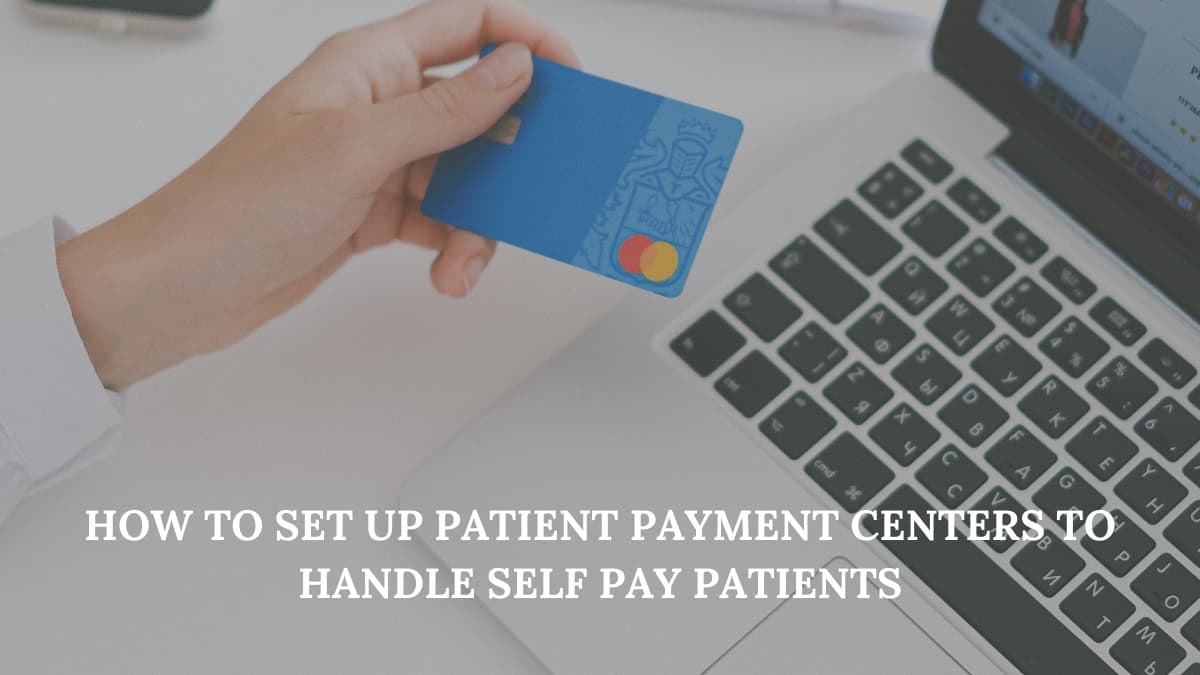
How to Set Up Patient Payment Centers to Handle Self Pay Patients
Even as the Affordable Cares Act gains momentum, many Americans still don’t have access to health insurance. There can be a number of reasons for such a plight. It can be because patients simply cannot afford to purchase health insurance, or they simply fall through the cracks because of residing in states like Florida who didn’t expand on their existing healthcare plan.
As such, self-pay patients are becoming more common. However, many can’t find themselves proper care as practitioners are still reluctant in accepting self-pay patients or don’t have patient payment centers that undertake such practice. So to encourage doctors to accept more patients of such nature, we are going to explore some tips and tricks that can help doctors accept self-pay patients with ease.
But first, let’s understand the reason behind the reluctance of so many doctors in accepting self-pay patients.
The Issues with Self Pay
It is estimated that approximately 81 percent of revenue collected from patients is never really recovered when it is self-paid. Add to this woes, almost 30 percent of patients are said to default on their bills.
Keeping these figures in mind, it is not difficult to understand why doctors are reluctant. Enabling Self-pay sure seems like a recipe for disaster for the functioning of any healthcare organization. However, there are effective ways to ensure there is a perfect patient payment plan in place to avoid the above scenarios of loss.
Establishing an Efficient Policy
Before accepting self-pay patients, it is highly imperative to have some formal payment policies in place. This will protect doctors from losses and payment defaulters. There are 4 factors that must be considered while establishing this policy.
1 – Insurance Co-pays
Set up the office to accept both cash and credit payments, as patients are responsible to fulfill their own co-pays anyways.
2 – Referrals
Referrals are required by insurance companies to recommend patients with specialists they should visit. It forms a big aspect of the primary care providers business.
3 – Payment Responsibility
Providers should set up convenient patient payment centers to allow patients with as much convenience as possible in making payments. Introduce the option of online bill payment to ensure bills are paid on time.
4 – Past Payments
Have a policy to ensure collection of past dues, not a single outstanding payment should be allowed to slip through the cracks.
Creating a formal payment policy will ensure each of these 4 problems are taken care of efficiently. The payment policy should be available on your practice’s website or in print hanging in your practice premises wherever it is visible to your visitors.
Does your Self Pay Patient have hidden healthcare coverage?
Many self-pay patients are opting to pay from their own pockets because they don’t have healthcare coverage. Check their records thoroughly for any past healthcare benefits they can exploit. Also, most self-pay patients do not remain the same as time progresses. They might opt for a health insurance program because they could probably afford healthcare now.
Implement a comprehensive healthcare insurance checklist to ensure a patient isn’t paying more than what he is required to, and that you as a provider are getting paid correctly and on time.
The Bottom Line
As you can tell by now, self-pay patients enjoy a bad reputation in the healthcare industry. However, they are also humans and in need of health care. Care providers can ensure flexible payment options, and clearly communicated payment policies to ensure patients receive the care they need, and providers get paid for the services rendered. Providers can state in their policies that payment is due when services are rendered, thus automatically setting a deadline for payment of dues.
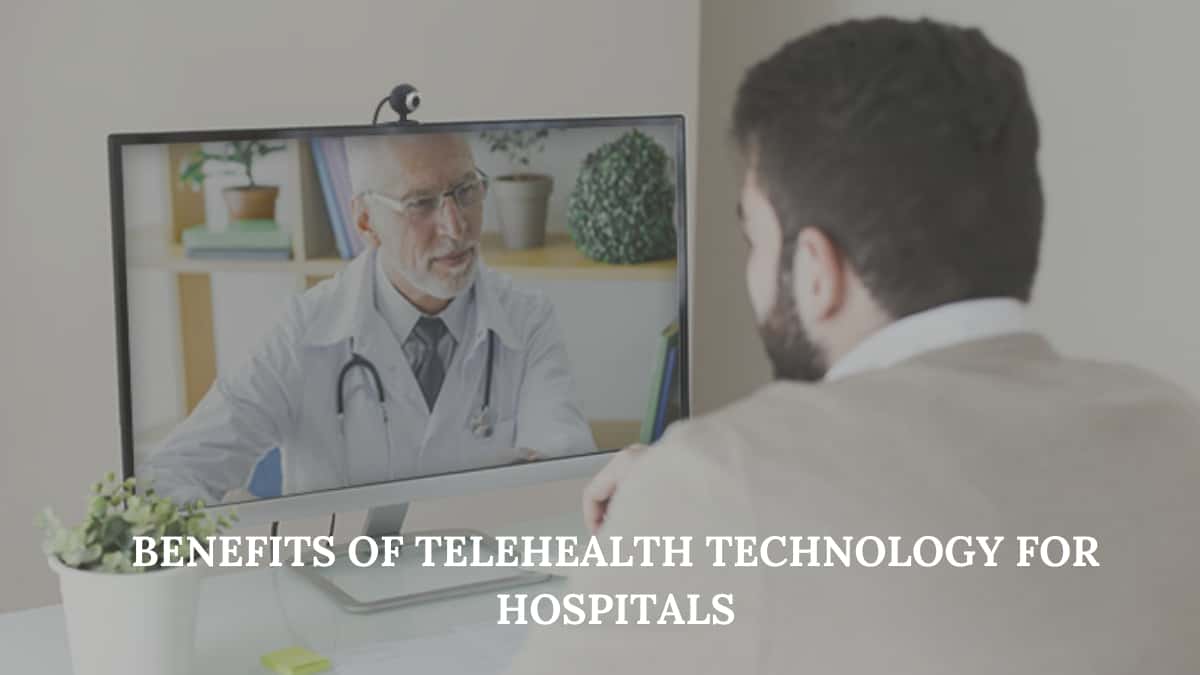
Benefits of Telehealth Technology for Hospitals
We know how important Telehealth technology has been in transforming health care. We know of the benefits it offers to both Patients and Providers alike. Some of which are as follows
- Improved Access to Healthcare
- Cutting Wait Time
- Making Health care affordable
Individuals are already taking full advantage of this revolutionary technology. They have mobile apps installed in their smartphones, and wearables on their wrist or shoulders to track their fitness. We know of the benefits that patients can have with telehealth. However, what are the benefits of telehealth on hospitals, clinics and other healthcare organizations.
In this article, we look at some of the benefits that hospitals and other healthcare organizations can enjoy by using Telehealth technology.
The many uses of Telehealth Technology on Healthcare Institutes and Organizations
Increased Revenue
Access to healthcare, for many American even today, is extremely challenging. Factors like transportation, distance to a nearby clinic etc. all play an important role in being hurdles for the proper access of healthcare. This can be even more inconvenient in cases of senior citizens or people with disabilities.
These individuals can barely make it to a clinic or hospital for proper care. However, with the help of telehealth technology, doctors and other practitioners can still schedule appointment and consult them live via a videoconferencing or live video tool. So, these individuals, who would normally have never become a part of client base, can now become your most valuable clients, thanks to Telehealth.
The same rationale applies to people who don’t have access to healthcare due to them residing in rural or remote regions. They too can be catered to with the help of telehealth technology.
Greater Visibility
It is widely estimated that most people prefer telehealth over physical visits. According to a study done by American Well, it was found that over 65 percent of patients want to see their doctors over video.
The rendering of virtual visits, mHealth apps, and remote patient monitoring solutions, a healthcare organization can attract positive media attention. Positive media attention, then eventually leads to new clients.
Reducing Readmissions
Telehealth technology like RPM solutions can help keep tabs on patients who are considered high-risk. With the help of real-time patient data being provided by this technology, care teams can act immediately before the patient’s condition worsens.
Hospitals are always seeking reduced readmission rates, more satisfied customers and avoiding penalties for subpar healthcare. A robust telehealth technology can help you accomplish that.
Increasing Productivity
Hospitals and Healthcare institutes are busy places. As such doctors and nurses have a lot on their plate, and are constantly on their toes. Telehealth, by imbuing efficiency into the overall functioning of a hospital helps in boosting the productivity of their staff.
Telehealth helps patients schedule their own appointments, which means this burden is alleviated from the shoulders of the staff. Mobile communication also enables staff to collaborate effectively with each other. With so many mundane tasks taken care of, the staff can focus better on their patients.
Better training
The science of medicine undergoes perpetual evolution. As such, people who practice medicine need to be constantly educated and informed of the developments in the world of healthcare. However, this can be very expensive. Some training programs charge exorbitantly high registration fees.
Thankfully, video conferencing technology today can help physicians attend training sessions remotely from the comfort of their own abode, without spending a ton of money. Virtual reality training solutions are also becoming very popular nowadays. They allow physicians to observe recorded surgeries from multiple angles and undergo simulation that offer hands-on experience to learn new techniques and procedures.
DENmaar’s TeleHealth Services
At DENmaar, our telehealth solution offers both patients and providers with a communication technology that allows the access and management of health care services from homes of patients or the practices of doctors. This tele-conferencing feature allows practitioners to attend to their patients, on their computer screens, where-in they can consult and serve their clients without having to make them wait in their clinics or making them transit long distances.
All you have to do to access our feature, whether you are a provider or patient, is to sign up to our app and avail our telepsych feature.
Our Partners






Ready to get started?
Feel free to reach out if you have any questions.
