

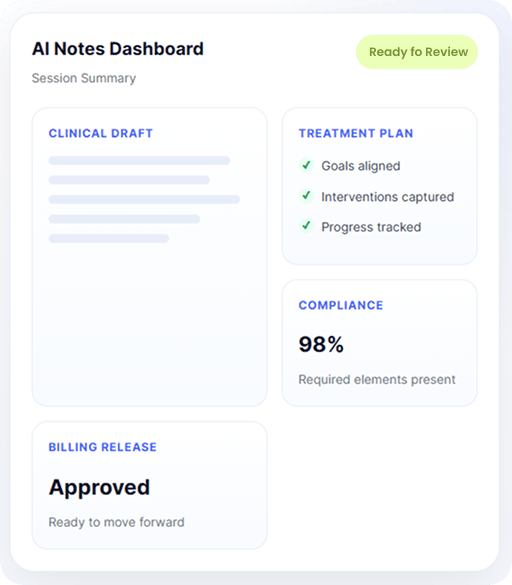
- Presenting problem identified
- Functional impairment documented
- Service is reasonable and necessary
- Treatment is expected to improve condition
AI Notes for Behavioral Health
Spend Less Time Writing Notes.
Spend More Time With Clients
Behavioral health providers face increasing documentation requirements while
trying to maintain quality care. Progress notes, treatment plans, assessments,
supervision documentation, and compliance requirements can consume hours
every week. DENmaar AI Notes helps clinicians complete documentation faster
while maintaining clinical accuracy and professional oversight.

Behavioral Health Focused

Clinical Accuracy & Oversight

Billing Workflow Ready

Reduce Documentation Time
Clinicians save hours each week on documentations.

Improve Note Consistency
AI-powered drafts improve quality and consistency.

Support Compliance Workflows
Build-in guidance for required documentation elements

Connect Notes to billing
Seamless integration with billing and operational workflows.
SUPPORTED DOCUMENTATION
Built Specifically for Behavioral Health
Unlike generic AI scribes, DENmaar AI Notes is designed for behavioral health workflows and
documentation requirements.
Individual Therapy
Family Therapy
Group Therapy
Substance Use Treatment
Case Management
Medication Management
Crisis Intervention
Clinical Supervision
Treatment Plans
Assessments and Reviews
AI NOTES WORKFLOW
How It Works
From captured session details to reviewed, billable documentation.

Record or Capture
Session Information
Patient check-in and
visit completed.

AI Generates a
Clinical Draft
AI Notes generate
structured documentation.

Review and Approve
Claim is created and
scrubbed for accuracy.

Release for Billing
Claim submitted to
the payer
DESIGNED FOR COMPLIANCE
Clinical Documentation with Compliance in Mind
AI Notes helps behavioral health providers document medical necessity, align treatment goals, identify
interventions, and support supervisor review workflows.
Compliance Support
Medical necessity documentation
Goal and treatment plan alignment
Intervention identification
Progress tracking
Required behavioral health documentation elements
Supervisor review workflows
Complete
Medical Necessity Documentation
Documentation supports the medical necessity of services provided and reflects the client’s ongoing treatment needs.
Evidence in Note
Aligned
Goal & Treatment Plan Alignment
Clinical documentation connects session content to active treatment goals and supports continuity across the plan of care.
Evidence in Note
- Active treatment goal referenced
- Session objectives tied to treatment plan
- Interventions support documented goals
- Progress linked back to care plan
Verified
Intervention Identification
Notes clearly identify the therapeutic interventions used during the session and how they relate to the client’s needs.
Evidence in Note
- Therapeutic intervention documented
- Intervention matched to presenting concerns
- Clinician actions clearly described
- Modality or technique identified where appropriate
Reviewed
Progress Tracking
Session documentation captures the client’s response to treatment and tracks change over time to support clinical decision-making.
Evidence in Note
- Client response to intervention documented
- Progress toward goals addressed
- Barriers or setbacks identified
- Ongoing symptoms or improvements noted
Included
Required Documentation Elements
Behavioral health notes include the core documentation elements needed for completeness, consistency, and payer readiness.
Evidence in Note
- Session date, duration, and service type included
- Relevant clinical observations documented
- Risk, safety, or notable concerns addressed when applicable
- Required note structure completed for the encounter
Available
Supervisor Review Workflow
Documentation can support internal review and approval workflows, helping supervisors monitor quality, accuracy, and compliance.
Evidence in Note
- Draft available for supervisor review
- Revisions or feedback can be incorporated
- Approval status is clearly tracked
- Final documentation is released after sign-off
MORE THAN A SCRIBE
Documentation Connected to the Rest of Your Workflow
Documentation can connect directly to scheduling, treatment plans, assessments, billing workflows, claims validation,
and provider productivity reporting.

Scheduling

Assessments

Claims Validation

DENmaar AI
Notes
Notes

Treatment Plans

Billing Workflows

Productivity Reporting
WHY ORGANIZATIONS CHOOSE DENMAAR
Built for Behavioral Health Teams and Organizations
DENmaar AI Notes is designed to support real-world clinical documentation and operational workflows.

Behavioral Health Focused
Customizable behavioral health workflows including therapy, psychiatry, substance use treatment, and multidisciplinary care models.

Scheduling & Operational Workflows
Integrated scheduling designed to support provider productivity, patient flow, authorization tracking, and claims readiness.

Supervisor Workflows
Built-in workflow logic designed to improve claim accuracy before submission through integrated operational checks and billing intelligence.

Eligibility & Insurance Verification
Integrated eligibility workflows designed to support Medicaid, commercial insurance, carve-outs, and behavioral health payer complexity.

Patient Engagement
Patient portal, intake workflows, secure communication, reminders, and measurement-based care tools.

Request an
AI Notes Trial
See how DENmaar AI Notes can help your clinicians reduce documentation time while improving
Request a demonstration or pilot program today.
Request Information
TESTIMONIALS
WHAT OUR CLIENTS SAY
On behalf of everyone at Meadowlark Counseling Services, I want to extend our sincere thanks for the continued improvements you and your team have made to the DENMaar EMR platform. We have been consistently impressed with both the functionality and user-friendly design of the system, which has made a meaningful difference in our day-to-day operations. The intuitive layout and ease of use have allowed our staff to spend less time navigating the system and more time focusing on client care. The regular updates and enhancements reflect your commitment to meeting the evolving needs of providers in the behavioral health and substance use treatment fields. We genuinely look forward to the new features introduced each month and appreciate how responsive the platform has been to the demands of clinical workflows. We have been so pleased with our experience that we’ve taken the opportunity to recommend DENMaar to other professionals in Pennsylvania who are working in the SUD field. Thank you again for your ongoing support and partnership. We are grateful to be working with a company that truly understands the needs of its users. KIndly, Becky Parks on behalf of the entire team at Meadowlark Counseling Services
I referred one of my colleagues Dr Aaron to you he is just starting g his psychology private practice and looking at where to start. I told him hands down you guys are the best billers and have a great EMR and team. He said he reached out just wanted to let you know!
FANTASTIC job keeping things rolling along with any and all of our billing concerns as well as responding to other issues which may well have been out of your wheelhouse. We are VERY grateful to have you and the crew in our corner.
I appreciate you all so much and DENmaar has been such a blessing Donna to our overall operations and success as an expanding company—allowing us to ultimately operate more efficiently, get our claims paid more consistently, ad stay on top of the critical credentialing piece, among other things. Teamwork does in fact, make the dream work. I’ll loop Chris/Isabella in on this message thread too, as I want All of your team to be aware of how much we appreciate our working relationship with DENmaar
Thank you for your diligence!! I appreciate it so much. Thank you Edwina…
Thank you so much Amy! I will be referring to DENmaar as often as I am asked about credentialing services.
Our Latest Blogs
How Conventional is Online Child Therapy
Most folks have a very Hollywood image of what psych therapy or counseling is. They picture adults talking to their psychiatrists while resting on large couches or laid-back comfortably on sofas. However, there is so much more to that concept. Today online therapy has successfully replaced physical consultations, thanks to conferencing via smartphones and computers.
Therapy, however, is equally common if not more frequent with children. Many parents are reasonably cynical about signing up for online child therapy or counseling. They have doubts on what impact it might have on their child.
To clear the air around the topic, we will look at how exactly online child therapy works its pros, cons, and its implications on the future of therapy.
So How Does Online Therapy works
Thanks to the advancements in technology, there are many licensed practitioners and behavioral experts who conduct child therapy online. The process is similar to the treatment they would have received in physical sessions.
These appointments usually take place via video, live chat, phone, or simple messaging. Smartphones, tablets, computers are all effective players in the dissemination of therapy. If there are parents involved, then the therapist may request parental input into the matter affecting their child. Parent-child online therapy sessions may be conducted to find out more about the child’s history or history of the mental illness in the family.
Treatment options are discussed, once a thorough assessment of the child is conducted. Rest assured there is confidentiality between the practitioner and the parents regarding the diagnosis of the child.
The most popular form of Online Therapy
Cognitive-behavioral therapy is one of the most popular therapies provided online today. It helps individual practitioners identify and change destructive thoughts in children. Researches have proven that online sessions are just as effective in conduct as their physical counterparts.
There are many other therapies as well that are equally important but cannot be provided online. Play therapy (Used to express emotions and act out situations) for example, cannot be done without physical presence.
Similarly, Sand tray therapy and other such interactive therapies are better performed in-person rather than online.
The Pros of Online Child therapy
- • Kids can meet their therapists from the comfort of their homes
- • Kids already comfortable with technology will find online therapy no big deal.
- • Appointments can be scheduled more conveniently, according to the convenience of both the therapist as well as the child
- • Online therapy is more accessible, reaching out to rural areas as well
- • Online therapy is cheaper than its counterpart
Cons
- • Technological problems can hinder the delivery of seamless therapy
- • Parents may feel as If they are being left out
- • Online therapy isn’t appropriate for all conditions, Therapies like Play therapy, sand tray etc. can only be delivered with in-person intervention.
- • Online therapists might reject insurance
The Bottom Line
Online therapy provides children with a much more convenient way to communicate with their therapists. Depending on the child age, preferences and needs, a child can be allowed to communicate to his/her therapist in a way that best suits them.
Response to online therapy for children is quite mixed today. While some reports are positive, others claim that their experience was too impersonal. So while some children may struggle, others find it easier to cope with the technology. It depends and varies according to the conditions of the children.
DENmaar’s TeleHealth Services
At DENmaar, our telehealth solution offers both patients and providers with a communication technology that allows the access and management of health care services from homes of patients or the practices of doctors. This teleconferencing feature allows practitioners to attend to their patients, on their computer screens, where-in they can consult and serve their clients without having to make them wait in their clinics or making them transit long distances.
All you have to do to access our feature, whether you are a provider or patient, is to sign up to our app and avail our telepsych feature.
The Many Fundamental Applications of Telehealth Technology
As the world struggles to recover from the tragedy of an ongoing pandemic, Telehealth technology has emerged as a critical messiah that is not only helping save lives but is also determined to save our way of life pertaining to the impending economic crisis.
Telehealth technology has allowed patients to continue availing healthcare, while simultaneously making sure practitioners and their clinics stay operational and financially viable as the world faces an uncertain future in lockdown.
What is Telehealth technology?
Telehealth can very simply be defined as technology that facilitates the delivery of health care, health information and health education via remote technologies like computers or mobile phones. Telehealth provides patients with the tool to consult with their doctors from the comfort of their respective abodes. If recent times are taken into consideration, it allows for face to face communication without compromising on the concept of physical distancing.
The Benefits of Telehealth include:
- • Making Healthcare accessible for rural and isolated communities.
- • Access to behavioral and other medical specialists
- • Making services available for communities and people with limited mobility, or transportation options
- • Improved communication between doctors and patients
- • Improved self-management of health care practice
The below article is focused on how pervasive telehealth technology has become in our healthcare industry. We will be specifically focusing on some of its key applications in terms of providing efficient and adequate care.
So without much further let’s get started.
Telehealth Technology Applications
Today, many technologies are being pumped into the industry with the promise of forever associating telehealth with the service of healthcare. These technologies include mHealth – smartphones and tablets for telehealth, remote patient monitoring, digital photography, audio and video technology, forward and store technology and many more.
Remote Patient Monitoring (RPM)
Remote Patient Monitoring, aka RPM is technology that involves collection, reporting, transmission and evaluation of crucial patient health data via electronic devices. RPM technologies require patients to measure their health data and then transmit it to their physicians for further evaluation. RPM technologies in the form of wearable electronic devices are now being used to collect an array of crucial patient health information like cardiac stats, oxygen levels, and respiratory rates.
(mhealth) Mobile health Telehealth technology
You would be hard strung to find an individual today who does not own and use a smartphone. Smartphones have become tools that have defined human civilization at the turn of the 21st century. Smartphones can now be used for entertainment, calculations, business, education, financial purposes, and so much more.
So it is only fair that it be used to make healthcare convenient. mHealth basically refers to mobile apps and tools that patients use on their smartphones or tablets to avail healthcare. These applications allow users to set medications, appointment reminders and share information with their dedicated practitioners, just like DENmaar’s mental health medical billing application.
Thanks to mHealth, patients can now use asthma or diabetes management tools or talk face to face with their doctors via video conferencing.
Video Conferencing
Perhaps the most relevant, considering the times we are living in; video conferencing has been such a sweet gift of science to mankind. Loved ones can now interact with each other daily and quite conveniently from anywhere around the world, path-breaking trade deals can be closed immediately without any communication barriers, and of course, doctors can advise their patients without making them wait in the clinic or travel long distances.
Real-time video communication platforms are helping doctors and clinicians take better care of their patients without meeting them in-person. This technology has facilitated healthcare for rural inhabitants and soldiers and militants stuck away from civilization.
Store and Forward
Store and forward technology refer to the usage of storage and transmission technology to capture, store and transmit patient health information for asynchronous healthcare delivery. Information like CAT scans, MRI’s, photos, videos, etc. are captured from patients and sent to assigned specialists and practitioners to assist with their healthcare. Technology like secure email platforms, servers, and routers are used to temporarily store this information and send it to the appropriate recipient in time.
Future of Telehealth technology
With many big players jumping in to meddle with this technology, you can bet Telehealth technology will be a key healthcare player in times to come ahead. Big names like Amazon and Wal-Mart have already begun operations on introducing their own version of telehealth technology. We can hope that telehealth technology can work effectively in bringing down healthcare costs and make healthcare more accessible to all.
DENmaar’s TeleHealth Services
At DENmaar, our telehealth solution offers both patients and providers with a communication technology that allows the access and management of health care services from homes of patients or the practices of doctors. This teleconferencing feature allows practitioners to attend to their patients, on their computer screens, where-in they can consult and serve their clients without having to make them wait in their clinics or making them transit long distances.
All you have to do to access our feature, whether you are a provider or patient, is to sign up to our app and avail our telepsych feature.
Understanding Autism Spectrum Disorder
It’s the month of April, also widely celebrated a World Autism Month among other events. However, given the severity of this condition, awareness about autism should be pervasive all year-round and not only for a single month. The awareness for autism commands a great amount of empathy from everyone as ASD’s vary among individuals suffering from it.
Certain therapies and treatments can do wonders for some while being completely futile for others. Caregivers like parents and nurses can also harbor different opinions on how to best deal with a condition of ASD.
This article is focused on not only spreading awareness about Autism but also helping parents and other caregivers better manage the conditions in their loved ones.
What is Autism Spectrum Disorder?
Autism Spectrum Disorder, or as it is popularly known as ASD is a complex developmental condition that saddles individuals suffering from it with challenges like inept social interaction, speech problems, non-verbal communication, and repetitive behaviors. The severity of ASD’s varying from person to person.
ASD is quite frequently first diagnosed in childhood, with signs first becoming noticeable around 2-3 years of age. Some children with autism may develop normally before ultimately losing all their previously gained skills.
The CDC estimates that at least one in 59 children have autism. It is also more common in boys than in girls, and the girls who do have ASD exhibit less obvious signs than boys. Although ASD is a permanent condition, many children who are diagnosed with the condition go on to live normal and independent lives.
The Characteristic of People suffering from ASD
Like we said, no two people will show the same behavioral signs when dealing with autism. Symptoms can mild or severe and change as time passes by. Some of the common characteristics are as follows:
Social and Communication Problems
This includes exhibiting difficulty in having a straight forward normal conversation, not showing interest, or sharing emotions. Issues in trying to understand social cues like eye contact or facial expressions.
Difficulty in Empathizing with People, things and events
Trouble in making friends, interacting with people and not making eye contact
Repetitive behaviors
This can include a number of things, mainly pertaining to hand flapping, flipping objects, lining up toys, speaking in gibberish or atypical manner, exhibiting interest in unusual activities, toe walking, etc.
It is important to note, that while many children with ASD have normal intelligence, some have very mild and significant intellectual delays.
Diagnosis
Early diagnosis of ASD is crucial in parents and caregivers being able to manage this condition. It is the only way by which a child’s symptoms can be reduced and his life ultimately improved. Like we said there is no definitive cure-all for autism spectrum disorder. It is mainly diagnosed by the obstinate observance of the child’s behavior like he talks and interacts with other children his age.
Trained practitioners can easily diagnose the condition by talking to the child and enquiring with his/her parents and caregivers. It is in compliance with federal law that any child suspected of having any kind of developmental disorder should be given a free evaluation. It is highly recommended that the child undergo all sorts of screening procedures to identify developmental disorders, if any, by age three.
If you have doubts about whether or not your child is developing properly, then bring it to the attention of your practitioner immediately. Every second is precious in handling the condition of autism wisely.
The CDC (Center for Disease Control and Prevention) identifies the following red flags as possible signs of ASD:
- • Not responding to his/her name by 12 months of age
- • Not pointing out to objects to display interest by 14 months of age
- • Getting upset very easily
- • Spinning in circles, flapping their hands incessantly
- • Having unusual and intense reactions to sight, smell, taste and feel
- • Avoiding eye contact
- • Preferring loneliness
- • Not playing ‘pretend’
As of now, no expert has clear answers on what actually causes autism. It can be due to genes, or the condition and environment in which a child is born and raised. A child is also at a greater risk of having autism, if there is a close family member who is already suffering from the condition.
How Autism is Treated
As of now there is really no cure for the condition of Autism. However, there are many therapies and treatments that can help people alleviate their symptoms and feel much better.
Some of those treatments are listed below
- • Behavioral Therapy
- • Play therapy
- • Occupational therapy
- • Speech therapy
- • Physical therapy
Alternative Treatments
Many alternative treatments are also in effect today, some of them include the following:
- • High dose Vitamins
- • Hyperbaric oxygen therapy
- • Melatonin to handle sleep issues
The research on these treatments is mixed, and results may vary from person to person. It is highly advisable to weigh the research and financial costs of such treatments before considering them for you or your loved ones.
Tips for Parents and Caregivers
Parents can really help their child overcome the problems posed by ASD by following the below simple tips:
- • Learn and be well informed about Autism Spectrum Disorder
- • Provide consistent structure and routine
- • Seek professional help
- • Build a rapport with other parents who are raising children with autism
- • Take your time and be patient while dealing with your child
DENmaar Partners with Autism Lizard to Offer Efficient Autism Management Program
A child with autism can be extremely stressful for the entire family. Handling it can be a headache, very time consuming and break your savings. DENmaar knows how important it is to take into account the emotional and physical health of the entire family, and thus have partnered with premier behavioral training service providers who offer legit, tried and tested autism solution for your family at an affordable price. DENmaar clients and subscribers can now avail tempting discounts for Autism lizards Family Autism Independence System program. Offer is available for a limited time only, so HURRY!!
Our Partners






Ready to get started?
Feel free to reach out if you have any questions.
