Artificial intelligence is becoming common in behavioral healthcare, but most of the attention remains focused on one task: generating progress notes.
Documentation is an important use of AI. Providers spend too much time completing notes, updating treatment plans, and ensuring that clinical records support both continuity of care and payer requirements. AI can make that work faster and more consistent.
But documentation represents only one part of operating a behavioral health practice.
Practices also manage patient calls, intake, scheduling, insurance verification, provider responsibilities, claim preparation, billing follow-up, and revenue-cycle exceptions. When AI is limited to progress notes, the practice may save time in one area while continuing to struggle with disconnected systems and manual processes everywhere else.
At DENmaar, our goal is broader: apply AI across the connected work of the practice.
The Problem With Standalone AI Tools
Many AI products are designed to perform one isolated function. One product records a session. Another generates a note. Another answers the telephone. Another review claims.
Each product may be useful, but the practice is still responsible for connecting the information and moving the work forward.
A call must become an intake. The intake must become an appointment. The appointment must lead to completed documentation. The documentation must support a clean claim. The claim must be monitored until it is paid.
If each step takes place in a different system, the organization still depends on staff members to transfer information, recognize problems, and determine what needs to happen next.
Adding more software does not necessarily make the practice easier to operate.
AI in Behavioral Health Works Better Inside a Connected Platform
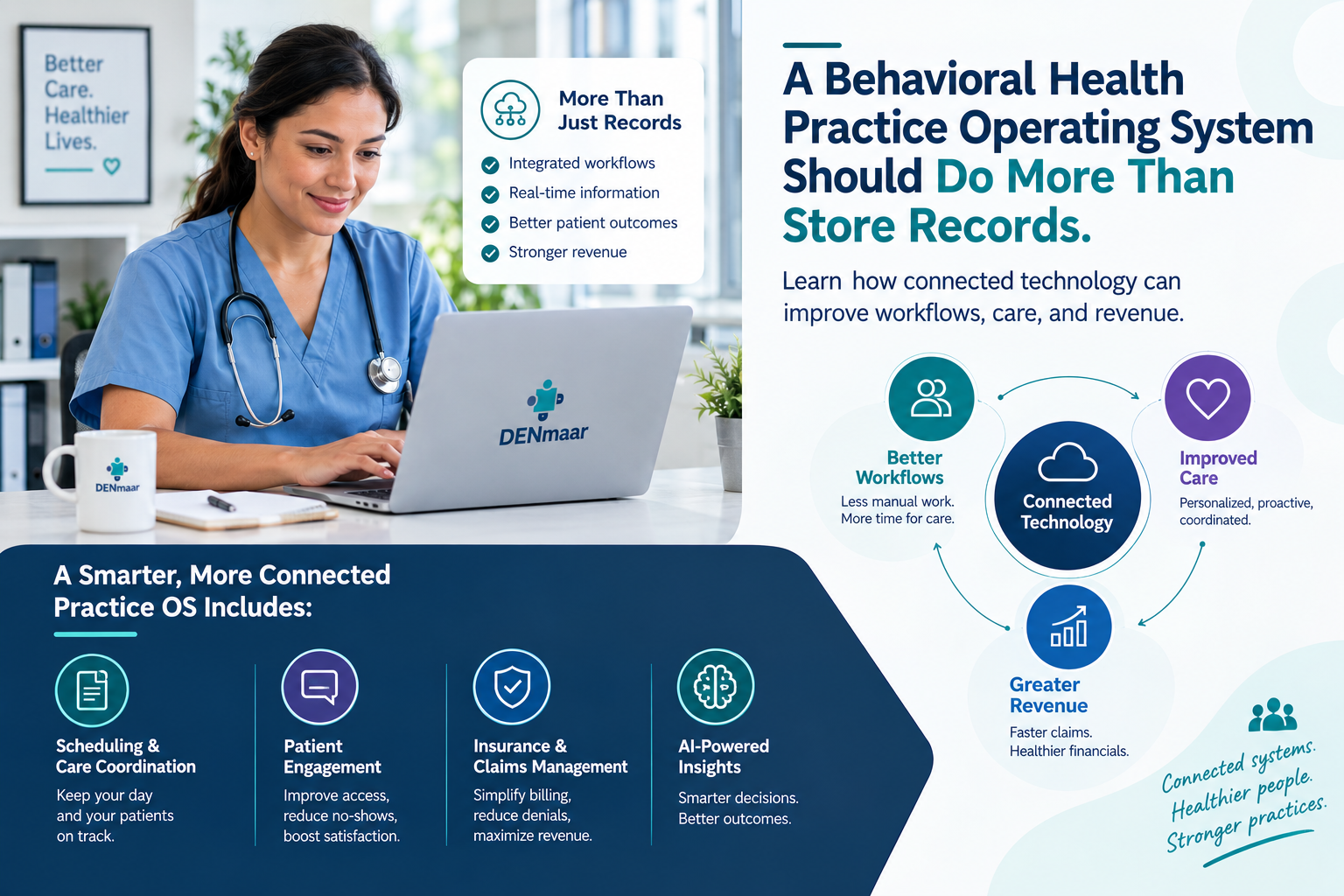
DENmaar combines the EHR, scheduling, clinical documentation, billing, credentialing, and operational support within one behavioral health platform.
This creates an opportunity to use AI differently.
Instead of treating AI as a separate application, we can introduce it directly into the workflows where clinical, administrative, and financial work already occurs.
Information gathered during patient intake can support scheduling and documentation. Clinical documentation can contribute to claim readiness. Claims data can guide billing follow-up. Operational information can help leadership identify where work is becoming delayed.
The value comes not only from what the AI can generate, but from its ability to help connect one stage of the practice to the next.
AI-Assisted Clinical Documentation
Clinical documentation remains one of the clearest and most immediate uses of AI in behavioral health.
DENmaar uses AI to assist with documentation such as:
- Biopsychosocial assessments
- Individualized treatment plans
- Measurable goals and objectives
- DAP, SOAP, and BIRP progress notes
- Psychiatry and medication-management notes
- Group and multidisciplinary documentation
- Clinical assessments and outcome measures
- Continuity between treatment plans and subsequent notes
The objective is not simply to produce text faster. It is to help providers create documentation that reflects the patient’s treatment, active goals, clinical progress, and applicable assessments.
Providers remain responsible for reviewing, editing, and approving AI-assisted documentation before it becomes part of the signed clinical record. AI supports clinical work; it does not replace clinical judgment.
AI at the Front Door of the Practice
The patient experience often begins before an appointment is ever scheduled.
Prospective patients call with questions about services, provider availability, insurance, locations, and appointment times. When staff members are busy or the office is closed, those opportunities can be lost.
The DENmaar AI Receptionist is designed to support the work surrounding that first contact, including:
- Responding to incoming calls
- Collecting new-patient information
- Handling common practice questions
- Supporting appointment and rescheduling requests
- Collecting preliminary insurance information
- Routing patients by provider, location, or service
- Preparing call summaries
- Identifying the appropriate next step for staff
Because the receptionist is being connected to the DENmaar platform, the information collected can move into the practice workflow instead of remaining inside a separate answering service.
The long-term objective is a smoother path from initial contact to registration, scheduling, insurance review, and care.
AI for Provider Workflow
Providers should not have to search multiple screens to determine what requires their attention.
An upcoming appointment may have an eligibility concern. A patient may be missing an assessment. A note may remain unsigned. A treatment plan may require an update. A supervisor may need to review documentation before a claim can move forward.
DENmaar’s Provider Work Area is being developed to bring these responsibilities into a more organized and prioritized view.
AI can help identify what is incomplete, explain why it matters, and direct the provider toward the appropriate action. Instead of presenting another collection of reports, the system can help answer a much more useful question:
What do I need to do next?
This is where AI can begin to reduce the daily friction providers experience inside traditional EHR systems.
AI in Claims and Billing Operations
Submitting a claim is only the beginning of the revenue cycle.
Billing teams must identify missing information, monitor payer responses, research problems, prioritize follow-up, and determine what action should be taken on each unresolved claim.
DENmaar’s Claims Copilot is designed to bring AI and operational intelligence into that process.
Potential applications include:
- Detecting missing or inconsistent claim information
- Identifying dependencies between documentation and billing
- Flagging claims requiring attention
- Organizing follow-up by urgency and financial impact
- Supporting denial and rejection analysis
- Recognizing recurring payer problems
- Recommending the next appropriate action
- Helping prevent avoidable submission delays
The goal is not to remove experienced billing professionals from the process. It is to give them clearer information, reduce repetitive research, and help them focus their attention where it will have the greatest impact.
Making Insurance Knowledge More Accessible
Healthcare reimbursement requirements are fragmented and constantly changing.
Rules may vary by payer, plan, state, provider type, service, location, and method of delivery. Staff members often search payer manuals, portals, internal notes, and previous claims to find an answer.
DENmaar is building an expanding insurance knowledge resource informed by real behavioral health billing situations.
This knowledge can support questions involving:
- Coding
- Prior authorization
- Medical necessity
- Documentation requirements
- Claim resolution
- Credentialing
- Telehealth
- Payer-specific policies
- Billing best practices
Bringing this knowledge closer to the workflow can help practices make better decisions without repeatedly starting the research process from the beginning.
AI for Practice Leadership
AI also has the potential to help owners and executives understand how the organization is operating.
When scheduling, provider activity, clinical documentation, claims, and collections exist inside a connected platform, leadership can gain better visibility into:
- Provider utilization
- Unfinished clinical work
- Workflow bottlenecks
- Claims waiting on documentation
- Recurring insurance problems
- Revenue-cycle exceptions
- Operational trends requiring intervention
The objective is not another dashboard filled with numbers. It is earlier recognition of the issues that could affect patient access, provider performance, or revenue.
One Patient Journey, Not a Collection of Features
The greatest opportunity for AI in behavioral healthcare is not found in any single feature.
A prospective patient contacts the practice. Information is collected and the patient is directed toward the right provider. Registration, patient insurance management, and assessments are completed. The provider documents the encounter. The documentation supports claim creation. The billing team addresses exceptions. Leadership monitors the performance of the organization.
These are not unrelated activities. They are stages of one connected patient and revenue journey.
That is why DENmaar is applying AI across the platform rather than treating it as a standalone documentation tool.
Building AI Carefully and Practically
AI in healthcare must be introduced with appropriate human review and clear responsibility.
Some DENmaar AI capabilities are available today. Others are in active development or being expanded through controlled pilots. We believe practices should know the difference.
Our approach is to show organizations what is currently working, explain what is being developed, and evaluate whether each workflow fits their actual operational needs.
The future of behavioral health technology is not simply an EHR with an AI button. It is a connected system that helps patients, providers, staff members, billers, and practice leaders move work forward with fewer delays and fewer disconnected steps.
That is the direction DENmaar is building toward: AI throughout the practice, applied where it can make the work clearer, faster, and easier to manage.
See How DENmaar Is Using AI Across Behavioral Healthcare
Learn how DENmaar connects patient access, clinical documentation, provider workflow, insurance knowledge, claims, and revenue-cycle operations within one platform.