

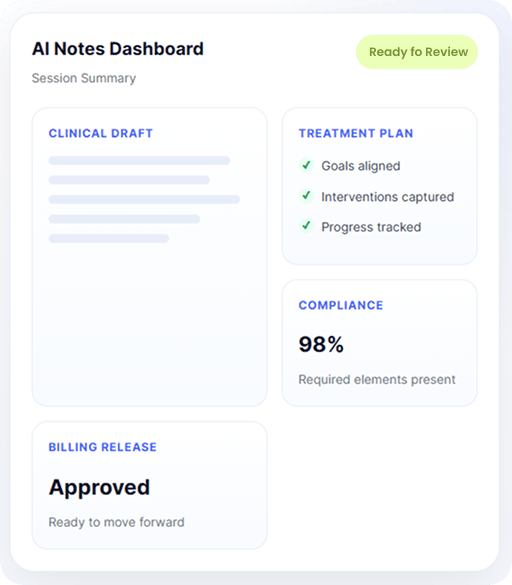
- Presenting problem identified
- Functional impairment documented
- Service is reasonable and necessary
- Treatment is expected to improve condition
AI Notes for Behavioral Health
Spend Less Time Writing Notes.
Spend More Time With Clients
Behavioral health providers face increasing documentation requirements while
trying to maintain quality care. Progress notes, treatment plans, assessments,
supervision documentation, and compliance requirements can consume hours
every week. DENmaar AI Notes helps clinicians complete documentation faster
while maintaining clinical accuracy and professional oversight.

Behavioral Health Focused

Clinical Accuracy & Oversight

Billing Workflow Ready

Reduce Documentation Time
Clinicians save hours each week on documentations.

Improve Note Consistency
AI-powered drafts improve quality and consistency.

Support Compliance Workflows
Build-in guidance for required documentation elements

Connect Notes to billing
Seamless integration with billing and operational workflows.
SUPPORTED DOCUMENTATION
Built Specifically for Behavioral Health
Unlike generic AI scribes, DENmaar AI Notes is designed for behavioral health workflows and
documentation requirements.
Individual Therapy
Family Therapy
Group Therapy
Substance Use Treatment
Case Management
Medication Management
Crisis Intervention
Clinical Supervision
Treatment Plans
Assessments and Reviews
AI NOTES WORKFLOW
How It Works
From captured session details to reviewed, billable documentation.

Record or Capture
Session Information
Patient check-in and
visit completed.

AI Generates a
Clinical Draft
AI Notes generate
structured documentation.

Review and Approve
Claim is created and
scrubbed for accuracy.

Release for Billing
Claim submitted to
the payer
DESIGNED FOR COMPLIANCE
Clinical Documentation with Compliance in Mind
AI Notes helps behavioral health providers document medical necessity, align treatment goals, identify
interventions, and support supervisor review workflows.
Compliance Support
Medical necessity documentation
Goal and treatment plan alignment
Intervention identification
Progress tracking
Required behavioral health documentation elements
Supervisor review workflows
Complete
Medical Necessity Documentation
Documentation supports the medical necessity of services provided and reflects the client’s ongoing treatment needs.
Evidence in Note
Aligned
Goal & Treatment Plan Alignment
Clinical documentation connects session content to active treatment goals and supports continuity across the plan of care.
Evidence in Note
- Active treatment goal referenced
- Session objectives tied to treatment plan
- Interventions support documented goals
- Progress linked back to care plan
Verified
Intervention Identification
Notes clearly identify the therapeutic interventions used during the session and how they relate to the client’s needs.
Evidence in Note
- Therapeutic intervention documented
- Intervention matched to presenting concerns
- Clinician actions clearly described
- Modality or technique identified where appropriate
Reviewed
Progress Tracking
Session documentation captures the client’s response to treatment and tracks change over time to support clinical decision-making.
Evidence in Note
- Client response to intervention documented
- Progress toward goals addressed
- Barriers or setbacks identified
- Ongoing symptoms or improvements noted
Included
Required Documentation Elements
Behavioral health notes include the core documentation elements needed for completeness, consistency, and payer readiness.
Evidence in Note
- Session date, duration, and service type included
- Relevant clinical observations documented
- Risk, safety, or notable concerns addressed when applicable
- Required note structure completed for the encounter
Available
Supervisor Review Workflow
Documentation can support internal review and approval workflows, helping supervisors monitor quality, accuracy, and compliance.
Evidence in Note
- Draft available for supervisor review
- Revisions or feedback can be incorporated
- Approval status is clearly tracked
- Final documentation is released after sign-off
MORE THAN A SCRIBE
Documentation Connected to the Rest of Your Workflow
Documentation can connect directly to scheduling, treatment plans, assessments, billing workflows, claims validation,
and provider productivity reporting.

Scheduling

Assessments

Claims Validation

DENmaar AI
Notes
Notes

Treatment Plans

Billing Workflows

Productivity Reporting
WHY ORGANIZATIONS CHOOSE DENMAAR
Built for Behavioral Health Teams and Organizations
DENmaar AI Notes is designed to support real-world clinical documentation and operational workflows.

Behavioral Health Focused
Customizable behavioral health workflows including therapy, psychiatry, substance use treatment, and multidisciplinary care models.

Scheduling & Operational Workflows
Integrated scheduling designed to support provider productivity, patient flow, authorization tracking, and claims readiness.

Supervisor Workflows
Built-in workflow logic designed to improve claim accuracy before submission through integrated operational checks and billing intelligence.

Eligibility & Insurance Verification
Integrated eligibility workflows designed to support Medicaid, commercial insurance, carve-outs, and behavioral health payer complexity.

Patient Engagement
Patient portal, intake workflows, secure communication, reminders, and measurement-based care tools.

Request an
AI Notes Trial
See how DENmaar AI Notes can help your clinicians reduce documentation time while improving
Request a demonstration or pilot program today.
Request Information
TESTIMONIALS
WHAT OUR CLIENTS SAY
On behalf of everyone at Meadowlark Counseling Services, I want to extend our sincere thanks for the continued improvements you and your team have made to the DENMaar EMR platform. We have been consistently impressed with both the functionality and user-friendly design of the system, which has made a meaningful difference in our day-to-day operations. The intuitive layout and ease of use have allowed our staff to spend less time navigating the system and more time focusing on client care. The regular updates and enhancements reflect your commitment to meeting the evolving needs of providers in the behavioral health and substance use treatment fields. We genuinely look forward to the new features introduced each month and appreciate how responsive the platform has been to the demands of clinical workflows. We have been so pleased with our experience that we’ve taken the opportunity to recommend DENMaar to other professionals in Pennsylvania who are working in the SUD field. Thank you again for your ongoing support and partnership. We are grateful to be working with a company that truly understands the needs of its users. KIndly, Becky Parks on behalf of the entire team at Meadowlark Counseling Services
I referred one of my colleagues Dr Aaron to you he is just starting g his psychology private practice and looking at where to start. I told him hands down you guys are the best billers and have a great EMR and team. He said he reached out just wanted to let you know!
FANTASTIC job keeping things rolling along with any and all of our billing concerns as well as responding to other issues which may well have been out of your wheelhouse. We are VERY grateful to have you and the crew in our corner.
I appreciate you all so much and DENmaar has been such a blessing Donna to our overall operations and success as an expanding company—allowing us to ultimately operate more efficiently, get our claims paid more consistently, ad stay on top of the critical credentialing piece, among other things. Teamwork does in fact, make the dream work. I’ll loop Chris/Isabella in on this message thread too, as I want All of your team to be aware of how much we appreciate our working relationship with DENmaar
Thank you for your diligence!! I appreciate it so much. Thank you Edwina…
Thank you so much Amy! I will be referring to DENmaar as often as I am asked about credentialing services.
Our Latest Blogs
The Present and Future of Telehealth Mental Health Care in the Workplace
The ongoing coronavirus crisis has already galvanized people into self-isolation. The isolation has already resulted in great stress among individuals across the US. Over 16 million Americans are estimated to be suffering from some form of depression; this number is likely to go up as the pandemic wreaks havoc on the streets.
As a result, many workers today are relegating to their employer provided mental health plans, widely encouraged by the employers themselves. They have realized the gravity of the disruption caused on their employee’s normal way of life, and how it can lead to unfathomable stress. There has also been a significant increase in the number of therapy sessions.
Telehealth in Workplace
Telehealth Mental health platforms like Ginger have noticed a rise in their user base as well. This shows that employees are now turning to telehealth technology to find reprieve from their mental health problems. Glass – a company that deploys their tool to help users find behavioral health practitioners have reported a 25% increase in their client base. Modern health – a virtual mental health app, on the other hand, has reported a 50 % increase in their user base.
Headspace, a popular meditation app has also found a substantial increase in their users. They say that meditation on their app has become 13 times more often than any previous month. Headspace’s user base is mostly filled with Google and LinkedIn employees. Taking advantage of this opportunity, they have proceeded to create a free content hub to provide guided meditation and mental health exercises as the global lockdown continues.
So as you can see, many telehealth apps are experiencing feats of success that they never dreamed of achieving. Addressing mental health has become a priority amongst businesses, who really want their employees to sail through these troubled seas without any problems whatsoever. Employees too, are relying on the available technology and programs in unprecedented numbers. Although mental health program existed before the pandemic hit, it had never been as popular as it is now.
Many Employers are actively encouraging users to take advantage of the EAP resources at the disposal of their employees. It is in times of such anxiety and uncertainty that behavioral health practitioners like counselors and psychiatrists are needed. However, with social distancing in effect, it is impossible to attend therapy sessions. This is precisely why Telehealth has come out as such a champion.
Employers understand how crucial their staff’s mental health is. In times where conference, meetings and other office practices have halted, mental health care has become a need of the hour for employees to maintain their productivity.
It is estimated that people with mental health issues report 20% drop in their productivity. Companies have no choice but to think about the safety and wellbeing of their employees. Apart from work, the desire for some form of human connection has also lead to such technology gaining momentum, thus helping users connect with their loved ones.
The Future of Telehealth Mental Health Care
Many epidemiologists have delivered warning signs of a yearlong fight with the novel coronavirus. In other words the virus is here to stay. In such a scenario, the work cannot be halted for an extended period of time. People will need to learn how to live with the crisis, and as a result people will need constant counseling. Thankfully, telehealth has never as advanced as it is today. With telehealth, you can rest assured your bread and butter continues while taking care of your mental health. Yes, the virus is here to stay, but so is the omniscient presence of telehealth.
DENmaar’s TeleHealth Services
At DENmaar, our telehealth solution offers both patients and providers with a communication technology that allows the access and management of health care services from homes of patients or the practices of doctors. This tele-conferencing feature allows practitioners to attend to their patients, on their computer screens, where-in they can consult and serve their clients without having to make them wait in their clinics or making them transit long distances.
All you have to do to access our feature, whether you are a provider or patient, is to sign up to our app and avail our telepsych feature.
The Popularity of Telehealth in Behavioral Health Care
We’ve come a long way since the early days of telehealth. With constant advancements, innovations, and updates in technology, Telehealth has become relatively potent as opposed to its beginning years. Its relevance has been proven even more fundamental, owing to the current pandemic.
Read More: How to Expand Private Practice Using Telemedicine
Almost all healthcare practices, organizations, and professionals are now implementing technology to not only provide consistent care to their clients but also ensure their practice remains open for business. This is especially true for the behavioral health care sector as well. The implementation of Telehealth in Behavioral health has made mental health care better, more cost-effective, and less stigmatized.
Telehealth’s major selling point has always been its accessibility. It can be a tool that transcends socio-geographical barriers to ensure better care is delivered on time whenever needed. Rural areas have greatly benefited from Telehealth.
How is Telehealth used in Behavioral Health?
Most behavioral health practices are aligned with psychiatry, counseling, and cognitive tests, there is barely any physical involvement in the rendering of behavioral health care. As such Telehealth and behavioral health go hand in hand. Behavioral professionals can still deliver efficient care via a mobile device with the help of telehealth.
Moreover, treating mental health with telehealth is easier, and cheaper as treatment is rendered in a virtual ambiance. There is also a stigma around mental health treatment, which dissuades many individuals from coming forward with their woes. It is estimated that about 42 million Americans have anxiety disorders, and at least 16 million are suffering from some form of depression. Telehealth, by providing a virtual incentive, helps patients get proper mental health care comfortably.
There are multiple research materials claiming that mental health issues come with medical comorbidity. For individuals who deal with multiple conditions like hypertension and depression at the same time, they can get the answers to their queries from a single virtual point, thus allowing for better access to care.
There are other incentives to telehealth as well. Patients no longer have to wait in long lines with patients who might carry contagious flu, which is one of the reasons why telehealth’s stock is up nowadays. There is also no long-distance travel, especially for residents of rural regions. There was a time when rural residents had to traverse on overnight journeys just to see a doctor. Telehealth has changed that.
The adoption of telehealth is already showing results in the behavioral space. According to the popular telehealth service Teladoc’s own research, practitioners have seen an impressive improvement in the mental health of their clients using telehealth. They have reported a 32% reduction in depression symptoms, a 31% reduction in anxiety, and a 20 percent reduction in stress.
DENmaar’s TeleHealth & Medical Billing Services
At DENmaar, our telehealth solution offers both patients and providers with a communication technology that allows the access and management of health care services from homes of patients or the practices of doctors. This teleconferencing feature allows practitioners to attend to their patients, on their computer screens, where-in they can consult and serve their clients without having to make them wait in their clinics or making them transit long distances.
All you have to do to access our feature, whether you are a provider or patient, is to sign up to our app and avail our telepsych feature.
Providing Telehealth in Nursing Homes during the COVID-19 Pandemic
So, what are the challenges facing telehealth in nursing homes?
Our older generation is more vulnerable to the novel coronavirus crisis. The stats and figures coming out from many severely affected regions around the planet have made it crystal clear. The symptoms are extremely dire in our elder community. This means nursing homes and other old-age care facilities are also facing significant risks.
Nursing homes are already taking precautionary measures like banning visits, canceling recreational activities, etc. to ensure the elders in their care are safe from this deadly virus. However, this may cause further problems. Isolating the elders from the outside world and canceling their recreational activities can take a heavy toll on their mental health.
Thankfully, psychologists and behavioral practitioners are considered essential workers and can render their services via an array of telehealth technology at their disposal. Medicare and Medicaid services are already allowing psychologists and other behavioral practitioners to use video conferencing tools such as Skype, Zoom, etc. to provide care to our elder community.
Now getting Telehealth to work in such facilities can be extremely challenging. Many clients do not have their own personal devices. Plus, a psychologist also needs to seek cooperation from nursing home staff who are already exhausted due to the ongoing crisis.
There are certain tips and methods that can be employed, to make sure care is provided to the elderly in the confines of their nursing homes or institutes. In this article, we will be exploring some of those tips.
So without much further ado, let’s look at a few tips that can make the Telehealth process run smoothly for nursing home staff and residents alike.
Tips for Smooth Functioning of Telehealth Process
Establish an Onsite Telehealth Liaison
Assign one staff member from the nursing home with the task of setting up and transferring telehealth devices from one client to another. Make him in charge of making sure everybody gets their time on the device. While executing this task, the staff member should ensure that all infection control protocols are being followed diligently.
Contact Staff
Reach out to your point of contact in the Tele-health facility, and collaborate with them to establish a comprehensive telehealth service plan. Check whether the facility has an appropriate device to deploy telehealth services, or whether you would be required to provide it to them. Find out whether they already have a telehealth program being used in association with other medical providers, and ask whether you can jump on-board with them.
Be Flexible with Your Schedule
Practitioners who render telehealth services daily are bound to be exhausted or overburdened by sessions. Conducting sessions across multiple platforms in one day may seem reasonable to neuter the stress of rendering care. Catering to six patients over a period of three hours is more efficient than catering to 10 in an 8-hour shift. This will allow reprieve for both the practitioner as well as the telehealth liaison. So it is wise to consider lesser sessions per site.
Educate the Staff
The nursing staff is present in nursing home facilities to take care of the daily needs of their elderly residents. As such they may not be well versed with understanding mental health needs. So it becomes the responsibility of a practitioner to inform and educate the nurses on the essential nature of mental health care. Explain to them how loneliness, anxiety, fear of the virus can lead to complications of mental health in their residents. Make sure you appreciate them for upholding the fundamental principles of telehealth technology as you need to build an amicable relationship with them. This is all necessary for the telehealth process to work effectively.
Think on Your Feet
We can assume that most residents of nursing homes do not have their own personal devices. This makes rendering of telehealth services all the more challenging. Therefore it is essential for practitioners to think on their feet to ensure these barriers are surpassed without a problem. If the facility you are working with does not possess such technology, then go ahead and provide them one yourself. For residents that do have their own telephonic devices, simply note down their number and connect with them directly via any teleconferencing tool like Skype and Zoom.
Inform the Site about Medicare’s Telemedicine Facility Fee
Medicare administrative personnel have lifted requirements to bill an originating facility fee for conducting telehealth sessions. The facility is now allowed to bill facility fees for the duration of the ongoing public health emergency. So the originating facility is now eligible for payments of originating site facility fee, which is independently billable under Medicare Part B.
The fee can easily cover payment of an hourly rate employee, who can be used to deploy and manage telehealth services in such institutions. Inform the sites of this benefit, and it will make your job of getting telehealth care available in such facilities a tad bit easier.
Funding
You can always consider funding a telehealth program in such facilities by applying for finance for technology and telehealth devices under the CARES ACT. Nursing facilities are already eligible for funding under this act, so why not exploit it for the greater good.
The Future of Telehealth Nursing amidst a Pandemic
As you can see, being more engaging and understanding of the regulations around telehealth in nursing facilities can make the implementation of telehealth easier in LTC sites.
As the crisis reaches its zenith, the need for telehealth only becomes more and more prevalent. We have to assume that the threat of this pandemic won’t be over soon. Therefore reliance on telehealth technology might very well become a norm.
As a psychologist or mental health practitioner, you should do everything in your power to ensure the elderly get the care they need pertaining to mental health. The above tips ensure you do just that.
DENmaar’s TeleHealth Services
At DENmaar, our telehealth solution offers both patients and providers with a communication technology that allows the access and management of health care services from homes of patients or the practices of doctors. This teleconferencing feature allows practitioners to attend to their patients, on their computer screens, where-in they can consult and serve their clients without having to make them wait in their clinics or making them transit long distances.
All you have to do to access our feature, whether you are a provider or patient, is to sign up to our app and avail our telepsych feature.
Our Partners






Ready to get started?
Feel free to reach out if you have any questions.
