

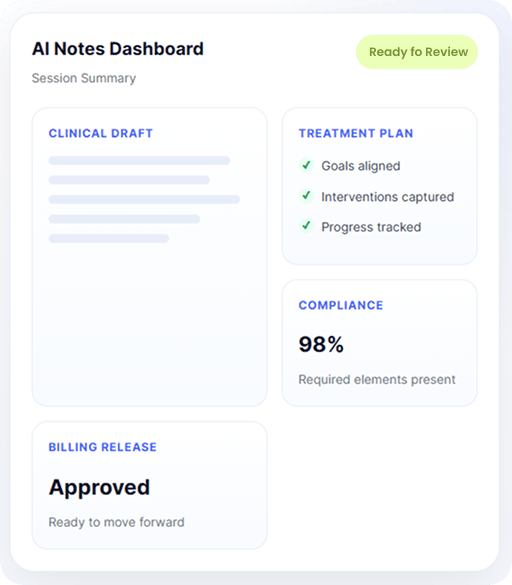
- Presenting problem identified
- Functional impairment documented
- Service is reasonable and necessary
- Treatment is expected to improve condition
AI Notes for Behavioral Health
Spend Less Time Writing Notes.
Spend More Time With Clients
Behavioral health providers face increasing documentation requirements while
trying to maintain quality care. Progress notes, treatment plans, assessments,
supervision documentation, and compliance requirements can consume hours
every week. DENmaar AI Notes helps clinicians complete documentation faster
while maintaining clinical accuracy and professional oversight.

Behavioral Health Focused

Clinical Accuracy & Oversight

Billing Workflow Ready

Reduce Documentation Time
Clinicians save hours each week on documentations.

Improve Note Consistency
AI-powered drafts improve quality and consistency.

Support Compliance Workflows
Build-in guidance for required documentation elements

Connect Notes to billing
Seamless integration with billing and operational workflows.
SUPPORTED DOCUMENTATION
Built Specifically for Behavioral Health
Unlike generic AI scribes, DENmaar AI Notes is designed for behavioral health workflows and
documentation requirements.
Individual Therapy
Family Therapy
Group Therapy
Substance Use Treatment
Case Management
Medication Management
Crisis Intervention
Clinical Supervision
Treatment Plans
Assessments and Reviews
AI NOTES WORKFLOW
How It Works
From captured session details to reviewed, billable documentation.

Record or Capture
Session Information
Patient check-in and
visit completed.

AI Generates a
Clinical Draft
AI Notes generate
structured documentation.

Review and Approve
Claim is created and
scrubbed for accuracy.

Release for Billing
Claim submitted to
the payer
DESIGNED FOR COMPLIANCE
Clinical Documentation with Compliance in Mind
AI Notes helps behavioral health providers document medical necessity, align treatment goals, identify
interventions, and support supervisor review workflows.
Compliance Support
Medical necessity documentation
Goal and treatment plan alignment
Intervention identification
Progress tracking
Required behavioral health documentation elements
Supervisor review workflows
Complete
Medical Necessity Documentation
Documentation supports the medical necessity of services provided and reflects the client’s ongoing treatment needs.
Evidence in Note
Aligned
Goal & Treatment Plan Alignment
Clinical documentation connects session content to active treatment goals and supports continuity across the plan of care.
Evidence in Note
- Active treatment goal referenced
- Session objectives tied to treatment plan
- Interventions support documented goals
- Progress linked back to care plan
Verified
Intervention Identification
Notes clearly identify the therapeutic interventions used during the session and how they relate to the client’s needs.
Evidence in Note
- Therapeutic intervention documented
- Intervention matched to presenting concerns
- Clinician actions clearly described
- Modality or technique identified where appropriate
Reviewed
Progress Tracking
Session documentation captures the client’s response to treatment and tracks change over time to support clinical decision-making.
Evidence in Note
- Client response to intervention documented
- Progress toward goals addressed
- Barriers or setbacks identified
- Ongoing symptoms or improvements noted
Included
Required Documentation Elements
Behavioral health notes include the core documentation elements needed for completeness, consistency, and payer readiness.
Evidence in Note
- Session date, duration, and service type included
- Relevant clinical observations documented
- Risk, safety, or notable concerns addressed when applicable
- Required note structure completed for the encounter
Available
Supervisor Review Workflow
Documentation can support internal review and approval workflows, helping supervisors monitor quality, accuracy, and compliance.
Evidence in Note
- Draft available for supervisor review
- Revisions or feedback can be incorporated
- Approval status is clearly tracked
- Final documentation is released after sign-off
MORE THAN A SCRIBE
Documentation Connected to the Rest of Your Workflow
Documentation can connect directly to scheduling, treatment plans, assessments, billing workflows, claims validation,
and provider productivity reporting.

Scheduling

Assessments

Claims Validation

DENmaar AI
Notes
Notes

Treatment Plans

Billing Workflows

Productivity Reporting
WHY ORGANIZATIONS CHOOSE DENMAAR
Built for Behavioral Health Teams and Organizations
DENmaar AI Notes is designed to support real-world clinical documentation and operational workflows.

Behavioral Health Focused
Customizable behavioral health workflows including therapy, psychiatry, substance use treatment, and multidisciplinary care models.

Scheduling & Operational Workflows
Integrated scheduling designed to support provider productivity, patient flow, authorization tracking, and claims readiness.

Supervisor Workflows
Built-in workflow logic designed to improve claim accuracy before submission through integrated operational checks and billing intelligence.

Eligibility & Insurance Verification
Integrated eligibility workflows designed to support Medicaid, commercial insurance, carve-outs, and behavioral health payer complexity.

Patient Engagement
Patient portal, intake workflows, secure communication, reminders, and measurement-based care tools.

Request an
AI Notes Trial
See how DENmaar AI Notes can help your clinicians reduce documentation time while improving
Request a demonstration or pilot program today.
Request Information
TESTIMONIALS
WHAT OUR CLIENTS SAY
On behalf of everyone at Meadowlark Counseling Services, I want to extend our sincere thanks for the continued improvements you and your team have made to the DENMaar EMR platform. We have been consistently impressed with both the functionality and user-friendly design of the system, which has made a meaningful difference in our day-to-day operations. The intuitive layout and ease of use have allowed our staff to spend less time navigating the system and more time focusing on client care. The regular updates and enhancements reflect your commitment to meeting the evolving needs of providers in the behavioral health and substance use treatment fields. We genuinely look forward to the new features introduced each month and appreciate how responsive the platform has been to the demands of clinical workflows. We have been so pleased with our experience that we’ve taken the opportunity to recommend DENMaar to other professionals in Pennsylvania who are working in the SUD field. Thank you again for your ongoing support and partnership. We are grateful to be working with a company that truly understands the needs of its users. KIndly, Becky Parks on behalf of the entire team at Meadowlark Counseling Services
I referred one of my colleagues Dr Aaron to you he is just starting g his psychology private practice and looking at where to start. I told him hands down you guys are the best billers and have a great EMR and team. He said he reached out just wanted to let you know!
FANTASTIC job keeping things rolling along with any and all of our billing concerns as well as responding to other issues which may well have been out of your wheelhouse. We are VERY grateful to have you and the crew in our corner.
I appreciate you all so much and DENmaar has been such a blessing Donna to our overall operations and success as an expanding company—allowing us to ultimately operate more efficiently, get our claims paid more consistently, ad stay on top of the critical credentialing piece, among other things. Teamwork does in fact, make the dream work. I’ll loop Chris/Isabella in on this message thread too, as I want All of your team to be aware of how much we appreciate our working relationship with DENmaar
Thank you for your diligence!! I appreciate it so much. Thank you Edwina…
Thank you so much Amy! I will be referring to DENmaar as often as I am asked about credentialing services.
Our Latest Blogs

Nurse Practitioner Credentialing: Why is It Vital for Nurses and Healthcare Organizations?
Credentialing is usually considered to be a process only meant for physicians. This cannot be any further from the truth. In fact, credentialing is equally important for all sorts of practitioners who participate in the provision of patient care, this also includes nurses. There are immense benefits to be enjoyed by a nurse who is credentialed. They can work towards advancing their career with recognized achievements and contribute to their own professional growth.
What is Nurse Credentialing?
Simply put, the nurse credentialing process involves the verification of an applicant nurse’s certifications and qualifications. This includes reference checks, verification of board-earned certifications, licensure, and educational qualifications, among many other things. This is usually done to ensure a nurse or physician is capable of providing healthcare to their patients.
Read More: Credentialing Process Checklist
Furthermore, it is mandatory for a nurse to be credentialed for a hospital or practice to be able to bill an insurance company or government agency.
What are the Benefits of Nurse Practitioner Credentialing?
Like we mentioned before, Credentialing is as fundamental for nurses as it is for physicians and equally beneficial. The following benefits await those nurses who are credentialed:
- • Professional Career Growth
- • Highlight Unique Skillsets
- • Helps employers reduce their administrative burden
- • Assure patients that their nurse is capable of taking care of them.
- • Give nurses a sense of accomplishment
- • Display a nurse’s commitment to his or her job.
Certification is an integral part of nurse practitioner credentialing. CEU credits, for instance, are important if a nurse wants to renew his or her license. Nurses are required to acquire certifications, which are specific to the scope of practice they indulge in. This is important if they want to continue pursuing their education or demonstrate their knowledge and skill set. Certifications are indirectly connected to the improved patient outcome as a certified nurse is better equipped with an expanded set of skills to take relatively better care of the patients they are in charge of.
Needless to say, certifications also improve the chances of a nurse getting employed. It increases their perceived value in the eyes of an employer. There is ample evidence throughout history that proves that nurses with credentials are far more likely to get hired than nurses without any certifications. Credentialed nurses are already assumed by hiring managers to possess the ideal knowledge and skill set needed to operate in complex patient care circumstances.
Aside from improving a nurse’s chances of getting hired, credentialing can also help boost a nurse’s average earned income. Certified nurses are believed to earn $10000 more annually than their non-certified counterparts.
This proves how important credentialing is to nurses. As such, it is important they get credentialed to enjoy an easy career ahead. That being said, getting credentialed comes with challenges of its own. The process can be far too time-consuming and frustratingly complex.
What is the Credentialing Process for Nurse Practitioners?
The credentialing process for nurse practitioners involves the following steps:
- • Select a certification body and apply
- • Send required information for verification
- • Participate in the exam
- • Get official certification
- • Go to the state board of nursing to apply for nurse licensure
- • Wait to receive the licensure for the board of nursing
- • Apply for a DEA and a controlled dangerous substance certificate
- • Apply for an NPI number
The applicant or the employer of the nurse should make sure all information submitted for verification is correct and complete. Any missing or erroneous details in the information submitted could result in the application getting rejected.
Unless the credentialing process is complete, the nurse practitioner cannot receive reimbursements for the services they render.
How long does the Credentialing Process take for New Nurse Practitioners?
The credentialing process can take anywhere between two to three weeks.
So as you can see, acquiring primary source verification for all nurse practitioners currently employed can be time-consuming for employers. The excruciatingly long process could result in delayed reimbursements and even delay the on-boarding process of a much-needed nurse to the staff.
This is why it is only wise to let a reputed third-party credentialing service provider handle the task at your behest. This is where DENmaar comes into play. With years of experience, our credentialing specialists at DENmaar can help your hospital and medical practice with the nurse credentialing process from start to finish.
You can explore our website to learn more or contact us now to get in touch with one of our representatives.
What Is Required to Navigate America’s Mental Health Care Crisis?
The demand for mental health services gets increased rapidly. However, with a shortage of psychiatrists, how can we ensure that providers deliver the best possible care to their patients.
The United States is experiencing an increasingly acute mental health crisis. Between 2017 and 2018, one in five Americans had a mental illness, and the epidemic has exacerbated feelings of anxiety, depression, and isolation. According to Mental Health America, moderate to severe anxiety reached its peak in September 2020, with more than eight out of 10 people showing moderate to severe symptoms at anxiety and depression screening.
The mental health care supply chain is down. More and more people are taking professional care, but it has become harder to get the care they need. They’ve found providers that don’t accept new patients, are out of the network, or just don’t fit.
Today, 37% of the US population lives in areas with a shortage of mental health professionals. For example, there are only 30 psychologists for every 100,000 people compared to 156 primary care physicians for every 100,000 Americans. Moreover, there is a national psychiatrists shortage, but more than half of those who practice therapy accept insurance or Medicaid, making high-quality care prohibitively expensive for many. Because of this lack of access, 60% of adults in the United States do not receive treatment for diagnosable mental illness each year.
The crisis affects all Americans, not just those with mental health symptoms and their loved ones. Mental health symptoms adversely affect physical health, leading to higher costs for insurance companies and employers to care for. For instance, people with the major depressive disorder show a considerable increase in patients compared to the total population.
Examining mental health care deficiencies
There are two major priorities for resolving this crisis: increasing the number of mental health professionals and helping those existing ones to handle their cases better.
The first is a difficult task. It needs an average of eight years of higher education and medical school and four years of residency to become a licensed psychiatrist. Even as new psychiatrists enter the field, more than 60% of psychiatrists are now 55 or older and rapidly retire. The fourth-oldest group in medical specialties will create a potential shortage of 6,000 to 15,000 psychiatrists by 2025.
This deficiency will put more pressure on the practice of psychiatrists. Fifteen-minute visits every three months have become the norm in many places, where there is not enough time to correctly complete the progress record, let alone provide high-quality medical care. The right long-term solution is to enable psychiatrists with technology and appropriate support functions instead of replacing them.
Innovation is needed, not first aid solutions.
There has been tremendous progress in increasing access from the adoption of telemedicine to premium consumer-focused therapy and mindfulness applications over the past decade. However, this is not enough.
Historically, the opportunities for psychiatrists have not presented themselves in a flexible, clinically driven way. High-quality providers are usually only available for hospitalized patients or on an out-of-network basis. Moreover, many find it challenging for
- Opening a private practice with low reimbursement rates for services
- Handling the burden of coordinating with insurance companies
- Working on the subsequent administrative tasks that follow every day
All the above factors can be stressful for psychiatrists, preventing them from giving remedies to their patients.
A blood test cannot diagnose depression, and psychiatrists do not have the right tools to track their patients’ progress. In addition, psychiatry lacks transparency and data for determining outcomes instead of most other disciplines. Research executed by the Centers for Disease Control and Prevention (CDC) found that almost 60% of psychiatrists do not use an approved electronic health records system, and 40% do not use it at all – meaning they are still writing on paper.
Technology can go a long way in more stressful aspects of managing mental health practices, including billing, insurance, and appointment schedules. But these measures have more potential, allowing providers to gain in-depth insights into their patients, track patient progress, enhance psychiatric practice, and achieve high-quality results.
Against the backdrop of the ever-increasing demand for the services of psychiatrists and mental health providers, it has become critical for providers to provide flexibility in treatment methods.
Who can be contacted to get the best mental health billing?
DENmaar provides an improved patient payment system, staff claim tools and quickly resolves the claim issues. Contact us today to do your credentialing using DENmaar’s psychiatric billing process.
Mental Health Billing vs Medical Billing
Mental health bills differ from medical bills because of changes in mental health care that are not found in primary or specialist care. Here’s how to handle it.
- Mental health bills differ from medical bills due to some of the variables included in the mental health treatment providers.
- For mental health bills, you should familiarize yourself with medical coding, verify patient insurance, and use the appropriate payer form.
- For best results, always check the benefits, store copies of crucial information, take notes when you talk to payers, and start the billing process as soon as possible.
- Mental health professionals look to improve their existing billing process or start accepting insurance and working directly with fee payers.
Mental health care patients usually have one common complaint: Many providers do not have health insurance, which can be expensive without insurance. As a mental health care provider, your approach may be different. You may not accept insurance because the mental health billing process is complex and frustrating.
However, this guide can assist you in understanding the mental health billing process. In addition, improved mental health billing structures come with more capacity for patients using insurance, which means more revenue.
How are mental health bills different from medical bills?
Mental health bills differ from medical bills in the following ways:
Pre-authorization: Payers must pre-authorize mental health services to patients before submitting medical claims. However, a 2019 report found that mental health visits are five times more likely to be out of network than primary or specialist services. Unfortunately, pre-authorization – even if requested promptly – is rare and complicates billing.
Front Office Staff: Medical practices usually consist of administrative staff handling billing and coding, leaving practitioners to focus solely on patient care. This system is less common in mental health care systems. These practices are usually sole proprietorships or small partnerships, meaning they do not have front office staff. Without additional staff, practitioners should handle the billing themselves.
Standardized billing procedures: While primary care physicians often perform the same tests and examinations on their patients, mental health practitioners provide a very diverse and customized service. The recurring nature of primary care means that medical bills are usually ready to go. The opposite is true for mental health care, making billing more complicated.
Creating an excellent standard: Standardizing primary care means that practitioners can easily combine multiple services into one perfect bill. On the other hand, the more diverse nature of mental health services makes it more challenging to create significant bills. The result is a longer and more difficult billing process.
How standardization affects mental health bills
Standardizing services provided is probably the most significant hurdle of the above factors in mental health care billing. Standardization issues arise from how these factors differ from primary or specialist care:
Session duration: Medical billing assumes approximately the same time for each patient – after all, regular blood tests and physical examinations take a long time. However, the duration of mental health sessions can vary greatly. For this reason, mental health billing codes vary based on session length, which is not heard in medical bills.
Daily or weekly service limits: In general, there are no primary or expert level restrictions on how often a patient can be treated. The same does not apply to mental health services. In hopes of standardizing mental health care bills, taxpayers set the maximum number of treatments a mental health patient can receive in a day or week. These artificial roofs can present billing challenges.
Therapeutic method: Cognitive behavioral therapy requires an entirely different CPT code than psychoanalysis. The result is more billing challenges.
The Bottom Line
The billing process can be frustrating and usually leaves a big sigh of relief compared to treating patients. And if you’re worried about not completing the process yourself, the billing features of DENmaar can be invaluable.
We have assisted many health care organizations in their mental health billing process, thus helping them concentrate on patient care. Call us today!
Our Partners






Ready to get started?
Feel free to reach out if you have any questions.
