

We don’t just submit claims. We create visibility and accountability around every unpaid claim—so management knows what’s being worked, what’s stuck, and why.
Know What’s Happening With Every Unpaid Claim
Behavioral health billing with complete visibility and accountability

98.1%
Clean Claim Rate
1.47%
Rejection Rate
0.32%
Denial Rate
5–10%
Denial Rate
10–20%
Average Revenue
Improvement
$0
EHR Software Fee
With Billing Services
With Billing Services
CLAIMS VISIBILITY
Your Claims May Be Getting
Submitted. But Are They Getting Paid?
Submitting a claim is only the beginning.
Your Claims May Be Getting
Submitted. But Are They Getting Paid?
Revenue is lost when rejected claims aren’t corrected, denials aren’t resolved, authorizations expire, payer requests go unanswered, and unpaid claims disappear into spreadsheets and work queues.
DENmaar gives behavioral health practices a clear view of:
- Which claims remain unpaid
- Why each claim is stuck
- What action has been taken
- Who is responsible for the next step
- When follow-up is due
- What the payer said during the last follow-up
- Which payers and problems are creating the most lost revenue
You no longer have to accept, “We’re working on it.”
You can see exactly what is being worked, what happened and what comes next.
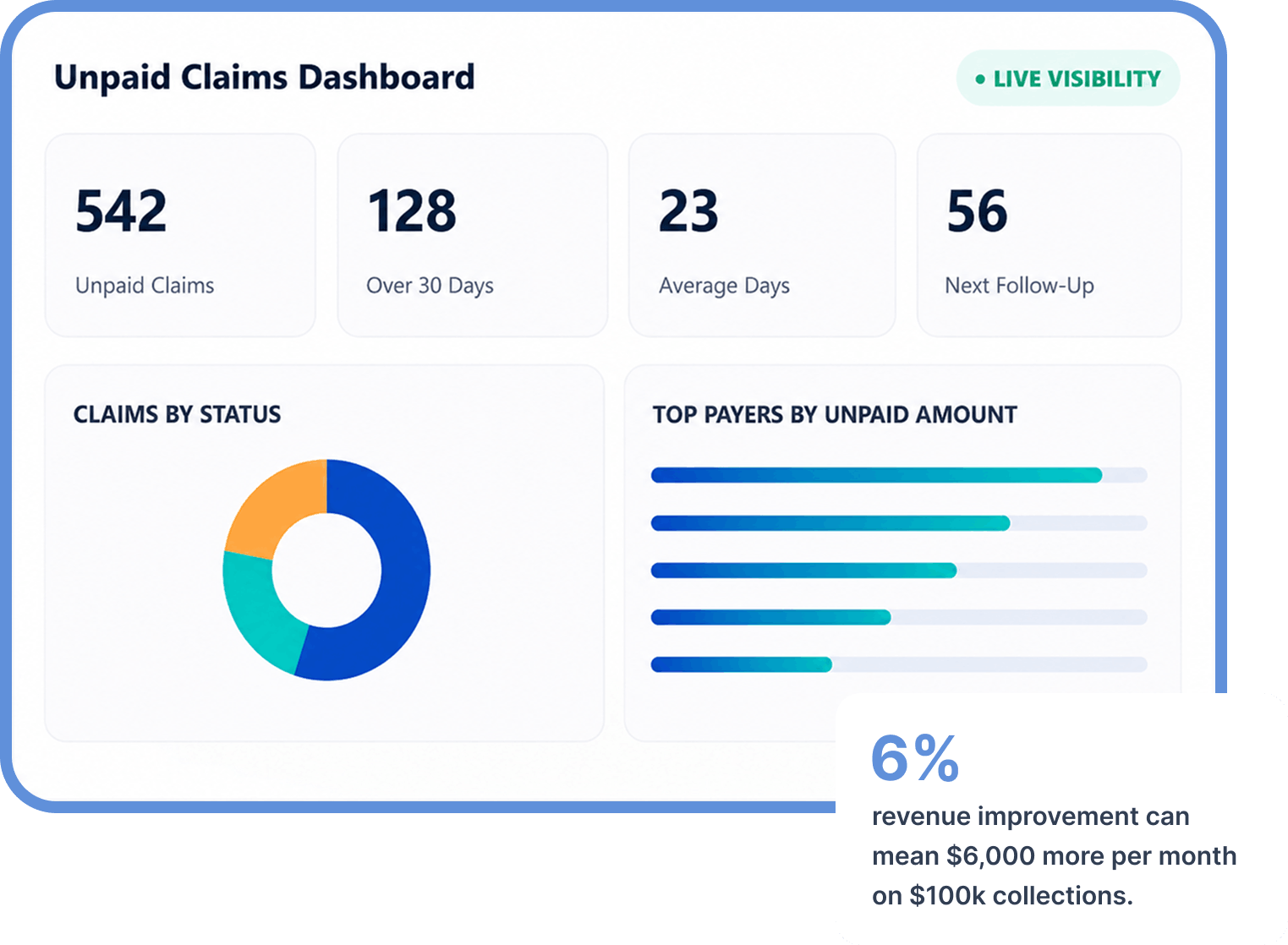
The Improvement in Claims Can Pay for DENmaar
any practices are already losing more money through preventable claim problems than they would spend fixing them.
For a practice collecting $100,000 per month
6% = +$6,000 / month
in realized insurance revenue
That improvement alone could offset the cost of DENmaar’s billing services.
- Behavioral health EHR software at no additional cost
- Claims Copilot
- Eligibility and insurance workflows
- Payment posting
- Rejection and denial management
- Aging-claim follow-up
- Reporting and management visibility
- Support from DENmaar’s Insurance Knowledge Team
Claim Lifecycle
Every Claim Has an Owner, a Status
and a Next Action
DENmaar creates a structured process for managing the entire claim lifecycle—from appointment readiness
through final payment.
01
Prevent Problems Before Submission
Eligibility, payer, authorization, credentialing and documentation issues are identified before they become rejected or denied claims.
02
Submit Clean Claims
Claims are reviewed for common errors and payer requirements before submission.
03
Monitor the Payer Lifecycle
Claims are tracked after submission so unresolved claims don’t quietly disappear into aging.
04
Assign the Next Action
Every problem claim has a clear status, responsible team member and required next step.
05
Document Every Follow-Up
Management can see when follow-up occurred, what the payer said and what must happen next.
06
Escalate Unresolved Claims
Claims receive additional attention before filing limits or appeal deadlines are missed.
07
Measure Performance
Monitor clean claims, rejections, denials and aging by payer, provider, location, service and responsible team member.
Management Visibility
Your Billing Operation Shouldn’t Be a
Black Box
Monthly reports tell you what has already happened. DENmaar provides visibility into
what is happening now.
Visibility creates accountability.
A practice should not have to wait until collections fall to discover that claims aren’t being worked effectively.
- Whether claims are being worked consistently
- Whether follow-up is producing results
- Why claims remain unpaid
- Whether the same errors keep recurring
- Where responsibility for the next action sits
- Which workflows or team members need support
- Which payers are causing the most problems
- How much revenue remains at risk
Visibility creates accountability.
Accountability creates action.
Action moves claims toward payment.
Improve the Team You Have—or Let DENmaar Manage the Process
Some practices already have an internal billing team but lack the technology, payer knowledge and management visibility required to oversee it. Others want an experienced partner to manage the entire revenue cycle.
OPTION 01
Claims Copilot for Your Existing Team
Give your billing staff the structured workflows, claim intelligence and accountability tools needed to manage unpaid claims more effectively. Management gains visibility without immediately replacing the internal team.
OPTION 02
Full Revenue Cycle Management
Let DENmaar manage claim creation and submission, rejection correction, payment posting, denial resolution, insurance follow-up, aging claims, payer escalation, patient balances and revenue-cycle reporting.
Either way, management gains control over the revenue cycle.
Behavioral Health Expertise
Built Specifically for Behavioral Health
Behavioral health billing requires more than generic claim submission.
Mental health therapy
Psychiatry and medication management
Substance-use treatment
Intensive outpatient and partial hospitalization programs
Community behavioral health
Multidisciplinary practices
Telehealth billing
Time and unit requirements
Rejections and denials
Built Specifically for Behavioral Health
- Behavioral health payer carve-outs
- Eligibility and benefit verification
- Prior authorizations
- Provider credentialing
- Therapy and psychiatric coding
- Same-day services
- Telehealth billing
- Missing or incomplete documentation
- Coordination of benefits
- Rejections and denials
- Aging insurance balances
Before Billing Begins
Problems Are Often Created Before Billing Begins
Many claim problems originate before the claim reaches the billing team.
An appointment may be scheduled with the wrong payer. Eligibility may not be verified. An authorization may be missing. Documentation may not support the code or units billed. A provider may not be enrolled correctly.
DENmaar connects scheduling, eligibility, authorizations, documentation and billing in one operational system.
This helps prevent bad claims—not merely work them after they fail.
Prevent the problem upstream.
01
Scheduling
Right payer • right workflow
02
Eligibility & Authorization
Verify before service
03
Documentation
Support code and units
03
Billing
Submit cleaner claims
More Than Billing
Technology, Insurance Expertise and
Human Follow-Through
Most billing companies provide reports. Most software companies provide tools. DENmaar combines:
Technology, Insurance Expertise and
Human Follow-Through
You get a system designed to improve the financial performance of your behavioral health practice.
Enterprise capability with small-practice simplicity.
- Behavioral health EHR technology
- Claims Copilot
- Revenue-cycle services
- Insurance knowledge
- Human payer follow-up
- Management visibility
- Operational accountability
Billing Review
See What Better Claims Performance Could Mean for Your Practice
If too many claims are rejected, denied, aging or simply unexplained, let’s look at the process together.
Current monthly insurance revenue
Baseline performance
Clean-claim rate
Rejection and denial rates
Claims over 30 days
Value of unpaid and aging claims
Follow-up process
Where accountability is breaking down
Let’s Determine Whether There Is Operational Alignment
We begin with a discussion focused on:
- Organizational structure
- Insurance workflows
- Operational goals
- Implementation fit
Request Information
Capterra, Software Advice And Get App 2023 / 25
Best Of Badges Awarded To DENmaar
2023 / 25 “Best of” badge winners = DENmaar Neuro has earned a well-deserved Best Value Badge.
See our reviews for our software being recognized as an impactful solution for your business.





Our Latest Blogs
Chatbots vs Agentic AI in EHR and RCM Systems: Understanding the Difference
Artificial intelligence is becoming part of the conversation around electronic health records (EHRs) and revenue cycle management (RCM). But answering a question and completing a workflow are different capabilities.
For a behavioral health practice, that difference matters. A useful answer can save time. A system that helps move work toward completion can change how the practice operates.
Agentic AI in EHR and RCM Systems
A chatbot provides a conversational interface. Depending on its connections and permissions, it may answer questions, explain information, summarize records, or draft content.
A provider might ask, “What documentation is still incomplete?” A billing specialist might ask, “What does this denial reason mean?”
An assistant connected to the appropriate data could identify unsigned notes or explain a denial. Staff would then take the next steps.
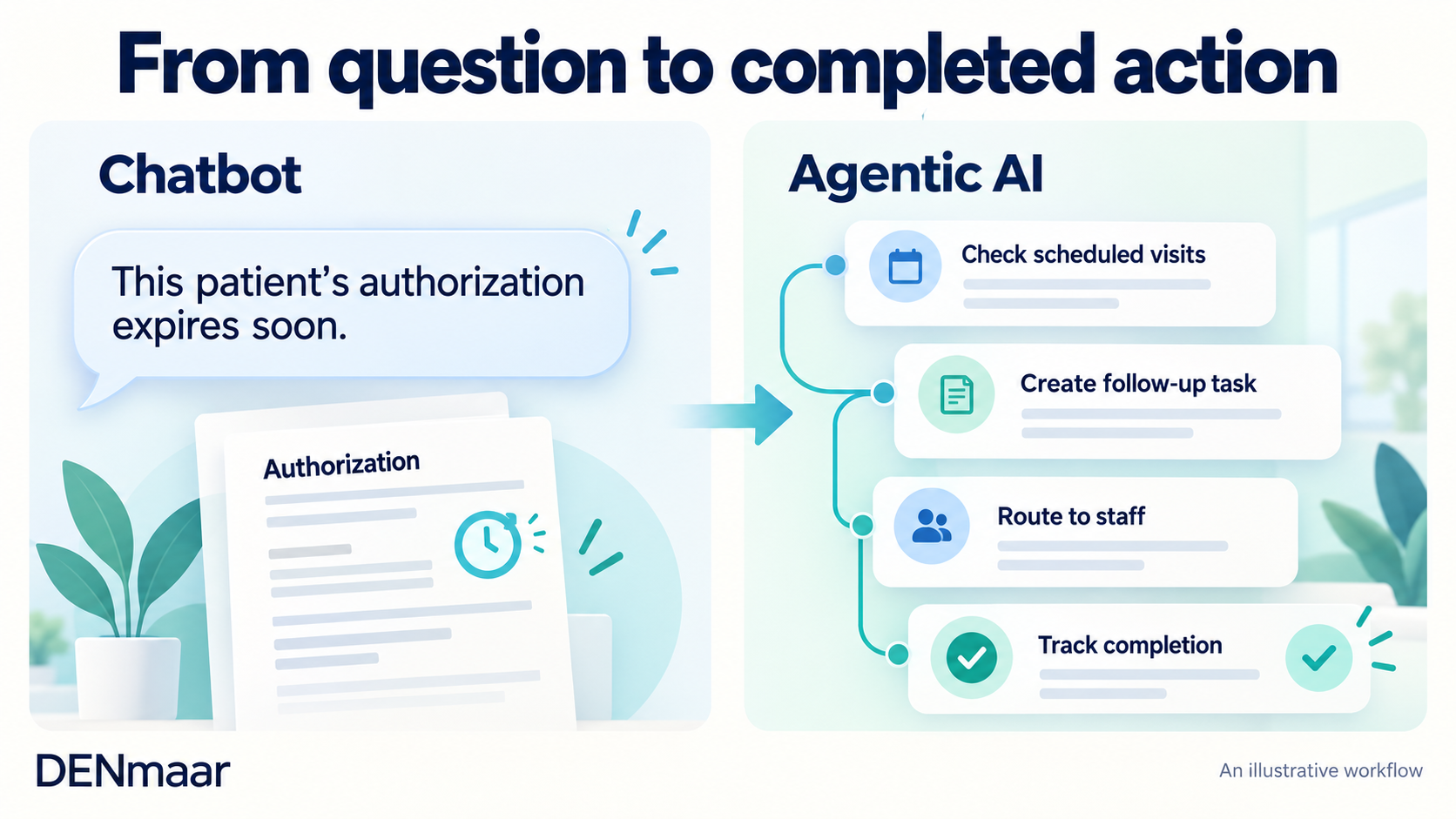
Instead of only explaining an authorization issue, an agent could check the authorization record, compare it with upcoming appointments, create a follow-up task, and route it to the appropriate employee.
Agentic AI can use connected tools to pursue a defined goal through multiple steps. It can select an available action, examine the result, and determine what should happen next within its permissions.
Instead of only explaining an authorization issue, an agent could check the authorization record, compare it with upcoming appointments, create a follow-up task, and route it to the appropriate employee.
These are illustrative possibilities, not claims that every EHR or RCM platform offers them today. For a broader look at agentic AI in behavioral health, the focus is on how carefully defined AI assistance could support everyday practice workflows.
Chatbots and Agentic AI: The Capability Difference
The distinction is also more nuanced than “chatbots talk, agents act.” A chatbot can be the interface through which a user directs an agent. What matters is the capability behind the conversation: which records it can access, which tools it can use, and how its work is controlled.
For provider documentation, conversational assistance could list incomplete notes and summarize what needs attention. An agentic workflow could prioritize outstanding work, open the relevant items, and route reminders or review tasks.
For authorization tracking, conversational assistance could explain recorded visit limits and dates. An agentic workflow could compare authorization data with scheduled services and assign exceptions for review.
For claim denials, conversational assistance could summarize a denial and suggest possible next steps. An agentic workflow could retrieve related claim details, prepare a follow-up task or draft correction, and route it for approval.
For patient billing, conversational assistance could explain a balance using available account information. An agentic workflow could check unresolved insurance activity and prepare an approved outreach workflow for staff review.
The benefit is fewer manual handoffs between identifying an issue and addressing it.
Agentic AI in EHR Workflows Needs More Than Automation
However, a scheduled reminder or a fixed rule is ordinary automation. It does not become agentic simply because a vendor adds an AI label. Agentic behavior involves selecting next steps based on the goal, available information, and results.
In an EHR or billing system, action needs accountability.
A practical design should limit access by role, record what the AI did, and clearly show what was completed, what failed, and what still requires attention. Missing or conflicting information should trigger review rather than a confident guess.
Clinical decisions, note signatures, coding changes, claim submissions, and financial adjustments need controls appropriate to their consequences. An agent may prepare work while a qualified person retains approval authority.
Eligibility results also should not be presented as a guarantee of payment. Moving faster does not remove the need to verify the underlying information.
Agentic AI in EHR: A Practical Starting Point for DENmaar
For DENmaar, the Provider Work Area is a practical place to connect conversational assistance with the work providers need to complete.
A useful first step is helping a provider see what needs attention and reach it more easily. Further development can focus on specific workflows where AI can prepare, route, or complete approved steps.
Success should be measured through everyday results: fewer clicks, fewer unresolved tasks, less duplicate work, and more timely completion.
The question practices should ask is simple: Does the AI only describe the work, or can it help move the work forward with clear permissions and visible results?
That is the difference that matters.
The healthcare workflow examples above are proposed applications, not documented DENmaar product capabilities.
Background Sources
OpenAI Agent definitions-> https://developers.openai.com/api/docs/guides/agents/define-agents
OpenAI Running agents-> https://developers.openai.com/api/docs/guides/agents/running-agents
OpenAI Guardrails and human review-> Guardrails and human review | OpenAI API
Frequently Asked Questions
What is Agentic AI in EHR systems?
Agentic AI in EHR systems can use approved tools and information to help complete defined workflows while keeping human oversight.
How is a chatbot different from Agentic AI?
A chatbot mainly provides conversational assistance, while Agentic AI can pursue defined goals through multiple approved workflow steps.
Can Agentic AI automate EHR workflows?
Agentic AI can potentially prepare, route, or complete approved workflow steps, depending on system access, permissions, and controls.
Can Agentic AI replace healthcare staff?
Agentic AI is designed to reduce repetitive work. Clinical decisions and other consequential actions should retain appropriate human oversight.
Why does Agentic AI matter for RCM?
It can help connect issue identification with follow-up, reducing manual handoffs and helping billing teams focus on unresolved revenue-cycle work.

Agentic AI in Behavioral Health: Helping Run Better Practices
Behavioral health practices have plenty of software. What they need is more help getting the work done.
An appointment needs confirmation. An intake packet remains incomplete. A provider has unsigned notes. A claim is waiting for information. Each issue may appear somewhere in the system, but someone still has to find it, understand it, and move it forward.
That is where agentic AI could make a meaningful difference in behavioral health.
How far away is it? Our view is that focused assistance is possible today. Dependable support across an entire organization will develop workflow by workflow.
From Answering Questions to Agentic AI Helping Complete Work
A chatbot gives people a conversational way to interact with software. An AI agent adds the ability to use approved tools, take steps toward a goal, check the results, and ask for help when needed.[1]
For a behavioral health practice, that could eventually mean asking:
“Help us prepare for tomorrow’s appointments.”
A connected agent could check for missing intake forms, identify records that need staff review, and prepare a prioritized task list. With the appropriate permissions and review process, it could also help initiate follow-up.
These are potential use cases, rather than capabilities we are announcing with our chatbot launch.
The value would come from reducing the effort between recognizing a problem and resolving it.
The Best Starting Points Are Everyday Tasks
We believe the most useful early applications will be specific, repeatable tasks with clear outcomes:
- Appointment preparation: Identify missing information before a visit.
- Provider workflow: Organize outstanding documentation and follow-up tasks.
- Billing coordination: Surface incomplete information holding up a claim and route it to the right person.
- Practice management: Summarize outstanding work so leaders can see where attention is needed.
Consider an unsigned note. Today, a staff member may discover it, locate the provider, send a reminder, and check again later. A future agent could help coordinate that sequence, while the provider remains responsible for reviewing and signing the documentation.
Small improvements like these could add up across a busy practice.
The Challenge Is Connecting Agentic AI to Real Operations
A convincing conversation is only the beginning.
To act reliably, AI needs access to the right information, permission to perform specific tasks, and a way to verify that its actions succeeded. Staff need to see what happened and intervene when something requires judgment.
A missing form and a clinical decision require different levels of oversight. Our approach is to start with bounded administrative work and expand only as each use case proves useful and dependable.
Success should be measured through fewer manual touches, less outstanding work, and more time available for patient care.
DENmaar’s Next Step Begins This Month
This month, DENmaar will introduce a chatbot feature.
That launch is an initial step toward making interaction with our system more conversational. It will also give us an opportunity to learn which questions and requests matter most to the practices using it.
From there, our direction is to identify specific workflows where AI can provide useful assistance, then build and evaluate those capabilities deliberately.
We see a practical path forward: begin with conversation, connect it to useful information, and progressively enable carefully defined actions.
For practices looking at a broader operating model for behavioral health, the opportunity is to connect AI assistance with the workflows that already move patients and work through the organization.
Behavioral health practices deserve technology that helps work move forward. Agentic AI brings that possibility closer, and everyday practice workflows are where we believe it can earn its place.
Background Source
[1] Anthropic, Trustworthy agents in practice. Supports the distinction between conversational assistance and agents that plan, use tools, check results, and seek human input. The proposed behavioral health use cases and DENmaar development direction above are editorial projections, not claims of currently released agent capabilities.
Frequently Asked Questions
What is agentic AI in behavioral health?
Agentic AI can help complete defined tasks, use approved tools, check results, and escalate work when human judgment is needed.
How can agentic AI help behavioral health practices?
It could help organize appointments, documentation, billing tasks, and other repeatable workflows while keeping staff involved in important decisions.
Is agentic AI available in healthcare today?
Focused AI assistance is already possible, while broader agentic workflows are developing gradually with defined permissions and human oversight.
What is the difference between AI and an AI agent?
AI can generate or analyze information. An AI agent can also use approved tools, take actions, check results, and seek human input.
How should practices adopt agentic AI?
Start with specific, repeatable administrative workflows where outcomes are clear, then expand as each use case proves useful and dependable.

A Connected Operating Model for Behavioral Health Practices: The Patient to Payment Cycle
A behavioral health practice does not operate as a collection of separate departments. A patient enters through a call, a message, a referral, or an online request. That interaction starts a chain of work that continues through scheduling, insurance, care, documentation, billing, and payment.
Most technology divides that chain into separate tools and queues. The front office answers the call. A scheduler books the appointment. Clinical staff document the service. Billers determine whether the claim can be submitted. When information is missing, people send messages, update spreadsheets, and wait for replies.
The problem is not that each person failed to do a task. The problem is that no system owns the complete journey. DENmaar calls that journey the Patient-to-Payment Cycle. It provides one operating model for moving every patient from first contact through completed care and collected revenue.
One Operating Model for Behavioral Health
The Patient-to-Payment Cycle connects patient access, clinical operations, and revenue cycle management. Each step prepares the next one. Information captured during the first conversation should support scheduling. Scheduling should initiate intake and insurance verification. The completed visit should trigger documentation, claim validation, submission, payment posting, and follow-up.
When these functions share the same workflow, staff no longer need to reconstruct what happened. The system can show the current status, identify what is missing, assign the next action, and measure the revenue affected by a delay.
AI Receptionist Begins the Cycle
The AI Receptionist is the front door. Its purpose is broader than answering the telephone. It should recognize the patient’s need, identify whether the practice can serve that patient, match the request to the right provider, schedule the appointment, collect insurance information, and begin intake.
A standalone voice assistant can take a message. An integrated receptionist can act on the practice’s real operating information: provider availability, specialties, state licenses, accepted plans, appointment rules, and service requirements. That difference determines whether automation reduces work or merely creates another queue for staff to review.
The Visit Must Be Ready Before It Begins
An appointment on the calendar is not necessarily ready for care. Eligibility may be inactive. Authorization may be missing. The selected provider may not be enrolled with the patient’s plan. Intake forms or insurance cards may still be incomplete.
A connected system should identify those issues before the appointment. Routine gaps can trigger automated reminders or requests. Only unusual situations should reach staff. This allows the practice to protect the patient’s experience while reducing the manual work that normally surrounds each visit.
Documentation Becomes Part of Revenue Integrity
Clinical documentation is often treated as a separate obligation. In practice, it is one of the conditions required for payment. The provider needs a clear work area showing today’s patients, notes due, treatment plans requiring review, assessments, authorization limits, and supervisor signatures.
AI-enabled practice operating systems can help draft and organize documentation, but the larger benefit comes from placing that assistance inside the operating workflow. The system should know which document is required, why it matters, and whether the encounter is ready to become a claim.
Clean Claims Start Before Submission
Traditional billing processes often discover problems after a payer rejects or denies the claim. The Patient-to-Payment Cycle moves that intelligence earlier. Before submission, the system can check eligibility, authorization, provider enrollment, required documentation, procedure codes, and modifiers, place of service, diagnosis compatibility, duplicates, and filing deadlines.
After submission, the same workflow should monitor acknowledgments, remittances, rejections, denials, underpayments, and stalled claims. When intervention is required, the system should explain the problem, recommend the next action, and route it to the right person.
People Should Manage Exceptions
Reducing administrative work does not require removing people from the process. It requires using their judgment where it has the most value. Routine, high-confidence actions can occur automatically. Unusual situations can be prepared for one-click approval. Complex clinical, payer, or credentialing issues can be escalated with the relevant information already assembled.
This changes the daily question from what work is waiting to what requires human judgment. Practice leaders gain a clearer view of blocked revenue, repeated workflow failures, provider bottlenecks, and the percentage of appointments reaching payment without billing intervention.
The System Improves Through Use
Every completed cycle produces useful operational knowledge. The platform learns which payer rules matter, which documentation gaps delay claims, which rejection patterns recur, and which actions lead to payment. Over time, work can move from manual handling to recommended action and then to automation.
That accumulated payer and workflow knowledge is more durable than any individual AI feature. It reflects the real behavior of behavioral health practices, providers, patients, claims, and insurance plans inside one connected process.
A Simpler Standard for Practice Technology
Behavioral health practices operating system should expect their technology to do more than store records and present task lists. The platform should actively move work forward, complete routine actions, and bring people into the process when their attention is genuinely needed.
The Patient-to-Payment Cycle gives DENmaar a clear standard for every product decision: does this capability help a patient reach care and help the practice collect the revenue earned for that care? When the answer is yes, it belongs in the core operating system.
DENmaar connects patient access, clinical workflow, insurance intelligence, and revenue cycle operations in one behavioral health platform.
Learn how DENmaar can help your practice manage the complete Patient-to-Payment Cycle.
Frequently Asked Questions
What is an operating model for behavioral health?
An operating model for behavioral health connects patient access, clinical care, insurance, billing, claims, and payment in one workflow.
What is the Patient-to-Payment Cycle?
It connects the patient’s first contact with scheduling, care, documentation, billing, claims, and collected revenue.
How can AI improve behavioral health workflows?
AI can automate routine work, identify missing information, organize tasks, and help staff focus on exceptions requiring human judgment.
Why should claims be checked before submission?
Pre-submission checks can identify eligibility, authorization, documentation, coding, and other issues before they cause claim delays or denials.
What should behavioral health technology connect?
It should connect patient access, scheduling, clinical documentation, insurance, billing, claims, credentialing, and revenue cycle operations.
Our Partners






Ready to get started?
Feel free to reach out if you have any questions.
