

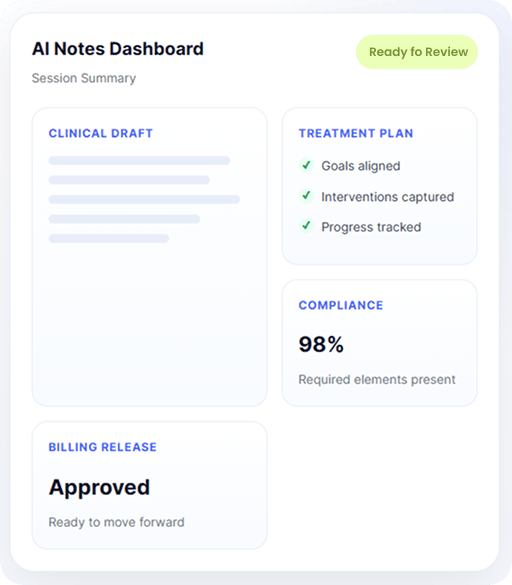
- Presenting problem identified
- Functional impairment documented
- Service is reasonable and necessary
- Treatment is expected to improve condition
AI Notes for Behavioral Health
Spend Less Time Writing Notes.
Spend More Time With Clients
Behavioral health providers face increasing documentation requirements while
trying to maintain quality care. Progress notes, treatment plans, assessments,
supervision documentation, and compliance requirements can consume hours
every week. DENmaar AI Notes helps clinicians complete documentation faster
while maintaining clinical accuracy and professional oversight.

Behavioral Health Focused

Clinical Accuracy & Oversight

Billing Workflow Ready

Reduce Documentation Time
Clinicians save hours each week on documentations.

Improve Note Consistency
AI-powered drafts improve quality and consistency.

Support Compliance Workflows
Build-in guidance for required documentation elements

Connect Notes to billing
Seamless integration with billing and operational workflows.
SUPPORTED DOCUMENTATION
Built Specifically for Behavioral Health
Unlike generic AI scribes, DENmaar AI Notes is designed for behavioral health workflows and
documentation requirements.
Individual Therapy
Family Therapy
Group Therapy
Substance Use Treatment
Case Management
Medication Management
Crisis Intervention
Clinical Supervision
Treatment Plans
Assessments and Reviews
AI NOTES WORKFLOW
How It Works
From captured session details to reviewed, billable documentation.

Record or Capture
Session Information
Patient check-in and
visit completed.

AI Generates a
Clinical Draft
AI Notes generate
structured documentation.

Review and Approve
Claim is created and
scrubbed for accuracy.

Release for Billing
Claim submitted to
the payer
DESIGNED FOR COMPLIANCE
Clinical Documentation with Compliance in Mind
AI Notes helps behavioral health providers document medical necessity, align treatment goals, identify
interventions, and support supervisor review workflows.
Compliance Support
Medical necessity documentation
Goal and treatment plan alignment
Intervention identification
Progress tracking
Required behavioral health documentation elements
Supervisor review workflows
Complete
Medical Necessity Documentation
Documentation supports the medical necessity of services provided and reflects the client’s ongoing treatment needs.
Evidence in Note
Aligned
Goal & Treatment Plan Alignment
Clinical documentation connects session content to active treatment goals and supports continuity across the plan of care.
Evidence in Note
- Active treatment goal referenced
- Session objectives tied to treatment plan
- Interventions support documented goals
- Progress linked back to care plan
Verified
Intervention Identification
Notes clearly identify the therapeutic interventions used during the session and how they relate to the client’s needs.
Evidence in Note
- Therapeutic intervention documented
- Intervention matched to presenting concerns
- Clinician actions clearly described
- Modality or technique identified where appropriate
Reviewed
Progress Tracking
Session documentation captures the client’s response to treatment and tracks change over time to support clinical decision-making.
Evidence in Note
- Client response to intervention documented
- Progress toward goals addressed
- Barriers or setbacks identified
- Ongoing symptoms or improvements noted
Included
Required Documentation Elements
Behavioral health notes include the core documentation elements needed for completeness, consistency, and payer readiness.
Evidence in Note
- Session date, duration, and service type included
- Relevant clinical observations documented
- Risk, safety, or notable concerns addressed when applicable
- Required note structure completed for the encounter
Available
Supervisor Review Workflow
Documentation can support internal review and approval workflows, helping supervisors monitor quality, accuracy, and compliance.
Evidence in Note
- Draft available for supervisor review
- Revisions or feedback can be incorporated
- Approval status is clearly tracked
- Final documentation is released after sign-off
MORE THAN A SCRIBE
Documentation Connected to the Rest of Your Workflow
Documentation can connect directly to scheduling, treatment plans, assessments, billing workflows, claims validation,
and provider productivity reporting.

Scheduling

Assessments

Claims Validation

DENmaar AI
Notes
Notes

Treatment Plans

Billing Workflows

Productivity Reporting
WHY ORGANIZATIONS CHOOSE DENMAAR
Built for Behavioral Health Teams and Organizations
DENmaar AI Notes is designed to support real-world clinical documentation and operational workflows.

Behavioral Health Focused
Customizable behavioral health workflows including therapy, psychiatry, substance use treatment, and multidisciplinary care models.

Scheduling & Operational Workflows
Integrated scheduling designed to support provider productivity, patient flow, authorization tracking, and claims readiness.

Supervisor Workflows
Built-in workflow logic designed to improve claim accuracy before submission through integrated operational checks and billing intelligence.

Eligibility & Insurance Verification
Integrated eligibility workflows designed to support Medicaid, commercial insurance, carve-outs, and behavioral health payer complexity.

Patient Engagement
Patient portal, intake workflows, secure communication, reminders, and measurement-based care tools.

Request an
AI Notes Trial
See how DENmaar AI Notes can help your clinicians reduce documentation time while improving
Request a demonstration or pilot program today.
Request Information
TESTIMONIALS
WHAT OUR CLIENTS SAY
On behalf of everyone at Meadowlark Counseling Services, I want to extend our sincere thanks for the continued improvements you and your team have made to the DENMaar EMR platform. We have been consistently impressed with both the functionality and user-friendly design of the system, which has made a meaningful difference in our day-to-day operations. The intuitive layout and ease of use have allowed our staff to spend less time navigating the system and more time focusing on client care. The regular updates and enhancements reflect your commitment to meeting the evolving needs of providers in the behavioral health and substance use treatment fields. We genuinely look forward to the new features introduced each month and appreciate how responsive the platform has been to the demands of clinical workflows. We have been so pleased with our experience that we’ve taken the opportunity to recommend DENMaar to other professionals in Pennsylvania who are working in the SUD field. Thank you again for your ongoing support and partnership. We are grateful to be working with a company that truly understands the needs of its users. KIndly, Becky Parks on behalf of the entire team at Meadowlark Counseling Services
I referred one of my colleagues Dr Aaron to you he is just starting g his psychology private practice and looking at where to start. I told him hands down you guys are the best billers and have a great EMR and team. He said he reached out just wanted to let you know!
FANTASTIC job keeping things rolling along with any and all of our billing concerns as well as responding to other issues which may well have been out of your wheelhouse. We are VERY grateful to have you and the crew in our corner.
I appreciate you all so much and DENmaar has been such a blessing Donna to our overall operations and success as an expanding company—allowing us to ultimately operate more efficiently, get our claims paid more consistently, ad stay on top of the critical credentialing piece, among other things. Teamwork does in fact, make the dream work. I’ll loop Chris/Isabella in on this message thread too, as I want All of your team to be aware of how much we appreciate our working relationship with DENmaar
Thank you for your diligence!! I appreciate it so much. Thank you Edwina…
Thank you so much Amy! I will be referring to DENmaar as often as I am asked about credentialing services.
Our Latest Blogs

Impact of AI on Medical Billing and Coding
By Healthcare Tech Outlook
For virtually all of the significant health IT vendors, using AI to understand a customer’s behaviors, predict their expectations, and show the correct data at the right time is a top priority.
FREMONT, CA: For several, it is hard to envision the future of Revenue Cycle Management (RCM) in the Artificial Intelligence (AI) era. How does this technology accelerate the business cycle and affect healthcare back-office day-to-day work? It is unknown when AI will be the industry norm at this stage, but there is some speculation about potential advantages that AI can soon bring.
AI Will Simplify Workflows for Medical Billing
Deep learning of the users’ interaction with Electronic Health Record (HER) and billing applications may have the most critical effect on a medical biller’s everyday life. For virtually all of the significant health IT vendors, using AI to understand a customer’s behaviors, predict their expectations, and show the correct data at the right time is a top priority. The ability to retrieve and manipulate information instantly has the power to significantly minimize labor spent on manual billing activities and allow workers to make smarter choices about the next steps to overcome denials.
Enhanced Medical Coding Precision
Its capacity to analyze text and the spoken word would be a core feature of AI. For procedures and diagnosis, systems can learn the language and assign specific codes. After code set updates, this functionality will have a profound effect to ensure the correct codes are used and paperwork is compliant, reducing the change that arises with updates to coding. If AI had been included, think how much simpler the transition from ICD-9 (International Classification of Diseases, Ninth Revision) to ICD-10 (Tenth Revision) would have been.
Immediate Pre-Authorizations
Its capacity to draw assumptions and forecasts will be one of the most critical facets of AI. It can take hours now, or even days, to get a payer’s pre-authorization. Future systems will interpret clinical data from a patient and assess the medical need of treatment within a few seconds. The good news for medical billers is that an automated mechanism will verify that authorization has been received and its related data collected, significantly minimizing (or eliminating) pre-authorization denials due to the absence of an authorization number.
Clinical Data

Webinar: Collaborative Care in Behavioral Health
Nearly one in five adults in the United States is affected by one or more mental health conditions. Unfortunately, for those living with common mental illnesses such as depression or anxiety, care is rarely coordinated across the entire care team to yield long-term improvement and mental health outcomes.
Join our webinar to explore the unique challenges in managing behavioral health and the benefits that collaborative care can deliver to your customers.
Collaborative Care: The New Model for Solving the Challenges of Fragmented Care in Behavioral Health
Wednesday, February 24, 2021 |12:00 – 12:30 PM EST
Our host, Colin Banas, MD, MHA, Chief Medical Officer of DrFirst will cover:
- • The importance of uniting the care and family team (CFT)
- • The necessity of marrying care collaboration with telehealth in a single, complete, and secure platform
- • The operational, administrative, and clinical efficiencies that will save your clients time and money

Colin Banas, MD, MHA,
CMO Medical Officer, DrFirst
Filling Up Your CAQH Profile without Issues
Getting on insurance panels requires one very crucial step. We are of course talking about CAQH registration. A provider needs to complete his CAQH profile to even entertain the idea of getting onto an insurance panel.
CAQH aka council of affordable quality healthcare is a program that allows insurance companies to use a single application system for all kinds of credentialing. Today, over 900 clinics, health plans and healthcare organization are estimated to be using it. They require a practitioner to complete their CAQH profile by filling up the CAQH attestation form mandatorily in order to submit their application.
The process although very simple in its premise, can be a little confounding for some to follow. That’s why we have decided to guide you through the entire process to avoid any room for doubts, so you can have a hassle free credentialing experience.
1 – Getting a CAQH Number
Many start their credentialing process before even approaching the CAQH profile. Chances are high that your insurance company is already using CAQH. You can check the list of participating organizations on the CAQH website to confirm this. If a particular company is using CAQH, then they send you a CAQH id number, probably in a letter via mail. You should wait for at least 2 weeks to ensure your application is received by the panel. If you still don’t receive it, then it’s time to give your insurance company a call.
Alternatively, you can choose to register yourself on the CAQH website. As such, you will receive your CAQH number via email. Do not lose this number as you will need it throughout the credentialing process. You need it to fill up your application and re-attest your information.
2 – Have all your information ready
The CAQH process is tedious and time consuming. Nobody expects you to finish it in one sitting as it can literally remove hours from your life. One way to speed up the process however is to make sure you have all the information and material you will need for processing ready.
Here’s a list of all the things you’ll need before you start filling up the CAQH attestation form
- • Personal information
- • Education and training information’
- • Practice location information with certification, address, contact detail, practice type etc. mentioned
- • Board certification
- • Disclosure of malpractice history
- • Malpractice insurance information
- • Work history
And the materials you’ll need are as follows
- • Resume
- • State licenses
- • Malpractice insurance policy
- • UPIN, NPI and other ID numbers
- • DEA certificate (if necessary)
- • CDS certificate (if necessary)
Make sure all your information is accurate. Your resume should be formatted with the correct date format, which is MM/YYYY, and there should be no gaps in employment. Failure to abide by any of the above requirements can lead to the rejection of your application. So do not rush into your application. Take your time to make sure everything is in order. Remember, errors can cost you way more time and money. Finally, you need to have scanned copies of all the required material in handy as you will be required to upload it.
3 – Start Working on Your Profile
Once you have all the information you need, it’s time to start completing your CAQH profile. We recommend you only undertake this task online. Doing this physically means tackling a dozen pages long application form that only prints correctly in color and cannot be transferred conveniently without a data entry professional to assist you.
Like we said before, you simply cannot complete the profile in one sitting. So take your time, save your progress and continue later. Once you’ve finished the profile click ‘next’. The website will ask you to verify your information once and ask you to attest whether all the information you provided is accurate.
Once you attest, you will receive a message that your profile is complete. Once you’re done, you have a choice to make. You need to make a decision as to who gets to access your profile, whether you will allow any insurance company that exhibits interest in having you on your panel, or choose manually which insurance company gets to see your profile and which company doesn’t.
In our opinion, the first option is the best as it will open you to more possibilities of being invited on multiple insurance panels. Make sure to never lose your application information as you will be required re-attest to the information once in a while, or on a quarterly basis. Respond to the request to re-attestation quickly as not doing so can result in insurance companies refusing to pay your claims.
Our Partners






Ready to get started?
Feel free to reach out if you have any questions.
