

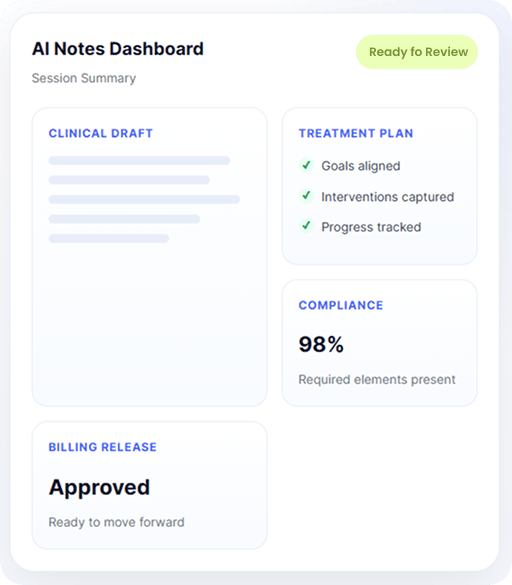
- Presenting problem identified
- Functional impairment documented
- Service is reasonable and necessary
- Treatment is expected to improve condition
AI Notes for Behavioral Health
Spend Less Time Writing Notes.
Spend More Time With Clients
Behavioral health providers face increasing documentation requirements while
trying to maintain quality care. Progress notes, treatment plans, assessments,
supervision documentation, and compliance requirements can consume hours
every week. DENmaar AI Notes helps clinicians complete documentation faster
while maintaining clinical accuracy and professional oversight.

Behavioral Health Focused

Clinical Accuracy & Oversight

Billing Workflow Ready

Reduce Documentation Time
Clinicians save hours each week on documentations.

Improve Note Consistency
AI-powered drafts improve quality and consistency.

Support Compliance Workflows
Build-in guidance for required documentation elements

Connect Notes to billing
Seamless integration with billing and operational workflows.
SUPPORTED DOCUMENTATION
Built Specifically for Behavioral Health
Unlike generic AI scribes, DENmaar AI Notes is designed for behavioral health workflows and
documentation requirements.
Individual Therapy
Family Therapy
Group Therapy
Substance Use Treatment
Case Management
Medication Management
Crisis Intervention
Clinical Supervision
Treatment Plans
Assessments and Reviews
AI NOTES WORKFLOW
How It Works
From captured session details to reviewed, billable documentation.

Record or Capture
Session Information
Patient check-in and
visit completed.

AI Generates a
Clinical Draft
AI Notes generate
structured documentation.

Review and Approve
Claim is created and
scrubbed for accuracy.

Release for Billing
Claim submitted to
the payer
DESIGNED FOR COMPLIANCE
Clinical Documentation with Compliance in Mind
AI Notes helps behavioral health providers document medical necessity, align treatment goals, identify
interventions, and support supervisor review workflows.
Compliance Support
Medical necessity documentation
Goal and treatment plan alignment
Intervention identification
Progress tracking
Required behavioral health documentation elements
Supervisor review workflows
Complete
Medical Necessity Documentation
Documentation supports the medical necessity of services provided and reflects the client’s ongoing treatment needs.
Evidence in Note
Aligned
Goal & Treatment Plan Alignment
Clinical documentation connects session content to active treatment goals and supports continuity across the plan of care.
Evidence in Note
- Active treatment goal referenced
- Session objectives tied to treatment plan
- Interventions support documented goals
- Progress linked back to care plan
Verified
Intervention Identification
Notes clearly identify the therapeutic interventions used during the session and how they relate to the client’s needs.
Evidence in Note
- Therapeutic intervention documented
- Intervention matched to presenting concerns
- Clinician actions clearly described
- Modality or technique identified where appropriate
Reviewed
Progress Tracking
Session documentation captures the client’s response to treatment and tracks change over time to support clinical decision-making.
Evidence in Note
- Client response to intervention documented
- Progress toward goals addressed
- Barriers or setbacks identified
- Ongoing symptoms or improvements noted
Included
Required Documentation Elements
Behavioral health notes include the core documentation elements needed for completeness, consistency, and payer readiness.
Evidence in Note
- Session date, duration, and service type included
- Relevant clinical observations documented
- Risk, safety, or notable concerns addressed when applicable
- Required note structure completed for the encounter
Available
Supervisor Review Workflow
Documentation can support internal review and approval workflows, helping supervisors monitor quality, accuracy, and compliance.
Evidence in Note
- Draft available for supervisor review
- Revisions or feedback can be incorporated
- Approval status is clearly tracked
- Final documentation is released after sign-off
MORE THAN A SCRIBE
Documentation Connected to the Rest of Your Workflow
Documentation can connect directly to scheduling, treatment plans, assessments, billing workflows, claims validation,
and provider productivity reporting.

Scheduling

Assessments

Claims Validation

DENmaar AI
Notes
Notes

Treatment Plans

Billing Workflows

Productivity Reporting
WHY ORGANIZATIONS CHOOSE DENMAAR
Built for Behavioral Health Teams and Organizations
DENmaar AI Notes is designed to support real-world clinical documentation and operational workflows.

Behavioral Health Focused
Customizable behavioral health workflows including therapy, psychiatry, substance use treatment, and multidisciplinary care models.

Scheduling & Operational Workflows
Integrated scheduling designed to support provider productivity, patient flow, authorization tracking, and claims readiness.

Supervisor Workflows
Built-in workflow logic designed to improve claim accuracy before submission through integrated operational checks and billing intelligence.

Eligibility & Insurance Verification
Integrated eligibility workflows designed to support Medicaid, commercial insurance, carve-outs, and behavioral health payer complexity.

Patient Engagement
Patient portal, intake workflows, secure communication, reminders, and measurement-based care tools.

Request an
AI Notes Trial
See how DENmaar AI Notes can help your clinicians reduce documentation time while improving
Request a demonstration or pilot program today.
Request Information
TESTIMONIALS
WHAT OUR CLIENTS SAY
On behalf of everyone at Meadowlark Counseling Services, I want to extend our sincere thanks for the continued improvements you and your team have made to the DENMaar EMR platform. We have been consistently impressed with both the functionality and user-friendly design of the system, which has made a meaningful difference in our day-to-day operations. The intuitive layout and ease of use have allowed our staff to spend less time navigating the system and more time focusing on client care. The regular updates and enhancements reflect your commitment to meeting the evolving needs of providers in the behavioral health and substance use treatment fields. We genuinely look forward to the new features introduced each month and appreciate how responsive the platform has been to the demands of clinical workflows. We have been so pleased with our experience that we’ve taken the opportunity to recommend DENMaar to other professionals in Pennsylvania who are working in the SUD field. Thank you again for your ongoing support and partnership. We are grateful to be working with a company that truly understands the needs of its users. KIndly, Becky Parks on behalf of the entire team at Meadowlark Counseling Services
I referred one of my colleagues Dr Aaron to you he is just starting g his psychology private practice and looking at where to start. I told him hands down you guys are the best billers and have a great EMR and team. He said he reached out just wanted to let you know!
FANTASTIC job keeping things rolling along with any and all of our billing concerns as well as responding to other issues which may well have been out of your wheelhouse. We are VERY grateful to have you and the crew in our corner.
I appreciate you all so much and DENmaar has been such a blessing Donna to our overall operations and success as an expanding company—allowing us to ultimately operate more efficiently, get our claims paid more consistently, ad stay on top of the critical credentialing piece, among other things. Teamwork does in fact, make the dream work. I’ll loop Chris/Isabella in on this message thread too, as I want All of your team to be aware of how much we appreciate our working relationship with DENmaar
Thank you for your diligence!! I appreciate it so much. Thank you Edwina…
Thank you so much Amy! I will be referring to DENmaar as often as I am asked about credentialing services.
Our Latest Blogs
The Major Difference between Telehealth and Telemedicine
At first glance, both telehealth and telemedicine seem very similar terms, that however, cannot be any further from the truth. Today the fields of Mobile IT health, digital health and telemedicine are changing so rapidly, that it is hard to settle on one accurate definition for these terms, hence you will see both Telemedicine and Telehealth being used interchangeably.
Both terms consist of very similar services which include patient monitoring, e-health, medical education, patient consultation etc. If you really want to get to technical with the terms then Telemedicine is a subset of Telehealth.
Telehealth, on the other hand is much broader term in scope which includes all telecommunication services that offer or engage in health care. Telemedicine refers only to clinical services.
Here’s a definition that could clear your mind on the concept:
Telemedicine refers to traditional clinical diagnosis and screening provided by technology, whereas Telehealth encompasses many different types of diagnosis, management and education. Telehealth concerns itself with many different range of telemedicine services which include both clinical and non-clinical services.
Telehealth being the more popular term can be found in general health care services, while Telemedicine deals specifically with a clinician that provides a very specific kind of health service.
Examples of Telehealth
- A video conferencing platform for consultation and education
- A health app that alerts people of impending outbreak
- Fit Bits that monitor your pulse and heart rate
Example of Telemedicine
- An app that helps physicians treat their patients remotely via video conferencing
- A software that allows patients to send photos of a rash or a mole that has been bothering them to their doctors.
- An app that schedules appointments with doctors within minutes.
As you can see Telemedicine is simply a small part of telehealth. Telemedicine has become even more popular and is being widely consumed thanks to the recent COVID-19 outbreak. If anything, it has proved its worth in times of emergency and will gain further validity once the pandemic is defeated.
DENmaar’sTeleHealth Services
At DENmaar, our telehealth solution offers both patients and providers with a communication technology that allows the access and management of health care services from homes of patients or the practices of doctors. This tele-conferencing feature allows practitioners to attend to their patients, on their computer screens, where-in they can consult and serve their clients without having to make them wait in their clinics or making them transit long distances.
All you have to do to access our feature, whether you are a provider or patient, is to sign up to our app and avail our telepsych feature.
Pros and Cons of Tele-Nursing
We all want our healthcare to be both effective in its treatment and affordable in its cost. When telehealth is implemented efficiently, both of the above aspects become easier to achieve. We can see improvements in patient satisfaction as well as management of healthcare amidst your own organization.
An advance in communication technology is only making things better for the telehealth industry. Smartphones today are faster and actually smart. Stronger internet connections are ensuring care is rendered uninterrupted. Today, telehealth is so much more than simply calling up your nurse to explain your symptoms.
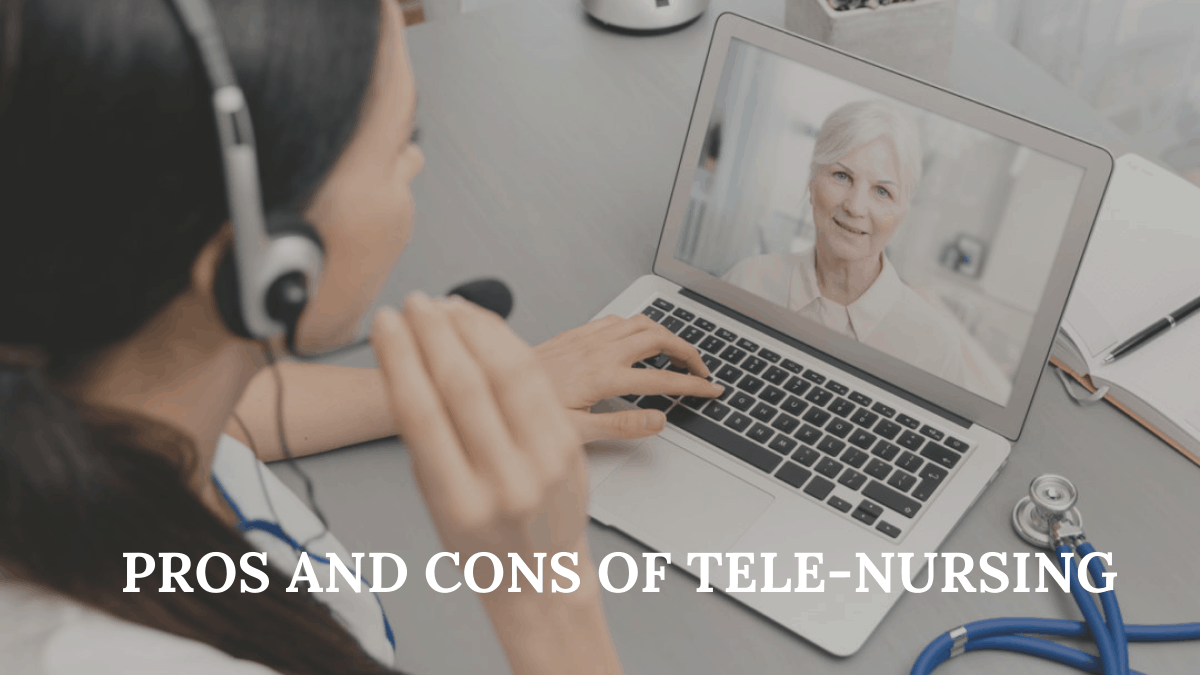
In this article, we will look at Tele-nursing, its pros, and its cons. So without much further ado, let’s jump right into the meat of this article.
Pros and Cons of Tele-Nursing
Better management of Chronic Conditions
RPM aka Remote patient monitoring has replaced traditional clinical visits today to manage chronic conditions like diabetes and COPD. In RPM there’s less fragmentation of care when a patient lapses with their responsibilities. With fewer contact, there are less clinical visits and readmissions. In one study, participants of the ‘behavioral health intervention telehealth program’ experienced less hospital admissions than the patients who did not participate.
Increased Access to Care
Patients who live in rural areas are the most significant beneficiaries of telehealth. Rural areas have always received the harsh end of a stick when it came to accessing to health care. Tele-health changed all of that. Now, rural areas, thanks to the strong internet connection and better smartphones have access to healthcare.
Avoid Risk
In the context of the recent COVID-19 outbreak, Telehealth provides a great opportunity for doctors to still consult their patients via videoconferencing while adhering to the mandatory discipline of social distancing.
Save Time
With telehealth, patients don’t have to travel long distances to meet their doctors. They don’t have to wait in long lines as well. Tele-health saves time which is precious to both doctors and patients.
Cons
Some Visits are Necessary
Although telehealth is crucial in providing convenient health care to patients, it still cannot make up for physical consultation which is necessary for most situations. Doctors cannot feel your stomach through telehealth, they cannot swab your throat, or listen discerningly to your lungs or heartbeat.
Licensing issues
Licensing issues restrict nurses from providing health care to patients that do not fall in their state. Nurses can only practice and provide care in the states that permit them to practice health care.
Reimbursement
Insurance coverage for telehealth services is still shoddy and needs a lot of work. Only 21 states today require private insurers to cover telehealth services. Medicaid programs vary from state to state in paying for services offered by nurses through telehealth.
DENmaar’s TeleHealth Services
At DENmaar, our telehealth solution offers both patients and providers with a communication technology that allows the access and management of health care services from homes of patients or the practices of doctors. This teleconferencing feature allows practitioners to attend to their patients, on their computer screens, where-in they can consult and serve their clients without having to make them wait in their clinics or making them transit long distances.
Cigna Embraces Telehealth Technology
Cigna has finally launched its own Telehealth services to offer its 12 million members access to primary health care services. The insurer has partnered with Florida based Telehealth service provider MDlIVE to bring its services to their insurers.
This isn’t the first time MDlIVE has partnered with an insurance company, Humana and Blue Cross Blue Shield, came before Cigna. They have however, partnered with Cigna before to provide urgent care through their Telehealth services.
The move has pushed Cigna into a newly popular arena of advanced healthcare technology. Amazon and Walmart are also rumored to be bringing in their own telehealth services in the market. The telehealth service means to improve access to rural areas for better healthcare, and provide specialty care without any hassle. If recent stats are anything to go by, then the younger generation are already ignoring traditional methods of physical consultations and opting for such online services instead.
What is Telehealth technology?
Telehealth provides patients with the tool to consult with their doctors from the comfort of their respective abodes. It allows for face to face communication without compromising on the concept of physical distancing. Videoconferencing, Fit bits, Apple watches are all examples of telehealth technology
The Benefits of Telehealth include:
- • Making Healthcare accessible for rural and isolated communities.
- • Access to behavioral and other medical specialists
- • Making services available for communities and people with limited mobility, or transportation options
- • Improved communication between doctors and patients
- • Improved self-management of health care practice
For many traditional health care professionals, Tele-health is still an uncharted territory. Venturing into something this unknown to them can seem intimidating. However, most Tele Health services today are easy to use and can be implemented with only minor level training.
DENmaar’s TeleHealth Services
At DENmaar, our telehealth solution offers both patients and providers with a communication technology that allows the access and management of health care services from homes of patients or the practices of doctors. This tele-conferencing feature allows practitioners to attend to their patients, on their computer screens, where-in they can consult and serve their clients without having to make them wait in their clinics or making them transit long distances.
All you have to do to access our feature, whether you are a provider or patient, is to sign up to our app and avail our telepsych feature.
Our Partners






Ready to get started?
Feel free to reach out if you have any questions.
