For years, healthcare software treated patient insurance as a relatively simple piece of information: enter the payer, member ID, group number, and subscriber details into the patient record.
That approach no longer reflects reality.
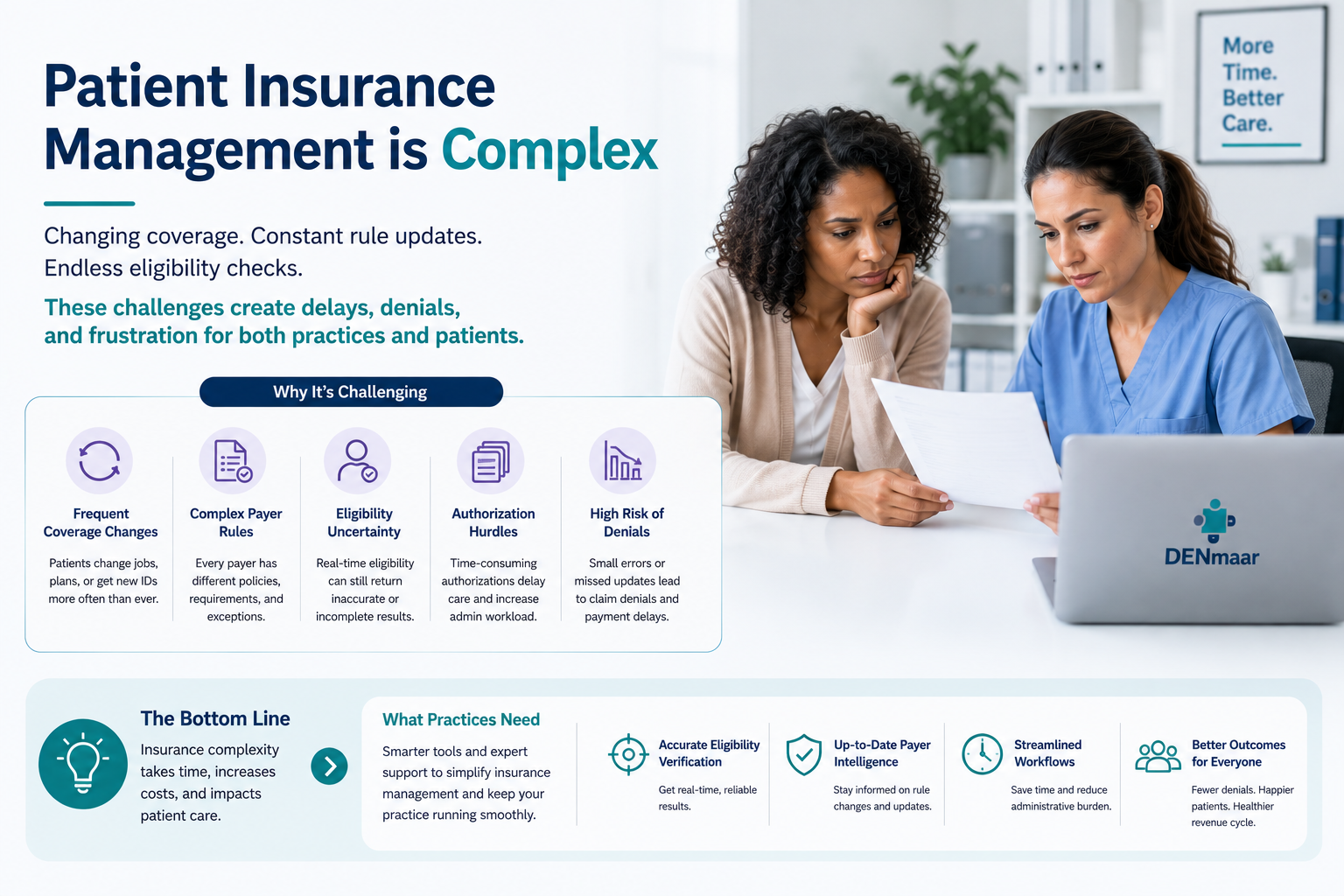
A patient’s insurance is not a static field. It is a changing timeline. Patients move between employer coverage, Medicaid, Medicare, Marketplace plans, and managed-care organizations. A plan may terminate, become secondary, or change administrators. A patient can remain covered by Medicaid while being assigned to a different managed-care plan with a new member number, provider network, and billing requirements.
Sometimes the patient does not know the change occurred. Sometimes the payer’s own records are not current. And sometimes a practice does not discover the problem until weeks after treatment, when the claim is denied.
Building software that can help practices manage this is extraordinarily challenging. It is also increasingly necessary.
Why Patient Insurance Management Is So Difficult
The information is constantly moving
The first difficulty is that there is no single, perfectly reliable source of truth.
The patient may provide an insurance card that appears active. An electronic eligibility response may show different coverage. The payer portal may contain newer information. A Medicaid system may show an assignment to a managed-care organization that has not yet reached every downstream system. Another insurer may claim to be secondary while its coordination-of-benefits records still identify it as primary.
Each source can be correct at one point in time and outdated at another.
Software therefore cannot simply overwrite the old insurance with the new insurance. It must understand effective dates, termination dates, coverage priority, verification dates, and the plan associated with each date of service. It must preserve history because a claim for a visit three months ago may need to be billed differently from a claim for today.
Eligibility Verification Does Not Answer Every Question
Electronic eligibility is essential, but it is not a complete solution.
An eligibility response may confirm that coverage exists without clearly resolving:
- Which plan is primary
- Whether behavioral-health benefits are administered by another company
- Whether the provider is in network
- Whether an authorization is required
- Whether the deductible has been met
- Whether another policy remains listed in the payer’s coordination-of-benefits records
- Whether a recent coverage change has propagated through every payer system
This is why a simple “active” indicator can give a practice false confidence. Coverage may be active while the claim is still directed to the wrong payer or missing information required for payment.
The Consequences Appear After Care Has Been Delivered
Insurance problems are especially damaging because they are often discovered after the appointment.
The provider has already treated the patient. The clinical note has been completed. Payroll may already have been calculated. Then the claim is denied because the patient changed plans, the payer believes another insurer is primary, or the member ID changed.
At that point, the practice must investigate the coverage, contact the patient, obtain a new card, update coordination of benefits, correct the claim, and resubmit it—often while facing a filing deadline.
For a behavioral-health practice providing ongoing weekly care, one unresolved insurance change can affect several visits before anyone recognizes the pattern. What appears to be one denial can quickly become a group of unpaid claims.
The Workflow Involves the Patient, Practice, Payer, and Billing Team
This is not only a data problem. It is a coordination problem.
A complete solution may need to:
- Reverify coverage before upcoming appointments
- Compare the current response with the insurance already on file
- Identify meaningful changes rather than merely displaying raw payer data
- Notify the appropriate practice staff
- Ask the patient to confirm coverage or upload a new card
- Prevent questionable claims from being sent prematurely
- Create a task when coordination of benefits must be corrected
- Track what was requested, who responded, and what remains unresolved
- Apply the corrected coverage to the appropriate dates of service
- Rebill affected claims without losing the original history
Every one of those actions touches a different part of the practice. If they are disconnected, staff end up managing the problem through spreadsheets, sticky notes, portal screenshots, emails, and memory.
That is exactly the operational fragmentation healthcare software should eliminate.
Why DENmaar Is Investing in This Problem
At DENmaar, we do not believe an EHR should merely store insurance information and leave the practice to manage everything that happens afterward.
Because we combine behavioral-health EHR, billing, credentialing, and operational support, we see the full effect of coverage changes. We see how inaccurate insurance information becomes a denied claim, how a denial becomes a patient balance, and how an unresolved coordination issue disrupts both revenue and care.
That experience is guiding the development of a more intelligent patient-insurance work area.
Our goal is to move beyond a static insurance screen toward a system that recognizes insurance as an ongoing operational process. The system should help practices see what changed, understand what action is required, communicate with the patient, protect affected claims, and follow the issue through resolution.
This will not be solved by a single button or one eligibility transaction. It requires thoughtful development, real billing experience, and continuous feedback from practices encountering these problems every day.
Difficult Problems Are Often the Ones Most Worth Solving
Developing this type of software is challenging precisely because healthcare coverage is complicated. Rules vary by payer and state. Data can arrive late. Patients may not understand their coverage. The same insurance issue can require a different response depending on the date of service and the type of plan.
But accepting that complexity as “just part of billing” is not good enough.
Practices should not have to discover insurance changes only after claims deny. Staff should not have to reconstruct coverage history manually. Providers should not be surprised months later that services were delivered under an inactive or incorrectly coordinated plan. Patients should receive timely requests for the information needed to keep their care and claims on track.
The solution will continue to evolve because the insurance environment continues to evolve. That is why DENmaar develops from actual practice and billing needs—not from a theoretical workflow.
We are building toward a system that does more than document care. We are building a system that helps the practice operate, recognize problems earlier, and take the next correct action.
Patient insurance may be one of the hardest areas to solve well. It is also one of the most important.