

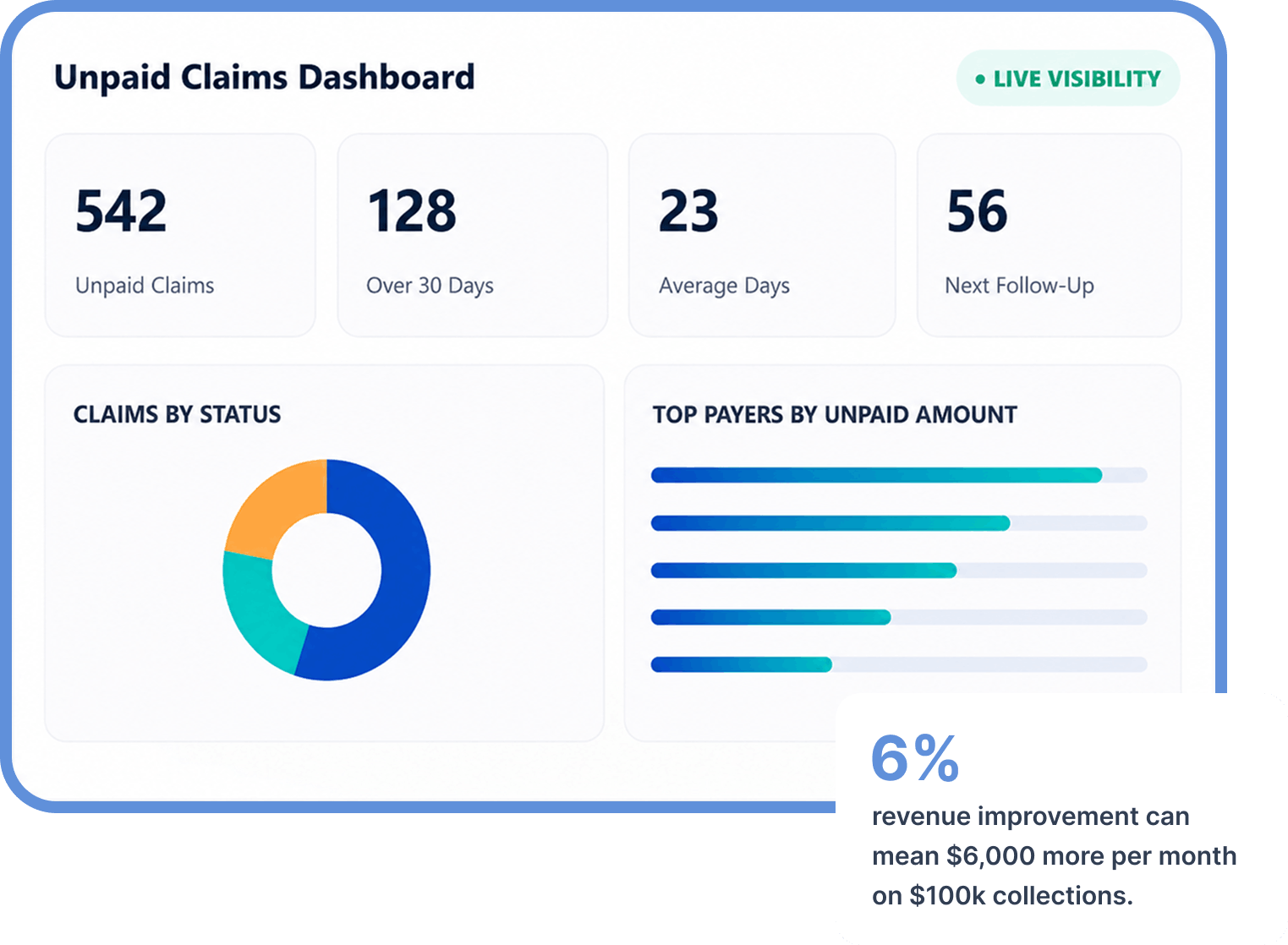
We don’t just submit claims. We create visibility and accountability around every unpaid claim—so management knows what’s being worked, what’s stuck, and why.
Know What’s Happening With Every Unpaid Claim
Behavioral health billing with complete visibility and accountability

98.1%
Clean Claim Rate
1.47%
Rejection Rate
0.32%
Denial Rate
5–10%
Denial Rate
10–20%
Average Revenue
Improvement
$0
EHR Software Fee
With Billing Services
With Billing Services
CLAIMS VISIBILITY
Your Claims May Be Getting
Submitted. But Are They Getting Paid?
Submitting a claim is only the beginning.
Your Claims May Be Getting
Submitted. But Are They Getting Paid?
Revenue is lost when rejected claims aren’t corrected, denials aren’t resolved, authorizations expire, payer requests go unanswered, and unpaid claims disappear into spreadsheets and work queues.
DENmaar gives behavioral health practices a clear view of:
- Which claims remain unpaid
- Why each claim is stuck
- What action has been taken
- Who is responsible for the next step
- When follow-up is due
- What the payer said during the last follow-up
- Which payers and problems are creating the most lost revenue
You no longer have to accept, “We’re working on it.”
You can see exactly what is being worked, what happened and what comes next.
The Improvement in Claims Can Pay for DENmaar
any practices are already losing more money through preventable claim problems than they would spend fixing them.
For a practice collecting $100,000 per month
6% = +$6,000 / month
in realized insurance revenue
That improvement alone could offset the cost of DENmaar’s billing services.
- Behavioral health EHR software at no additional cost
- Claims Copilot
- Eligibility and insurance workflows
- Payment posting
- Rejection and denial management
- Aging-claim follow-up
- Reporting and management visibility
- Support from DENmaar’s Insurance Knowledge Team
Claim Lifecycle
Every Claim Has an Owner, a Status
and a Next Action
DENmaar creates a structured process for managing the entire claim lifecycle—from appointment readiness
through final payment.
01
Prevent Problems Before Submission
Eligibility, payer, authorization, credentialing and documentation issues are identified before they become rejected or denied claims.
02
Submit Clean Claims
Claims are reviewed for common errors and payer requirements before submission.
03
Monitor the Payer Lifecycle
Claims are tracked after submission so unresolved claims don’t quietly disappear into aging.
04
Assign the Next Action
Every problem claim has a clear status, responsible team member and required next step.
05
Document Every Follow-Up
Management can see when follow-up occurred, what the payer said and what must happen next.
06
Escalate Unresolved Claims
Claims receive additional attention before filing limits or appeal deadlines are missed.
07
Measure Performance
Monitor clean claims, rejections, denials and aging by payer, provider, location, service and responsible team member.
Management Visibility
Your Billing Operation Shouldn’t Be a
Black Box
Monthly reports tell you what has already happened. DENmaar provides visibility into
what is happening now.
Visibility creates accountability.
A practice should not have to wait until collections fall to discover that claims aren’t being worked effectively.
- Whether claims are being worked consistently
- Whether follow-up is producing results
- Why claims remain unpaid
- Whether the same errors keep recurring
- Where responsibility for the next action sits
- Which workflows or team members need support
- Which payers are causing the most problems
- How much revenue remains at risk
Visibility creates accountability.
Accountability creates action.
Action moves claims toward payment.
Improve the Team You Have—or Let DENmaar Manage the Process
Some practices already have an internal billing team but lack the technology, payer knowledge and management visibility required to oversee it. Others want an experienced partner to manage the entire revenue cycle.
OPTION 01
Claims Copilot for Your Existing Team
Give your billing staff the structured workflows, claim intelligence and accountability tools needed to manage unpaid claims more effectively. Management gains visibility without immediately replacing the internal team.
OPTION 02
Full Revenue Cycle Management
Let DENmaar manage claim creation and submission, rejection correction, payment posting, denial resolution, insurance follow-up, aging claims, payer escalation, patient balances and revenue-cycle reporting.
Either way, management gains control over the revenue cycle.
Behavioral Health Expertise
Built Specifically for Behavioral Health
Behavioral health billing requires more than generic claim submission.
Mental health therapy
Psychiatry and medication management
Substance-use treatment
Intensive outpatient and partial hospitalization programs
Community behavioral health
Multidisciplinary practices
Telehealth billing
Time and unit requirements
Rejections and denials
Built Specifically for Behavioral Health
- Behavioral health payer carve-outs
- Eligibility and benefit verification
- Prior authorizations
- Provider credentialing
- Therapy and psychiatric coding
- Same-day services
- Telehealth billing
- Missing or incomplete documentation
- Coordination of benefits
- Rejections and denials
- Aging insurance balances
Before Billing Begins
Problems Are Often Created Before Billing Begins
Many claim problems originate before the claim reaches the billing team.
An appointment may be scheduled with the wrong payer. Eligibility may not be verified. An authorization may be missing. Documentation may not support the code or units billed. A provider may not be enrolled correctly.
DENmaar connects scheduling, eligibility, authorizations, documentation and billing in one operational system.
This helps prevent bad claims—not merely work them after they fail.
Prevent the problem upstream.
01
Scheduling
Right payer • right workflow
02
Eligibility & Authorization
Verify before service
03
Documentation
Support code and units
03
Billing
Submit cleaner claims
More Than Billing
Technology, Insurance Expertise and
Human Follow-Through
Most billing companies provide reports. Most software companies provide tools. DENmaar combines:
Technology, Insurance Expertise and
Human Follow-Through
You get a system designed to improve the financial performance of your behavioral health practice.
Enterprise capability with small-practice simplicity.
- Behavioral health EHR technology
- Claims Copilot
- Revenue-cycle services
- Insurance knowledge
- Human payer follow-up
- Management visibility
- Operational accountability
Billing Review
See What Better Claims Performance Could Mean for Your Practice
If too many claims are rejected, denied, aging or simply unexplained, let’s look at the process together.
Current monthly insurance revenue
Baseline performance
Clean-claim rate
Rejection and denial rates
Claims over 30 days
Value of unpaid and aging claims
Follow-up process
Where accountability is breaking down
Let’s Determine Whether There Is Operational Alignment
We begin with a discussion focused on:
- Organizational structure
- Insurance workflows
- Operational goals
- Implementation fit
Request Information
Capterra, Software Advice And Get App 2023 / 25
Best Of Badges Awarded To DENmaar
2023 / 25 “Best of” badge winners = DENmaar Neuro has earned a well-deserved Best Value Badge.
See our reviews for our software being recognized as an impactful solution for your business.





Our Latest Blogs

Why Is E-Prescribing Essential For Providers & Patients
The introduction of e-prescription in 2003 made it a more convenient, cheaper, and safer alternative to prescription for doctors, pharmacies, and patients.
Through electronic prescribing, or ‘e-prescribing,’ healthcare providers can enter prescription information into a computer – such as a tablet, laptop, or desktop computer – and use special software to transmit prescriptions to pharmacies and connect to transport networks securely.
The adoption of standards to facilitate the electronic prescribing process is a crucial government component in accelerating the adoption of electronic health records and building national health information technology infrastructure.
In short, the goal of increasing e-Prescribing is to improve workflow, increase patient safety, and increase transparency in future drug pricing.
What is e-prescribing?
Electronic prescribing is a process that healthcare providers use to send prescriptions to a patient’s preferred pharmacy.
There are several benefits to e-prescription software (Rcopia), including simplifying obtaining a pharmacy prescription, dispensing medication, and getting a new refill.
Medical software plays a vital role in the adoption and use of electronic prescriptions, as these solutions contain the necessary tools.
Imagine the challenge for a pediatrician looking at a new patient and deciding what medications they can take, exceptionally if the patient’s parents did not prescribe them ahead of time. In such cases, determining what medications the young patient is taking or what may be allergic to them becomes more complex and dangerous.
Electronic prescriptions are just one condition that describes the immediate benefits of electronic medical records (EMR) software. However, these tools are essential features of the best medical software, offering healthcare providers a detailed look at a patient’s medication history, even if they’ve never seen one before.
In 2019, doctors used e-prescription for controlled and non-controlled substances online at a higher rate than in the previous two years. In addition, online prescriptions for uncontrolled substances increased from 76 percent in 2017 to 86 percent in 2019.
While the COVID-19 epidemic affects patients and providers worldwide, a reliable national health information network has never been more critical.
EPCS Technology
Many states enacted electronic prescription requirements, meaning that more prescriptions were written electronically, which helped protect patients’ prescriptions from fraud and abuse. Since 2017, the number of electronic prescriptions written has increased.
Furthermore, the introduction and use of Electronic Prescription for Controlled Substances (EPCS) technology aim to help providers integrate prescription information into EHR (electronic health records), which can increase patient safety and help prevent diversion and fraud. ECPS technology can also facilitate doctors’ workflow and reduce the burden on the patient.
Electronic prescription software options
Some popular software choices for 2022 offer e-prescribing for healthcare organizations without an EMR system.
Other high-performance companies offer electronically prescribed programs that act as standalone applications or integrate with existing EHR platforms. These tools usually make finding prescription drugs easier, checking patient drug records, and obtaining real-time prescriptions. Most potential adverse reactions and drug tests against known patient allergies are also indicated.
Best E-Prescription Software
With DENmaar, you would be able to access all the medication information regarding your patient at a button. The medications prescribed in Rcopia (e-prescription software) are pulled into our EHR, and we provide a very intuitive and easy-to-use access to the medication information. The data is extracted in real-time from the Rcopia portal and made available to provide a seamless experience.
Why is e-prescription essential?
Prevent clerical errors
According to a Food and Drug Administration study, there have been 95,000 prescription errors since 2000. One of the major causes of this problem is that many drugs are similar or have similar spellings. Electronic prescriptions help to illustrate this by showing drug options side by side and allowing providers to customize the prescription of their choice.
Complete the patient’s medical records
The second most important advantage of e-prescription is its data management capabilities. By keeping medical records, other healthcare providers can determine what prescription medications the patient is taking and when their prescription was last filled. In addition, electronic prescriptions can redefine compliance by making it easier for states to track prescriptions in multiple pharmacies and allowing states to integrate them into prescription drug monitoring programs (PDMPs).
Healthcare provider recommendation tools
Electronic prescribing provides instant information on allergies, drug interactions, and duplicate treatments, providing health professionals with the data and professional intelligence needed to ensure patients receive the proper medication. Electronic prescriptions also include system alerts that notify healthcare professionals about potential drug interactions and repeat treatments.
A significant additional benefit of e-prescription is time-saving for pharmacy staff who calls to check orders. Moreover, carefully written prescriptions save time for pharmacy staff and doctors.
E-prescription capabilities allow physicians and healthcare professionals to meet all the challenges and make it easier to determine which medications the new patient is taking – even if they do not remember them before the visit.

Nurse Practitioner Credentialing: Why is It Vital for Nurses and Healthcare Organizations?
Credentialing is usually considered to be a process only meant for physicians. This cannot be any further from the truth. In fact, credentialing is equally important for all sorts of practitioners who participate in the provision of patient care, this also includes nurses. There are immense benefits to be enjoyed by a nurse who is credentialed. They can work towards advancing their career with recognized achievements and contribute to their own professional growth.
What is Nurse Credentialing?
Simply put, the nurse credentialing process involves the verification of an applicant nurse’s certifications and qualifications. This includes reference checks, verification of board-earned certifications, licensure, and educational qualifications, among many other things. This is usually done to ensure a nurse or physician is capable of providing healthcare to their patients.
Read More: Credentialing Process Checklist
Furthermore, it is mandatory for a nurse to be credentialed for a hospital or practice to be able to bill an insurance company or government agency.
What are the Benefits of Nurse Practitioner Credentialing?
Like we mentioned before, Credentialing is as fundamental for nurses as it is for physicians and equally beneficial. The following benefits await those nurses who are credentialed:
- • Professional Career Growth
- • Highlight Unique Skillsets
- • Helps employers reduce their administrative burden
- • Assure patients that their nurse is capable of taking care of them.
- • Give nurses a sense of accomplishment
- • Display a nurse’s commitment to his or her job.
Certification is an integral part of nurse practitioner credentialing. CEU credits, for instance, are important if a nurse wants to renew his or her license. Nurses are required to acquire certifications, which are specific to the scope of practice they indulge in. This is important if they want to continue pursuing their education or demonstrate their knowledge and skill set. Certifications are indirectly connected to the improved patient outcome as a certified nurse is better equipped with an expanded set of skills to take relatively better care of the patients they are in charge of.
Needless to say, certifications also improve the chances of a nurse getting employed. It increases their perceived value in the eyes of an employer. There is ample evidence throughout history that proves that nurses with credentials are far more likely to get hired than nurses without any certifications. Credentialed nurses are already assumed by hiring managers to possess the ideal knowledge and skill set needed to operate in complex patient care circumstances.
Aside from improving a nurse’s chances of getting hired, credentialing can also help boost a nurse’s average earned income. Certified nurses are believed to earn $10000 more annually than their non-certified counterparts.
This proves how important credentialing is to nurses. As such, it is important they get credentialed to enjoy an easy career ahead. That being said, getting credentialed comes with challenges of its own. The process can be far too time-consuming and frustratingly complex.
What is the Credentialing Process for Nurse Practitioners?
The credentialing process for nurse practitioners involves the following steps:
- • Select a certification body and apply
- • Send required information for verification
- • Participate in the exam
- • Get official certification
- • Go to the state board of nursing to apply for nurse licensure
- • Wait to receive the licensure for the board of nursing
- • Apply for a DEA and a controlled dangerous substance certificate
- • Apply for an NPI number
The applicant or the employer of the nurse should make sure all information submitted for verification is correct and complete. Any missing or erroneous details in the information submitted could result in the application getting rejected.
Unless the credentialing process is complete, the nurse practitioner cannot receive reimbursements for the services they render.
How long does the Credentialing Process take for New Nurse Practitioners?
The credentialing process can take anywhere between two to three weeks.
So as you can see, acquiring primary source verification for all nurse practitioners currently employed can be time-consuming for employers. The excruciatingly long process could result in delayed reimbursements and even delay the on-boarding process of a much-needed nurse to the staff.
This is why it is only wise to let a reputed third-party credentialing service provider handle the task at your behest. This is where DENmaar comes into play. With years of experience, our credentialing specialists at DENmaar can help your hospital and medical practice with the nurse credentialing process from start to finish.
You can explore our website to learn more or contact us now to get in touch with one of our representatives.
What Is Required to Navigate America’s Mental Health Care Crisis?
The demand for mental health services gets increased rapidly. However, with a shortage of psychiatrists, how can we ensure that providers deliver the best possible care to their patients.
The United States is experiencing an increasingly acute mental health crisis. Between 2017 and 2018, one in five Americans had a mental illness, and the epidemic has exacerbated feelings of anxiety, depression, and isolation. According to Mental Health America, moderate to severe anxiety reached its peak in September 2020, with more than eight out of 10 people showing moderate to severe symptoms at anxiety and depression screening.
The mental health care supply chain is down. More and more people are taking professional care, but it has become harder to get the care they need. They’ve found providers that don’t accept new patients, are out of the network, or just don’t fit.
Today, 37% of the US population lives in areas with a shortage of mental health professionals. For example, there are only 30 psychologists for every 100,000 people compared to 156 primary care physicians for every 100,000 Americans. Moreover, there is a national psychiatrists shortage, but more than half of those who practice therapy accept insurance or Medicaid, making high-quality care prohibitively expensive for many. Because of this lack of access, 60% of adults in the United States do not receive treatment for diagnosable mental illness each year.
The crisis affects all Americans, not just those with mental health symptoms and their loved ones. Mental health symptoms adversely affect physical health, leading to higher costs for insurance companies and employers to care for. For instance, people with the major depressive disorder show a considerable increase in patients compared to the total population.
Examining mental health care deficiencies
There are two major priorities for resolving this crisis: increasing the number of mental health professionals and helping those existing ones to handle their cases better.
The first is a difficult task. It needs an average of eight years of higher education and medical school and four years of residency to become a licensed psychiatrist. Even as new psychiatrists enter the field, more than 60% of psychiatrists are now 55 or older and rapidly retire. The fourth-oldest group in medical specialties will create a potential shortage of 6,000 to 15,000 psychiatrists by 2025.
This deficiency will put more pressure on the practice of psychiatrists. Fifteen-minute visits every three months have become the norm in many places, where there is not enough time to correctly complete the progress record, let alone provide high-quality medical care. The right long-term solution is to enable psychiatrists with technology and appropriate support functions instead of replacing them.
Innovation is needed, not first aid solutions.
There has been tremendous progress in increasing access from the adoption of telemedicine to premium consumer-focused therapy and mindfulness applications over the past decade. However, this is not enough.
Historically, the opportunities for psychiatrists have not presented themselves in a flexible, clinically driven way. High-quality providers are usually only available for hospitalized patients or on an out-of-network basis. Moreover, many find it challenging for
- Opening a private practice with low reimbursement rates for services
- Handling the burden of coordinating with insurance companies
- Working on the subsequent administrative tasks that follow every day
All the above factors can be stressful for psychiatrists, preventing them from giving remedies to their patients.
A blood test cannot diagnose depression, and psychiatrists do not have the right tools to track their patients’ progress. In addition, psychiatry lacks transparency and data for determining outcomes instead of most other disciplines. Research executed by the Centers for Disease Control and Prevention (CDC) found that almost 60% of psychiatrists do not use an approved electronic health records system, and 40% do not use it at all – meaning they are still writing on paper.
Technology can go a long way in more stressful aspects of managing mental health practices, including billing, insurance, and appointment schedules. But these measures have more potential, allowing providers to gain in-depth insights into their patients, track patient progress, enhance psychiatric practice, and achieve high-quality results.
Against the backdrop of the ever-increasing demand for the services of psychiatrists and mental health providers, it has become critical for providers to provide flexibility in treatment methods.
Who can be contacted to get the best mental health billing?
DENmaar provides an improved patient payment system, staff claim tools and quickly resolves the claim issues. Contact us today to do your credentialing using DENmaar’s psychiatric billing process.
Our Partners






Ready to get started?
Feel free to reach out if you have any questions.
