

We don’t just submit claims. We create visibility and accountability around every unpaid claim—so management knows what’s being worked, what’s stuck, and why.
Know What’s Happening With Every Unpaid Claim
Behavioral health billing with complete visibility and accountability

98.1%
Clean Claim Rate
1.47%
Rejection Rate
0.32%
Denial Rate
5–10%
Denial Rate
10–20%
Average Revenue
Improvement
$0
EHR Software Fee
With Billing Services
With Billing Services
CLAIMS VISIBILITY
Your Claims May Be Getting
Submitted. But Are They Getting Paid?
Submitting a claim is only the beginning.
Your Claims May Be Getting
Submitted. But Are They Getting Paid?
Revenue is lost when rejected claims aren’t corrected, denials aren’t resolved, authorizations expire, payer requests go unanswered, and unpaid claims disappear into spreadsheets and work queues.
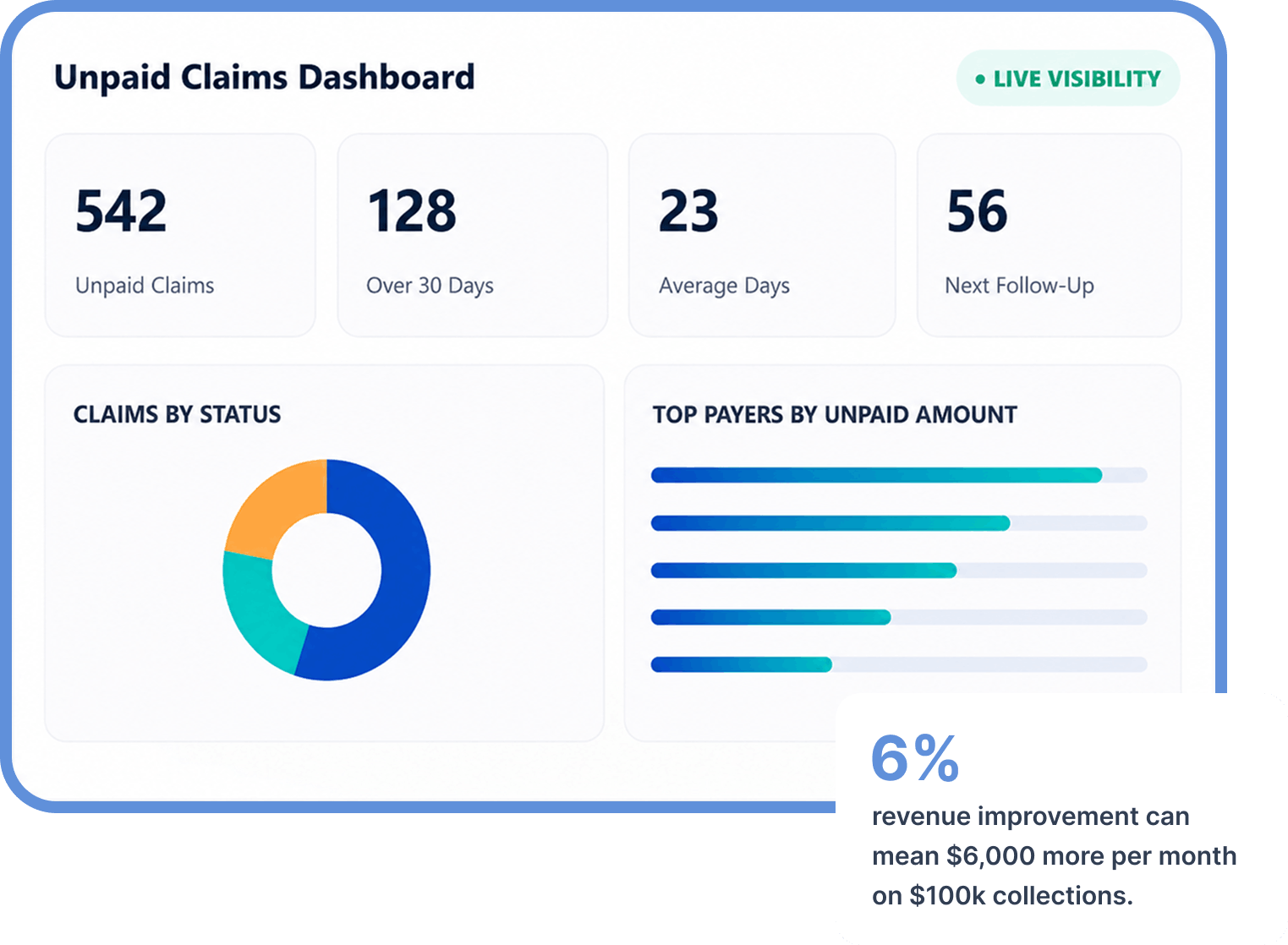
DENmaar gives behavioral health practices a clear view of:
- Which claims remain unpaid
- Why each claim is stuck
- What action has been taken
- Who is responsible for the next step
- When follow-up is due
- What the payer said during the last follow-up
- Which payers and problems are creating the most lost revenue
You no longer have to accept, “We’re working on it.”
You can see exactly what is being worked, what happened and what comes next.
The Improvement in Claims Can Pay for DENmaar
any practices are already losing more money through preventable claim problems than they would spend fixing them.
For a practice collecting $100,000 per month
6% = +$6,000 / month
in realized insurance revenue
That improvement alone could offset the cost of DENmaar’s billing services.
- Behavioral health EHR software at no additional cost
- Claims Copilot
- Eligibility and insurance workflows
- Payment posting
- Rejection and denial management
- Aging-claim follow-up
- Reporting and management visibility
- Support from DENmaar’s Insurance Knowledge Team
Claim Lifecycle
Every Claim Has an Owner, a Status
and a Next Action
DENmaar creates a structured process for managing the entire claim lifecycle—from appointment readiness
through final payment.
01
Prevent Problems Before Submission
Eligibility, payer, authorization, credentialing and documentation issues are identified before they become rejected or denied claims.
02
Submit Clean Claims
Claims are reviewed for common errors and payer requirements before submission.
03
Monitor the Payer Lifecycle
Claims are tracked after submission so unresolved claims don’t quietly disappear into aging.
04
Assign the Next Action
Every problem claim has a clear status, responsible team member and required next step.
05
Document Every Follow-Up
Management can see when follow-up occurred, what the payer said and what must happen next.
06
Escalate Unresolved Claims
Claims receive additional attention before filing limits or appeal deadlines are missed.
07
Measure Performance
Monitor clean claims, rejections, denials and aging by payer, provider, location, service and responsible team member.
Management Visibility
Your Billing Operation Shouldn’t Be a
Black Box
Monthly reports tell you what has already happened. DENmaar provides visibility into
what is happening now.
Visibility creates accountability.
A practice should not have to wait until collections fall to discover that claims aren’t being worked effectively.
- Whether claims are being worked consistently
- Whether follow-up is producing results
- Why claims remain unpaid
- Whether the same errors keep recurring
- Where responsibility for the next action sits
- Which workflows or team members need support
- Which payers are causing the most problems
- How much revenue remains at risk
Visibility creates accountability.
Accountability creates action.
Action moves claims toward payment.
Improve the Team You Have—or Let DENmaar Manage the Process
Some practices already have an internal billing team but lack the technology, payer knowledge and management visibility required to oversee it. Others want an experienced partner to manage the entire revenue cycle.
OPTION 01
Claims Copilot for Your Existing Team
Give your billing staff the structured workflows, claim intelligence and accountability tools needed to manage unpaid claims more effectively. Management gains visibility without immediately replacing the internal team.
OPTION 02
Full Revenue Cycle Management
Let DENmaar manage claim creation and submission, rejection correction, payment posting, denial resolution, insurance follow-up, aging claims, payer escalation, patient balances and revenue-cycle reporting.
Either way, management gains control over the revenue cycle.
Behavioral Health Expertise
Built Specifically for Behavioral Health
Behavioral health billing requires more than generic claim submission.
Mental health therapy
Psychiatry and medication management
Substance-use treatment
Intensive outpatient and partial hospitalization programs
Community behavioral health
Multidisciplinary practices
Telehealth billing
Time and unit requirements
Rejections and denials
Built Specifically for Behavioral Health
- Behavioral health payer carve-outs
- Eligibility and benefit verification
- Prior authorizations
- Provider credentialing
- Therapy and psychiatric coding
- Same-day services
- Telehealth billing
- Missing or incomplete documentation
- Coordination of benefits
- Rejections and denials
- Aging insurance balances
Before Billing Begins
Problems Are Often Created Before Billing Begins
Many claim problems originate before the claim reaches the billing team.
An appointment may be scheduled with the wrong payer. Eligibility may not be verified. An authorization may be missing. Documentation may not support the code or units billed. A provider may not be enrolled correctly.
DENmaar connects scheduling, eligibility, authorizations, documentation and billing in one operational system.
This helps prevent bad claims—not merely work them after they fail.
Prevent the problem upstream.
01
Scheduling
Right payer • right workflow
02
Eligibility & Authorization
Verify before service
03
Documentation
Support code and units
03
Billing
Submit cleaner claims
More Than Billing
Technology, Insurance Expertise and
Human Follow-Through
Most billing companies provide reports. Most software companies provide tools. DENmaar combines:
Technology, Insurance Expertise and
Human Follow-Through
You get a system designed to improve the financial performance of your behavioral health practice.
Enterprise capability with small-practice simplicity.
- Behavioral health EHR technology
- Claims Copilot
- Revenue-cycle services
- Insurance knowledge
- Human payer follow-up
- Management visibility
- Operational accountability
Billing Review
See What Better Claims Performance Could Mean for Your Practice
If too many claims are rejected, denied, aging or simply unexplained, let’s look at the process together.
Current monthly insurance revenue
Baseline performance
Clean-claim rate
Rejection and denial rates
Claims over 30 days
Value of unpaid and aging claims
Follow-up process
Where accountability is breaking down
Let’s Determine Whether There Is Operational Alignment
We begin with a discussion focused on:
- Organizational structure
- Insurance workflows
- Operational goals
- Implementation fit
Request Information
Capterra, Software Advice And Get App 2023 / 25
Best Of Badges Awarded To DENmaar
2023 / 25 “Best of” badge winners = DENmaar Neuro has earned a well-deserved Best Value Badge.
See our reviews for our software being recognized as an impactful solution for your business.





Our Latest Blogs

Best Practices to Avoid Payer Rejection During Enrollment
Getting enrolled into an insurance company’s network isn’t an easy task. Throughout the process, you’ll find that you have very little control over the outcome of the entire proceedings. You’ll find yourself at odds with the insurance companies whose network you so desperately want to join. Chances are that things might not pan out as you’d hoped.
Payer rejection is a reality that most providers do not want to ever encounter. Sadly, hearing a straightforward ‘No’ from payers after a very lengthy application process is more common than you can imagine. Most of the times providers have no clue what led to the rejection. What exactly went wrong that warranted the denial of an application? You’ll probably never know.
You can take solace in the fact that you are not the only healthcare provider in America that had to go through this ordeal. Getting paneled is not easy. It isn’t impossible either or as complicated as most people spell it out to be. There are a few steps or measures a provider can take to overcome a denial during enrollment.
This article will give you a peek at those tips, but first… let’s understand why application denials even happen in the first place.
Reasons for Insurance Panel Denials
You have to understand that insurance companies have the ultimate power to set and adjust the number of providers they accommodate into their network. Payers want to save costs for themselves while at the same time trying to fulfill the promise of better healthcare that they’ve made to their enrollees. As such, payers have a plethora of reasons to deny applications.
They can reject an application because of an error in the application, wrong or missing information, or if the provider doesn’t meet the dictated qualification criteria. Payers may also reject an application if they are currently not accepting providers belonging to a specific demographic.
Read More: Importance of Medical Credentialing
Other typical reasons for payer rejection maybe because of the following:
- • Failure to meet provider standards as dictated by the payer.
- • Over-saturation of a provider type pertaining to a service area or community.
- • The provider failed to comply with the payer’s conditions of participation.
- • The provider failed to meet requirements pertaining to out-of-state enrollments.
Persistence is Key to Overcoming Payer Rejection
Normally it’s typical of providers to simply give up once their application has been rejected. However, what they aren’t aware of is that they still have time to turn the tides in their favor. There are, in fact, a ton of things you can resort to in a bid to overturn your rejection. We know this can be daunting. As such, we highly recommend hiring a credentialing specialist to advocate at the behest of your case in front of the payers.
To begin with, try to request a face-to-face meeting or a conference call with the decision-makers to clearly convey your case. Remember, persistence is the key. Do not take ‘no’ for an answer. Reach out to the authorized personnel in the payer’s office to understand why your application was rejected and what you can do to fix the situation.
You can use LinkedIn to find the right people to talk to. For instance, go to LinkedIn and search employee titles under the payer’s company name. Try to connect with provider management representatives and initiate a conversation with them.
Most of the time, the reason behind denials has to do with the provider type. In such a scenario, providing more information even though the payers haven’t asked for it can make a lot of difference. Convey the demographic and the patient population you serve as a healthcare provider. This is more important if the demographic is related to any of the following:
- • Non-English-speaking communities.
- • Rural
- • Disabled
- • Geriatric
- • Pediatric
- • Chronic Condition
Steps to Take for Simple Provider Enrollment
You can try several things to get yourself enrolled successfully on the insurance company’s panel. A few of the things you can try are as follows:
- • Get letters that convey support from the community you serve.
- • Seek a second-level appeal from a decision-maker or manager of the insurance company.
- • Suggest a trial period where you will only serve a select number of patients, offering free comparison analysis when that period has concluded.
- • Make use of a phone instead of email or letters to clearly convey your message.
- • Request a face-to-face meeting and set up a conference call.
- • Compose a letter that shines a positive spotlight on the services of your practice or clinic.
- • Host an in-service visit to help payers better understand your services.
Learn more on Medical Credentialing Process
Getting paneled with an insurance company is no child’s play. It is an excruciatingly long process with multiple moving parts. One wrong move and you must undertake the entire enrollment process all over again, which can be both time-consuming and costly. As such, it is in your best interest to seek the help of credentialing specialists to guide you throughout the process.
This is where DENmaar’s provider credentialing services come into play. DENmaar is home to highly qualified credentialing experts that shoulder the responsibility of provider enrollment on your behalf. We do not rest until your place on the payer’s panel is secure.
To learn more about our credentialing and provider enrollment services, we recommend you contact us today.

5 Essential Things to Learn About the Process of Medical Credentialing
Medical Credentialing can be defined as a process of verifying whether a healthcare provider is capable of performing his duties. This often complex and long procedure involves checking the credentials of a provider such as his or her education, residency, licenses, certification, training, etc. This makes credentialing a fundamental process, which is undertaken to help medical organizations against revenue losses and patients against poor-quality healthcare.
As such, medical credentialing is integral to the success of a healthcare practice. No healthcare practice, clinic, or hospital can hope to succeed without undergoing the medical credentialing process.
Regardless of whether you are running an established practice or are new to the game. Credentialing is something we at DENmaar recommend all medical practices take care of as soon as possible. To further convince you about the overwhelming merits of credentialing, we would like to shed light on a few facts about credentialing that every medical practitioner and enterprise should know about.
So without much further ado, let’s look at all of them.
1) Credentialing is Important to Prevent Revenue Losses
As someone running a medical practice, you must understand how important credentialing is to your enterprise’s revenue cycle. It is imperative to get credentialed if you expect to treat each and every patient that crosses the threshold of your medical practice. You have to be enrolled with insurance companies to get reimbursed for the care you provide.
It is highly recommended that new providers wait to treat patients until their credentialing process is complete. Moreover, established physicians themselves cannot treat their patients or receive payments from insurance companies for the care provided if their credentials have lapsed. They will have to wait until their credentials are again approved and verified to expect reimbursement for their services from insurance companies.
So both credentialing and re-credentialing are important to maintain the integrity of a healthcare organization’s revenue cycle. Timely credentialing ensures that a medical practitioner or practice is enjoying an optimal influx of revenue for the care they are providing.
2) Boosting Patient Confidence
As we mentioned before, the most important purpose of credentialing is to assure patients that the doctor and nurses in charge of their medical care are qualified to do their job and thus can be trusted with their care. Credentialing gives patients the peace of mind they need as they essentially put their lives into somebody else’s hands.
With credentialing, patients can rest easy knowing there was a rigorous process involved to verify the merit and experience of the healthcare provider taking care of them. The credentialing process can be a great way to identify deceitful providers and prevent them from defrauding patients.
3) Accuracy is Non-Negotiable with Documentation
Even minor errors during the documentation of your credentialing process can cost you dearly. It is extremely important to be careful when filling in important information that is mandatory for credentialing. There is an extensive amount of paperwork involved, which must all be executed accurately and in a timely manner.
Entering the wrong details, missing out on key information can delay the credentialing process for weeks. Worst case scenario, your application is rejected and you have to go through the entire credentialing process all over again. Suffice to say, this can be extremely frustrating. Hence, we recommend getting the documentation part right on your first go itself.
We also recommend having all the necessary paperwork in place as dictated by the National Committee for Quality Assurance. As such, you will have proof of due diligence and records, which can come in handy in the event of a claim’s denial or audit.
4) Follow-Up and Begin Early
Credentialing is an excruciatingly long process. The entire process can take somewhere around 90-120 days to conclude. So we recommend you start as early as possible to get credentialed in order to start inviting patients to your practice. You can hope to expedite the process by making sure all paperwork is taken care of and all details are filled incorrectly.
Make sure you follow up as frequently as possible with your verification sources. Request them to send you verification responses immediately. Follow-up throughout your credentialing process, right up until your application is approved. Do not stop until you’ve secured your enrollment.
5) Credentialing and RCM Go Hand-in-Hand
As Credentialing can help prevent revenue losses, it is only natural to draw a connection between it and a medical organization’s revenue cycle. Poor credentialing will result in delayed payments, claim denials, loss of revenue, and a number of other issues that harm an organization’s revenue cycle. In other words, credentialing helps keep the revenue cycle running, and as such, should be taken seriously.
The Bottom Line
Credentialing is extremely fundamental and no medical organization or practitioner can afford to ignore it, lest they don’t seek success in the ever-volatile and evolving healthcare industry. That being said, the credentialing process isn’t exactly child’s play. It can be time-consuming and dauntingly complex.
Most practitioners simply do not have the resources, time, or skill needed to handle the process efficiently. Fortunately, this is where we at DENmaar become so valuable. Outsourcing your healthcare credentialing burden to us will help your practice save time and money.
DENmaar is home to a team of credentialing experts who handle all the nitty-gritty details of the credentialing process at your behest, making sure you submit accurate claims and secure your enrollment with insurance companies to start treating patients.
From documentation to frequent follow-ups, we’ll take care of it all. You can contact us today to learn more about DENmaar’s medical credentialing service.

Essential Steps to Follow in Revenue Cycle Management
The revenue cycle is an integral part of any healthcare organization. The absence of an efficient revenue cycle management system could result in a healthcare practice losing thousands of dollars in inpatient payments, reimbursements, and other promising revenue streams. Suffice to say; a healthcare practice cannot hope to survive, let alone thrive, without a robust RCM system.
Understanding the intricacies associated with patient revenue cycle management is fundamental in handling the process efficiently. Just like any other process, RCM also consists of a few vital steps that must be followed diligently for the healthcare organization or practice to succeed.
Revenue cycle management incorporates the entire revenue cycle, right from appointment to the eventual moment when a patient’s bill is paid in full. So without much further ado, let’s look at the essential steps required to manage revenue cycles effectively and efficiently.
1 – Pre-Authorization/Verifying Eligibility
The very first step in RCM is registration and pre-authorization. You must gather a patient’s insurance and financial information to proceed further. This step can be improved by implementing fully integrated medical billing tools that facilitate pricing transparency and insurance verification.
This step can be further improved by having an automated eligibility verification tool in place. The device can help save time by instantly providing insight into how the healthcare organization will be compensated for its services. The device also helps patients by reminding them of their financial responsibility.
2 – Charge Capture
Charge capture is the second step in RCM, wherein the services rendered to a patient are transcribed into billable charges. This is the moment when a medical billing code is assigned to the claim, thus making it an essential part of claims processing. You can code more accurately by employing credible RCM software that gives you access to imperative coding tools. Accurate coding will result in timely reimbursements. You can also save tons of money on administrative costs associated with claim re-works by simply using a claims scrubbing tool to ensure each claim is coded accurately the very first time.
3 – Claims Submission and Managing Denials
After you are done with charge capture, the very next step is submitting the claim. Accurately coded claims must be submitted to the payer to ensure timely reimbursements. It is imperative to submit clean claims to prevent claim denials. You can improve this process by employing practice management software.
With the help of such assistance, you can track your claims in real-time. You can also stop them before they have a chance of being rejected if you believe the submitted claim has issues. Make sure the accuracy rate of your claims is as high as 99% if you seek faster compensation for your services. This can be achieved by implementing medical billing solutions that identify and notify your team of any coding errors in the claim.
Suppose you can’t afford a practice management software or don’t know how to use it. In that case, you can outsource the RCM process to a reputable vendor who harbors the technology mentioned above and can take care of the claims submission process capably on your behalf.
If a claim is denied, a billing partner and the right software will help you rectify and resubmit the claim as quickly as possible.
4 – Payment
The patient’s insurance provider reviews the submitted claim. Once reviewed, the payment will be released to your healthcare organization. You can improve the payment process by implementing a billing solution that allows patients to view and pay their bills via a robust patient portal. The answer can also send scheduled reminders to patients and prompt them to clear their dues as soon as possible. The hired third-party medical billing partner can also help establish quality collection services to ensure payments are on time and complete.
5 – Reporting
Typically the RCM process is complete once the payment has been recovered. However, it is also essential to have access to quality reports that give insight into the entire revenue cycle management system. These insights can devise strategies to avoid mistakes associated with the RCM process in the future. The reports will help you find out the areas that need improvement in how RCM was performed to ensure you are not losing money. Your billing partner can help you reduce time in A/R by identifying roadblocks in the revenue cycle with comprehensive reporting.
Outsourcing to DENmaar for Hassle-Free Patient Revenue Cycle Management.
It is also important to note that managing a revenue cycle can be tedious and time-consuming. Spending hours sifting through patient data can be frustrating for staff members who are also responsible for other healthcare organization or hospital administrative tasks. An overburdened staff can commit errors that ultimately affect the overall quality of an RCM process.
As such, a fundamental step in revenue cycle management also involves the question of RCM outsourcing. A healthcare organization must decide whether they want to outsource RCM services or take care of them in-house. In hindsight, outsourcing RCM to a reputable medical billing company has proven to be a cost-effective and time-efficient practice that has immensely benefited many practitioners, hospitals, and healthcare organizations.
Outsourcing is a wise practice to consider if healthcare organizations seek to maximize their profits and drastically reduce the burden of patient revenue cycle management. DENmaar is one such medical billing company with an impeccable reputation when it comes to the rendering of quality RCM services.
We at DENmaar are insurance billing experts. Together with our robust RCM software makes DENmaar more than capable of not only managing your entire revenue cycle efficiently but also helping your organization succeed with a fully optimized medical billing system. Get in touch with us now to know how DENmaar can help you with your medical billing processes.
Our Partners






Ready to get started?
Feel free to reach out if you have any questions.
