

We don’t just submit claims. We create visibility and accountability around every unpaid claim—so management knows what’s being worked, what’s stuck, and why.
Know What’s Happening With Every Unpaid Claim
Behavioral health billing with complete visibility and accountability

98.1%
Clean Claim Rate
1.47%
Rejection Rate
0.32%
Denial Rate
5–10%
Denial Rate
10–20%
Average Revenue
Improvement
$0
EHR Software Fee
With Billing Services
With Billing Services
CLAIMS VISIBILITY
Your Claims May Be Getting
Submitted. But Are They Getting Paid?
Submitting a claim is only the beginning.
Your Claims May Be Getting
Submitted. But Are They Getting Paid?
Revenue is lost when rejected claims aren’t corrected, denials aren’t resolved, authorizations expire, payer requests go unanswered, and unpaid claims disappear into spreadsheets and work queues.
DENmaar gives behavioral health practices a clear view of:
- Which claims remain unpaid
- Why each claim is stuck
- What action has been taken
- Who is responsible for the next step
- When follow-up is due
- What the payer said during the last follow-up
- Which payers and problems are creating the most lost revenue
You no longer have to accept, “We’re working on it.”
You can see exactly what is being worked, what happened and what comes next.
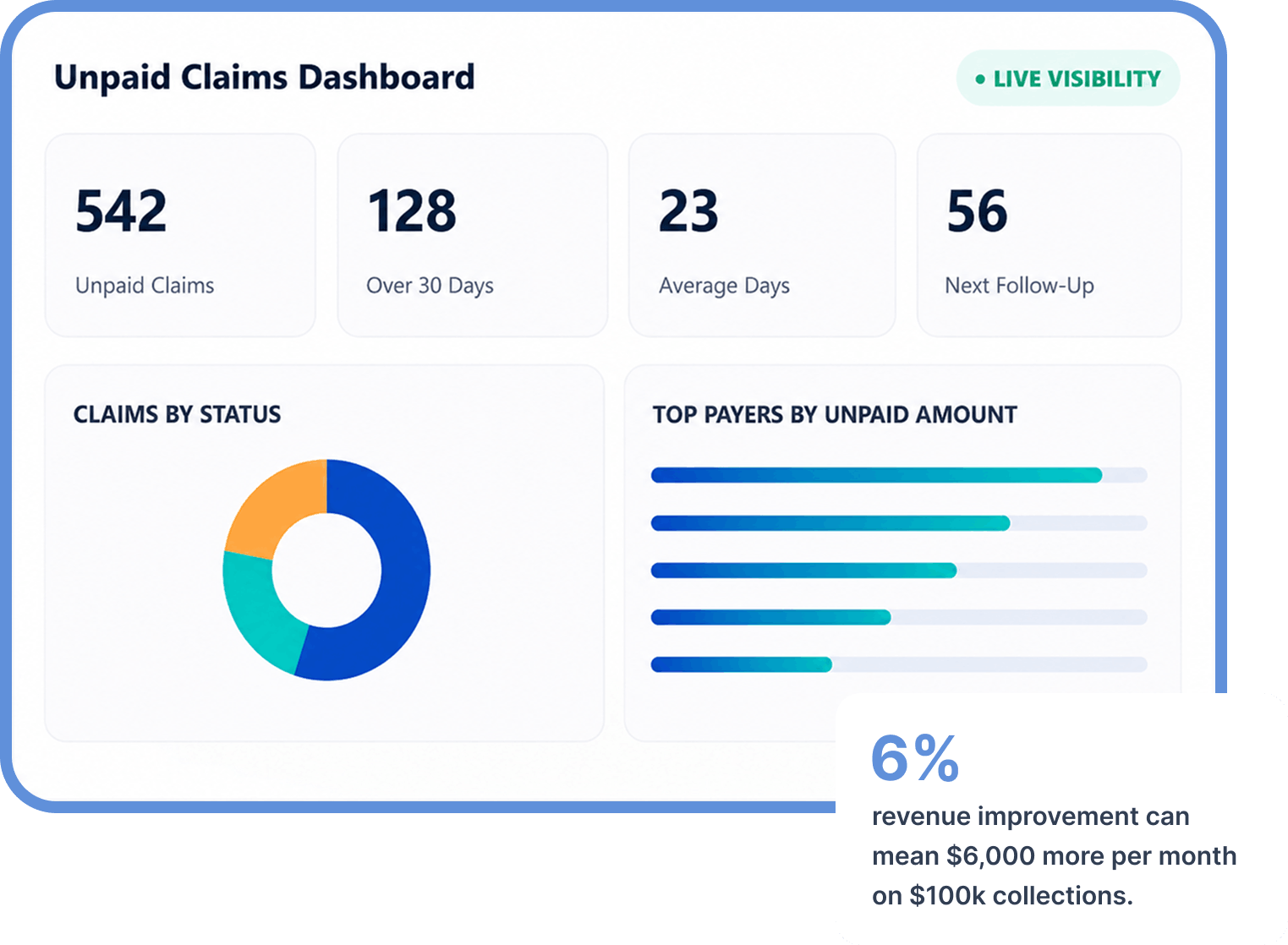
The Improvement in Claims Can Pay for DENmaar
any practices are already losing more money through preventable claim problems than they would spend fixing them.
For a practice collecting $100,000 per month
6% = +$6,000 / month
in realized insurance revenue
That improvement alone could offset the cost of DENmaar’s billing services.
- Behavioral health EHR software at no additional cost
- Claims Copilot
- Eligibility and insurance workflows
- Payment posting
- Rejection and denial management
- Aging-claim follow-up
- Reporting and management visibility
- Support from DENmaar’s Insurance Knowledge Team
Claim Lifecycle
Every Claim Has an Owner, a Status
and a Next Action
DENmaar creates a structured process for managing the entire claim lifecycle—from appointment readiness
through final payment.
01
Prevent Problems Before Submission
Eligibility, payer, authorization, credentialing and documentation issues are identified before they become rejected or denied claims.
02
Submit Clean Claims
Claims are reviewed for common errors and payer requirements before submission.
03
Monitor the Payer Lifecycle
Claims are tracked after submission so unresolved claims don’t quietly disappear into aging.
04
Assign the Next Action
Every problem claim has a clear status, responsible team member and required next step.
05
Document Every Follow-Up
Management can see when follow-up occurred, what the payer said and what must happen next.
06
Escalate Unresolved Claims
Claims receive additional attention before filing limits or appeal deadlines are missed.
07
Measure Performance
Monitor clean claims, rejections, denials and aging by payer, provider, location, service and responsible team member.
Management Visibility
Your Billing Operation Shouldn’t Be a
Black Box
Monthly reports tell you what has already happened. DENmaar provides visibility into
what is happening now.
Visibility creates accountability.
A practice should not have to wait until collections fall to discover that claims aren’t being worked effectively.
- Whether claims are being worked consistently
- Whether follow-up is producing results
- Why claims remain unpaid
- Whether the same errors keep recurring
- Where responsibility for the next action sits
- Which workflows or team members need support
- Which payers are causing the most problems
- How much revenue remains at risk
Visibility creates accountability.
Accountability creates action.
Action moves claims toward payment.
Improve the Team You Have—or Let DENmaar Manage the Process
Some practices already have an internal billing team but lack the technology, payer knowledge and management visibility required to oversee it. Others want an experienced partner to manage the entire revenue cycle.
OPTION 01
Claims Copilot for Your Existing Team
Give your billing staff the structured workflows, claim intelligence and accountability tools needed to manage unpaid claims more effectively. Management gains visibility without immediately replacing the internal team.
OPTION 02
Full Revenue Cycle Management
Let DENmaar manage claim creation and submission, rejection correction, payment posting, denial resolution, insurance follow-up, aging claims, payer escalation, patient balances and revenue-cycle reporting.
Either way, management gains control over the revenue cycle.
Behavioral Health Expertise
Built Specifically for Behavioral Health
Behavioral health billing requires more than generic claim submission.
Mental health therapy
Psychiatry and medication management
Substance-use treatment
Intensive outpatient and partial hospitalization programs
Community behavioral health
Multidisciplinary practices
Telehealth billing
Time and unit requirements
Rejections and denials
Built Specifically for Behavioral Health
- Behavioral health payer carve-outs
- Eligibility and benefit verification
- Prior authorizations
- Provider credentialing
- Therapy and psychiatric coding
- Same-day services
- Telehealth billing
- Missing or incomplete documentation
- Coordination of benefits
- Rejections and denials
- Aging insurance balances
Before Billing Begins
Problems Are Often Created Before Billing Begins
Many claim problems originate before the claim reaches the billing team.
An appointment may be scheduled with the wrong payer. Eligibility may not be verified. An authorization may be missing. Documentation may not support the code or units billed. A provider may not be enrolled correctly.
DENmaar connects scheduling, eligibility, authorizations, documentation and billing in one operational system.
This helps prevent bad claims—not merely work them after they fail.
Prevent the problem upstream.
01
Scheduling
Right payer • right workflow
02
Eligibility & Authorization
Verify before service
03
Documentation
Support code and units
03
Billing
Submit cleaner claims
More Than Billing
Technology, Insurance Expertise and
Human Follow-Through
Most billing companies provide reports. Most software companies provide tools. DENmaar combines:
Technology, Insurance Expertise and
Human Follow-Through
You get a system designed to improve the financial performance of your behavioral health practice.
Enterprise capability with small-practice simplicity.
- Behavioral health EHR technology
- Claims Copilot
- Revenue-cycle services
- Insurance knowledge
- Human payer follow-up
- Management visibility
- Operational accountability
Billing Review
See What Better Claims Performance Could Mean for Your Practice
If too many claims are rejected, denied, aging or simply unexplained, let’s look at the process together.
Current monthly insurance revenue
Baseline performance
Clean-claim rate
Rejection and denial rates
Claims over 30 days
Value of unpaid and aging claims
Follow-up process
Where accountability is breaking down
Let’s Determine Whether There Is Operational Alignment
We begin with a discussion focused on:
- Organizational structure
- Insurance workflows
- Operational goals
- Implementation fit
Request Information
Capterra, Software Advice And Get App 2023 / 25
Best Of Badges Awarded To DENmaar
2023 / 25 “Best of” badge winners = DENmaar Neuro has earned a well-deserved Best Value Badge.
See our reviews for our software being recognized as an impactful solution for your business.





Our Latest Blogs

Mental Health Billing vs Medical Billing
Mental health bills differ from medical bills because of changes in mental health care that are not found in primary or specialist care. Here’s how to handle it.
- Mental health bills differ from medical bills due to some of the variables included in the mental health treatment providers.
- For mental health bills, you should familiarize yourself with medical coding, verify patient insurance, and use the appropriate payer form.
- For best results, always check the benefits, store copies of crucial information, take notes when you talk to payers, and start the billing process as soon as possible.
- Mental health professionals look to improve their existing billing process or start accepting insurance and working directly with fee payers.
Mental health care patients usually have one common complaint: Many providers do not have health insurance, which can be expensive without insurance. As a mental health care provider, your approach may be different. You may not accept insurance because the mental health billing process is complex and frustrating.
However, this guide can assist you in understanding the mental health billing process. In addition, improved mental health billing structures come with more capacity for patients using insurance, which means more revenue.
How are mental health bills different from medical bills?
Mental health bills differ from medical bills in the following ways:
Pre-authorization: Payers must pre-authorize mental health services to patients before submitting medical claims. However, a 2019 report found that mental health visits are five times more likely to be out of network than primary or specialist services. Unfortunately, pre-authorization – even if requested promptly – is rare and complicates billing.
Front Office Staff: Medical practices usually consist of administrative staff handling billing and coding, leaving practitioners to focus solely on patient care. This system is less common in mental health care systems. These practices are usually sole proprietorships or small partnerships, meaning they do not have front office staff. Without additional staff, practitioners should handle the billing themselves.
Standardized billing procedures: While primary care physicians often perform the same tests and examinations on their patients, mental health practitioners provide a very diverse and customized service. The recurring nature of primary care means that medical bills are usually ready to go. The opposite is true for mental health care, making billing more complicated.
Creating an excellent standard: Standardizing primary care means that practitioners can easily combine multiple services into one perfect bill. On the other hand, the more diverse nature of mental health services makes it more challenging to create significant bills. The result is a longer and more difficult billing process.
How standardization affects mental health bills
Standardizing services provided is probably the most significant hurdle of the above factors in mental health care billing. Standardization issues arise from how these factors differ from primary or specialist care:
Session duration: Medical billing assumes approximately the same time for each patient – after all, regular blood tests and physical examinations take a long time. However, the duration of mental health sessions can vary greatly. For this reason, mental health billing codes vary based on session length, which is not heard in medical bills.
Daily or weekly service limits: In general, there are no primary or expert level restrictions on how often a patient can be treated. The same does not apply to mental health services. In hopes of standardizing mental health care bills, taxpayers set the maximum number of treatments a mental health patient can receive in a day or week. These artificial roofs can present billing challenges.
Therapeutic method: Cognitive behavioral therapy requires an entirely different CPT code than psychoanalysis. The result is more billing challenges.
The Bottom Line
The billing process can be frustrating and usually leaves a big sigh of relief compared to treating patients. And if you’re worried about not completing the process yourself, the billing features of DENmaar can be invaluable.
We have assisted many health care organizations in their mental health billing process, thus helping them concentrate on patient care. Call us today!

The only Physician Credentialing Process Checklist You’ll Need in 2022
Understanding the process of credentialing is simple. It is a process that entails the procurement and verification of information that ascertains whether or not a physician is capable of fulfilling his or her medical obligations. The process is fundamental for everyone involved with the healthcare industry. This includes the practitioners, nurses, and of course, the patients.
The credentialing process in itself, however, is burdensome, to say the least. A typical credentialing process can take 90 to 150 days to conclude. Hurdles like missing or incorrect information in the applications submitted can result in claim denials, which essentially means you’ll have to undergo the entire process all over again, costing you both valuable money and precious time.
That being said, you can’t simply ignore the process either. Credentialing is important for a variety of reasons.
- • It can help build patient trust
- • It lowers the risk of medical errors.
- • It helps medical organizations from losing revenue
- • It improves a practitioner’s reputation.
- • It can help you save costs
- • It protects healthcare organizations from future lawsuits.
Needless to say, the credentialing process is too valuable to pass. Yes, it can be uniquely frustrating to perform. However, we believe the following checklist can guide you competently for a smoother credentialing process.
So without much further, allow us to acquaint you with the only Physician credentialing process checklist you’ll need for a seamless experience.
Physician Credentialing Process Checklist
The very first thing to do when starting the credentialing process is to make sure you are always one step ahead. The way to ensure that is by starting as early as possible. With that out of the way, you can begin the process.
1. Submit the Pre-Application
It won’t take you time to notice or experience how tedious the credentialing process can be. To begin with, you will need to submit a pre-application based on the healthcare facility or insurance network you want to join. It is at this juncture in the process that insurance companies weed out applicants that are not eligible for credentialing.
This step involves a background check. You will be checked for:
- • Board Certifications
- • Criminal Records
- • Record of disciplinary action taken against you or your practice.
If any issues arise here, you will be asked to submit further information. If there aren’t any issues, then you move on to the next step.
2. Submitting the Applications
This step forms the actual meat of the process. You will be required to submit all information possible that vouch for your legitimacy as a healthcare provider. The most fundamental checklist will be as follows:
- • Transcripts and educational history
- • DEA registration
- • Board certification
- • Medical license
- • Continual malpractice coverage
- • Work history
- • Professional and personal reference
- • Explanation of gaps in work history
- • Personal immunization record
- • Personal health history
- • CAQH Enrollment
- • Hospital affiliation
All of the above information must be backed by solid documentation and relevant letters of recommendation.
3. Receipt Verification
Once the application is submitted, you might feel inclined to take a sigh of relief. However, it will be too early to do so. In fact, we recommend constant follow-ups via call and emails to confirm that your application has been received and is under review. The credentialing board may reach out to you for further information. If that does happen, we recommend submitting the information as quickly as possible. Make sure you have copies of all the documents submitted ready at a moment’s notice.
The above procedure entails the checklist for a traditional physician credentialing process. Medical practices may need to work with a new checklist to assist them in adding new providers. So if you are someone who runs a medical practice and wants to add a new provider to your staff, then the following checklist is for you.
Checklist for adding a new provider
- You will need to provide an updated CAQH profile with a new practice affiliation. Also, make sure the provider’s driving license and DEA are updated with the new state if the affiliation is different from their previous one.
- The group that will be adding the new provider will be required to supplement a list of payers that they are currently affiliated with. This will include Medicaid HMOs, worker’s compensation, Tricare, Medicare advantage, etc.
- Update your practice’s CAQH profile and supply tax companies with your Tax ID.
- You will be required to submit a new and updated malpractice policy and also update it in your CAQH profile.
- You will be required to provide the practice’s primary billing type. This information will be listed on your application with Tax ID.
- Mention Medicare’s PTAN that you plan to be included on. This information will be listed on the Medicare application of the new provider linked to your group.
- The following Documentation will be mandatory.
- • Professional State License
- • Board Certification
- • CAQH Login and Password
- • PECOS Login and Password
- • PLI Certification
- • Professional School Diploma
- • State Medicaid Login and Password
- • Current CV with precise beginning and end date
- • Hospital Admitting Privilege
- • Certification of completing internships, fellowships, etc.
The Bottom Line
Credentialing demands a plethora of information from practitioners. So much so that the whole process might feel a tad bit overwhelming. It also counts that all the information you do gather is complete and accurate. The consequences of failing to ensure that can be disastrous.
So if you are still confused about the process and have no idea what information to carry, then we suggest you give our physician credentialing specialists at DENmaar a call. We are at your service whenever you need us. We’ll assist you with the entire process as well, making sure you make it on a payer’s network without a hassle.
Contact us now to learn more.

Provider Re-credentialing – Explained
You would be wrong to assume that the credentialing process is over once a provider has been accepted into a payer’s network. In fact, providers are required to undergo routine screening and license verification to maintain compliance and provide quality care to their patients. This process that involves periodic screening and verification is what we call recredentialing.
Recredentialing process is done to verify the training and qualifications of a provider and notify healthcare organizations if fraud or abuse is found. Now it is no secret that undertaking the credentialing process is no easy task. It can be time-consuming and burdensome. However, the cost of neglecting the procedure can be much direr.
Hospitals and similar healthcare organizations are staring at revenue losses in the upwards of millions on litigation, delayed payments, and civil monetary penalties without recredentialing.
Now that you know how important the process of recredentialing is, we will take a deep dive into the subject to make sure you learn everything there is to know about it.
So without much further ado, let’s get started.
Read More on Importance of Medical Credentialing
How Many Time Does a Provider Need to Be Recredentialed?
The answer to this question will vary from state to state. In most American states, the provider must be credentialed immediately when hired. Later, they must undergo re-credentialing every two years. There are exceptions to this rule, however, as some states like Illinois require providers to be recredentialed every three years.
To know exactly how often a provider needs to be recredentialed, it would be wise to check state laws and regulations that apply to your healthcare organization.
The Initial Requirements for Recredentialing
First and foremost, it is the responsibility of the healthcare organization to notify the doctors and nurses working under them at least 60 days before the recredentialing due date. Providers should be given access to all applications online. Remember, the recredentialing process varies from state to state and can take months to conclude.
To expedite the process, we recommend keeping the necessary documentation on file. We also suggest preparing organization-specific requirements well ahead of time. If the process is too overwhelming to handle, we recommend you give us at DENmaar a call and our credentialing specialists will be happy to shoulder the recredentialing process on your behalf.
Information Verified During Recredentialing
A traditional recredentialing process will entail the verification of the following documents:
- • Drug Enforcement Administration or Controlled Dangerous Substances Certification
- • State Licenses
- • Board Certification
- • Malpractice Claims History
- • Work History
- • Recent Malpractice Insurance Coverage
- • Medicare and Medicaid Sanctions
- • National Provider Identifier Number (NPI)
- • State Sanctions and Restrictions on Licensure and Limitations on Scope of Practice.
What Happens When an Application is denied?
A provider is notified with a written notice that includes the reason for denial in case their application is rejected by the credentialing committee. Providers have the right to submit an appeal contesting the denial. The provider must request reconsideration in writing within 30 days of receiving a denial.
The written request must be submitted along with the necessary documents. The reconsideration will be scheduled within 60 days. Remember, the provider has no further option if his or her claim is denied a second time.
Learn More on How to Avoid Payer Rejection During Enrollment
Getting Recredentialed Without a Hassle
Issues with recredentialing are more common than you would assume. That being said, there are ways by which you can make sure those issues never arise during your procedure. To begin with, healthcare organizations should maintain evidence of a provider’s application in a secure credentials file. They should also adopt a system that keeps all relevant information current.
However, the only guaranteed way to make sure you don’t fail with recredentialing is to seek help from credentialing specialists in the industry like DENmaar. DENmaar has been helping healthcare organizations across the United States with credentialing provider enrollment for decades now. As such, we have the talent, resources, and insight needed to handle the complex process of credentialing at the behest of your healthcare organization.
You can get in touch with us now to learn more about DENmaar’s recredentialing services.
Our Partners






Ready to get started?
Feel free to reach out if you have any questions.
