

We don’t just submit claims. We create visibility and accountability around every unpaid claim—so management knows what’s being worked, what’s stuck, and why.
Know What’s Happening With Every Unpaid Claim
Behavioral health billing with complete visibility and accountability

98.1%
Clean Claim Rate
1.47%
Rejection Rate
0.32%
Denial Rate
5–10%
Denial Rate
10–20%
Average Revenue
Improvement
$0
EHR Software Fee
With Billing Services
With Billing Services
CLAIMS VISIBILITY
Your Claims May Be Getting
Submitted. But Are They Getting Paid?
Submitting a claim is only the beginning.
Your Claims May Be Getting
Submitted. But Are They Getting Paid?
Revenue is lost when rejected claims aren’t corrected, denials aren’t resolved, authorizations expire, payer requests go unanswered, and unpaid claims disappear into spreadsheets and work queues.
DENmaar gives behavioral health practices a clear view of:
- Which claims remain unpaid
- Why each claim is stuck
- What action has been taken
- Who is responsible for the next step
- When follow-up is due
- What the payer said during the last follow-up
- Which payers and problems are creating the most lost revenue
You no longer have to accept, “We’re working on it.”
You can see exactly what is being worked, what happened and what comes next.
The Improvement in Claims Can Pay for DENmaar
any practices are already losing more money through preventable claim problems than they would spend fixing them.
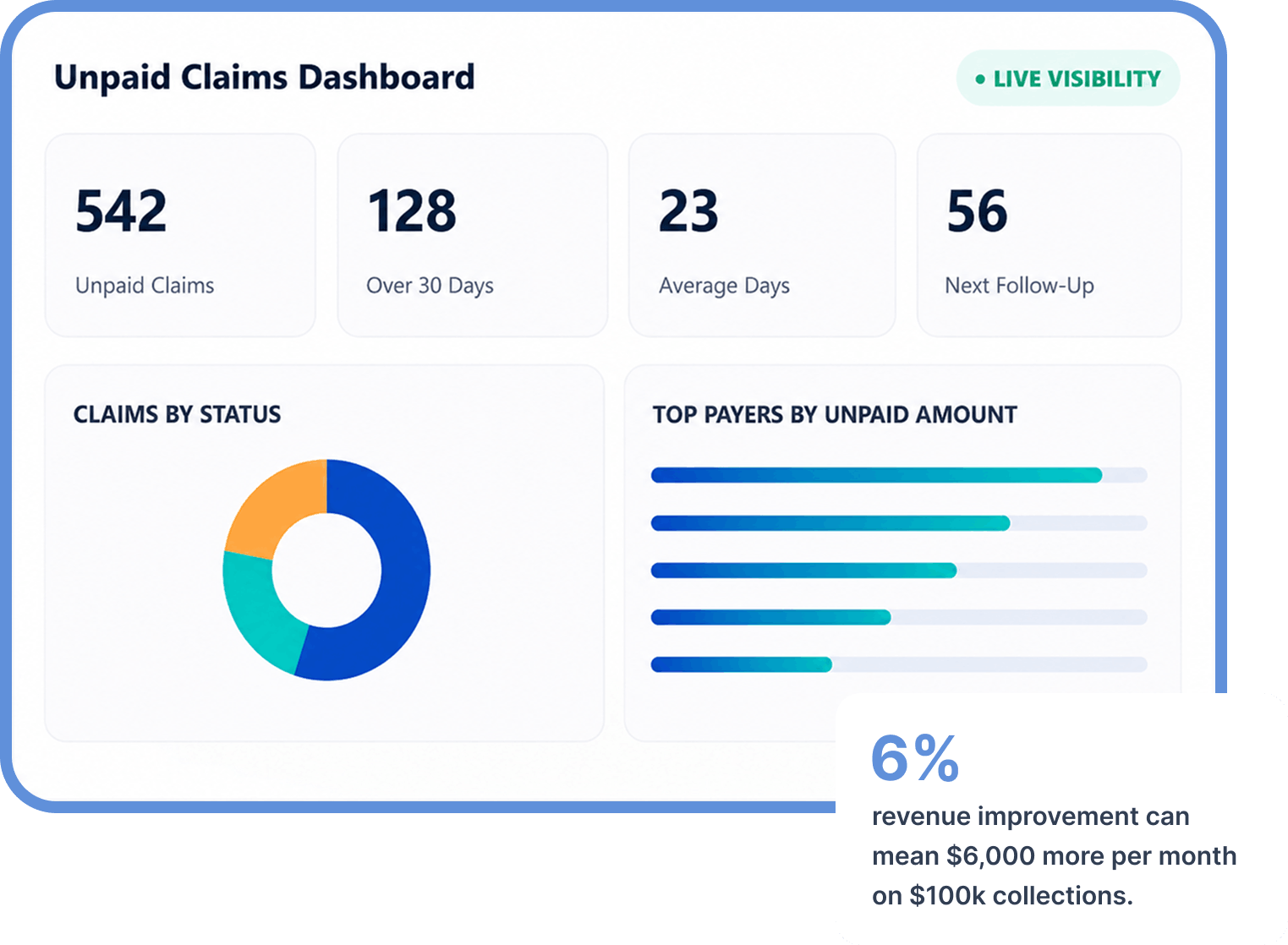
For a practice collecting $100,000 per month
6% = +$6,000 / month
in realized insurance revenue
That improvement alone could offset the cost of DENmaar’s billing services.
- Behavioral health EHR software at no additional cost
- Claims Copilot
- Eligibility and insurance workflows
- Payment posting
- Rejection and denial management
- Aging-claim follow-up
- Reporting and management visibility
- Support from DENmaar’s Insurance Knowledge Team
Claim Lifecycle
Every Claim Has an Owner, a Status
and a Next Action
DENmaar creates a structured process for managing the entire claim lifecycle—from appointment readiness
through final payment.
01
Prevent Problems Before Submission
Eligibility, payer, authorization, credentialing and documentation issues are identified before they become rejected or denied claims.
02
Submit Clean Claims
Claims are reviewed for common errors and payer requirements before submission.
03
Monitor the Payer Lifecycle
Claims are tracked after submission so unresolved claims don’t quietly disappear into aging.
04
Assign the Next Action
Every problem claim has a clear status, responsible team member and required next step.
05
Document Every Follow-Up
Management can see when follow-up occurred, what the payer said and what must happen next.
06
Escalate Unresolved Claims
Claims receive additional attention before filing limits or appeal deadlines are missed.
07
Measure Performance
Monitor clean claims, rejections, denials and aging by payer, provider, location, service and responsible team member.
Management Visibility
Your Billing Operation Shouldn’t Be a
Black Box
Monthly reports tell you what has already happened. DENmaar provides visibility into
what is happening now.
Visibility creates accountability.
A practice should not have to wait until collections fall to discover that claims aren’t being worked effectively.
- Whether claims are being worked consistently
- Whether follow-up is producing results
- Why claims remain unpaid
- Whether the same errors keep recurring
- Where responsibility for the next action sits
- Which workflows or team members need support
- Which payers are causing the most problems
- How much revenue remains at risk
Visibility creates accountability.
Accountability creates action.
Action moves claims toward payment.
Improve the Team You Have—or Let DENmaar Manage the Process
Some practices already have an internal billing team but lack the technology, payer knowledge and management visibility required to oversee it. Others want an experienced partner to manage the entire revenue cycle.
OPTION 01
Claims Copilot for Your Existing Team
Give your billing staff the structured workflows, claim intelligence and accountability tools needed to manage unpaid claims more effectively. Management gains visibility without immediately replacing the internal team.
OPTION 02
Full Revenue Cycle Management
Let DENmaar manage claim creation and submission, rejection correction, payment posting, denial resolution, insurance follow-up, aging claims, payer escalation, patient balances and revenue-cycle reporting.
Either way, management gains control over the revenue cycle.
Behavioral Health Expertise
Built Specifically for Behavioral Health
Behavioral health billing requires more than generic claim submission.
Mental health therapy
Psychiatry and medication management
Substance-use treatment
Intensive outpatient and partial hospitalization programs
Community behavioral health
Multidisciplinary practices
Telehealth billing
Time and unit requirements
Rejections and denials
Built Specifically for Behavioral Health
- Behavioral health payer carve-outs
- Eligibility and benefit verification
- Prior authorizations
- Provider credentialing
- Therapy and psychiatric coding
- Same-day services
- Telehealth billing
- Missing or incomplete documentation
- Coordination of benefits
- Rejections and denials
- Aging insurance balances
Before Billing Begins
Problems Are Often Created Before Billing Begins
Many claim problems originate before the claim reaches the billing team.
An appointment may be scheduled with the wrong payer. Eligibility may not be verified. An authorization may be missing. Documentation may not support the code or units billed. A provider may not be enrolled correctly.
DENmaar connects scheduling, eligibility, authorizations, documentation and billing in one operational system.
This helps prevent bad claims—not merely work them after they fail.
Prevent the problem upstream.
01
Scheduling
Right payer • right workflow
02
Eligibility & Authorization
Verify before service
03
Documentation
Support code and units
03
Billing
Submit cleaner claims
More Than Billing
Technology, Insurance Expertise and
Human Follow-Through
Most billing companies provide reports. Most software companies provide tools. DENmaar combines:
Technology, Insurance Expertise and
Human Follow-Through
You get a system designed to improve the financial performance of your behavioral health practice.
Enterprise capability with small-practice simplicity.
- Behavioral health EHR technology
- Claims Copilot
- Revenue-cycle services
- Insurance knowledge
- Human payer follow-up
- Management visibility
- Operational accountability
Billing Review
See What Better Claims Performance Could Mean for Your Practice
If too many claims are rejected, denied, aging or simply unexplained, let’s look at the process together.
Current monthly insurance revenue
Baseline performance
Clean-claim rate
Rejection and denial rates
Claims over 30 days
Value of unpaid and aging claims
Follow-up process
Where accountability is breaking down
Let’s Determine Whether There Is Operational Alignment
We begin with a discussion focused on:
- Organizational structure
- Insurance workflows
- Operational goals
- Implementation fit
Request Information
Capterra, Software Advice And Get App 2023 / 25
Best Of Badges Awarded To DENmaar
2023 / 25 “Best of” badge winners = DENmaar Neuro has earned a well-deserved Best Value Badge.
See our reviews for our software being recognized as an impactful solution for your business.





Our Latest Blogs
Filling Up Your CAQH Profile without Issues
Getting on insurance panels requires one very crucial step. We are of course talking about CAQH registration. A provider needs to complete his CAQH profile to even entertain the idea of getting onto an insurance panel.
CAQH aka council of affordable quality healthcare is a program that allows insurance companies to use a single application system for all kinds of credentialing. Today, over 900 clinics, health plans and healthcare organization are estimated to be using it. They require a practitioner to complete their CAQH profile by filling up the CAQH attestation form mandatorily in order to submit their application.
The process although very simple in its premise, can be a little confounding for some to follow. That’s why we have decided to guide you through the entire process to avoid any room for doubts, so you can have a hassle free credentialing experience.
1 – Getting a CAQH Number
Many start their credentialing process before even approaching the CAQH profile. Chances are high that your insurance company is already using CAQH. You can check the list of participating organizations on the CAQH website to confirm this. If a particular company is using CAQH, then they send you a CAQH id number, probably in a letter via mail. You should wait for at least 2 weeks to ensure your application is received by the panel. If you still don’t receive it, then it’s time to give your insurance company a call.
Alternatively, you can choose to register yourself on the CAQH website. As such, you will receive your CAQH number via email. Do not lose this number as you will need it throughout the credentialing process. You need it to fill up your application and re-attest your information.
2 – Have all your information ready
The CAQH process is tedious and time consuming. Nobody expects you to finish it in one sitting as it can literally remove hours from your life. One way to speed up the process however is to make sure you have all the information and material you will need for processing ready.
Here’s a list of all the things you’ll need before you start filling up the CAQH attestation form
- • Personal information
- • Education and training information’
- • Practice location information with certification, address, contact detail, practice type etc. mentioned
- • Board certification
- • Disclosure of malpractice history
- • Malpractice insurance information
- • Work history
And the materials you’ll need are as follows
- • Resume
- • State licenses
- • Malpractice insurance policy
- • UPIN, NPI and other ID numbers
- • DEA certificate (if necessary)
- • CDS certificate (if necessary)
Make sure all your information is accurate. Your resume should be formatted with the correct date format, which is MM/YYYY, and there should be no gaps in employment. Failure to abide by any of the above requirements can lead to the rejection of your application. So do not rush into your application. Take your time to make sure everything is in order. Remember, errors can cost you way more time and money. Finally, you need to have scanned copies of all the required material in handy as you will be required to upload it.
3 – Start Working on Your Profile
Once you have all the information you need, it’s time to start completing your CAQH profile. We recommend you only undertake this task online. Doing this physically means tackling a dozen pages long application form that only prints correctly in color and cannot be transferred conveniently without a data entry professional to assist you.
Like we said before, you simply cannot complete the profile in one sitting. So take your time, save your progress and continue later. Once you’ve finished the profile click ‘next’. The website will ask you to verify your information once and ask you to attest whether all the information you provided is accurate.
Once you attest, you will receive a message that your profile is complete. Once you’re done, you have a choice to make. You need to make a decision as to who gets to access your profile, whether you will allow any insurance company that exhibits interest in having you on your panel, or choose manually which insurance company gets to see your profile and which company doesn’t.
In our opinion, the first option is the best as it will open you to more possibilities of being invited on multiple insurance panels. Make sure to never lose your application information as you will be required re-attest to the information once in a while, or on a quarterly basis. Respond to the request to re-attestation quickly as not doing so can result in insurance companies refusing to pay your claims.

The Rising Popularity of Telemental Health Services in Modern Times
What constitutes the best medical billing software for mental health services? Is it an excellent user interface? Or Is it the ability to perform all tasks like scheduling, appointment booking, tracking payments, and billing automatically? Ask this question to a mental health practitioner, and the answer would be all of the above.
And why not? Why not have software that is not only easy to use but also relieves doctors and practitioners from the hassles of everyday billing and payments.
Keeping this frustration in mind, DENmaar set on a journey to bring the mental health industry a medical billing software that would work to rid mental health practitioners of their payment-related hassles. Our billing software comes with an easy to comprehend user interface that would fit right in with your daily medical choirs.
With a hard-earned reputation, DENmaar specializes in professional and facility billing for insurance claims and patient responsibility. Our clients receive our RCM and Mobile apps to easily create charges, which we later submit to insurance and bill patients. All associated expenses are included when used with our insurance billing services.
DENmaar’s fully automated and highly advanced software was developed to bring our clients the benefits of both professional and institutional billing. State of the art insurance claims processing will keep organizations and providers ahead of the game with automated eligibility verification, claims status updates, claims rejections and denial resolution processes.
Our system also allows for the tracking of your claim status. If due to some unfortunate circumstances, your claim does get rejected and denied, then our experts are at your service to take the necessary actions needed for the approval of your claim.
What makes DENmaar’s Medical Billing Software Special.
Improved Patient Payment System
DENpay is HiPAA compliant and integrates a Virtual Terminal within our RCM to create a conveniently seamless way for patients to make their payments. For providers, it automates the entire payment tracking system and reconciling patient payments. Patients can safely store credit cards and balances automatically billed. Other payment options include emailing a blind statement requesting payment or making a payment with our patient apps. Statements may also be mailed by clicking a button, no printing or stuffing envelopes. How much does this patient payment system cost our clients? $0 It is included as a complimentary feature when using our insurance billing services.
Claim Issues Resolved
Claims which have been denied and rejected are immediately followed up on by DENmaar’s team. We leave no room for such claim issues to occur. Each account has a dedicated Claims Resolution Specialist, a Credentialing Specialist, and an Onboarding Specialist to handle adding insurance panels for billing. That is why DENmaar has a very high first-time claim submission pass through. Payments come in a timely. This allows for cash flows to be maximized, thus making an organization witness its highest revenue generation period.
Staff Claim Tools
All of our software modules, provider and patient apps include Intake and Assessment forms, Telehealth, Electronic Prescription and EMR, Scheduling, Eligibility Verification. Service accounts may use any or all of our features, we provide it as a complimentary product. Our system is cloud based, making transitioning to our platform a breeze.
Choosing DENmaar
DENmaar has been working in the behavioral health industry since 2008 and understands the challenges of a practitioner engaged in within the specialty. Our medical billing software was designed and constructed keeping mental health medical billing in mind. By utilizing our own proprietary RCM system for claims processing we ensure continual advancement in this important financial area. The additional clinical tool for both therapists and medical doctors is a unique feature not typically found in a therapy notes product. We believe we are positioned well now and in the future and would like to take hard working mental health providers with us as we work together to serve the needs of an increasingly needed medical service.

How to Set Up Patient Payment Centers to Handle Self Pay Patients
Even as the Affordable Cares Act gains momentum, many Americans still don’t have access to health insurance. There can be a number of reasons for such a plight. It can be because patients simply cannot afford to purchase health insurance, or they simply fall through the cracks because of residing in states like Florida who didn’t expand on their existing healthcare plan.
As such, self-pay patients are becoming more common. However, many can’t find themselves proper care as practitioners are still reluctant in accepting self-pay patients or don’t have patient payment centers that undertake such practice. So to encourage doctors to accept more patients of such nature, we are going to explore some tips and tricks that can help doctors accept self-pay patients with ease.
But first, let’s understand the reason behind the reluctance of so many doctors in accepting self-pay patients.
The Issues with Self Pay
It is estimated that approximately 81 percent of revenue collected from patients is never really recovered when it is self-paid. Add to this woes, almost 30 percent of patients are said to default on their bills.
Keeping these figures in mind, it is not difficult to understand why doctors are reluctant. Enabling Self-pay sure seems like a recipe for disaster for the functioning of any healthcare organization. However, there are effective ways to ensure there is a perfect patient payment plan in place to avoid the above scenarios of loss.
Establishing an Efficient Policy
Before accepting self-pay patients, it is highly imperative to have some formal payment policies in place. This will protect doctors from losses and payment defaulters. There are 4 factors that must be considered while establishing this policy.
1 – Insurance Co-pays
Set up the office to accept both cash and credit payments, as patients are responsible to fulfill their own co-pays anyways.
2 – Referrals
Referrals are required by insurance companies to recommend patients with specialists they should visit. It forms a big aspect of the primary care providers business.
3 – Payment Responsibility
Providers should set up convenient patient payment centers to allow patients with as much convenience as possible in making payments. Introduce the option of online bill payment to ensure bills are paid on time.
4 – Past Payments
Have a policy to ensure collection of past dues, not a single outstanding payment should be allowed to slip through the cracks.
Creating a formal payment policy will ensure each of these 4 problems are taken care of efficiently. The payment policy should be available on your practice’s website or in print hanging in your practice premises wherever it is visible to your visitors.
Does your Self Pay Patient have hidden healthcare coverage?
Many self-pay patients are opting to pay from their own pockets because they don’t have healthcare coverage. Check their records thoroughly for any past healthcare benefits they can exploit. Also, most self-pay patients do not remain the same as time progresses. They might opt for a health insurance program because they could probably afford healthcare now.
Implement a comprehensive healthcare insurance checklist to ensure a patient isn’t paying more than what he is required to, and that you as a provider are getting paid correctly and on time.
The Bottom Line
As you can tell by now, self-pay patients enjoy a bad reputation in the healthcare industry. However, they are also humans and in need of health care. Care providers can ensure flexible payment options, and clearly communicated payment policies to ensure patients receive the care they need, and providers get paid for the services rendered. Providers can state in their policies that payment is due when services are rendered, thus automatically setting a deadline for payment of dues.
Our Partners






Ready to get started?
Feel free to reach out if you have any questions.
