

We don’t just submit claims. We create visibility and accountability around every unpaid claim—so management knows what’s being worked, what’s stuck, and why.
Know What’s Happening With Every Unpaid Claim
Behavioral health billing with complete visibility and accountability

98.1%
Clean Claim Rate
1.47%
Rejection Rate
0.32%
Denial Rate
5–10%
Denial Rate
10–20%
Average Revenue
Improvement
$0
EHR Software Fee
With Billing Services
With Billing Services
CLAIMS VISIBILITY
Your Claims May Be Getting
Submitted. But Are They Getting Paid?
Submitting a claim is only the beginning.
Your Claims May Be Getting
Submitted. But Are They Getting Paid?
Revenue is lost when rejected claims aren’t corrected, denials aren’t resolved, authorizations expire, payer requests go unanswered, and unpaid claims disappear into spreadsheets and work queues.
DENmaar gives behavioral health practices a clear view of:
- Which claims remain unpaid
- Why each claim is stuck
- What action has been taken
- Who is responsible for the next step
- When follow-up is due
- What the payer said during the last follow-up
- Which payers and problems are creating the most lost revenue
You no longer have to accept, “We’re working on it.”
You can see exactly what is being worked, what happened and what comes next.
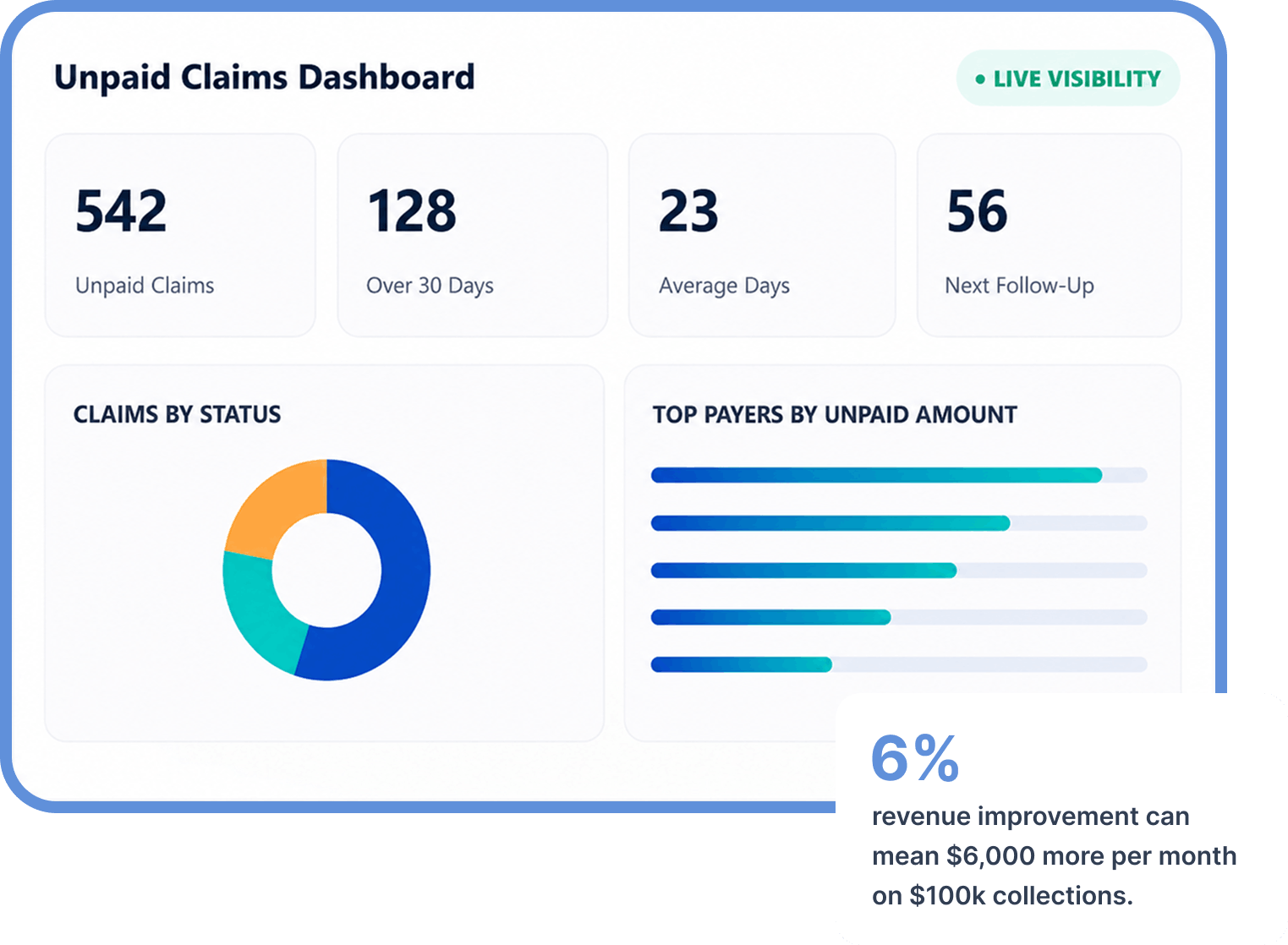
The Improvement in Claims Can Pay for DENmaar
any practices are already losing more money through preventable claim problems than they would spend fixing them.
For a practice collecting $100,000 per month
6% = +$6,000 / month
in realized insurance revenue
That improvement alone could offset the cost of DENmaar’s billing services.
- Behavioral health EHR software at no additional cost
- Claims Copilot
- Eligibility and insurance workflows
- Payment posting
- Rejection and denial management
- Aging-claim follow-up
- Reporting and management visibility
- Support from DENmaar’s Insurance Knowledge Team
Claim Lifecycle
Every Claim Has an Owner, a Status
and a Next Action
DENmaar creates a structured process for managing the entire claim lifecycle—from appointment readiness
through final payment.
01
Prevent Problems Before Submission
Eligibility, payer, authorization, credentialing and documentation issues are identified before they become rejected or denied claims.
02
Submit Clean Claims
Claims are reviewed for common errors and payer requirements before submission.
03
Monitor the Payer Lifecycle
Claims are tracked after submission so unresolved claims don’t quietly disappear into aging.
04
Assign the Next Action
Every problem claim has a clear status, responsible team member and required next step.
05
Document Every Follow-Up
Management can see when follow-up occurred, what the payer said and what must happen next.
06
Escalate Unresolved Claims
Claims receive additional attention before filing limits or appeal deadlines are missed.
07
Measure Performance
Monitor clean claims, rejections, denials and aging by payer, provider, location, service and responsible team member.
Management Visibility
Your Billing Operation Shouldn’t Be a
Black Box
Monthly reports tell you what has already happened. DENmaar provides visibility into
what is happening now.
Visibility creates accountability.
A practice should not have to wait until collections fall to discover that claims aren’t being worked effectively.
- Whether claims are being worked consistently
- Whether follow-up is producing results
- Why claims remain unpaid
- Whether the same errors keep recurring
- Where responsibility for the next action sits
- Which workflows or team members need support
- Which payers are causing the most problems
- How much revenue remains at risk
Visibility creates accountability.
Accountability creates action.
Action moves claims toward payment.
Improve the Team You Have—or Let DENmaar Manage the Process
Some practices already have an internal billing team but lack the technology, payer knowledge and management visibility required to oversee it. Others want an experienced partner to manage the entire revenue cycle.
OPTION 01
Claims Copilot for Your Existing Team
Give your billing staff the structured workflows, claim intelligence and accountability tools needed to manage unpaid claims more effectively. Management gains visibility without immediately replacing the internal team.
OPTION 02
Full Revenue Cycle Management
Let DENmaar manage claim creation and submission, rejection correction, payment posting, denial resolution, insurance follow-up, aging claims, payer escalation, patient balances and revenue-cycle reporting.
Either way, management gains control over the revenue cycle.
Behavioral Health Expertise
Built Specifically for Behavioral Health
Behavioral health billing requires more than generic claim submission.
Mental health therapy
Psychiatry and medication management
Substance-use treatment
Intensive outpatient and partial hospitalization programs
Community behavioral health
Multidisciplinary practices
Telehealth billing
Time and unit requirements
Rejections and denials
Built Specifically for Behavioral Health
- Behavioral health payer carve-outs
- Eligibility and benefit verification
- Prior authorizations
- Provider credentialing
- Therapy and psychiatric coding
- Same-day services
- Telehealth billing
- Missing or incomplete documentation
- Coordination of benefits
- Rejections and denials
- Aging insurance balances
Before Billing Begins
Problems Are Often Created Before Billing Begins
Many claim problems originate before the claim reaches the billing team.
An appointment may be scheduled with the wrong payer. Eligibility may not be verified. An authorization may be missing. Documentation may not support the code or units billed. A provider may not be enrolled correctly.
DENmaar connects scheduling, eligibility, authorizations, documentation and billing in one operational system.
This helps prevent bad claims—not merely work them after they fail.
Prevent the problem upstream.
01
Scheduling
Right payer • right workflow
02
Eligibility & Authorization
Verify before service
03
Documentation
Support code and units
03
Billing
Submit cleaner claims
More Than Billing
Technology, Insurance Expertise and
Human Follow-Through
Most billing companies provide reports. Most software companies provide tools. DENmaar combines:
Technology, Insurance Expertise and
Human Follow-Through
You get a system designed to improve the financial performance of your behavioral health practice.
Enterprise capability with small-practice simplicity.
- Behavioral health EHR technology
- Claims Copilot
- Revenue-cycle services
- Insurance knowledge
- Human payer follow-up
- Management visibility
- Operational accountability
Billing Review
See What Better Claims Performance Could Mean for Your Practice
If too many claims are rejected, denied, aging or simply unexplained, let’s look at the process together.
Current monthly insurance revenue
Baseline performance
Clean-claim rate
Rejection and denial rates
Claims over 30 days
Value of unpaid and aging claims
Follow-up process
Where accountability is breaking down
Let’s Determine Whether There Is Operational Alignment
We begin with a discussion focused on:
- Organizational structure
- Insurance workflows
- Operational goals
- Implementation fit
Request Information
Capterra, Software Advice And Get App 2023 / 25
Best Of Badges Awarded To DENmaar
2023 / 25 “Best of” badge winners = DENmaar Neuro has earned a well-deserved Best Value Badge.
See our reviews for our software being recognized as an impactful solution for your business.





Our Latest Blogs
Expansion of Telehealth to Make it Part of The Permanent Workflow by CIOS
Telehealth has rapidly evolved from a temporary healthcare solution into a permanent part of modern healthcare delivery. During the COVID 19 pandemic, hospitals and healthcare systems implemented telemedicine technologies to maintain patient care while reducing in person interactions.
Today, healthcare organizations are no longer treating telehealth as a short term solution. Instead, hospitals, healthcare providers, and Chief Information Officers (CIOs) are integrating virtual care into long term operational workflows to improve patient access, streamline communication, and increase healthcare efficiency.
The Growing Importance of Telehealth in Healthcare
Telehealth has transformed how healthcare providers deliver medical services. From virtual consultations to remote patient monitoring, healthcare systems are now combining in person and virtual care to create a more connected patient experience.
Healthcare organizations are investing in scalable telemedicine technologies that support long term digital healthcare strategies and improve operational efficiency.
Why Hospitals Are Integrating Telehealth Into Permanent Workflows
Improved Patient Accessibility
Telehealth allows patients to connect with healthcare providers remotely, reducing travel time and improving access to care for rural and underserved communities.
Better Patient Engagement
Integrated telehealth platforms create a seamless digital experience that improves communication between patients and providers throughout the care journey.
Increased Operational Efficiency
Virtual care solutions help hospitals reduce administrative burdens, improve scheduling workflows, and optimize resource management.
Enhanced Care Coordination
Unified telehealth systems allow healthcare teams to collaborate more effectively by combining messaging, video appointments, patient records, and scheduling into a single platform.
Financial and Operational Benefits
Healthcare organizations adopting telehealth technologies often experience improved patient satisfaction, stronger brand reputation, and increased efficiency in care delivery.
The Role of CIOs in Telehealth Expansion
Chief Information Officers and healthcare IT leaders are responsible for integrating telehealth technologies across healthcare systems while ensuring compliance, security, and workflow efficiency.
Their focus includes:
- Implementing secure telemedicine platforms
- Integrating telehealth with existing EHR systems
- Improving digital patient experiences
- Streamlining provider workflows
- Expanding virtual care capabilities across departments
Healthcare leaders are increasingly viewing telehealth as an essential component of enterprise healthcare operations.
Embedding Telehealth Into Everyday Healthcare Operations
Modern healthcare systems are integrating telehealth directly into clinical workflows to improve care coordination and simplify administrative processes.
A unified telehealth platform allows healthcare providers to:
- Access patient records quickly
- Conduct secure video consultations
- Manage virtual appointments efficiently
- Improve communication between healthcare teams
- Reduce the need for multiple software systems
Virtual Patient Care Inside Hospitals
Telehealth technology is no longer limited to remote appointments. Hospitals are now using virtual care systems inside patient rooms to improve efficiency and patient engagement.
Virtual Nursing Units
Virtual nursing technology allows healthcare providers to complete non bedside tasks remotely, including:
- Patient education
- Medication reviews
- Documentation support
- Discharge coordination
This approach helps bedside nurses focus more on direct patient care while reducing administrative workload.
In Room Virtual Communication
Telehealth systems installed in patient rooms allow social workers, family members, and healthcare providers to communicate safely and efficiently with patients during hospital stays.
This improves patient satisfaction and supports collaborative care delivery.
Benefits of Unified Telehealth Platforms
Healthcare organizations are moving toward centralized telehealth systems that combine multiple functions into one secure platform.
Benefits include:
- Fewer software logins and administrative steps
- Better patient data accessibility
- Improved provider collaboration
- Faster communication between departments
- Streamlined patient care workflows
Learn how our EHR and EMR solutions support integrated telehealth workflows and healthcare efficiency
Why HIPAA Compliant Telehealth Matters
Security and compliance are critical when implementing telemedicine technology. Healthcare organizations must use HIPAA compliant telehealth platforms to protect patient information and maintain healthcare privacy standards.
Secure telehealth systems ensure safe communication, encrypted patient data, and reliable virtual care delivery.
The Future of Telehealth in Healthcare
Telehealth, telemedicine, and virtual nursing are reshaping the future of healthcare delivery. As healthcare systems continue investing in digital transformation, virtual care will remain a permanent and essential part of patient care strategies.
Healthcare organizations that adopt integrated telehealth technologies today will be better positioned to improve patient outcomes, increase efficiency, and support long term healthcare innovation.
Frequently Asked Questions
What is telehealth in healthcare?
Telehealth is the use of digital communication technologies such as video calls and remote monitoring tools to deliver healthcare services virtually.
Why are hospitals integrating telehealth into permanent workflows?
Hospitals are integrating telehealth to improve patient access, streamline operations, enhance care coordination, and increase healthcare efficiency.
What role do CIOs play in telehealth expansion?
CIOs manage the implementation, integration, security, and optimization of telehealth systems within healthcare organizations.
What are virtual nursing units?
Virtual nursing units use telehealth technology to support non bedside nursing tasks such as patient education, documentation, and discharge coordination.
Why is HIPAA compliance important in telehealth?
HIPAA compliance protects patient privacy and ensures secure communication between healthcare providers and patients during virtual care sessions.

5 Credentialing Issues in Healthcare & Their Resolutions
Credentialing issues in healthcare are extremely common. In fact, the process of provider credentialing has to be a prominent compliance issue for medical practices. It is quite normal for providers to have their applications rejected due to omissions and errors. The consequences can be considerably more disastrous without proper data insight and process oversight.
Table of Contents
- 1. 5 Common Credentialing Issues
- 2. Overcoming Issues with Healthcare Credentialing
- 3. We recommend verifying your state’s guidelines for:
- 4. The Bottom Line
Now, mistakes happen in any process. However, the mistakes in credentialing can be especially punishing. For instance, credentialing issues for nurse practitioners can cost a nurse their career. Moreover, mistakes in credentialing can cost healthcare organizations their hard-earned reputation. Suffice to say, no one can afford the legal and financial complications that follow a poorly executed credentialing process.
In this article, we would like to shine a light on some of the most common challenges with the medical credentialing system. We hope that being aware of these challenges will make you better equipped to tackle them.
5 Common Credentialing Issues
1. Keeping Information Up-To-Date
Many healthcare organizations struggle to access relevant applicant information. It is estimated that around 85% of submitted applications suffer from inaccurate, missing, or irrelevant information. It is mandatory to re-attest even minor changes like changes to address and phone number in the CAQH database.
Missing information or outdated details can quickly derail the already complicated and time-consuming credentialing process. The issue becomes even direr when you consider how frequently individual practitioners change the healthcare institutions they work for. Healthcare organizations must keep pace with the changes as they occur to avoid issues during the process.
2. Time-Consuming
It is no secret that the medical credentialing process is a time-consuming one. An application review can take around 90 days to complete. When you consider the involvement of additional stakeholders like contract negotiators and insurance companies, the process can easily go as long as six months. That is a long time and most healthcare organizations find their operations stalled because of it.
3. Staying Compliant
As we mentioned before, compliance issues are most prevalent in the credentialing process. Each state has different standards and policy guidelines that a provider needs to adhere to. Additionally, national organizations like CAQH have their own specific requirements that have to be met as well. This, of course, causes frustrating issues.
Read More: Credentialing Process Checklist You’ll Need in 2022
The rules, regulations, and requirements for medical credentialing vary from state to state. It also doesn’t help that these rules and regulations are volatile and experience frequent changes. It is important to leverage a reliable credentialing service or system to keep up with varying and changing regulations.
4. Challenging to Change Credentialing Program
As your healthcare organization grows and credentialing requirements become inevitably more complex, you will have no choice but to add integrations or switch to a different assessment system entirely. Migrating information in such a scenario, especially when you have a lot of preset prompts and questions that are not standard compliant, can become almost impossible.
You will have no option but to lose one or two components to make the migration possible. It is precisely because of this reason that many healthcare organizations get stuck with outdated platforms that are not capable of efficiently undertaking the credentialing process.
5. Ensuring the Privacy of Healthcare Professionals
Background checks are an integral part of the credentialing process. They are essential to determine that the applicant possesses the skills and qualifications required to provide care to patients. The process entails the submission of crucial documents such as practice license, work history, education qualification, etc.
As such, privacy become of the utmost importance. The credentialing organization will require information about an applicant’s entire history. Not disclosing this important information can result in the practitioner’s application being rejected. You will need a credentialing service or platform that keeps all of this information up-to-date and secure from prying eyes. Sadly, most organizations don’t have adequate platforms to safeguard such valuable information.
Overcoming Issues with Healthcare Credentialing
1. Outsource Your Credentialing Task
When it comes to hiring someone to overtake your credentialing process, there are two options at your disposal. You can try hiring an in-house staff that is dedicated to managing the process from start to finish or opt to outsource the task to third-party specialists like DENmaar.
Out of the two, outsourcing is evidently a relatively more cost-effective and time-efficient way to handle credentialing. With outsourcing, you get access to credentialing experts and their technology. Moreover, you aren’t saving money by not hiring personnel on salaries.
2. Pay Special Attention to Individual State Guidelines
It is important to do your homework with regards to what rules, legislations and policies would be applicable to your healthcare organization. As each state has different requirements, you need help of medical credentialing experts that are aware of policies and can help you with seamless and compliant transition.
We recommend verifying your state’s guidelines for:
- • Licenses
- • Education qualifications
- • Certifications.
3. Leverage Credentialing System Technology that Automates the Process
There are systems and advanced technology available today that can help your business automate the credentialing process to a good degree. We recommend looking for a credentialing platform that can:
- • Reduce Credentialing Workload Affecting Your Staff
- • Reduce Training Time for New Staff
- • Save time to focus on company growth.
Implementing such technology can be expensive. However, you stand to enjoy greater benefits in the long run with these technologies managing crucial aspects of your credentialing process.
The Bottom Line
Credentialing is no child’s play. Most healthcare organizations do not have the staff or resources to handle it with the care deserved. Fortunately, you can save yourself a lot of trouble by simply hiring credentialing specialists like DENmaar.
We understand how frustrating the process can be, and thus offer services dedicated to relieving you of this unwanted burden. We provide a fully automated system that gives you real-time updates of your credentialing application status. Plus, you get automatically notified by our robust system on the imminent expiration of documents, so your practice continues to legally serve patients with insurance. Moreover, we offer medical insurance credentialing services for sole practitioners as well as huge medical organizations.
What is Medical Credentialing, and How it Works & Costs?
Medical credentialing is a complex concept to understand. So it is only natural for one to have several questions about it. In this article, we aim to answer some of the most frequently asked questions surrounding the topic, and in the process, help you understand this complicated but fundamental aspect of our medical world even better.
Table of Contents
- 1. How Exactly Does Medical Credentialing Work?
- 1.1. What are the Benefits of Medical Credentialing?
- 1.2. Can a Provider Allowed to Work During the Credentialing Process?
- 1.3. What Kind of Facilities Need Credentialing?
- 1.4. What is the NCQA?
- 1.5. What is TJC?
- 1.6. What is CMS?
- 1.7. What Does Primary Source Verification Mean?
- 1.8. What is the Credentialing Committee?
- 1.9. How Long Does a Medical Credentialing Process Last?
- 1.10. How much will Medical Credentialing Cost You?
- 2. What Do I Look for in a Credentialing Service Provider?
So without much further ado, let’s get started.
How Exactly Does Medical Credentialing Work?
Medical credentialing is a process undertaken with the main purpose of maintaining high standards of quality expected from the medical industry. The process usually entails the verification of a healthcare provider’s competency with regards to their educational qualifications, work history, certifications, etc.
A credentialing authority will contact a provider’s university, certification board and licensing agency to verify whether he or she is capable of providing healthcare. Credentialing is considered to be imperative for all types of providers who engage in providing medical assistance to patients. It needs to be conducted at regular intervals to make sure a healthcare organization or provider is complying with regulatory standards and policies set by bodies like the Centers of Medicare and Medicaid Services, The Joint Commission, National Committee for Quality Assurance, etc.
What are the Benefits of Medical Credentialing?
Medical credentialing has a plethora of benefits in store for all parties involved with the process. Credentialing provides hospital and clinics with the assurance that their hired staff will offer their services at the level of standards expected of them. Insurance companies can keep their costs down by making sure only competent medical professionals pass the credentialing process.
Practitioners also benefits immensely from credentialing as they can expand their services to more patients with access to different types of health insurance. However, patients stand to benefit the most out of credentialing. They can rest assured on receiving the highest quality of care from the most qualified providers.
Can a Provider Allowed to Work During the Credentialing Process?
It is recommended for a healthcare provider to halt their services until the entire credentialing process is complete. This guarantees that all patients receive quality care from only those providers who have verified qualification to offer their services. A healthcare organization is putting itself in unnecessary risk by letting non-credentialed individuals work for them.
That being said, there are a few exceptions to the rule. Medical students, for instance, don’t need credentialing as long as their duties to do not cross the scope of their educational program. They typically don’t need to undergo credentialing as they are working under the strict supervision of superior credentialed providers.
What Kind of Facilities Need Credentialing?
Aside from practitioners, facilities that engage in the act of providing healthcare need credentialing as well. As such, the following services and facilities need to undertake the process to show they comply with the expected standards of care and competence.
- • Dialysis
- • Ambulance
- • Home Health Services
- • Hospice Care
- • Durable Medical Equipment
- • Independent Diagnostic Testing
- • IV Home Infusion Therapy
- • Laboratories
- • Prosthetics
- • Orthotics
- • Lithotripsy
- • Urgent Care Centers
- • Radiology
What is the NCQA?
The NCQA, aka The National Commission for Quality Assurance is an independent non-profit organization. Their job is to evaluate the quality of healthcare provided by medical practices and issues credentials based on their findings. The organizations that go to NCQA for credentialing include managed behavioral healthcare organizations, preferred provider organizations, credentials verification organizations, etc.
What is TJC?
The TJC, or the Joint Commission, is an organization tasked with maintaining high standards of healthcare in the United States of America. They conduct surveys that aim to verify the standards of healthcare provided by the hospitals in USA. Organizations like hospitals proactively answer to accrediting surveys hosted by the TJC every three years.
What is CMS?
The CMS, or The Centers for Medicare and Medicaid Services is a federal agency that serves under the United Stated Department Health and Human Services. It is responsible for performing a number of functions, which include evaluating quality standards of clinical labs and facilities that have been offering care to patients for a long time. The CMS works closely with state governments to administer and monitor Children’s Health Insurance Program, Medicaid, etc.
What Does Primary Source Verification Mean?
Primary Source Verification basically means that a credentialing authority will directly verify a provider or organization’s credentials from the source of that credential itself. For instance, a CVO will directly contact the university to verify a practitioners education qualifications. This is usually done to avoid fraud. As such, documents from third-party sources are not entertained.
What is the Credentialing Committee?
Credentialing committee is responsible for overseeing the entire application review process. They have to make sure that the applicants meet the desired set of quality standards. This committee will include doctors with varying specialties, a liaison with the CVO and a chairperson. If you meet the basic requirements of credentialing, you can appeal a committee’s decision. You will receive all the information needed if it is deemed that you have the right to appeal.
How Long Does a Medical Credentialing Process Last?
The medical credentialing process can be excruciatingly long. It can take anywhere from days to weeks, and sometimes months. Typically, you can expect the credentialing process to take as long as 90 to 120 days. As such, we recommend starting your application process at least 3 months before you begin your duties as a healthcare provider.
How much will Medical Credentialing Cost You?
The costs for medical credentialing will vary from CVO to CVO, organization to organization and specialty to specialty. Generally speaking, you can expect to pay around three to four hundred dollars for your application fee alone. You can also anticipate partial reimbursements after your credentialing process has been completed successfully.
You will also incur costs on periodic and re-credentialing as well. However, you can expect to get this done at a discounted rate.
What Do I Look for in a Credentialing Service Provider?
Experience and a good reputation are arguably two of the most prominent factors you must consider when looking for a credentialing service provider. Such service providers are usually home to credentialing specialists who possess the resources, insight and experience needed to handle the entire credentialing and re-credentialing process from start to finish in a quick, efficient and hassle-free manner.
You will find the above qualities demonstrated perfectly by the credentialing specialists’ right here at DENmaar. With years of industry experience, we’ve helped many providers and facilities get credentialed and can do the same for you.
Reach out to us at 844-727-3627 to learn more about our services.
Our Partners






Ready to get started?
Feel free to reach out if you have any questions.
