

We don’t just submit claims. We create visibility and accountability around every unpaid claim—so management knows what’s being worked, what’s stuck, and why.
Know What’s Happening With Every Unpaid Claim
Behavioral health billing with complete visibility and accountability

98.1%
Clean Claim Rate
1.47%
Rejection Rate
0.32%
Denial Rate
5–10%
Denial Rate
10–20%
Average Revenue
Improvement
$0
EHR Software Fee
With Billing Services
With Billing Services
CLAIMS VISIBILITY
Your Claims May Be Getting
Submitted. But Are They Getting Paid?
Submitting a claim is only the beginning.
Your Claims May Be Getting
Submitted. But Are They Getting Paid?
Revenue is lost when rejected claims aren’t corrected, denials aren’t resolved, authorizations expire, payer requests go unanswered, and unpaid claims disappear into spreadsheets and work queues.
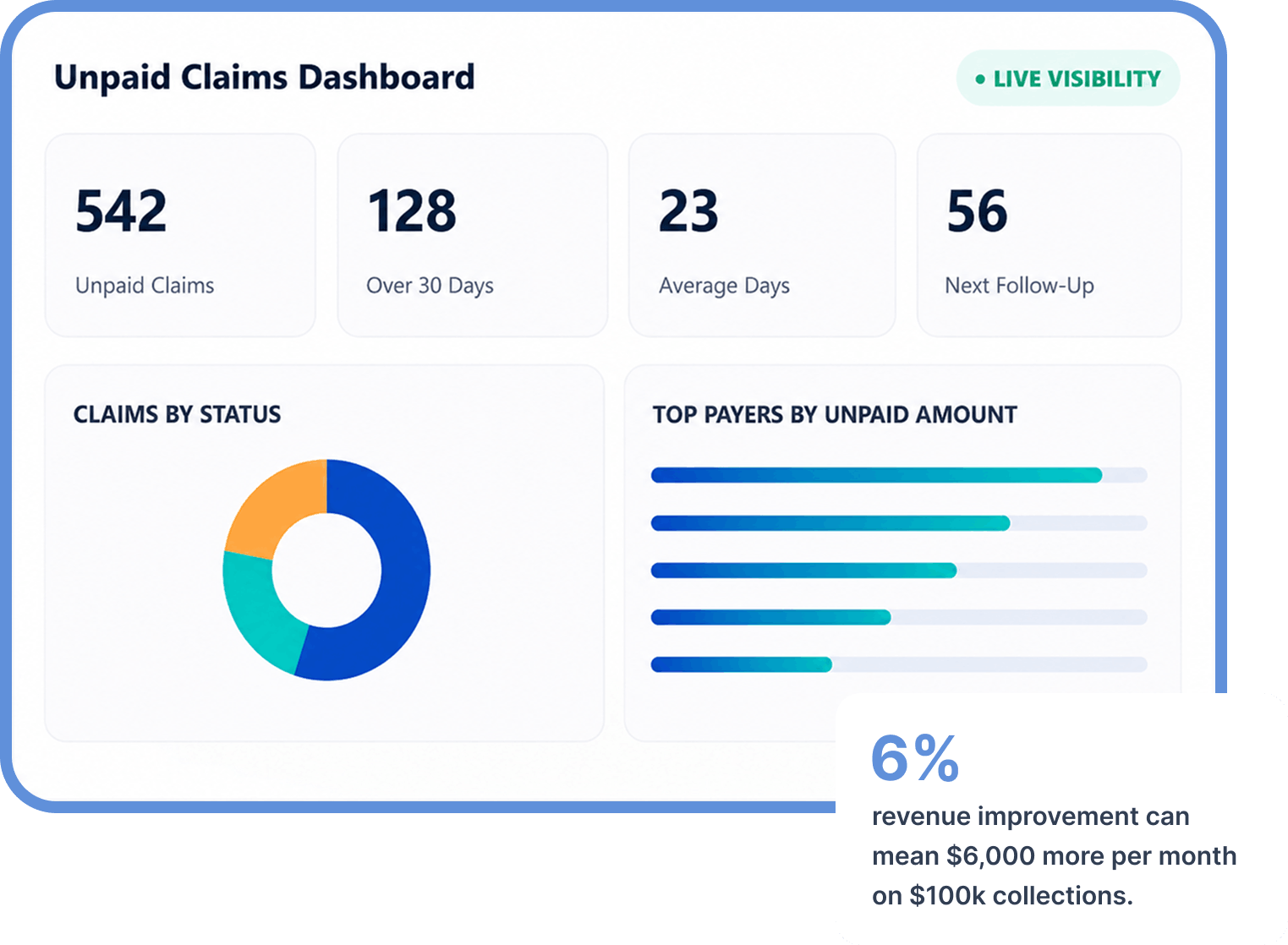
DENmaar gives behavioral health practices a clear view of:
- Which claims remain unpaid
- Why each claim is stuck
- What action has been taken
- Who is responsible for the next step
- When follow-up is due
- What the payer said during the last follow-up
- Which payers and problems are creating the most lost revenue
You no longer have to accept, “We’re working on it.”
You can see exactly what is being worked, what happened and what comes next.
The Improvement in Claims Can Pay for DENmaar
any practices are already losing more money through preventable claim problems than they would spend fixing them.
For a practice collecting $100,000 per month
6% = +$6,000 / month
in realized insurance revenue
That improvement alone could offset the cost of DENmaar’s billing services.
- Behavioral health EHR software at no additional cost
- Claims Copilot
- Eligibility and insurance workflows
- Payment posting
- Rejection and denial management
- Aging-claim follow-up
- Reporting and management visibility
- Support from DENmaar’s Insurance Knowledge Team
Claim Lifecycle
Every Claim Has an Owner, a Status
and a Next Action
DENmaar creates a structured process for managing the entire claim lifecycle—from appointment readiness
through final payment.
01
Prevent Problems Before Submission
Eligibility, payer, authorization, credentialing and documentation issues are identified before they become rejected or denied claims.
02
Submit Clean Claims
Claims are reviewed for common errors and payer requirements before submission.
03
Monitor the Payer Lifecycle
Claims are tracked after submission so unresolved claims don’t quietly disappear into aging.
04
Assign the Next Action
Every problem claim has a clear status, responsible team member and required next step.
05
Document Every Follow-Up
Management can see when follow-up occurred, what the payer said and what must happen next.
06
Escalate Unresolved Claims
Claims receive additional attention before filing limits or appeal deadlines are missed.
07
Measure Performance
Monitor clean claims, rejections, denials and aging by payer, provider, location, service and responsible team member.
Management Visibility
Your Billing Operation Shouldn’t Be a
Black Box
Monthly reports tell you what has already happened. DENmaar provides visibility into
what is happening now.
Visibility creates accountability.
A practice should not have to wait until collections fall to discover that claims aren’t being worked effectively.
- Whether claims are being worked consistently
- Whether follow-up is producing results
- Why claims remain unpaid
- Whether the same errors keep recurring
- Where responsibility for the next action sits
- Which workflows or team members need support
- Which payers are causing the most problems
- How much revenue remains at risk
Visibility creates accountability.
Accountability creates action.
Action moves claims toward payment.
Improve the Team You Have—or Let DENmaar Manage the Process
Some practices already have an internal billing team but lack the technology, payer knowledge and management visibility required to oversee it. Others want an experienced partner to manage the entire revenue cycle.
OPTION 01
Claims Copilot for Your Existing Team
Give your billing staff the structured workflows, claim intelligence and accountability tools needed to manage unpaid claims more effectively. Management gains visibility without immediately replacing the internal team.
OPTION 02
Full Revenue Cycle Management
Let DENmaar manage claim creation and submission, rejection correction, payment posting, denial resolution, insurance follow-up, aging claims, payer escalation, patient balances and revenue-cycle reporting.
Either way, management gains control over the revenue cycle.
Behavioral Health Expertise
Built Specifically for Behavioral Health
Behavioral health billing requires more than generic claim submission.
Mental health therapy
Psychiatry and medication management
Substance-use treatment
Intensive outpatient and partial hospitalization programs
Community behavioral health
Multidisciplinary practices
Telehealth billing
Time and unit requirements
Rejections and denials
Built Specifically for Behavioral Health
- Behavioral health payer carve-outs
- Eligibility and benefit verification
- Prior authorizations
- Provider credentialing
- Therapy and psychiatric coding
- Same-day services
- Telehealth billing
- Missing or incomplete documentation
- Coordination of benefits
- Rejections and denials
- Aging insurance balances
Before Billing Begins
Problems Are Often Created Before Billing Begins
Many claim problems originate before the claim reaches the billing team.
An appointment may be scheduled with the wrong payer. Eligibility may not be verified. An authorization may be missing. Documentation may not support the code or units billed. A provider may not be enrolled correctly.
DENmaar connects scheduling, eligibility, authorizations, documentation and billing in one operational system.
This helps prevent bad claims—not merely work them after they fail.
Prevent the problem upstream.
01
Scheduling
Right payer • right workflow
02
Eligibility & Authorization
Verify before service
03
Documentation
Support code and units
03
Billing
Submit cleaner claims
More Than Billing
Technology, Insurance Expertise and
Human Follow-Through
Most billing companies provide reports. Most software companies provide tools. DENmaar combines:
Technology, Insurance Expertise and
Human Follow-Through
You get a system designed to improve the financial performance of your behavioral health practice.
Enterprise capability with small-practice simplicity.
- Behavioral health EHR technology
- Claims Copilot
- Revenue-cycle services
- Insurance knowledge
- Human payer follow-up
- Management visibility
- Operational accountability
Billing Review
See What Better Claims Performance Could Mean for Your Practice
If too many claims are rejected, denied, aging or simply unexplained, let’s look at the process together.
Current monthly insurance revenue
Baseline performance
Clean-claim rate
Rejection and denial rates
Claims over 30 days
Value of unpaid and aging claims
Follow-up process
Where accountability is breaking down
Let’s Determine Whether There Is Operational Alignment
We begin with a discussion focused on:
- Organizational structure
- Insurance workflows
- Operational goals
- Implementation fit
Request Information
Capterra, Software Advice And Get App 2023 / 25
Best Of Badges Awarded To DENmaar
2023 / 25 “Best of” badge winners = DENmaar Neuro has earned a well-deserved Best Value Badge.
See our reviews for our software being recognized as an impactful solution for your business.





Our Latest Blogs

Insurance Credentialing for therapists
- Revenue Cycle Management (RCM)
- Verification of Insurance Eligibility
- Indexing Medical Records
- Data Conversion
- Medical Coding Services
Stop losing clients. Call us now on 844-727-3627
Best Insurance credentialing services for therapists
Effective insurance paneling for therapists is imperative to improving practice performance. Without proper registration, insurance companies may delay or deny payments even if the doctor is competent and can provide medically necessary services. Best insurance panels for therapists verify that a physician meets the payer’s criteria by reviewing an individual’s licensure, experience, certification, education, training, affiliation, malpractice, adverse clinical events, and judgment.
We at DENmaar provide insurance credentialing for physical therapists, helping service providers generate better revenue. Our services simplify the payer enrollment process when doctors start their first practice, Transit from one practice to another, add a new doctor to an existing group, and want to register with a new payer. The Medical insurance credentialing process for therapists is a highly detail-oriented process that requires constant attention. After submitting the required documents, our credentialing coordinator monitors the application status and addresses any additional requirements daily to ensure accurate and timely acceptance of each network. The complexities of adopting a group practice or facility are incredibly time-consuming. We can work with each provider or office management staff to retrieve all the necessary information for the applications. We ensure that the providers are in proper network condition to provide services at the facility. Our team has experience paneling mental health therapists, for all types of licenses, insurances, and various business structures.
DENmaar is one of the best insurance credentialing companies for therapists in the US.
Fully Automated system at your service
Individual/Group Provider Enrollment
We assist the physicians/providers in enrolling and attesting with the payer’s network to offer services to the patients who are members of the payer’s plans.
CAQH Completion and Management
We assist you in completing, updating, and maintaining your CAQH profile to obtain a CAQH ID and help with insurance certification, contracting, and registration.
Primary Source Verification
We verify credentials such as training, certification, education, licensure, etc., with the primary source to improve care quality and decrease liability risk.
Hospital Privileging
We assist in authorizing the health care practitioner’s specific scope and content of patient care services to ensure that they are appropriately licensed, carry malpractice insurance, and meet hospital requirements.
Who we help with insurance credentialing for therapists
We simplify the insurance credentialing process for therapists for the following entities.
- Physical Therapists
- Occupational Therapists
- Speech Therapists
- Behavioral Therapists
Insurance carriers we support
- Cigna
- Aetna
- Anthem
- Blue Cross Blue Shield (BCBS)
- Humana
- Medicaid
- Medicare
- Optum
- Oscar
- Tricare
- UMR
- United Healthcare (UHC)
Who we help with insurance credentialing for therapists
Getting accredited opens your doors to these patients as it is impossible to bill insurance companies without credentialing. The insurance credentialing process can be tedious, long, and frustrating, but everything else becomes more manageable once you’re done. So save your time and ensure efficiency with us.
- Updated License
- National Provider Identifier (NPI) Number
- Tax ID number
- Liability Insurance Proof
- Minimum 3 Professional references
- Graduate school transcript copy
- Employment history of minimum 5 Years
DENmaar’s Insurance Credentialing Services for Therapists and their Benefits
- Substantial reduction in errors common in manual operations.
- It helps medical practices focus on patient care and allows the medical center to collect, filter, report, and manage the accreditation process from an unbiased perspective.
- A medical practice can also save millions of dollars in lawsuits and malpractice cases by ensuring that all healthcare providers working in their facilities are qualified and have their credentials verified.
- It saves time and labor for health care providers, shortens the stage of diagnosis and treatment, and ensures timely payment.
- The traditional credentialing process means many paper documents and files for different health care providers.
- A central database helps prevent long-term formation, with easy access to analysis.
Why choose an insurance credentialing service for therapists?
Healthcare centers face the difficult task of insurance credentialing while increasing costs, be it operational costs or payments to healthcare providers for their services. A medical practice must ensure quality care, which can only happen when credentialed and skilled healthcare providers are employed. Only authorized doctors and staff should be allowed to operate to ensure proper diagnosis and treatment of patients to avoid medical malpractice.
Here is where DENmaar insurance credentialing services for therapists are needed. We have highly skilled insurance credentialing experts who undertake credentialing on your behalf. We take care of the paperwork, appeals, case follow-up, and handling claims denials. We ensure an error-free application process, significantly reducing your chances of rejection.
We continuously monitor the payers on your behalf and ensure your credentialing process is effective and successful. At DENmaar, we take your burden of credentialing and offer non-stop work until we make you a part of the insurance carrier’s network.
Insurance Credentialing Services Therapists Can Depend On
Our web portal offers valuable articles and the latest news to provide the proper guidance and tips for making the credentialing process fruitful and effortless.
Refer to the below-mentioned articles to understand insurance credentialing services for therapists better:
- Adding Therapists to Private Practice Insurance Credential
- ABA Credentialing -The Importance of Credentialing
- Aetna Provider Credentialing – The Process
- Mental Health Credentialing – The Process
- Cigna Credentialing – Getting On the Cigna Panel
- BCBS Insurance Credentialing Services – The Procedure
- Psychologists Insurance Credentialing Services
- Affordable Insurance Credentialing Services-Cost Efficiency
- Addiction Treatment Credentialing-Benefits of Credentialing
- Humana Health Insurance Credentialing – Getting On the Panel
- Credentialing Doctors to Your Group Practice
- UMR Credentialing – The Process
- CAQH Insurance Credentialing-It’s Benefits in Credentialing
- Insurance Credentialing Specialists – Its Importance
- Oscar Credentialing – Getting on Insurance Panels
- Insurance Credentialing and Contracting-Their Merits
- Insurance credentialing 101 – Understanding Credentialing
- Top Insurance Companies to Be Credentialed With
- Bankers Life Insurance Credentialing – Getting on the Panel
- Insurance Credentialing for Nurse Practitioners
- Letter of Interest for Insurance Credentialing -Tips To Mind
We provide insurance credentialing services for therapists to remove the burden on our clients. Also, our services are offered at the best prices with advanced automation assistance and maximum efficiency.
We always strive hard and value each of your clients. Also, we work for you so that you do not miss even a single client whose value is more than the cost of credentialing.
Frequently Asked Questions
What is insurance credentialing for therapists?
Insurance credentialing for therapists refer to verifying a licensed health care provider’s education, training, and qualified professional history.
How often do therapists have to get credentialed?
Therapists have to be credentialed once in three years at least. Some perform even more often.
Why is credentialing so hard?
Credentialing is a process that needs more labor. You need people to manage the workflow, enter the data, fact-check the reporting, etc. Not having the appropriate staff allocation can lead to mistakes, which will lead to delays, ultimately impacting your revenue.

Is mental health billing obstructing your treatment process?
Mental health services billing is more complex than in other areas of health care due to the type of services, timing, scope, and limitations of mental health treatment.
For instance, if a patient goes to the doctor for a routine checkup, he will almost certainly have a standard series of tests and exams. It usually involves measuring the patient’s height and weight, taking their blood pressure, and listening to their heart. These tests are, for the most part, standardized for all patients, take the same amount of time, and have slight patient-to-patient variation.
Similarly, when providers bill health insurance companies for regular checkups, the billing is uniform, recurring, and often bundled into a single fee. However, the same cannot be applied to mental health treatments.
That’s why a mental health care provider must have a streamlined mental health billing process that permits you to concentrate on what’s essential – caring for patients with the best treatment. Here are some mental health billing challenges in the treatment process and well-proven tips for handling them.
Challenge 1: Denied or delayed claims
Sometimes it can be challenging to collect payments for services rendered. The more insurance companies delay making necessary payments, the harder it will be to collect the money you need. Fortunately, instead of facing the challenges of accepting claims regularly, there are several steps you can take to ensure you continue to receive the claims you deserve in a consistent and continuous stream.
Solution: Identify procrastination and how to avoid it
Learn about potential claims delays, including the most common delays with insurance companies. Insurance companies will mostly not accept a claim exceeding the maximum amount allowed on the policy. If you expect this will be a challenge, you should review how the insurance company is billed to ensure you don’t exceed the limit. Coding problems, which can be easily avoided by working closely with a billing professional specializing in mental health, can help facilitate approval and ensure you receive your payments on time.
At last, consider accepting cash payments from patients who may or may not work with certain insurance providers, which can help facilitate payments and keep your clinic running smoothly.
Challenge #2: Patient Insurance Changes and Pre-Approvals
Patients are seeking mental health care regularly schedule appointments and services. Some people may have the same insurance for years, making providing mental health billing for services relatively easy. Any change in insurance may result in your claim being denied, leaving you with uncollected payments. Similarly, the necessary care will not be provided if an insurance company offers treatment to a patient without prior authorization. It may eventually leave the patient unable to afford these services, resulting in lost appointments and revenue opportunities.
Solution: Check insurance coverage and requirements
When a new patient makes their first visit, check with their insurance company to ensure they don’t need special approval steps. Continue to check your patients’ insurance and coverage at each visit, and remind regular patients to notify you immediately if their insurance changes.
Our state-of-the-art EHR platform can help you quickly and easily determine whether a patient has the necessary coverage to complete an appointment. If your patient does not have the insurance coverage required for the appointment or cannot check insurance, you may need to reschedule.
Suppose you were previously an in-network provider but moved out of the network or to a different network tier for a particular provider. In that case, you may need to notify your patients. Make sure this happens before their appointment to give them enough time to sort through any potential insurance or payment changes.
Challenge #3: Insurance Company Presentation Preferences
Nowadays, most insurance companies utilize a digital billing model. But, this does not mean that every company prefers the same registration method. Your employees may be forced to keep changing preferences — and if you file incorrectly, you may struggle to collect payment from that insurance company.
Solution: Collaborate with a professional medical billing specialist
A dedicated mental health billing specialist can help you stay abreast of the ongoing changes in the insurance industry, including the changes many companies are making. Your mental health billing specialist will grow and change your practice with varying needs, ensuring insurance claims are submitted correctly so you can collect payments more efficiently.
Outsourcing mental health medical billing to a third party
As you can see, a lot of work is involved in adequately filing claims for mental health providers. Thus, it’s not surprising that many providers prefer to use a third-party mental health billing company to handle claims so they can focus on patient care and treatment.
Denmaar works 24/7 with mental health providers to provide pre-authorization, billing, and mental health medical coding, follow up on claims and assist with appeals of insurance claims. Check out our mental health billing and coding services, and contact us immediately if you think this is the best option for your facility.
We, Denmaar, have demonstrated our expertise in various fields by implementing uniform quality and timely strategies to improve multiple practices. They have the best experts who closely monitor the accounts and ensure that all medical bills and coding confusions are addressed with practical solutions. Call us now!

Tips to reduce contradictions of mental and behavioral health
Medical billing is a complex process in which medical billing for mental health services is more complicated than ever and comes with unique challenges. Many services are covered under mental health, such as pre-authorization, anxiety dissipation, size and availability of office staff, and mental and behavioral health bills that cater to more disadvantages.
Mental health bills
One of the best factors is paying more attention to patients to understand the mental and behavioral health billing process. In addition, refusal management is a good reason to increase the importance of medical billing for medical professionals. In this blog, we will look at how and why mental health bills are complex and difficult to handle and what can be done to reduce billing claims rejection.
Why are mental health bills so difficult?
Consider other areas of medical billing. You may see some standard procedures followed due to specific treatment and recovery periods, but this may not be the case with mental and behavioral health. Factors such as time, service variables, scope, and mental health treatment limitations make them more complex and ambiguous.
As counseling and billing vary from patient to patient, providers may have difficulty billing and making claims as the causes may increase in patients.
Best practices for mental health care billing:
While the billing process for mental health services is difficult to handle, providers follow these tips to simplify their approach and system.
# 1: Double-check insurance and coverage for the patients
Since the patients have their insurance cards, providers can quickly check the benefits of their policy and whether the services they use are included in the policy. It also lets the providers know how much the insurance company pays the patient for the service.
# 2: Understanding CPT Code:
If the CPT (Current Procedural Terminology) codes are not specified properly, there is no point in doing the whole process properly. These signs show how much you will have to pay for certain healthcare services delivered to patients. Unlike other medical billing procedures, you will not easily find CPT codes for mental health and billing. Standard CPT codes are not used for cognitive and behavioral health bills; Instead, they should contain specific E / M codes and the corresponding CPT codes.ce coverage considering the status of waived cases; Reclassification of neglected cases; Offer details.
Your payment mental health billing claim form looks in three ways: history, examination, and medical decision-making.
History contains details of current illness, past family and social history, and repetition of rules. The examination section covers the type of tests to be performed, the nature of the problem, and the patient’s history. Finally, the column for medical decision-making includes the number of diagnoses or treatments made by the patient, the complexity of the data, and the risk of complications.
CPT codes play an important role in rejecting mental health bill claims; Therefore, practitioners/hospitals should remember that updating their system quickly with CPT codes can help overcome complaints related to mental health bills.
# 3: Learn how to submit claims properly
Just as the symbols in the claim form are important, it also makes sense to understand how to fill out each column on the claim form. You need to go through the full procedure at the beginning, and before filling out, if in doubt, clarify this with the expert involved in submitting the claim and then proceed to fill out and submit the form.
Conclusion
Outsourcing your medical billing and coding process is a wise choice to make your mental health billing process easier and reimburse you without denying any claims. Contact the best medical billing and coding outsourcing company, “Denmaar,” which offers high quality, support, and maximum refunds in medical billing and coding.he benefits and skills of mental well-being before seeing a patient. The attachment will emphasize the limits of normal division; deductible, visits per year allowed, any membership requirements, and Case Street numbers.
About Denmaar’s medical billing service:
We are a medical billing company that provides medical billing services and supports doctors, hospitals, medical institutions, and group practices through our comprehensive medical billing solutions. We help you earn more through our fast and affordable services. In addition, our customized Revenue Cycle Management (RCM) solutions allow physicians to increase additional revenue and reduce administrative burdens or losses.
Our Partners






Ready to get started?
Feel free to reach out if you have any questions.
