

We don’t just submit claims. We create visibility and accountability around every unpaid claim—so management knows what’s being worked, what’s stuck, and why.
Know What’s Happening With Every Unpaid Claim
Behavioral health billing with complete visibility and accountability

98.1%
Clean Claim Rate
1.47%
Rejection Rate
0.32%
Denial Rate
5–10%
Denial Rate
10–20%
Average Revenue
Improvement
$0
EHR Software Fee
With Billing Services
With Billing Services
CLAIMS VISIBILITY
Your Claims May Be Getting
Submitted. But Are They Getting Paid?
Submitting a claim is only the beginning.
Your Claims May Be Getting
Submitted. But Are They Getting Paid?
Revenue is lost when rejected claims aren’t corrected, denials aren’t resolved, authorizations expire, payer requests go unanswered, and unpaid claims disappear into spreadsheets and work queues.
DENmaar gives behavioral health practices a clear view of:
- Which claims remain unpaid
- Why each claim is stuck
- What action has been taken
- Who is responsible for the next step
- When follow-up is due
- What the payer said during the last follow-up
- Which payers and problems are creating the most lost revenue
You no longer have to accept, “We’re working on it.”
You can see exactly what is being worked, what happened and what comes next.
The Improvement in Claims Can Pay for DENmaar
any practices are already losing more money through preventable claim problems than they would spend fixing them.
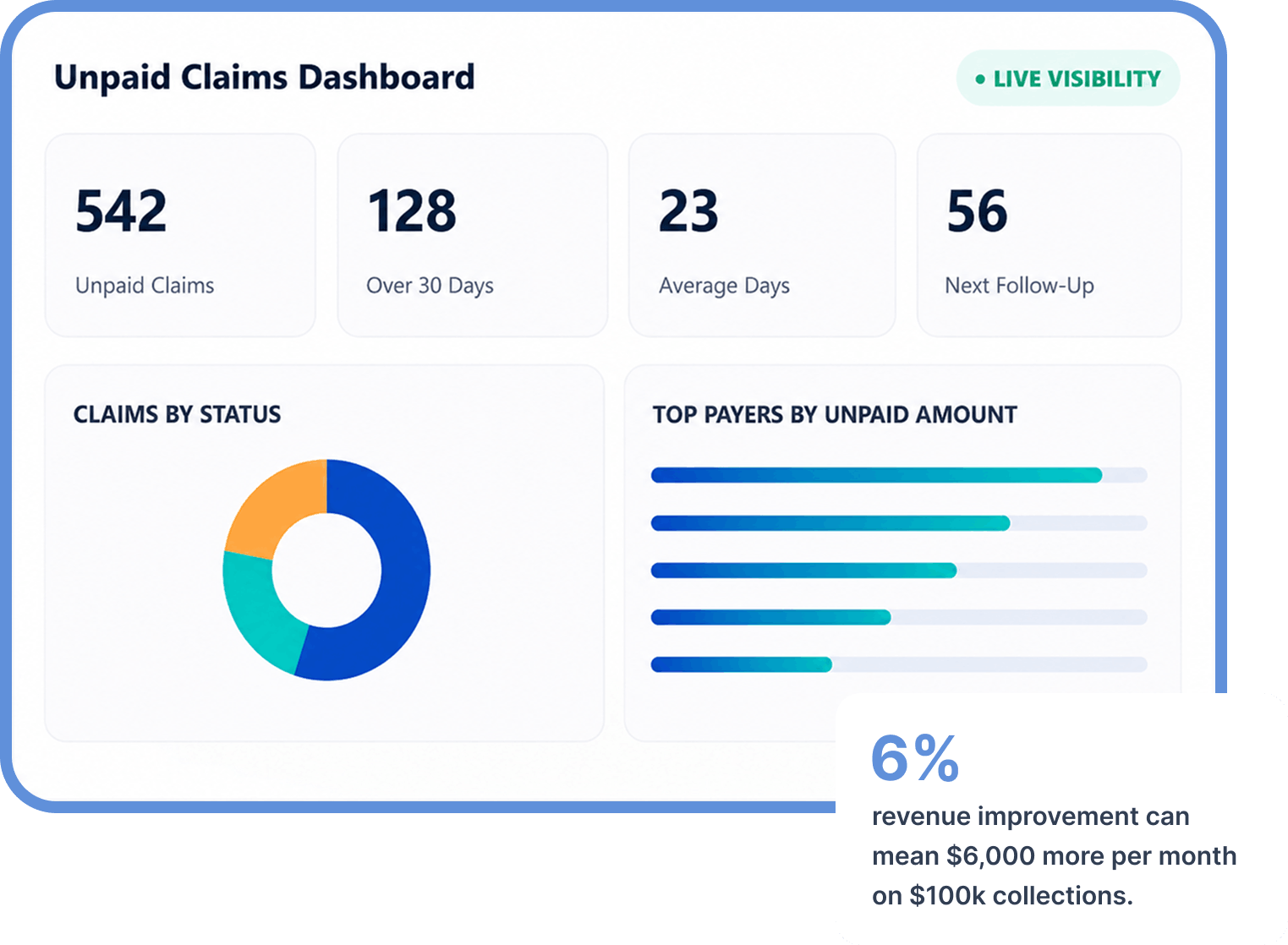
For a practice collecting $100,000 per month
6% = +$6,000 / month
in realized insurance revenue
That improvement alone could offset the cost of DENmaar’s billing services.
- Behavioral health EHR software at no additional cost
- Claims Copilot
- Eligibility and insurance workflows
- Payment posting
- Rejection and denial management
- Aging-claim follow-up
- Reporting and management visibility
- Support from DENmaar’s Insurance Knowledge Team
Claim Lifecycle
Every Claim Has an Owner, a Status
and a Next Action
DENmaar creates a structured process for managing the entire claim lifecycle—from appointment readiness
through final payment.
01
Prevent Problems Before Submission
Eligibility, payer, authorization, credentialing and documentation issues are identified before they become rejected or denied claims.
02
Submit Clean Claims
Claims are reviewed for common errors and payer requirements before submission.
03
Monitor the Payer Lifecycle
Claims are tracked after submission so unresolved claims don’t quietly disappear into aging.
04
Assign the Next Action
Every problem claim has a clear status, responsible team member and required next step.
05
Document Every Follow-Up
Management can see when follow-up occurred, what the payer said and what must happen next.
06
Escalate Unresolved Claims
Claims receive additional attention before filing limits or appeal deadlines are missed.
07
Measure Performance
Monitor clean claims, rejections, denials and aging by payer, provider, location, service and responsible team member.
Management Visibility
Your Billing Operation Shouldn’t Be a
Black Box
Monthly reports tell you what has already happened. DENmaar provides visibility into
what is happening now.
Visibility creates accountability.
A practice should not have to wait until collections fall to discover that claims aren’t being worked effectively.
- Whether claims are being worked consistently
- Whether follow-up is producing results
- Why claims remain unpaid
- Whether the same errors keep recurring
- Where responsibility for the next action sits
- Which workflows or team members need support
- Which payers are causing the most problems
- How much revenue remains at risk
Visibility creates accountability.
Accountability creates action.
Action moves claims toward payment.
Improve the Team You Have—or Let DENmaar Manage the Process
Some practices already have an internal billing team but lack the technology, payer knowledge and management visibility required to oversee it. Others want an experienced partner to manage the entire revenue cycle.
OPTION 01
Claims Copilot for Your Existing Team
Give your billing staff the structured workflows, claim intelligence and accountability tools needed to manage unpaid claims more effectively. Management gains visibility without immediately replacing the internal team.
OPTION 02
Full Revenue Cycle Management
Let DENmaar manage claim creation and submission, rejection correction, payment posting, denial resolution, insurance follow-up, aging claims, payer escalation, patient balances and revenue-cycle reporting.
Either way, management gains control over the revenue cycle.
Behavioral Health Expertise
Built Specifically for Behavioral Health
Behavioral health billing requires more than generic claim submission.
Mental health therapy
Psychiatry and medication management
Substance-use treatment
Intensive outpatient and partial hospitalization programs
Community behavioral health
Multidisciplinary practices
Telehealth billing
Time and unit requirements
Rejections and denials
Built Specifically for Behavioral Health
- Behavioral health payer carve-outs
- Eligibility and benefit verification
- Prior authorizations
- Provider credentialing
- Therapy and psychiatric coding
- Same-day services
- Telehealth billing
- Missing or incomplete documentation
- Coordination of benefits
- Rejections and denials
- Aging insurance balances
Before Billing Begins
Problems Are Often Created Before Billing Begins
Many claim problems originate before the claim reaches the billing team.
An appointment may be scheduled with the wrong payer. Eligibility may not be verified. An authorization may be missing. Documentation may not support the code or units billed. A provider may not be enrolled correctly.
DENmaar connects scheduling, eligibility, authorizations, documentation and billing in one operational system.
This helps prevent bad claims—not merely work them after they fail.
Prevent the problem upstream.
01
Scheduling
Right payer • right workflow
02
Eligibility & Authorization
Verify before service
03
Documentation
Support code and units
03
Billing
Submit cleaner claims
More Than Billing
Technology, Insurance Expertise and
Human Follow-Through
Most billing companies provide reports. Most software companies provide tools. DENmaar combines:
Technology, Insurance Expertise and
Human Follow-Through
You get a system designed to improve the financial performance of your behavioral health practice.
Enterprise capability with small-practice simplicity.
- Behavioral health EHR technology
- Claims Copilot
- Revenue-cycle services
- Insurance knowledge
- Human payer follow-up
- Management visibility
- Operational accountability
Billing Review
See What Better Claims Performance Could Mean for Your Practice
If too many claims are rejected, denied, aging or simply unexplained, let’s look at the process together.
Current monthly insurance revenue
Baseline performance
Clean-claim rate
Rejection and denial rates
Claims over 30 days
Value of unpaid and aging claims
Follow-up process
Where accountability is breaking down
Let’s Determine Whether There Is Operational Alignment
We begin with a discussion focused on:
- Organizational structure
- Insurance workflows
- Operational goals
- Implementation fit
Request Information
Capterra, Software Advice And Get App 2023 / 25
Best Of Badges Awarded To DENmaar
2023 / 25 “Best of” badge winners = DENmaar Neuro has earned a well-deserved Best Value Badge.
See our reviews for our software being recognized as an impactful solution for your business.





Our Latest Blogs

Why Is Medical Credentialing So Important?
Medical credentialing has to be the single most important thing that every healthcare practice and practitioner needs to undertake in the United States. It is a process by which the expertise and qualifications of doctors and nurses are verified. As such, this is one procedure that helps patients trust the healthcare provider of their choice.
Simply verifying a healthcare organization of a practitioner’s credentials isn’t where the merits of the medical credentialing end, though. There is an important financial incentive involved in getting credentialed as well. For instance, most healthcare organizations cannot receive payment for the care offered from insurance companies like Medicare and Medicaid if they do not have medical credentialing.
That being said, we’ve barely scratched the surface trying to explain how fundamental a role medical credentialing plays in the success of healthcare professionals and organizations. There is way more to unpack with medical credentialing when it comes to its benefits. That is what we will try to accomplish today with the help of this article.
We will be looking at all reasons why medical credentialing is vital for hospitals, clinics, and healthcare professionals in general.
But first… let’s take a brief detour to understand how ancient this ostensibly modern practice is.
History of Medical Credentialing
Medical credentialing isn’t a new concept. Instead, it is somewhat of a tradition that has lasted for centuries in a variety of forms. Its origins can be traced all the way back to 1000 BC. The first-ever medical credentialing process took place in ancient Persia, where the cult of Zoroaster demanded a physician treat three heretics. If all three survived their treatment, the physician would be qualified to provide care to patients until the end of their life.
We’ve come a long way since then. The process has evolved to become much more regulated. However, the basic gist of the procedure remains the same – to ensure that a doctor or nurse is qualified to administer treatment to patients.
Reasons Why Credentialing is Important
1. Protecting Patients
As we mentioned, medical credentialing is undertaken to determine whether a practice or healthcare professional is qualified to treat patients. Patient care has always been the core purpose of medical credentialing. The process itself is rather complex and involves verifying a practitioner’s credentials against various relevant data points.
For instance, a practitioner is continuously checked against major publications like Death Master File, Sex Offender Registries, National Abuse Registry, OFAC, and many other sources. A provider can be denied credentialing if their name shows up in any of the above data points. Credentialing can also be denied if a provider’s license has expired or defaulted on their student loans.
Credentialing instills confidence among patients. For example, it would be nice to know that a particular doctor in charge of providing treatment to a child is not a registered sex offender or that a psychologist has the qualifications necessary to provide you with sound advice.
Competency and Performance Reviews are an integral part of the credentialing process. Organizations in charge of this process leave no stone unturned in determining whether a practice or healthcare professionals are worthy of being credentialed. As a result, patients can feel safe going for treatment to clinics and hospitals whose staff are all credentialed.
2. Helps Medical Organizations Prevent Revenue Loss
It is important to note that no insurance company will reimburse a hospital or medical practice if they lack medical credentialing. A medical organization has to first get in-network with insurance carriers like Medicare, Medicaid, etc., to be able to cater to patients with health insurance. A non-credentialed medical organization is not complying with state and federal regulations. This alone can open a can of legal issues (more on this later.)
To put it more succinctly, an insurance carrier will deny reimbursement to a healthcare organization if they hire providers that aren’t credentialed. Furthermore, if a refund has already occurred and it is later revealed that the provider did not possess medical credentialing, they will be hit with fines and civil monetary penalties. Therefore, a healthcare organization must make sure a provider’s credentials are verified upon hire. Not doing so only leaves the practice open to a severe financial hit down the line.
Read More: 5 Things to Learn about Medical Credentialing Process
3. Medical Credentialing Helps Providers Avoid Lawsuits
In a lawsuit, Medical Credentialing has proven to serve as a cover protecting healthcare organizations. For instance, the first thing the law will consider when examining a lawsuit against a healthcare practice is whether or not it complies with state and federal regulations. If a medical practice follows best practices and possesses staff with the necessary accreditations and qualifications, the organization is more likely to imprint a good impression on the Justice System.
On the other hand, if a healthcare organization faces medical negligence and patient endangerment charges, its providers are excluded from medical credentialing. As a result, there is no way to win a lawsuit. Moreover, losing the lawsuit won’t be the worst thing that happens to the practice. The organization’s reputation will be destroyed in the media, leading to serious patient mistrust.
The Bottom Line
Medical credentialing does a lot more than just verifying healthcare professionals’ legitimacy as you learn for yourself. Medical credentialing is such an integral part of our healthcare system today that no healthcare practice can thrive, let alone survive, without undertaking the process.
That being said, the credentialing process isn’t exactly child’s play. It can be complex, time-consuming, and overwhelming to undertake. Fortunately, we at DENmaar take care of the often excruciating credentialing process. Our credentialing specialists ensure you have error-free paperwork ready to help you get in-network with insurance carriers as quickly as possible.
Over the years, we’ve helped many healthcare organizations with their credentialing tasks, thus providing them with more leeway to focus on patient care and other core areas of their practice.
Contact DENmaar now to learn more about the medical credentialing process and how we can help your practice.

Impact of AI on Medical Billing and Coding
By Healthcare Tech Outlook
For virtually all of the significant health IT vendors, using AI to understand a customer’s behaviors, predict their expectations, and show the correct data at the right time is a top priority.
FREMONT, CA: For several, it is hard to envision the future of Revenue Cycle Management (RCM) in the Artificial Intelligence (AI) era. How does this technology accelerate the business cycle and affect healthcare back-office day-to-day work? It is unknown when AI will be the industry norm at this stage, but there is some speculation about potential advantages that AI can soon bring.
AI Will Simplify Workflows for Medical Billing
Deep learning of the users’ interaction with Electronic Health Record (HER) and billing applications may have the most critical effect on a medical biller’s everyday life. For virtually all of the significant health IT vendors, using AI to understand a customer’s behaviors, predict their expectations, and show the correct data at the right time is a top priority. The ability to retrieve and manipulate information instantly has the power to significantly minimize labor spent on manual billing activities and allow workers to make smarter choices about the next steps to overcome denials.
Enhanced Medical Coding Precision
Its capacity to analyze text and the spoken word would be a core feature of AI. For procedures and diagnosis, systems can learn the language and assign specific codes. After code set updates, this functionality will have a profound effect to ensure the correct codes are used and paperwork is compliant, reducing the change that arises with updates to coding. If AI had been included, think how much simpler the transition from ICD-9 (International Classification of Diseases, Ninth Revision) to ICD-10 (Tenth Revision) would have been.
Immediate Pre-Authorizations
Its capacity to draw assumptions and forecasts will be one of the most critical facets of AI. It can take hours now, or even days, to get a payer’s pre-authorization. Future systems will interpret clinical data from a patient and assess the medical need of treatment within a few seconds. The good news for medical billers is that an automated mechanism will verify that authorization has been received and its related data collected, significantly minimizing (or eliminating) pre-authorization denials due to the absence of an authorization number.
Clinical Data

Webinar: Collaborative Care in Behavioral Health
Nearly one in five adults in the United States is affected by one or more mental health conditions. Unfortunately, for those living with common mental illnesses such as depression or anxiety, care is rarely coordinated across the entire care team to yield long-term improvement and mental health outcomes.
Join our webinar to explore the unique challenges in managing behavioral health and the benefits that collaborative care can deliver to your customers.
Collaborative Care: The New Model for Solving the Challenges of Fragmented Care in Behavioral Health
Wednesday, February 24, 2021 |12:00 – 12:30 PM EST
Our host, Colin Banas, MD, MHA, Chief Medical Officer of DrFirst will cover:
- • The importance of uniting the care and family team (CFT)
- • The necessity of marrying care collaboration with telehealth in a single, complete, and secure platform
- • The operational, administrative, and clinical efficiencies that will save your clients time and money

Colin Banas, MD, MHA,
CMO Medical Officer, DrFirst
Our Partners






Ready to get started?
Feel free to reach out if you have any questions.
