

We don’t just submit claims. We create visibility and accountability around every unpaid claim—so management knows what’s being worked, what’s stuck, and why.
Know What’s Happening With Every Unpaid Claim
Behavioral health billing with complete visibility and accountability

98.1%
Clean Claim Rate
1.47%
Rejection Rate
0.32%
Denial Rate
5–10%
Denial Rate
10–20%
Average Revenue
Improvement
$0
EHR Software Fee
With Billing Services
With Billing Services
CLAIMS VISIBILITY
Your Claims May Be Getting
Submitted. But Are They Getting Paid?
Submitting a claim is only the beginning.
Your Claims May Be Getting
Submitted. But Are They Getting Paid?
Revenue is lost when rejected claims aren’t corrected, denials aren’t resolved, authorizations expire, payer requests go unanswered, and unpaid claims disappear into spreadsheets and work queues.
DENmaar gives behavioral health practices a clear view of:
- Which claims remain unpaid
- Why each claim is stuck
- What action has been taken
- Who is responsible for the next step
- When follow-up is due
- What the payer said during the last follow-up
- Which payers and problems are creating the most lost revenue
You no longer have to accept, “We’re working on it.”
You can see exactly what is being worked, what happened and what comes next.
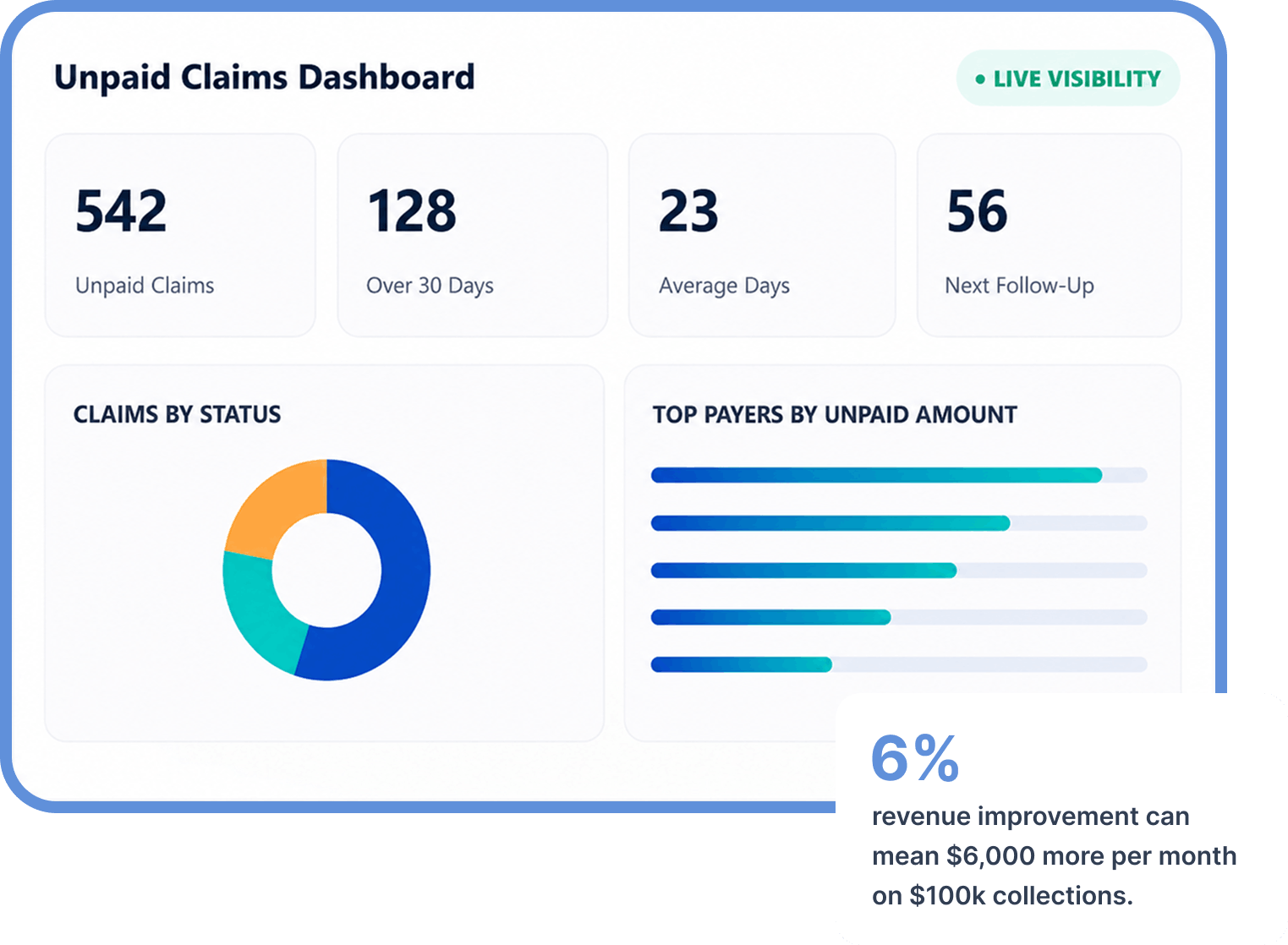
The Improvement in Claims Can Pay for DENmaar
any practices are already losing more money through preventable claim problems than they would spend fixing them.
For a practice collecting $100,000 per month
6% = +$6,000 / month
in realized insurance revenue
That improvement alone could offset the cost of DENmaar’s billing services.
- Behavioral health EHR software at no additional cost
- Claims Copilot
- Eligibility and insurance workflows
- Payment posting
- Rejection and denial management
- Aging-claim follow-up
- Reporting and management visibility
- Support from DENmaar’s Insurance Knowledge Team
Claim Lifecycle
Every Claim Has an Owner, a Status
and a Next Action
DENmaar creates a structured process for managing the entire claim lifecycle—from appointment readiness
through final payment.
01
Prevent Problems Before Submission
Eligibility, payer, authorization, credentialing and documentation issues are identified before they become rejected or denied claims.
02
Submit Clean Claims
Claims are reviewed for common errors and payer requirements before submission.
03
Monitor the Payer Lifecycle
Claims are tracked after submission so unresolved claims don’t quietly disappear into aging.
04
Assign the Next Action
Every problem claim has a clear status, responsible team member and required next step.
05
Document Every Follow-Up
Management can see when follow-up occurred, what the payer said and what must happen next.
06
Escalate Unresolved Claims
Claims receive additional attention before filing limits or appeal deadlines are missed.
07
Measure Performance
Monitor clean claims, rejections, denials and aging by payer, provider, location, service and responsible team member.
Management Visibility
Your Billing Operation Shouldn’t Be a
Black Box
Monthly reports tell you what has already happened. DENmaar provides visibility into
what is happening now.
Visibility creates accountability.
A practice should not have to wait until collections fall to discover that claims aren’t being worked effectively.
- Whether claims are being worked consistently
- Whether follow-up is producing results
- Why claims remain unpaid
- Whether the same errors keep recurring
- Where responsibility for the next action sits
- Which workflows or team members need support
- Which payers are causing the most problems
- How much revenue remains at risk
Visibility creates accountability.
Accountability creates action.
Action moves claims toward payment.
Improve the Team You Have—or Let DENmaar Manage the Process
Some practices already have an internal billing team but lack the technology, payer knowledge and management visibility required to oversee it. Others want an experienced partner to manage the entire revenue cycle.
OPTION 01
Claims Copilot for Your Existing Team
Give your billing staff the structured workflows, claim intelligence and accountability tools needed to manage unpaid claims more effectively. Management gains visibility without immediately replacing the internal team.
OPTION 02
Full Revenue Cycle Management
Let DENmaar manage claim creation and submission, rejection correction, payment posting, denial resolution, insurance follow-up, aging claims, payer escalation, patient balances and revenue-cycle reporting.
Either way, management gains control over the revenue cycle.
Behavioral Health Expertise
Built Specifically for Behavioral Health
Behavioral health billing requires more than generic claim submission.
Mental health therapy
Psychiatry and medication management
Substance-use treatment
Intensive outpatient and partial hospitalization programs
Community behavioral health
Multidisciplinary practices
Telehealth billing
Time and unit requirements
Rejections and denials
Built Specifically for Behavioral Health
- Behavioral health payer carve-outs
- Eligibility and benefit verification
- Prior authorizations
- Provider credentialing
- Therapy and psychiatric coding
- Same-day services
- Telehealth billing
- Missing or incomplete documentation
- Coordination of benefits
- Rejections and denials
- Aging insurance balances
Before Billing Begins
Problems Are Often Created Before Billing Begins
Many claim problems originate before the claim reaches the billing team.
An appointment may be scheduled with the wrong payer. Eligibility may not be verified. An authorization may be missing. Documentation may not support the code or units billed. A provider may not be enrolled correctly.
DENmaar connects scheduling, eligibility, authorizations, documentation and billing in one operational system.
This helps prevent bad claims—not merely work them after they fail.
Prevent the problem upstream.
01
Scheduling
Right payer • right workflow
02
Eligibility & Authorization
Verify before service
03
Documentation
Support code and units
03
Billing
Submit cleaner claims
More Than Billing
Technology, Insurance Expertise and
Human Follow-Through
Most billing companies provide reports. Most software companies provide tools. DENmaar combines:
Technology, Insurance Expertise and
Human Follow-Through
You get a system designed to improve the financial performance of your behavioral health practice.
Enterprise capability with small-practice simplicity.
- Behavioral health EHR technology
- Claims Copilot
- Revenue-cycle services
- Insurance knowledge
- Human payer follow-up
- Management visibility
- Operational accountability
Billing Review
See What Better Claims Performance Could Mean for Your Practice
If too many claims are rejected, denied, aging or simply unexplained, let’s look at the process together.
Current monthly insurance revenue
Baseline performance
Clean-claim rate
Rejection and denial rates
Claims over 30 days
Value of unpaid and aging claims
Follow-up process
Where accountability is breaking down
Let’s Determine Whether There Is Operational Alignment
We begin with a discussion focused on:
- Organizational structure
- Insurance workflows
- Operational goals
- Implementation fit
Request Information
Capterra, Software Advice And Get App 2023 / 25
Best Of Badges Awarded To DENmaar
2023 / 25 “Best of” badge winners = DENmaar Neuro has earned a well-deserved Best Value Badge.
See our reviews for our software being recognized as an impactful solution for your business.





Our Latest Blogs

What are the benefits of behavioral and mental health billing services?
Behavioral health and mental health billing services play a critical role in helping clinics, psychiatrists, therapists, and social workers manage their revenue cycle efficiently. With increasing administrative complexity and insurance requirements, professional billing support ensures accurate claims processing, reduced denials, and improved cash flow.
This guide explains the key benefits of behavioral health billing services and how they improve practice efficiency and financial performance.
What Are Behavioral and Mental Health Billing Services
Behavioral and mental health billing services involve managing the complete revenue cycle for mental health providers. This includes patient eligibility checks, claims submission, payment posting, denial management, and insurance follow ups.
These services are designed specifically for psychiatry, counseling, psychology, and social work practices to ensure smooth financial operations while providers focus on patient care.
Learn more about our medicaid billing solutions and explore how they improve revenue cycle efficiency.
Key Benefits of Behavioral Health Billing Services
Improved Claims Accuracy
Professional billing teams ensure that all claims are submitted correctly with complete patient and insurance information. This reduces errors and increases approval rates.
Faster Reimbursements
Accurate submissions and timely follow ups help practices receive payments faster, improving overall cash flow and financial stability.
Reduced Claim Denials
Billing specialists identify errors before submission and manage denied claims efficiently, ensuring maximum revenue recovery.
Eligibility and Benefits Verification
Insurance eligibility is verified before patient visits, ensuring that coverage details such as deductibles, co pays, and session limits are clearly understood.
Explore the best EHR and EMR solutions for streamlined healthcare management.
Efficient Patient Onboarding
Billing services support smooth patient registration by handling financial verification, documentation, and insurance communication.
Core Functions of Mental Health Billing Services
Claims Processing
Accurate entry of patient data, submission of electronic claims, and tracking claim status until completion.
Payment Posting
Recording payments received from insurance companies and patients to maintain accurate financial records.
Denial Management
Identifying rejected claims, correcting errors, and resubmitting claims for reimbursement.
Financial Reporting
Generating detailed financial reports to analyze revenue performance, payment trends, and outstanding balances.
Insurance Follow Ups
Consistent communication with insurance providers to resolve pending claims and ensure timely payments.
Learn about our practice management approach at DENmaar for efficient healthcare operations and streamlined workflows.
How Billing Services Improve Practice Management
Mental health billing services support clinics by streamlining administrative operations and reducing workload. Providers gain access to real time financial data, claim tracking, and reporting dashboards that improve decision making.
This allows healthcare professionals to focus more on patient care instead of administrative tasks.
Online Access and Transparency
Modern behavioral health billing systems provide secure online access where providers can track claims, monitor payments, and review financial reports anytime. This improves transparency and operational efficiency across the practice.
Frequently Asked Questions
What is behavioral health billing?
Behavioral health billing is the process of managing insurance claims, payments, and revenue cycle operations for mental health and psychiatric services.
Why is mental health billing important?
It ensures accurate claims submission, reduces denials, improves cash flow, and allows healthcare providers to focus on patient care instead of administrative work.
How do billing services reduce claim denials?
Billing experts verify patient data, check insurance eligibility, and correct errors before claim submission to reduce rejection rates.
What is eligibility verification in billing?
It is the process of confirming a patient’s insurance coverage, benefits, deductibles, and session limits before treatment begins.
Can billing services improve practice revenue?
Yes, professional billing services improve claim accuracy, speed up reimbursements, and recover denied claims, leading to better overall revenue.
A Quick Guide to Behavioral Health Practitioner Credentialing
The following article will tell everything you need to know about successfully getting on an insurance panel as a mental health practitioner.
This goes without saying but getting on an insurance panel is no easy task and can be incredibly frustrating, especially for mental health practitioners with already a lot on their plate. One way to make the credentialing process less overwhelming would involve being aware of certain fundamentals related to the arduous but necessary task.
That is exactly what we at DENmaar aim to do with the help of the below guide. So, without much further ado, let’s get started.
Finding Reputable Insurance Panels
By now you must be aware of all the health insurance companies active in your city and state. From large brands like Cigna to national entities like Medicare, it would be wise to keep a note of all these names before you start the credentialing process.
We would recommend making a spreadsheet that includes all of these companies. Moreover, expand your search by contacting your professional network. If you aren’t sure how many insurance companies are active in your state, then doing a quick Google search will provide the answers you need.
Make sure you note down the contact and address info of each of the insurance companies you find online. Save this information on your spreadsheet. Learn about the conditions regarding provider credentialing that apply to each specific company and make a note of them as well.
Learn About the Requirements of Insurance Companies.
Insurance companies are constantly on the lookout for reliable practitioners for their panels. You must make a good case about your skills and strengths as a mental health practitioner in your application.
Below are a few things that insurance panels seek in their applicants.
1. Location
Insurance companies look favorably upon practitioners who are actively serving patients in an under-served location. Your chances of getting on an insurance panel skyrocket if you are operating a clinic or practice in an area where that isn’t adequately populated with healthcare providers like you offering their services.
2. Cultural Diversity
Do not forget to mention your ethnic background, especially if you belong to an atypical one. Also mention if you speak multiple languages. These defining characteristics will increase your chances of getting on an insurance panel.
3. Qualities and Specialty
Make sure to emphasize the training and educational qualifications you possess. Do not forget to mention your specialties, especially when you specialize in offering healthcare to kids, elders, and LGBT or minority members of society.
4. Crisis Therapy
Insurance Panels are likely to look favorably upon healthcare providers that respond to emergencies quickly.
The above factors make you stand-out, and as such, should be emphasized in your application to increase your chances of getting successfully credentialed. We recommend making a list of everything that makes you stand out among other mental health practitioners in your vicinity before undertaking the credentialing process.
Create a Good Resume and Letter of Intent
You need a good, comprehensive resume that highlights your skills and accomplishments. Follow the below pointers to create a compelling resume and letter of intent.
- • Make sure your resume is short. One page is more than enough
- • Focus on things that make you unique rather than mentioning things that anyone can do.
- • Always use short sentences
- • Form sentences in active voice
- • Do not misrepresent your skills or lie. Also, do not undersell yourself.
The following format will make for an ideal resume:
- • Contact information, License number with date of issue.
- • Statement of intent
- • Credentials, skills, specialties, educational qualifications
- • Mention job experience. Include references to the organizations you’ve worked with, in the past.
- • Include additional skills like the ability to speak multiple languages, etc.
The letter of intent is another thing you must be careful about when composing. You want to be distinguishable while portraying yourself in good light. The below format would make for an ideal letter of intent.
- • Clearly state the name of the insurance panel you want to be on.
- • Mention your credentials and educational qualifications
- • Explain what makes you stand out among your peers. This could be language, culture, availability, etc.
- • Mention if you have clients that are already on that panel and are being billed out of network.
- • Close your letter by letting your intentions and desire to join the panel crystal clear.
Finally, Apply to the Insurance Panels
Now that you are prepared, it’s finally time to submit your application.
- • Mail your resume along with the letter of intent to the appropriate application address.
- • Note down the date on which you applied.
- • Call the application office exactly one week after submission for confirmation. Note down the name of the representative that answered your call for follow-up and mention the date you called on.
- • Confirm the next steps and also ask when you can follow up next.
- • If for some reason your application is rejected. Do not be heartbroken and be ready to re-apply immediately.
Conclusion
Getting on an insurance panel is tough but not impossible. The above guide will considerably simplify the process for you. To make the process even more hassle-free, we recommend you give us at DENmaar a call. We are home to the credentialing experts and resources needed to help you get on an insurance panel effectively and efficiently.
You can explore our website or contact us now to learn more about how we can help with mental health insurance credentialing.

How to overcome the challenges in medical credentialing
How to overcome the challenges that medical credentialing faces?
Medical credentialing is one of the most critical compliance issues in medical practice today. However, this is a time-consuming and complex process to do it properly. A poor medical credential can lead to registration problems and legal and financial complications. Do you know what weakens the medical credentialing process? Here are the top 4 most common medical credentialing challenges that every practitioner should be aware of and solutions to overcome those challenges in the credentialing process.
What is medical credentialing?
Medical credentialing is the process of verifying and evaluating the eligibility of a healthcare provider with educational qualifications, employment history, training experience, special resident certificates, licenses, and other eligibility details.
Challenges in Medical Credentialing
1. Lack of staff to verify credentials.
The medical credentialing process requires an expert team or organization to provide credentials to each healthcare provider providing services to patients. Do you know whose credentials should be checked? The list includes doctors, nurses, physicians, assistants, therapists, and every other provider. For each individual, their full educational qualifications, employment history, training certificates, residence, licenses, and any board-issued certificates in the provider’s specialization area should be carefully checked. So it will consume more teamwork to handle this big operation properly without any error.
Not allocating enough resources or staff to complete the medical credentialing process – is a common mistake due to some methods. This reduces revenue and creates work stress for the limited team available. In addition, when employees make mistakes with the application and the insurance provider does not accept the application, it delays the payment process.
What is the solution?
Outsourcing the medical credentialing process to the medical billing service providers will help you overcome this challenge easily because a reputable organization retains responsible and expert staff for the credentialing process. So the team will handle everything smoothly and on time without any errors, which will save valuable time and money.
2. Incomplete application of service provider
Provider registration applications are essential for completing the medical credentialing process. So it should be done correctly with all the necessary information. Unfortunately, some methods may fail to do so accurately without losing any data fields, resulting in payment delays and rejection of claims.
What is the solution?
Human errors are common when working on provider registration applications. To avoid this error, software based on advanced credentials will help you do it right. In addition, this automated process usually requires less administrative effort – it eliminates human errors, which saves you time, money, and resources.
3. Update the information
Access to applicant information is a significant challenge for healthcare organizations. An excellent medical credentialing process ensures that the healthcare provider is up to date with board certificates and licenses. All healthcare providers must regularly renew their licenses and credentials and keep them updated. About 85% of approval requests contain incorrect, missing, or outdated information. Even small changes, such as an address or phone number, must be re-authenticated in the CAQH database before the system can process the application.
What is the solution?
The doctor’s contact information and other relevant data are readily available to help you speed up the credentialing process. The re-credentialing process will also take a long time. The law will also reduce such recognition issues.
4. Deadline
The medical credentialing process plays an essential role in the revenue cycle of your healthcare organization. The end-to-end process will only take 90 days for the organization to review the application. However, when considering additional stakeholders such as insurance providers – the process can take up to six months – adding to your organization’s downtime.
What is the solution?
Give priority to safety, and spend as much time as possible. If it takes less time, you will be ahead of schedule.
DENmaar’s Medical Credential Services – The right choice to make your credentialing process more accessible.
What do we do?
- Collects and reviews all necessary documents to ensure completeness and accuracy before submitting payment
- Relieves staff and service providers from the time-consuming task of registering and re-credentialing with government and commercial paying agencies.
- Ensures timely approval to all service providers to avoid payment delay or loss of payment
- Liaises with thousands of payments across all states and manages all communications and follow-up through an application approval
- Works with our billing team to monitor any denials and communicate with fee payers for immediate resolution
Where to get the best credentialing service?
We, DENmaar, are the home for credentialing professionals to help you manage and navigate all the paperwork without any hassle. Since we take care of the entire credentialing process from start to finish, you will have time to focus on patient care.
Our Partners






Ready to get started?
Feel free to reach out if you have any questions.
