

- Presenting problem identified
- Functional impairment documented
- Service is reasonable and necessary
- Treatment is expected to improve condition
AI Notes for Behavioral Health
Spend Less Time Writing Notes.
Spend More Time With Clients
Behavioral health providers face increasing documentation requirements while
trying to maintain quality care. Progress notes, treatment plans, assessments,
supervision documentation, and compliance requirements can consume hours
every week. DENmaar AI Notes helps clinicians complete documentation faster
while maintaining clinical accuracy and professional oversight.

Behavioral Health Focused

Clinical Accuracy & Oversight

Billing Workflow Ready
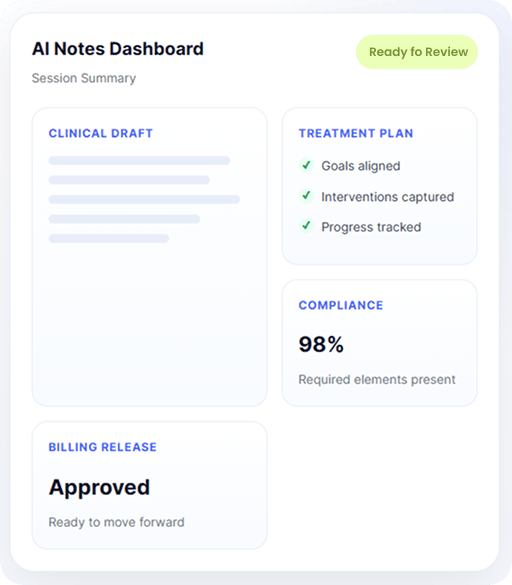

Reduce Documentation Time
Clinicians save hours each week on documentations.

Improve Note Consistency
AI-powered drafts improve quality and consistency.

Support Compliance Workflows
Build-in guidance for required documentation elements

Connect Notes to billing
Seamless integration with billing and operational workflows.
SUPPORTED DOCUMENTATION
Built Specifically for Behavioral Health
Unlike generic AI scribes, DENmaar AI Notes is designed for behavioral health workflows and
documentation requirements.
Individual Therapy
Family Therapy
Group Therapy
Substance Use Treatment
Case Management
Medication Management
Crisis Intervention
Clinical Supervision
Treatment Plans
Assessments and Reviews
AI NOTES WORKFLOW
How It Works
From captured session details to reviewed, billable documentation.

Record or Capture
Session Information
Patient check-in and
visit completed.

AI Generates a
Clinical Draft
AI Notes generate
structured documentation.

Review and Approve
Claim is created and
scrubbed for accuracy.

Release for Billing
Claim submitted to
the payer
DESIGNED FOR COMPLIANCE
Clinical Documentation with Compliance in Mind
AI Notes helps behavioral health providers document medical necessity, align treatment goals, identify
interventions, and support supervisor review workflows.
Compliance Support
Medical necessity documentation
Goal and treatment plan alignment
Intervention identification
Progress tracking
Required behavioral health documentation elements
Supervisor review workflows
Complete
Medical Necessity Documentation
Documentation supports the medical necessity of services provided and reflects the client’s ongoing treatment needs.
Evidence in Note
Aligned
Goal & Treatment Plan Alignment
Clinical documentation connects session content to active treatment goals and supports continuity across the plan of care.
Evidence in Note
- Active treatment goal referenced
- Session objectives tied to treatment plan
- Interventions support documented goals
- Progress linked back to care plan
Verified
Intervention Identification
Notes clearly identify the therapeutic interventions used during the session and how they relate to the client’s needs.
Evidence in Note
- Therapeutic intervention documented
- Intervention matched to presenting concerns
- Clinician actions clearly described
- Modality or technique identified where appropriate
Reviewed
Progress Tracking
Session documentation captures the client’s response to treatment and tracks change over time to support clinical decision-making.
Evidence in Note
- Client response to intervention documented
- Progress toward goals addressed
- Barriers or setbacks identified
- Ongoing symptoms or improvements noted
Included
Required Documentation Elements
Behavioral health notes include the core documentation elements needed for completeness, consistency, and payer readiness.
Evidence in Note
- Session date, duration, and service type included
- Relevant clinical observations documented
- Risk, safety, or notable concerns addressed when applicable
- Required note structure completed for the encounter
Available
Supervisor Review Workflow
Documentation can support internal review and approval workflows, helping supervisors monitor quality, accuracy, and compliance.
Evidence in Note
- Draft available for supervisor review
- Revisions or feedback can be incorporated
- Approval status is clearly tracked
- Final documentation is released after sign-off
MORE THAN A SCRIBE
Documentation Connected to the Rest of Your Workflow
Documentation can connect directly to scheduling, treatment plans, assessments, billing workflows, claims validation,
and provider productivity reporting.

Scheduling

Assessments

Claims Validation

DENmaar AI
Notes
Notes

Treatment Plans

Billing Workflows

Productivity Reporting
WHY ORGANIZATIONS CHOOSE DENMAAR
Built for Behavioral Health Teams and Organizations
DENmaar AI Notes is designed to support real-world clinical documentation and operational workflows.

Behavioral Health Focused
Customizable behavioral health workflows including therapy, psychiatry, substance use treatment, and multidisciplinary care models.

Scheduling & Operational Workflows
Integrated scheduling designed to support provider productivity, patient flow, authorization tracking, and claims readiness.

Supervisor Workflows
Built-in workflow logic designed to improve claim accuracy before submission through integrated operational checks and billing intelligence.

Eligibility & Insurance Verification
Integrated eligibility workflows designed to support Medicaid, commercial insurance, carve-outs, and behavioral health payer complexity.

Patient Engagement
Patient portal, intake workflows, secure communication, reminders, and measurement-based care tools.

Request an
AI Notes Trial
See how DENmaar AI Notes can help your clinicians reduce documentation time while improving
Request a demonstration or pilot program today.
Request Information
TESTIMONIALS
WHAT OUR CLIENTS SAY
On behalf of everyone at Meadowlark Counseling Services, I want to extend our sincere thanks for the continued improvements you and your team have made to the DENMaar EMR platform. We have been consistently impressed with both the functionality and user-friendly design of the system, which has made a meaningful difference in our day-to-day operations. The intuitive layout and ease of use have allowed our staff to spend less time navigating the system and more time focusing on client care. The regular updates and enhancements reflect your commitment to meeting the evolving needs of providers in the behavioral health and substance use treatment fields. We genuinely look forward to the new features introduced each month and appreciate how responsive the platform has been to the demands of clinical workflows. We have been so pleased with our experience that we’ve taken the opportunity to recommend DENMaar to other professionals in Pennsylvania who are working in the SUD field. Thank you again for your ongoing support and partnership. We are grateful to be working with a company that truly understands the needs of its users. KIndly, Becky Parks on behalf of the entire team at Meadowlark Counseling Services
I referred one of my colleagues Dr Aaron to you he is just starting g his psychology private practice and looking at where to start. I told him hands down you guys are the best billers and have a great EMR and team. He said he reached out just wanted to let you know!
FANTASTIC job keeping things rolling along with any and all of our billing concerns as well as responding to other issues which may well have been out of your wheelhouse. We are VERY grateful to have you and the crew in our corner.
I appreciate you all so much and DENmaar has been such a blessing Donna to our overall operations and success as an expanding company—allowing us to ultimately operate more efficiently, get our claims paid more consistently, ad stay on top of the critical credentialing piece, among other things. Teamwork does in fact, make the dream work. I’ll loop Chris/Isabella in on this message thread too, as I want All of your team to be aware of how much we appreciate our working relationship with DENmaar
Thank you for your diligence!! I appreciate it so much. Thank you Edwina…
Thank you so much Amy! I will be referring to DENmaar as often as I am asked about credentialing services.
Our Latest Blogs

5 Credentialing Issues in Healthcare & Their Resolutions
Credentialing issues in healthcare are extremely common. In fact, the process of provider credentialing has to be a prominent compliance issue for medical practices. It is quite normal for providers to have their applications rejected due to omissions and errors. The consequences can be considerably more disastrous without proper data insight and process oversight.
Table of Contents
- 1. 5 Common Credentialing Issues
- 2. Overcoming Issues with Healthcare Credentialing
- 3. We recommend verifying your state’s guidelines for:
- 4. The Bottom Line
Now, mistakes happen in any process. However, the mistakes in credentialing can be especially punishing. For instance, credentialing issues for nurse practitioners can cost a nurse their career. Moreover, mistakes in credentialing can cost healthcare organizations their hard-earned reputation. Suffice to say, no one can afford the legal and financial complications that follow a poorly executed credentialing process.
In this article, we would like to shine a light on some of the most common challenges with the medical credentialing system. We hope that being aware of these challenges will make you better equipped to tackle them.
5 Common Credentialing Issues
1. Keeping Information Up-To-Date
Many healthcare organizations struggle to access relevant applicant information. It is estimated that around 85% of submitted applications suffer from inaccurate, missing, or irrelevant information. It is mandatory to re-attest even minor changes like changes to address and phone number in the CAQH database.
Missing information or outdated details can quickly derail the already complicated and time-consuming credentialing process. The issue becomes even direr when you consider how frequently individual practitioners change the healthcare institutions they work for. Healthcare organizations must keep pace with the changes as they occur to avoid issues during the process.
2. Time-Consuming
It is no secret that the medical credentialing process is a time-consuming one. An application review can take around 90 days to complete. When you consider the involvement of additional stakeholders like contract negotiators and insurance companies, the process can easily go as long as six months. That is a long time and most healthcare organizations find their operations stalled because of it.
3. Staying Compliant
As we mentioned before, compliance issues are most prevalent in the credentialing process. Each state has different standards and policy guidelines that a provider needs to adhere to. Additionally, national organizations like CAQH have their own specific requirements that have to be met as well. This, of course, causes frustrating issues.
Read More: Credentialing Process Checklist You’ll Need in 2022
The rules, regulations, and requirements for medical credentialing vary from state to state. It also doesn’t help that these rules and regulations are volatile and experience frequent changes. It is important to leverage a reliable credentialing service or system to keep up with varying and changing regulations.
4. Challenging to Change Credentialing Program
As your healthcare organization grows and credentialing requirements become inevitably more complex, you will have no choice but to add integrations or switch to a different assessment system entirely. Migrating information in such a scenario, especially when you have a lot of preset prompts and questions that are not standard compliant, can become almost impossible.
You will have no option but to lose one or two components to make the migration possible. It is precisely because of this reason that many healthcare organizations get stuck with outdated platforms that are not capable of efficiently undertaking the credentialing process.
5. Ensuring the Privacy of Healthcare Professionals
Background checks are an integral part of the credentialing process. They are essential to determine that the applicant possesses the skills and qualifications required to provide care to patients. The process entails the submission of crucial documents such as practice license, work history, education qualification, etc.
As such, privacy become of the utmost importance. The credentialing organization will require information about an applicant’s entire history. Not disclosing this important information can result in the practitioner’s application being rejected. You will need a credentialing service or platform that keeps all of this information up-to-date and secure from prying eyes. Sadly, most organizations don’t have adequate platforms to safeguard such valuable information.
Overcoming Issues with Healthcare Credentialing
1. Outsource Your Credentialing Task
When it comes to hiring someone to overtake your credentialing process, there are two options at your disposal. You can try hiring an in-house staff that is dedicated to managing the process from start to finish or opt to outsource the task to third-party specialists like DENmaar.
Out of the two, outsourcing is evidently a relatively more cost-effective and time-efficient way to handle credentialing. With outsourcing, you get access to credentialing experts and their technology. Moreover, you aren’t saving money by not hiring personnel on salaries.
2. Pay Special Attention to Individual State Guidelines
It is important to do your homework with regards to what rules, legislations and policies would be applicable to your healthcare organization. As each state has different requirements, you need help of medical credentialing experts that are aware of policies and can help you with seamless and compliant transition.
We recommend verifying your state’s guidelines for:
- • Licenses
- • Education qualifications
- • Certifications.
3. Leverage Credentialing System Technology that Automates the Process
There are systems and advanced technology available today that can help your business automate the credentialing process to a good degree. We recommend looking for a credentialing platform that can:
- • Reduce Credentialing Workload Affecting Your Staff
- • Reduce Training Time for New Staff
- • Save time to focus on company growth.
Implementing such technology can be expensive. However, you stand to enjoy greater benefits in the long run with these technologies managing crucial aspects of your credentialing process.
The Bottom Line
Credentialing is no child’s play. Most healthcare organizations do not have the staff or resources to handle it with the care deserved. Fortunately, you can save yourself a lot of trouble by simply hiring credentialing specialists like DENmaar.
We understand how frustrating the process can be, and thus offer services dedicated to relieving you of this unwanted burden. We provide a fully automated system that gives you real-time updates of your credentialing application status. Plus, you get automatically notified by our robust system on the imminent expiration of documents, so your practice continues to legally serve patients with insurance. Moreover, we offer medical insurance credentialing services for sole practitioners as well as huge medical organizations.
What is Medical Credentialing, and How it Works & Costs?
Medical credentialing is a complex concept to understand. So it is only natural for one to have several questions about it. In this article, we aim to answer some of the most frequently asked questions surrounding the topic, and in the process, help you understand this complicated but fundamental aspect of our medical world even better.
Table of Contents
- 1. How Exactly Does Medical Credentialing Work?
- 1.1. What are the Benefits of Medical Credentialing?
- 1.2. Can a Provider Allowed to Work During the Credentialing Process?
- 1.3. What Kind of Facilities Need Credentialing?
- 1.4. What is the NCQA?
- 1.5. What is TJC?
- 1.6. What is CMS?
- 1.7. What Does Primary Source Verification Mean?
- 1.8. What is the Credentialing Committee?
- 1.9. How Long Does a Medical Credentialing Process Last?
- 1.10. How much will Medical Credentialing Cost You?
- 2. What Do I Look for in a Credentialing Service Provider?
So without much further ado, let’s get started.
How Exactly Does Medical Credentialing Work?
Medical credentialing is a process undertaken with the main purpose of maintaining high standards of quality expected from the medical industry. The process usually entails the verification of a healthcare provider’s competency with regards to their educational qualifications, work history, certifications, etc.
A credentialing authority will contact a provider’s university, certification board and licensing agency to verify whether he or she is capable of providing healthcare. Credentialing is considered to be imperative for all types of providers who engage in providing medical assistance to patients. It needs to be conducted at regular intervals to make sure a healthcare organization or provider is complying with regulatory standards and policies set by bodies like the Centers of Medicare and Medicaid Services, The Joint Commission, National Committee for Quality Assurance, etc.
What are the Benefits of Medical Credentialing?
Medical credentialing has a plethora of benefits in store for all parties involved with the process. Credentialing provides hospital and clinics with the assurance that their hired staff will offer their services at the level of standards expected of them. Insurance companies can keep their costs down by making sure only competent medical professionals pass the credentialing process.
Practitioners also benefits immensely from credentialing as they can expand their services to more patients with access to different types of health insurance. However, patients stand to benefit the most out of credentialing. They can rest assured on receiving the highest quality of care from the most qualified providers.
Can a Provider Allowed to Work During the Credentialing Process?
It is recommended for a healthcare provider to halt their services until the entire credentialing process is complete. This guarantees that all patients receive quality care from only those providers who have verified qualification to offer their services. A healthcare organization is putting itself in unnecessary risk by letting non-credentialed individuals work for them.
That being said, there are a few exceptions to the rule. Medical students, for instance, don’t need credentialing as long as their duties to do not cross the scope of their educational program. They typically don’t need to undergo credentialing as they are working under the strict supervision of superior credentialed providers.
What Kind of Facilities Need Credentialing?
Aside from practitioners, facilities that engage in the act of providing healthcare need credentialing as well. As such, the following services and facilities need to undertake the process to show they comply with the expected standards of care and competence.
- • Dialysis
- • Ambulance
- • Home Health Services
- • Hospice Care
- • Durable Medical Equipment
- • Independent Diagnostic Testing
- • IV Home Infusion Therapy
- • Laboratories
- • Prosthetics
- • Orthotics
- • Lithotripsy
- • Urgent Care Centers
- • Radiology
What is the NCQA?
The NCQA, aka The National Commission for Quality Assurance is an independent non-profit organization. Their job is to evaluate the quality of healthcare provided by medical practices and issues credentials based on their findings. The organizations that go to NCQA for credentialing include managed behavioral healthcare organizations, preferred provider organizations, credentials verification organizations, etc.
What is TJC?
The TJC, or the Joint Commission, is an organization tasked with maintaining high standards of healthcare in the United States of America. They conduct surveys that aim to verify the standards of healthcare provided by the hospitals in USA. Organizations like hospitals proactively answer to accrediting surveys hosted by the TJC every three years.
What is CMS?
The CMS, or The Centers for Medicare and Medicaid Services is a federal agency that serves under the United Stated Department Health and Human Services. It is responsible for performing a number of functions, which include evaluating quality standards of clinical labs and facilities that have been offering care to patients for a long time. The CMS works closely with state governments to administer and monitor Children’s Health Insurance Program, Medicaid, etc.
What Does Primary Source Verification Mean?
Primary Source Verification basically means that a credentialing authority will directly verify a provider or organization’s credentials from the source of that credential itself. For instance, a CVO will directly contact the university to verify a practitioners education qualifications. This is usually done to avoid fraud. As such, documents from third-party sources are not entertained.
What is the Credentialing Committee?
Credentialing committee is responsible for overseeing the entire application review process. They have to make sure that the applicants meet the desired set of quality standards. This committee will include doctors with varying specialties, a liaison with the CVO and a chairperson. If you meet the basic requirements of credentialing, you can appeal a committee’s decision. You will receive all the information needed if it is deemed that you have the right to appeal.
How Long Does a Medical Credentialing Process Last?
The medical credentialing process can be excruciatingly long. It can take anywhere from days to weeks, and sometimes months. Typically, you can expect the credentialing process to take as long as 90 to 120 days. As such, we recommend starting your application process at least 3 months before you begin your duties as a healthcare provider.
How much will Medical Credentialing Cost You?
The costs for medical credentialing will vary from CVO to CVO, organization to organization and specialty to specialty. Generally speaking, you can expect to pay around three to four hundred dollars for your application fee alone. You can also anticipate partial reimbursements after your credentialing process has been completed successfully.
You will also incur costs on periodic and re-credentialing as well. However, you can expect to get this done at a discounted rate.
What Do I Look for in a Credentialing Service Provider?
Experience and a good reputation are arguably two of the most prominent factors you must consider when looking for a credentialing service provider. Such service providers are usually home to credentialing specialists who possess the resources, insight and experience needed to handle the entire credentialing and re-credentialing process from start to finish in a quick, efficient and hassle-free manner.
You will find the above qualities demonstrated perfectly by the credentialing specialists’ right here at DENmaar. With years of industry experience, we’ve helped many providers and facilities get credentialed and can do the same for you.
Reach out to us at 844-727-3627 to learn more about our services.

Why Does Patient Scheduling Needs An Upgrade?
Healthcare providers can take these necessary actions for the patients in scheduling appointments.
Patients always look for convenient and flexible access to healthcare, and for many, this means looking for self-care options. In addition, healthcare approaches influence digital experiences in other industries, including hospitality and travel, in many ways.
For example, self-scheduling bypasses common barriers to access, such as working hours and waiting times. In addition, by enabling patients to schedule their services, physicians build commitment, which has been shown to bridge the gap in care.
The experience of digital patient participation has evolved significantly during the Covid-19 pandemic. With asynchronous symptom screening tools that can be deployed with the help of cloud-based platforms like DENmaar, the care experience can start online quickly. Moreover, the patient’s scheduling is particularly strong during the vaccination process.
When the COVID-19 vaccine became available in late 2020, thousands of people were at risk of overwhelming the health system due to the need to vaccinate quickly and efficiently. The automated self-scheduling process reduced the burden on healthcare workers and enabled patients to choose visits for themselves, allowing healthcare workers to focus on other priorities.
According to a study, about 80 percent of patients prefer doctors who offer online scheduling. Also, a 2019 survey found that 70 percent of patients said they would choose providers who would send emails or texts to take preventive or follow-up care.
Healthcare systems need to evaluate their scheduling options to avoid long waiting times and poor patient experiences because it can affect their ability to attract new patients and retain existing patients. Moreover, patients and staff will benefit from investing in better digital solutions, such as scheduling options.
While making scheduling more straightforward and accessible for patients will help fill out calendars, canceling appointments and no-shows can create vacancies at the back-end of the scheduling process. Patients cancel or miss medical visits for various reasons, but good patient participation strategies can help providers move forward and keep up with the scheduling software.
Here are the top four reasons why patients cancel medical visits and what providers can do to address these issues:
1. Anxiety before an appointment due to unknown fears
For many, the fear and apprehension of seeing a doctor can cause visits to be avoided, delayed, or cancelled. Patients fear the bad news, are reprimanded for postponing treatment, and are uncertain about their financial responsibility. Patients may wait for the visit to avoid a blood test or some tests and procedures. Concerns about exposure to Covid-19 have also increased over the past year, resulting in more patients postponing care or cancelling visits.
Helping patients understand what to expect during their visit helps reduce the fear. In addition, offering virtual care services such as video visits and remote patient monitoring is an excellent option for patients in times of global health crisis.
2. Concerns about high financial costs
Out-of-pocket expenses and employer deductions are higher than usual. According to a poll, many say they do not receive the medical care they need because of the cost. Twenty-two percent of those surveyed stopped treating a severe condition because of the cost.
Helping patients understand their financial responsibilities and educating them about payment plans and their financial options can help reduce cancellations. In addition, using automated digital recording and recording software can help medical office staff gather information about early payments on a patient’s journey and help them have a better conversation about financial resources and responsibilities before a visit.
3. No convenient schedule
Studies show that people work longer hours per week. Challenging work schedules, family lifestyles, and personal commitments make it difficult for some to prioritize their health. When the consequences of taking a break from a workday to see a doctor seem more severe than a health problem, it is easier for patients to prioritize meetings and tasks than their scheduled doctor’s visit, especially if they are not seriously ill.
The availability of flexible scheduling options and virtual care can play a role in helping patients prioritize their health, even in their busy schedules. Also, updated integrations in EHR with video conferencing tools can enable seamless and secure digital encounters for patients.
4. Unavailability of appointment
Increased queues and waiting times can significantly affect cancellation rates. Sick patients, frustrated by waiting so long for an appointment, are more likely to have it cancelled and taken care of in an emergency or retail clinic.
Keeping a small percentage of appointments for daily visits and offering virtual care to visually impaired patients make’s it easier for patients to remain loyal to their known providers and reduces the likelihood of intermittent care elsewhere. Automated waiting list software can help medical offices fill out cancelled visits of patients expecting an early visit. Features that allow patients to schedule for several weeks or even months can help keep patients well and promote a good schedule.
Expecting and working with patient barriers can help providers build a system that works for patients and lead to better financial, operational, and clinical outcomes. When appointment scheduling revolves around patient access and convenience, healthcare providers and staff also reap the benefits of efficient processing.
Who can take care of your patient scheduling?
The DENmaar Scheduler offers several key features that you should look for when analyzing the quality of a patient scheduling system. The DENmaar schedule may be available to operating staff, but they may not have access to the patient’s complete medical information. This feature helps reduce the risk of any privacy and security breaches.
DENmaar Scheduler is a one-click system for adding, removing, or editing visits, thus reducing the possibility of human error.
Since DENmaar scheduler providers have remote access to their patient portal schedule, it is helpful for them to adjust visits or availability as needed.
Our Partners






Ready to get started?
Feel free to reach out if you have any questions.
