

We don’t just submit claims. We create visibility and accountability around every unpaid claim—so management knows what’s being worked, what’s stuck, and why.
Know What’s Happening With Every Unpaid Claim
Behavioral health billing with complete visibility and accountability

98.1%
Clean Claim Rate
1.47%
Rejection Rate
0.32%
Denial Rate
5–10%
Denial Rate
10–20%
Average Revenue
Improvement
$0
EHR Software Fee
With Billing Services
With Billing Services
CLAIMS VISIBILITY
Your Claims May Be Getting
Submitted. But Are They Getting Paid?
Submitting a claim is only the beginning.
Your Claims May Be Getting
Submitted. But Are They Getting Paid?
Revenue is lost when rejected claims aren’t corrected, denials aren’t resolved, authorizations expire, payer requests go unanswered, and unpaid claims disappear into spreadsheets and work queues.
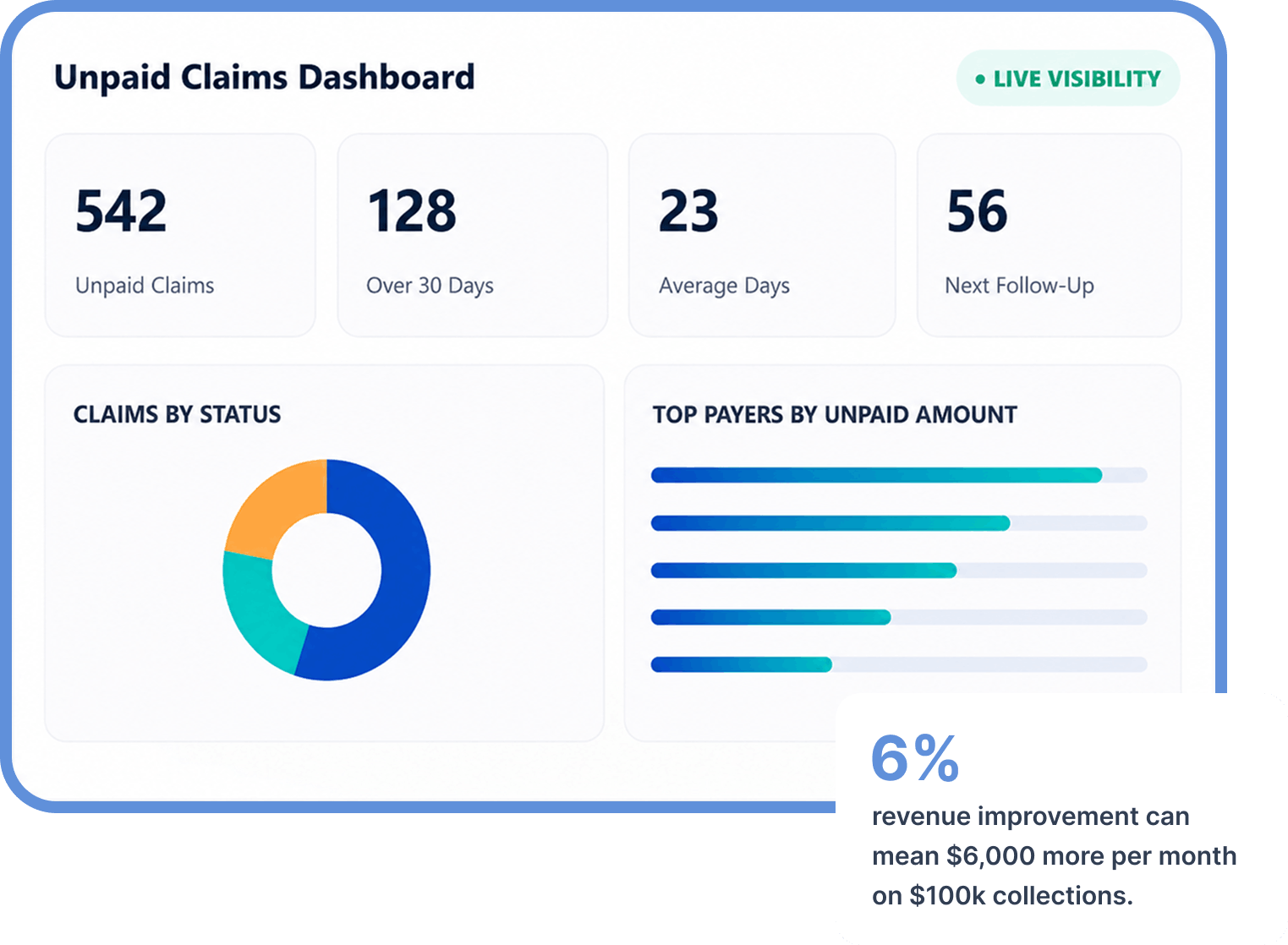
DENmaar gives behavioral health practices a clear view of:
- Which claims remain unpaid
- Why each claim is stuck
- What action has been taken
- Who is responsible for the next step
- When follow-up is due
- What the payer said during the last follow-up
- Which payers and problems are creating the most lost revenue
You no longer have to accept, “We’re working on it.”
You can see exactly what is being worked, what happened and what comes next.
The Improvement in Claims Can Pay for DENmaar
any practices are already losing more money through preventable claim problems than they would spend fixing them.
For a practice collecting $100,000 per month
6% = +$6,000 / month
in realized insurance revenue
That improvement alone could offset the cost of DENmaar’s billing services.
- Behavioral health EHR software at no additional cost
- Claims Copilot
- Eligibility and insurance workflows
- Payment posting
- Rejection and denial management
- Aging-claim follow-up
- Reporting and management visibility
- Support from DENmaar’s Insurance Knowledge Team
Claim Lifecycle
Every Claim Has an Owner, a Status
and a Next Action
DENmaar creates a structured process for managing the entire claim lifecycle—from appointment readiness
through final payment.
01
Prevent Problems Before Submission
Eligibility, payer, authorization, credentialing and documentation issues are identified before they become rejected or denied claims.
02
Submit Clean Claims
Claims are reviewed for common errors and payer requirements before submission.
03
Monitor the Payer Lifecycle
Claims are tracked after submission so unresolved claims don’t quietly disappear into aging.
04
Assign the Next Action
Every problem claim has a clear status, responsible team member and required next step.
05
Document Every Follow-Up
Management can see when follow-up occurred, what the payer said and what must happen next.
06
Escalate Unresolved Claims
Claims receive additional attention before filing limits or appeal deadlines are missed.
07
Measure Performance
Monitor clean claims, rejections, denials and aging by payer, provider, location, service and responsible team member.
Management Visibility
Your Billing Operation Shouldn’t Be a
Black Box
Monthly reports tell you what has already happened. DENmaar provides visibility into
what is happening now.
Visibility creates accountability.
A practice should not have to wait until collections fall to discover that claims aren’t being worked effectively.
- Whether claims are being worked consistently
- Whether follow-up is producing results
- Why claims remain unpaid
- Whether the same errors keep recurring
- Where responsibility for the next action sits
- Which workflows or team members need support
- Which payers are causing the most problems
- How much revenue remains at risk
Visibility creates accountability.
Accountability creates action.
Action moves claims toward payment.
Improve the Team You Have—or Let DENmaar Manage the Process
Some practices already have an internal billing team but lack the technology, payer knowledge and management visibility required to oversee it. Others want an experienced partner to manage the entire revenue cycle.
OPTION 01
Claims Copilot for Your Existing Team
Give your billing staff the structured workflows, claim intelligence and accountability tools needed to manage unpaid claims more effectively. Management gains visibility without immediately replacing the internal team.
OPTION 02
Full Revenue Cycle Management
Let DENmaar manage claim creation and submission, rejection correction, payment posting, denial resolution, insurance follow-up, aging claims, payer escalation, patient balances and revenue-cycle reporting.
Either way, management gains control over the revenue cycle.
Behavioral Health Expertise
Built Specifically for Behavioral Health
Behavioral health billing requires more than generic claim submission.
Mental health therapy
Psychiatry and medication management
Substance-use treatment
Intensive outpatient and partial hospitalization programs
Community behavioral health
Multidisciplinary practices
Telehealth billing
Time and unit requirements
Rejections and denials
Built Specifically for Behavioral Health
- Behavioral health payer carve-outs
- Eligibility and benefit verification
- Prior authorizations
- Provider credentialing
- Therapy and psychiatric coding
- Same-day services
- Telehealth billing
- Missing or incomplete documentation
- Coordination of benefits
- Rejections and denials
- Aging insurance balances
Before Billing Begins
Problems Are Often Created Before Billing Begins
Many claim problems originate before the claim reaches the billing team.
An appointment may be scheduled with the wrong payer. Eligibility may not be verified. An authorization may be missing. Documentation may not support the code or units billed. A provider may not be enrolled correctly.
DENmaar connects scheduling, eligibility, authorizations, documentation and billing in one operational system.
This helps prevent bad claims—not merely work them after they fail.
Prevent the problem upstream.
01
Scheduling
Right payer • right workflow
02
Eligibility & Authorization
Verify before service
03
Documentation
Support code and units
03
Billing
Submit cleaner claims
More Than Billing
Technology, Insurance Expertise and
Human Follow-Through
Most billing companies provide reports. Most software companies provide tools. DENmaar combines:
Technology, Insurance Expertise and
Human Follow-Through
You get a system designed to improve the financial performance of your behavioral health practice.
Enterprise capability with small-practice simplicity.
- Behavioral health EHR technology
- Claims Copilot
- Revenue-cycle services
- Insurance knowledge
- Human payer follow-up
- Management visibility
- Operational accountability
Billing Review
See What Better Claims Performance Could Mean for Your Practice
If too many claims are rejected, denied, aging or simply unexplained, let’s look at the process together.
Current monthly insurance revenue
Baseline performance
Clean-claim rate
Rejection and denial rates
Claims over 30 days
Value of unpaid and aging claims
Follow-up process
Where accountability is breaking down
Let’s Determine Whether There Is Operational Alignment
We begin with a discussion focused on:
- Organizational structure
- Insurance workflows
- Operational goals
- Implementation fit
Request Information
Capterra, Software Advice And Get App 2023 / 25
Best Of Badges Awarded To DENmaar
2023 / 25 “Best of” badge winners = DENmaar Neuro has earned a well-deserved Best Value Badge.
See our reviews for our software being recognized as an impactful solution for your business.





Our Latest Blogs

Understanding Autism Spectrum Disorder
It’s the month of April, also widely celebrated a World Autism Month among other events. However, given the severity of this condition, awareness about autism should be pervasive all year-round and not only for a single month. The awareness for autism commands a great amount of empathy from everyone as ASD’s vary among individuals suffering from it.
Certain therapies and treatments can do wonders for some while being completely futile for others. Caregivers like parents and nurses can also harbor different opinions on how to best deal with a condition of ASD.
This article is focused on not only spreading awareness about Autism but also helping parents and other caregivers better manage the conditions in their loved ones.
What is Autism Spectrum Disorder?
Autism Spectrum Disorder, or as it is popularly known as ASD is a complex developmental condition that saddles individuals suffering from it with challenges like inept social interaction, speech problems, non-verbal communication, and repetitive behaviors. The severity of ASD’s varying from person to person.
ASD is quite frequently first diagnosed in childhood, with signs first becoming noticeable around 2-3 years of age. Some children with autism may develop normally before ultimately losing all their previously gained skills.
The CDC estimates that at least one in 59 children have autism. It is also more common in boys than in girls, and the girls who do have ASD exhibit less obvious signs than boys. Although ASD is a permanent condition, many children who are diagnosed with the condition go on to live normal and independent lives.
The Characteristic of People suffering from ASD
Like we said, no two people will show the same behavioral signs when dealing with autism. Symptoms can mild or severe and change as time passes by. Some of the common characteristics are as follows:
Social and Communication Problems
This includes exhibiting difficulty in having a straight forward normal conversation, not showing interest, or sharing emotions. Issues in trying to understand social cues like eye contact or facial expressions.
Difficulty in Empathizing with People, things and events
Trouble in making friends, interacting with people and not making eye contact
Repetitive behaviors
This can include a number of things, mainly pertaining to hand flapping, flipping objects, lining up toys, speaking in gibberish or atypical manner, exhibiting interest in unusual activities, toe walking, etc.
It is important to note, that while many children with ASD have normal intelligence, some have very mild and significant intellectual delays.
Diagnosis
Early diagnosis of ASD is crucial in parents and caregivers being able to manage this condition. It is the only way by which a child’s symptoms can be reduced and his life ultimately improved. Like we said there is no definitive cure-all for autism spectrum disorder. It is mainly diagnosed by the obstinate observance of the child’s behavior like he talks and interacts with other children his age.
Trained practitioners can easily diagnose the condition by talking to the child and enquiring with his/her parents and caregivers. It is in compliance with federal law that any child suspected of having any kind of developmental disorder should be given a free evaluation. It is highly recommended that the child undergo all sorts of screening procedures to identify developmental disorders, if any, by age three.
If you have doubts about whether or not your child is developing properly, then bring it to the attention of your practitioner immediately. Every second is precious in handling the condition of autism wisely.
The CDC (Center for Disease Control and Prevention) identifies the following red flags as possible signs of ASD:
- • Not responding to his/her name by 12 months of age
- • Not pointing out to objects to display interest by 14 months of age
- • Getting upset very easily
- • Spinning in circles, flapping their hands incessantly
- • Having unusual and intense reactions to sight, smell, taste and feel
- • Avoiding eye contact
- • Preferring loneliness
- • Not playing ‘pretend’
As of now, no expert has clear answers on what actually causes autism. It can be due to genes, or the condition and environment in which a child is born and raised. A child is also at a greater risk of having autism, if there is a close family member who is already suffering from the condition.
How Autism is Treated
As of now there is really no cure for the condition of Autism. However, there are many therapies and treatments that can help people alleviate their symptoms and feel much better.
Some of those treatments are listed below
- • Behavioral Therapy
- • Play therapy
- • Occupational therapy
- • Speech therapy
- • Physical therapy
Alternative Treatments
Many alternative treatments are also in effect today, some of them include the following:
- • High dose Vitamins
- • Hyperbaric oxygen therapy
- • Melatonin to handle sleep issues
The research on these treatments is mixed, and results may vary from person to person. It is highly advisable to weigh the research and financial costs of such treatments before considering them for you or your loved ones.
Tips for Parents and Caregivers
Parents can really help their child overcome the problems posed by ASD by following the below simple tips:
- • Learn and be well informed about Autism Spectrum Disorder
- • Provide consistent structure and routine
- • Seek professional help
- • Build a rapport with other parents who are raising children with autism
- • Take your time and be patient while dealing with your child
DENmaar Partners with Autism Lizard to Offer Efficient Autism Management Program
A child with autism can be extremely stressful for the entire family. Handling it can be a headache, very time consuming and break your savings. DENmaar knows how important it is to take into account the emotional and physical health of the entire family, and thus have partnered with premier behavioral training service providers who offer legit, tried and tested autism solution for your family at an affordable price. DENmaar clients and subscribers can now avail tempting discounts for Autism lizards Family Autism Independence System program. Offer is available for a limited time only, so HURRY!!

The Major Difference between Telehealth and Telemedicine
At first glance, both telehealth and telemedicine seem very similar terms, that however, cannot be any further from the truth. Today the fields of Mobile IT health, digital health and telemedicine are changing so rapidly, that it is hard to settle on one accurate definition for these terms, hence you will see both Telemedicine and Telehealth being used interchangeably.
Both terms consist of very similar services which include patient monitoring, e-health, medical education, patient consultation etc. If you really want to get to technical with the terms then Telemedicine is a subset of Telehealth.
Telehealth, on the other hand is much broader term in scope which includes all telecommunication services that offer or engage in health care. Telemedicine refers only to clinical services.
Here’s a definition that could clear your mind on the concept:
Telemedicine refers to traditional clinical diagnosis and screening provided by technology, whereas Telehealth encompasses many different types of diagnosis, management and education. Telehealth concerns itself with many different range of telemedicine services which include both clinical and non-clinical services.
Telehealth being the more popular term can be found in general health care services, while Telemedicine deals specifically with a clinician that provides a very specific kind of health service.
Examples of Telehealth
- A video conferencing platform for consultation and education
- A health app that alerts people of impending outbreak
- Fit Bits that monitor your pulse and heart rate
Example of Telemedicine
- An app that helps physicians treat their patients remotely via video conferencing
- A software that allows patients to send photos of a rash or a mole that has been bothering them to their doctors.
- An app that schedules appointments with doctors within minutes.
As you can see Telemedicine is simply a small part of telehealth. Telemedicine has become even more popular and is being widely consumed thanks to the recent COVID-19 outbreak. If anything, it has proved its worth in times of emergency and will gain further validity once the pandemic is defeated.
DENmaar’sTeleHealth Services
At DENmaar, our telehealth solution offers both patients and providers with a communication technology that allows the access and management of health care services from homes of patients or the practices of doctors. This tele-conferencing feature allows practitioners to attend to their patients, on their computer screens, where-in they can consult and serve their clients without having to make them wait in their clinics or making them transit long distances.
All you have to do to access our feature, whether you are a provider or patient, is to sign up to our app and avail our telepsych feature.

Pros and Cons of Tele-Nursing
We all want our healthcare to be both effective in its treatment and affordable in its cost. When telehealth is implemented efficiently, both of the above aspects become easier to achieve. We can see improvements in patient satisfaction as well as management of healthcare amidst your own organization.
An advance in communication technology is only making things better for the telehealth industry. Smartphones today are faster and actually smart. Stronger internet connections are ensuring care is rendered uninterrupted. Today, telehealth is so much more than simply calling up your nurse to explain your symptoms.
In this article, we will look at Tele-nursing, its pros, and its cons. So without much further ado, let’s jump right into the meat of this article.
Pros and Cons of Tele-Nursing
Better management of Chronic Conditions
RPM aka Remote patient monitoring has replaced traditional clinical visits today to manage chronic conditions like diabetes and COPD. In RPM there’s less fragmentation of care when a patient lapses with their responsibilities. With fewer contact, there are less clinical visits and readmissions. In one study, participants of the ‘behavioral health intervention telehealth program’ experienced less hospital admissions than the patients who did not participate.
Increased Access to Care
Patients who live in rural areas are the most significant beneficiaries of telehealth. Rural areas have always received the harsh end of a stick when it came to accessing to health care. Tele-health changed all of that. Now, rural areas, thanks to the strong internet connection and better smartphones have access to healthcare.
Avoid Risk
In the context of the recent COVID-19 outbreak, Telehealth provides a great opportunity for doctors to still consult their patients via videoconferencing while adhering to the mandatory discipline of social distancing.
Save Time
With telehealth, patients don’t have to travel long distances to meet their doctors. They don’t have to wait in long lines as well. Tele-health saves time which is precious to both doctors and patients.
Cons
Some Visits are Necessary
Although telehealth is crucial in providing convenient health care to patients, it still cannot make up for physical consultation which is necessary for most situations. Doctors cannot feel your stomach through telehealth, they cannot swab your throat, or listen discerningly to your lungs or heartbeat.
Licensing issues
Licensing issues restrict nurses from providing health care to patients that do not fall in their state. Nurses can only practice and provide care in the states that permit them to practice health care.
Reimbursement
Insurance coverage for telehealth services is still shoddy and needs a lot of work. Only 21 states today require private insurers to cover telehealth services. Medicaid programs vary from state to state in paying for services offered by nurses through telehealth.
DENmaar’s TeleHealth Services
At DENmaar, our telehealth solution offers both patients and providers with a communication technology that allows the access and management of health care services from homes of patients or the practices of doctors. This teleconferencing feature allows practitioners to attend to their patients, on their computer screens, where-in they can consult and serve their clients without having to make them wait in their clinics or making them transit long distances.
Our Partners






Ready to get started?
Feel free to reach out if you have any questions.
