

We don’t just submit claims. We create visibility and accountability around every unpaid claim—so management knows what’s being worked, what’s stuck, and why.
Know What’s Happening With Every Unpaid Claim
Behavioral health billing with complete visibility and accountability

98.1%
Clean Claim Rate
1.47%
Rejection Rate
0.32%
Denial Rate
5–10%
Denial Rate
10–20%
Average Revenue
Improvement
$0
EHR Software Fee
With Billing Services
With Billing Services
CLAIMS VISIBILITY
Your Claims May Be Getting
Submitted. But Are They Getting Paid?
Submitting a claim is only the beginning.
Your Claims May Be Getting
Submitted. But Are They Getting Paid?
Revenue is lost when rejected claims aren’t corrected, denials aren’t resolved, authorizations expire, payer requests go unanswered, and unpaid claims disappear into spreadsheets and work queues.
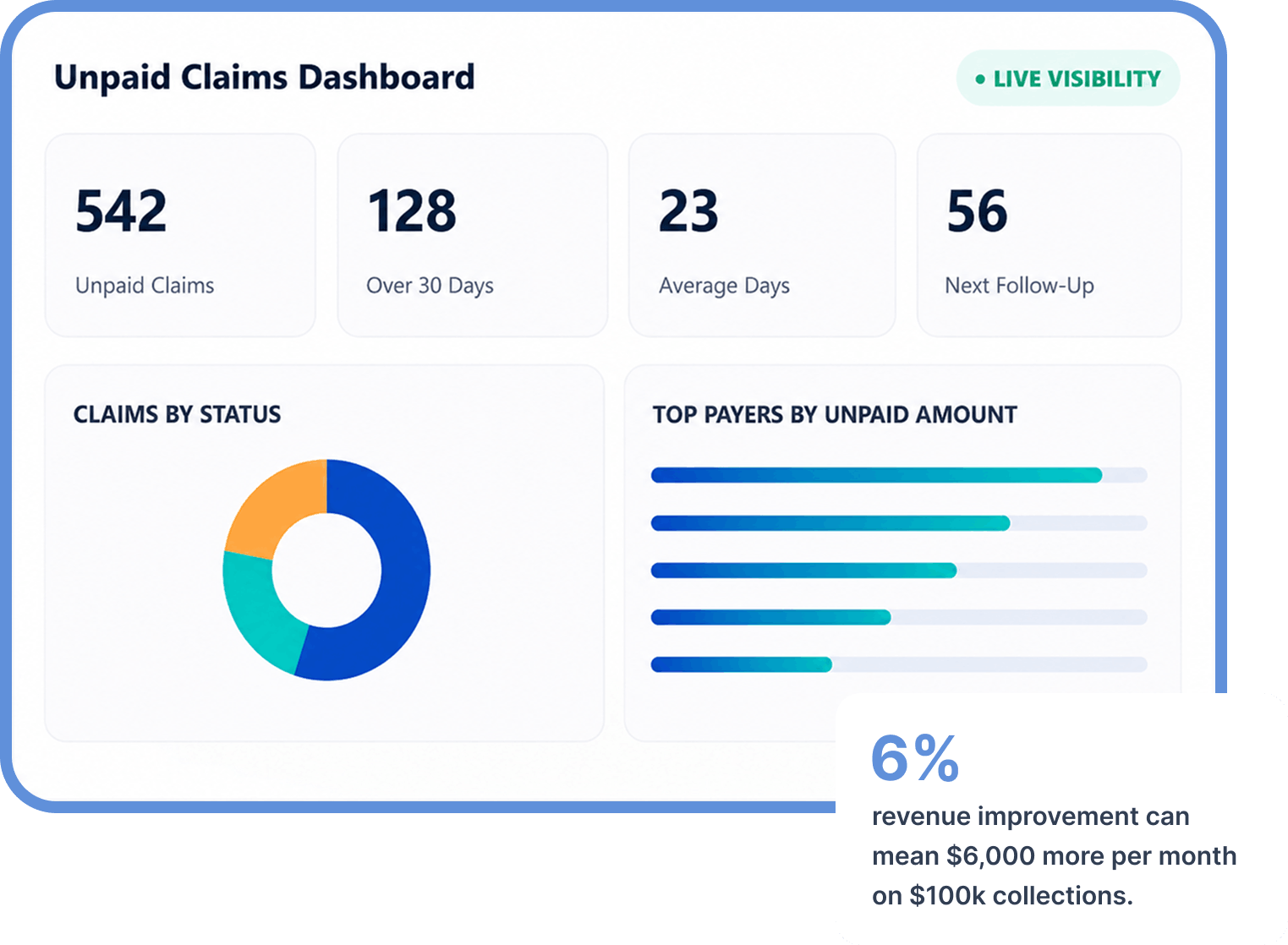
DENmaar gives behavioral health practices a clear view of:
- Which claims remain unpaid
- Why each claim is stuck
- What action has been taken
- Who is responsible for the next step
- When follow-up is due
- What the payer said during the last follow-up
- Which payers and problems are creating the most lost revenue
You no longer have to accept, “We’re working on it.”
You can see exactly what is being worked, what happened and what comes next.
The Improvement in Claims Can Pay for DENmaar
any practices are already losing more money through preventable claim problems than they would spend fixing them.
For a practice collecting $100,000 per month
6% = +$6,000 / month
in realized insurance revenue
That improvement alone could offset the cost of DENmaar’s billing services.
- Behavioral health EHR software at no additional cost
- Claims Copilot
- Eligibility and insurance workflows
- Payment posting
- Rejection and denial management
- Aging-claim follow-up
- Reporting and management visibility
- Support from DENmaar’s Insurance Knowledge Team
Claim Lifecycle
Every Claim Has an Owner, a Status
and a Next Action
DENmaar creates a structured process for managing the entire claim lifecycle—from appointment readiness
through final payment.
01
Prevent Problems Before Submission
Eligibility, payer, authorization, credentialing and documentation issues are identified before they become rejected or denied claims.
02
Submit Clean Claims
Claims are reviewed for common errors and payer requirements before submission.
03
Monitor the Payer Lifecycle
Claims are tracked after submission so unresolved claims don’t quietly disappear into aging.
04
Assign the Next Action
Every problem claim has a clear status, responsible team member and required next step.
05
Document Every Follow-Up
Management can see when follow-up occurred, what the payer said and what must happen next.
06
Escalate Unresolved Claims
Claims receive additional attention before filing limits or appeal deadlines are missed.
07
Measure Performance
Monitor clean claims, rejections, denials and aging by payer, provider, location, service and responsible team member.
Management Visibility
Your Billing Operation Shouldn’t Be a
Black Box
Monthly reports tell you what has already happened. DENmaar provides visibility into
what is happening now.
Visibility creates accountability.
A practice should not have to wait until collections fall to discover that claims aren’t being worked effectively.
- Whether claims are being worked consistently
- Whether follow-up is producing results
- Why claims remain unpaid
- Whether the same errors keep recurring
- Where responsibility for the next action sits
- Which workflows or team members need support
- Which payers are causing the most problems
- How much revenue remains at risk
Visibility creates accountability.
Accountability creates action.
Action moves claims toward payment.
Improve the Team You Have—or Let DENmaar Manage the Process
Some practices already have an internal billing team but lack the technology, payer knowledge and management visibility required to oversee it. Others want an experienced partner to manage the entire revenue cycle.
OPTION 01
Claims Copilot for Your Existing Team
Give your billing staff the structured workflows, claim intelligence and accountability tools needed to manage unpaid claims more effectively. Management gains visibility without immediately replacing the internal team.
OPTION 02
Full Revenue Cycle Management
Let DENmaar manage claim creation and submission, rejection correction, payment posting, denial resolution, insurance follow-up, aging claims, payer escalation, patient balances and revenue-cycle reporting.
Either way, management gains control over the revenue cycle.
Behavioral Health Expertise
Built Specifically for Behavioral Health
Behavioral health billing requires more than generic claim submission.
Mental health therapy
Psychiatry and medication management
Substance-use treatment
Intensive outpatient and partial hospitalization programs
Community behavioral health
Multidisciplinary practices
Telehealth billing
Time and unit requirements
Rejections and denials
Built Specifically for Behavioral Health
- Behavioral health payer carve-outs
- Eligibility and benefit verification
- Prior authorizations
- Provider credentialing
- Therapy and psychiatric coding
- Same-day services
- Telehealth billing
- Missing or incomplete documentation
- Coordination of benefits
- Rejections and denials
- Aging insurance balances
Before Billing Begins
Problems Are Often Created Before Billing Begins
Many claim problems originate before the claim reaches the billing team.
An appointment may be scheduled with the wrong payer. Eligibility may not be verified. An authorization may be missing. Documentation may not support the code or units billed. A provider may not be enrolled correctly.
DENmaar connects scheduling, eligibility, authorizations, documentation and billing in one operational system.
This helps prevent bad claims—not merely work them after they fail.
Prevent the problem upstream.
01
Scheduling
Right payer • right workflow
02
Eligibility & Authorization
Verify before service
03
Documentation
Support code and units
03
Billing
Submit cleaner claims
More Than Billing
Technology, Insurance Expertise and
Human Follow-Through
Most billing companies provide reports. Most software companies provide tools. DENmaar combines:
Technology, Insurance Expertise and
Human Follow-Through
You get a system designed to improve the financial performance of your behavioral health practice.
Enterprise capability with small-practice simplicity.
- Behavioral health EHR technology
- Claims Copilot
- Revenue-cycle services
- Insurance knowledge
- Human payer follow-up
- Management visibility
- Operational accountability
Billing Review
See What Better Claims Performance Could Mean for Your Practice
If too many claims are rejected, denied, aging or simply unexplained, let’s look at the process together.
Current monthly insurance revenue
Baseline performance
Clean-claim rate
Rejection and denial rates
Claims over 30 days
Value of unpaid and aging claims
Follow-up process
Where accountability is breaking down
Let’s Determine Whether There Is Operational Alignment
We begin with a discussion focused on:
- Organizational structure
- Insurance workflows
- Operational goals
- Implementation fit
Request Information
Capterra, Software Advice And Get App 2023 / 25
Best Of Badges Awarded To DENmaar
2023 / 25 “Best of” badge winners = DENmaar Neuro has earned a well-deserved Best Value Badge.
See our reviews for our software being recognized as an impactful solution for your business.





Our Latest Blogs

Understanding Claim Denial and Claim Rejection – They are Not the Same!
At first glance, both claim denial and claim rejection can seem the same exact thing. Many practitioners use the term interchangeably. We are here to tell you how to grave a mistake that can be. This ostensibly simple misunderstanding can be detrimental to your practice and push your revenue cycle into disarray. It is extremely imperative to understand the differences between these two terms if you are to stabilize your practices cash flows.
The Difference
Claim Denial
Claim denial can be defined as claims that were received and processed by the insurance companies, but a negative determination was made. You simply cannot resubmit such claims; they need to be researched to understand why this particular claim was denied and then write an appropriate appeal for its resubmission. If this claim is resubmitted without an appeal, then the chances are that it will be rejected as a duplicate, thus costing you more time and money.
Claim rejection
Claim rejection is altogether a different concept. These are claims that do not meet specific data requirements or are formatted inappropriately, which ultimately resulted in their rejection. These medical claims cannot be processed as they were never received by the insurance companies and entered into their computer database. This type of claims can be easily resubmitted if the errors are rectified. The errors can be as simple as a missing alphabet in the name or a transposed digit from the patient’s user I.D
The Reason for Denial and Rejection of Claims
There are 5 major reasons for medical claim rejections, and they are as follows:
- • Missing information, for e.g. missing address, pin code or phone number.
- • Duplicate claim for service – claims that were mistakenly submitted more than once
- • Service is already adjudicated
- • Service is not covered by the payer
- • The limit for filing has expired
Improving claim rejection and denial rates
Whether you are someone who has a dedicated in-house staff, or outsourced coding and billing to a third-party service provider, you need to follow some crucial steps to ensure your claims aren’t rejected or denied.
- • Track and analyze patterns in payer denial and rejections. Once you have categorized these denials and rejections, you can devise a strategy to cut their rates.
- • Train your billing staff on how to handle claim denials appropriately.
- • Schedule routine audits to identify problems before claims are sent to the payer.
- • Work with payers to avoid denials by discussing, revising and eliminating contract requirements.
- • Use billing software or hire a vendor to take care of claim denial and rejections efficiently.
The Bottom Line
Claim denials and rejections are some of the most prevalent challenges that practitioners face today. A lot of care needs to be taken to avoid denial and rejections. Thankfully, we at Denmaar are here to clear the air surrounding medical billing and help you submit strong claims that have very low chances of denial and rejection.
Here at Denmaar, we partner with concerned practitioners to offer pre-authorization, third party billing, claims follow-up, and to assist with appeals for any denied insurance claims. With Denmaar, you get the assistance of our behavioural health billing specialists to make your billing process easier than ever.

Avoiding Billing Errors for an Efficient Behavioral Medical Billing Process
Medical billing can be a crucial, but complicated process. It constitutes one of the most vital components of the health care industry, especially the behavioral healthcare sector. What makes the behavioral medical billing process concerning is the frequent billing errors that are pervasive throughout the industry.
Errors in coding are frequent sights to witness, especially when it comes to behavioral health, as such the diagnosis, treatment and coverage for a patient can be extremely messy. This, in turn, makes the claim submission process messy, resulting in most cases with denial of the claim.
Prominent Billing Errors
If we have any chance of combatting the issue of billing, we must first try to understand its cause. Some of the most common errors are listed below.
Clerical Errors
Errors such as incorrect spellings, typos in insurance ID’s are a major reason for insurance firms denying claims. The name, contact, and address of both the provider and insurance company could be entered incorrectly. This is because the medical bills can be influenced and changed by dozens of people, hence such errors are common
Outdated Information
Apart from incorrect information, outdated or obsolete information can also put a wrench in your claim approval ambitions. Outdated information may come from the patient themselves. Claims can be rejected if data is found to be outdated; hence keeping data up-to-date is crucial.
Incorrect Quantities
An incorrectly entered quantity can end up charging the patient extra. Even erroneously adding a zero at the end of a number might widely exaggerate the cost of the treatment. Such errors should be avoided at all costs.
Messy Documentation
Most physicians have illegible handwriting. At this point, this has developed into a cliché amongst various medical professionals. However, this can also result in claim rejections as the handwritten documents are simply too messy to be comprehensive.
Double Billing
Double billing, unfortunately, is a common Behavioral medical billing mistake that has been going on since time immemorial. A patient might be charged twice, once by the doctor and once by a nurse who wasn’t aware of the doctor’s actions. A patient might also be charged twice for both drugs prescribed and drugs administered.
Undercoding
Undercoding occurs when the act of behavioral medical billing for a service is less expensive than the treatment provided, or leaving out codes altogether. Patients might be undercoded by providers to minimize patient’s costs or avoid any audits. Unlike other errors, this error affects the provider more than the patients.
Upcoding
Upcoding occurs when the act of billing for a service is more expensive than the treatment provided. This happens when a billing code is incorrectly changed to represent a more severe treatment or diagnosis. Upcoding has been deemed illegal and can also inflate a medical bill.
Incorrect or Mismatched Codes
Incorrect or mismatched codes can occur when a provider upcodes a patient’s diagnosis without changing his billing code. Mismatched codes can also inflate claims due to upcoding.
Unbundling
Unbundling is an act of billing for individual services that can be covered under a less expensive treatment plan. This basically means that charges which were typically falling under one code are now being listed separately.
Best Practices to Avoid Billing Errors
With the above causes now crystal clear, let’s look at some of the best practices that can help you avoid billing errors, and thus prevent claim rejections.
- • Double Check Patient’s Personal Information
This is probably one of the easiest ways to avoid medical billing errors-simply verify and re-verify your patient’s personal information. Make sure all the information submitted by them is correct and devoid of any silly mistakes and omissions. - • Double Check Patient’s Insurance Information
Make sure to call your patient’s insurance company before you provide them with your services. Check whether their policy number and coverage are the same and that you have updated billing contact information. - • Establish a policy to compile billing information
Establish a clear and precise policy that communicates accurately how billing information needs to be handled and managed by your staff. You have to ensure your patients aren’t being charged twice, hence make one person-in-charge of monitoring and managing the staff that handles billing. - • Follow up on your claims
You can avoid errors by simply being diligent in your follow-ups with insurance companies. A representative working on your claim might be able to inform you of errors, allowing you to rectify and re-submit a polished claim again. - • Establish Clear Communication and Co-ordination
Everyone working on a claim in your staff should be well aware of their roles and responsibilities. They should also be well organized and coordinated to know how to communicate with each other effectively. Stay up-to-date It is crucial that you stay up-to-date with your claim process and avoid the entry of any kind of obsolete information from your documentation.
DENmaar’s Mental Health Medical Billing Service
As you can guess from the article, behavioral health medical billing is not a walk in the park. A lot of effort, blood, and sweat goes into the entire process. It can be time-consuming and really frustrating for mental health practitioners who just want to tend to their client’s needs.
Here at DENmaar, we partner with concerned practitioners to offer pre-authorization, third party billing, claims follow-up, and to assist with appeals for any denied insurance claims. With DENmaar, you get the assistance of our behavioral health billing specialists to make your billing process easier than ever.

Behavioral Medical Billing VS Conventional Medical Billing
Behavioral medical billing is one thing that mental health practitioners simply wish to do away with. It is a special kind of frustration that is conjured when you try to file insurance claims for mental and behavioral health benefits.
Due to the types of services offered, or the pre-authorization needed, the challenges that mental health practitioners face are unlike any their contemporaries have to deal with.
What Makes Mental Health Billing so Complicated?
Lack of a standardized process as compared to other practices would be a simple answer to this question. In a Behavioral health practice, there are a number of variants when it comes to types of services offered. Major time in behavioral healthcare is spent on therapy sessions. Insurance companies take note of how long the duration of these treatments can go for, as well as how many of these sessions can take place in a day. Both counselors and psychiatrists simply have a very different way of dispensing their services.
These make it very difficult for them to balance their treatments with an adequate billing system. Another area that clearly distinguishes mental health billing from other conventional billing plans is the fact that the problems with behavioral medical billing are only amplified by office budgets.
Counselors will often try to process their own bills, to cut down on operation costs for their private practices. The lack of dedicated staff to update billing codes for behavioral health, changing regulations, and billing practices for each of the respective insurance companies, will result in rejection rates skyrocketing.
If you want to process your claims quicker, then the following can help:
File within the time allotted by the insurance company
Use only the billing format required by your client’s insurance company
Use the appropriate code for the delivered treatment
Limit the bill’s total to the fee allowed by your client’s insurance policy
Use the appropriate policy number for the bill claim
Submit the claim to the right address
Receive pre-approval for treatment as needed by the insurance plan
On average, only 85 percent of claims for behavioral healthcare is approved. Improving these approval rates is the biggest challenge facing behavioral healthcare providers today.
Make it a habit to double-check your client’s insurance plan before each and every visit. Sudden policy changes and lapses in coverage are common in the world of health insurance. Try to stay ahead of the game for your own benefit.
Be up-to-date on each of your client’s insurance company filing methods. Paper and fax have become a thing of the past, and are now being replaced by email, and online filing services. Stay in touch with the insurance companies, as you don’t know when they will change their billing method.
DENmaar’s Behavioral Health Medical Billing Services.
As you can guess from the article, medical billing for mental health is not a walk in the park. A lot of effort, blood, and sweat goes into the entire process. It can be time-consuming and really frustrating for mental health practitioners who just want to tend to their client’s needs.
Here at DENmaar, we partner with concerned practitioners to offer pre-authorization, third party billing, claims follow-up, and to assist with appeals for any denied insurance claims. With DENmaar, you get the assistance of our behavioral medical billing consultants to make your billing process easier than ever.
Our Partners






Ready to get started?
Feel free to reach out if you have any questions.
