

- Therapy and medication management
- IOP, PHP, and SUD treatment programs
- Case management, community support, and residential services
DENmaar Revenue Cycle Intelligence
Claims Copilot ™
Stop Chasing Claims.
Start Preventing Problems.
Claims Copilot is DENmaar’s behavioral health revenue cycle solution
designed to help practices prevent claim issues before submission, reduce
aging, accelerate reimbursement, and improve operational performance.

Pre-Submission Claim Readiness

Payer Lifecycle Monitoring

Aging & Collections Visibility
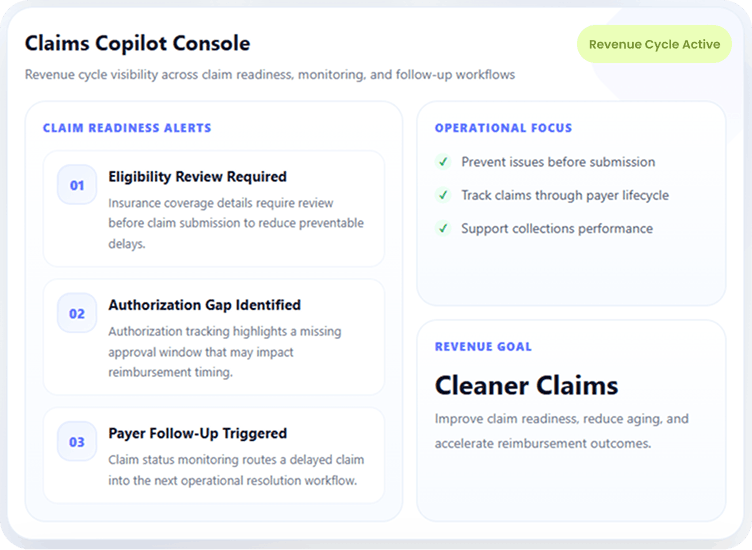
Pre-Submission Readiness
Catch eligibility, authorization, payer, and documentation issues before claims go out.
Lifecycle Claim Monitoring
Track claims after submission with rejection management, status visibility, and aging oversight.
Operational Performance
Support clean claim performance, reduce aged claims, and improve collections visibility.
Behavioral Health Focused
Designed for therapy, medication management, SUD, IOP/PHP, community support, and more.
Built for Behavioral Health
Designed for Behavioral Health
Revenue Cycle Workflows
Whether your organization provides therapy, medication management, IOP,
PHP, SUD treatment, case management, community support, or residential
services, Claims Copilot is built around the operational and reimbursement
realities of behavioral health.

Behavioral health support areas
Claims Copilot is positioned to support behavioral health organizations that need stronger claim readiness, reimbursement visibility, and operational follow-up across complex service lines.
Prevent Problems Before Claims Are Submitted
Address Revenue Cycle Breakdowns
Before They Turn Into Denials or Delays
Most claim problems begin long before a claim is submitted. Claims Copilot helps practices identify and
resolve those issues earlier so reimbursement performance is not undermined later.

Verify Insurance Eligibility
Confirm insurance coverage details early to reduce preventable reimbursement delays and billing confusion.

Review Insurance Information & ID Cards
Validate insurance information and supporting details so claims are built on more accurate payer data.

Track Authorizations
Monitor authorization requirements and approval status to reduce avoidable denials tied to missing coverage approvals.

Monitor Provider Credentialing Requirements
Support awareness of credentialing-related payer requirements that can affect billing and reimbursement workflows.

Identify Claim Issues Before Submission
Catch missing information, workflow gaps, and other claim barriers before the claim enters the payer lifecycle.

Improve Documentation-to-Billing Alignment
Route messages and requests to the appropriate team, department, or follow-up queue.
How Claims Copilot Works
A continuous workflow built to
support prevention, monitoring, and resolution.
Claims Copilot doesn’t stop at submission. It supports the operational work needed before the claim goes out, then continues
tracking activity through the payer lifecycle to help teams reduce delays, aging, and reimbursement bottlenecks.
1
Review claim readiness before submission
Insurance, eligibility, authorization, and workflow details are reviewed to identify claim risks before they become downstream reimbursement problems.
2
Submit claims and monitor payer activity
Once claims are submitted, Claims Copilot supports visibility into rejections, claim status, aging, and other signals that indicate a claim may require action.
3
Route follow-up through the right workflow
Operational tasks can be prioritized based on the issue—whether the next step involves internal follow-up, claim correction, payer research, or payment posting support.
From prevention to reimbursement performance.
Claims Copilot is designed to help organizations manage the full payer journey—not just claim submission. The result is a more proactive revenue cycle process with clearer visibility and fewer avoidable surprises.

Before submission:
improve readiness across insurance, authorizations, and documentation alignment

After submission:
monitor claim status, rejections, denial patterns, and aging across the payer lifecycle.

Operationally:
help teams reduce aging, recover delayed payments, and improve turnaround performance.
Monitor Claims Through the Entire Payer Lifecycle
Submitting claims is only the beginning.
Claims Copilot continuously tracks claim progress and supports the workflows needed to identify
reimbursement issues, respond to payer friction, and keep claims moving toward payment.

Claim Submission & Rejection Visibility
Support clean electronic claim submission while maintaining visibility into rejections and claim issues that need attention after submission.
- Electronic claim submission
- Rejection management support
- Visibility into claim readiness breakdowns

Status Monitoring & Aging Analysis
Track claims after submission to identify delays, payer inactivity, unresolved statuses, and aging trends that can impact collections.
- Claim status monitoring
- Aging analysis and prioritization
- Operational follow-up workflow visibility

Denials, Follow-Up & Payment Support
Improve follow-through on denied or delayed claims by supporting structured next steps across payer follow-up, resolution activity, and payment posting workflows.
- Denial tracking
- Follow-up workflow support
- Payment posting support
Reduce Aging and Improve Collections
Give your organization earlier visibility, better follow-through, and fewer preventable delays.
Many behavioral health organizations struggle with growing accounts receivable because claim issues are discovered too late. Claims Copilot helps teams stay ahead of the work required to keep reimbursement moving.

Reduce aged claims
improve readiness across insurance, authorizations, and documentation alignment.

Recover delayed payments
Identify unresolved payer issues sooner and reduce the amount of time claims spend waiting without meaningful action.

Improve turnaround and clean claim performance
Support stronger revenue cycle performance by reducing preventable breakdowns before and after submission.
A Partnership Approach
Successful revenue cycle management requires operational collaboration.
Many behavioral health organizations struggle with growing accounts receivable because claim issues are discovered too late. Claims Copilot helps teams stay ahead of the work required to keep reimbursement moving.

Before submission:
improve readiness across insurance, authorizations, and documentation alignment.

After submission:
monitor claim status, rejections, denial patterns, and aging across the payer lifecycle.

Operationally:
help teams reduce aging, recover delayed payments, and improve turnaround performance.
Included With DENmaar
Claims Copilot is part of the DENmaar
Behavioral Productivity Platform.
When DENmaar manages your insurance billing, your organization also gains access to the broader operational and clinical
platform that supports scheduling, documentation, reporting, and patient management workflows.

Behavioral Health EHR
Clinical and operational workflows designed around behavioral health documentation and care delivery.

Scheduling
Integrated scheduling workflows to support patient flow, operational visibility, and billing readiness.

Documentation Tools
Clinical notes, treatment plans, and documentation workflows that support stronger operational alignment.

AI-Assisted Notes
Support documentation efficiency while maintaining professional review and oversight workflows.

Treatment Plans
Behavioral health planning tools that connect care planning with documentation and operational workflows.

Clinical Workflows
Support multidisciplinary behavioral health processes with connected operational and clinical workflows.

Reporting
Visibility into productivity, claim performance, and operational trends across the platform.

Patient Management Tools
Connected workflows for patient registration, intake coordination, operational follow-up, and practice support.
Request an
AI Notes Trial
See how DENmaar AI Notes can help your clinicians reduce documentation time while improving
Request a demonstration or pilot program today.
Request Information
TESTIMONIALS
WHAT OUR CLIENTS SAY
On behalf of everyone at Meadowlark Counseling Services, I want to extend our sincere thanks for the continued improvements you and your team have made to the DENMaar EMR platform. We have been consistently impressed with both the functionality and user-friendly design of the system, which has made a meaningful difference in our day-to-day operations. The intuitive layout and ease of use have allowed our staff to spend less time navigating the system and more time focusing on client care. The regular updates and enhancements reflect your commitment to meeting the evolving needs of providers in the behavioral health and substance use treatment fields. We genuinely look forward to the new features introduced each month and appreciate how responsive the platform has been to the demands of clinical workflows. We have been so pleased with our experience that we’ve taken the opportunity to recommend DENMaar to other professionals in Pennsylvania who are working in the SUD field. Thank you again for your ongoing support and partnership. We are grateful to be working with a company that truly understands the needs of its users. KIndly, Becky Parks on behalf of the entire team at Meadowlark Counseling Services
I referred one of my colleagues Dr Aaron to you he is just starting g his psychology private practice and looking at where to start. I told him hands down you guys are the best billers and have a great EMR and team. He said he reached out just wanted to let you know!
FANTASTIC job keeping things rolling along with any and all of our billing concerns as well as responding to other issues which may well have been out of your wheelhouse. We are VERY grateful to have you and the crew in our corner.
I appreciate you all so much and DENmaar has been such a blessing Donna to our overall operations and success as an expanding company—allowing us to ultimately operate more efficiently, get our claims paid more consistently, ad stay on top of the critical credentialing piece, among other things. Teamwork does in fact, make the dream work. I’ll loop Chris/Isabella in on this message thread too, as I want All of your team to be aware of how much we appreciate our working relationship with DENmaar
Thank you for your diligence!! I appreciate it so much. Thank you Edwina…
Thank you so much Amy! I will be referring to DENmaar as often as I am asked about credentialing services.
Our Latest Blogs

Medical Insurance Credentialing: Everything you need to know to avoid losing money and clients
Accurate and timely acceptance of medical insurance is essential for obtaining payment from insurance companies. It’s complicated, time-consuming, and can cost thousands of dollars if you get it wrong. That’s why it’s important to partner with a medical billing company that has experience and a proven track record of success.
What is Medical Insurance Credentialing?
Insurance companies check that medical providers are legitimate and eligible to be compensated for services rendered. When a particular payer credentials a service provider, they can bill the payer directly and receive compensation.
What types of medical professionals require credentialing?
Every practice you want to bill an insurance company for must be approved. These include hospitals, clinics, doctors, dentists, physical therapists, behavioral health therapists, optometrists, etc. The term “In-network” (inside the network) means that the provider is currently credentialed by a particular insurance company and is eligible to file claims for reimbursement.
How difficult is it to get credentialed?
It is very complex and time-consuming. It usually takes 20 hours or more to apply to a single-payer. Every country has different needs. Specialists may also require unique documents. These variables make it effortless to miss a step, add the wrong document copy, or make a mistake.
Why are credential errors so common?
Even the slightest mistake in the credentialing process results in claims being denied, which means significant delays in the provider’s revenue stream. Timing is important.
What are the requirements for the credentialing
Providers have 30 to 90 days to submit the claim after the day of service, depending on the state and purpose. Then, the payer has 90 to 120 days to file that claim. If the claim is rejected and resubmitted, the waiting period starts again. But denying a claim does not reset the 90-day clock for payment. Providers may experience timely application problems if they see patients not credentialed adequately by payers.
Are there other ways providers lose money due to credentialing errors?
Large payers may make up a more significant percentage of a practice’s revenue. If most of your claims are delayed for three months, you may not have enough income to keep the doors open. You may need to stop seeing customers until the problem is resolved. On the other hand, they could not recover the lost revenue due to the expiry of the application period.
How most credentialing systems do manage?
Medical practices typically hire one person to handle the credentialing process, which involves gathering about 20 different documents, ensuring the data is accurate and submitting them one by one to other payers. This person will ideally be responsible for re-credentialing in subsequent years. But if that person leaves, gets reassigned, or even gets busy and forgets the approval order, organizational knowledge is lost, and the deadline is missed.
So many practices choose to use credentialing software or outsource the tasks to a billing company that provides this service. Outsourcing to a credentialing service such as DENmaar is an easy way to manage the process.
Why an outsourcing dependency task is better than doing the in-house with dedicated software?
Credential programs are expensive, making them out of reach for most small practices. Although users are limited to most of the tracking features, users complain that the software is challenging to locate. For example, you may fail to set it correctly and miss the re-credentialing window.
How have credentials changed since COVID-19?
The pandemic has changed the healthcare landscape, especially in behavioral health. Many new patients sought treatment and demanded that providers accept insurance. Previously, small clinics could only get away with cash services. Suddenly, they had to get credentials to fill a genuine medical need and didn’t know how to do it.
Another significant change in credential requirements was telehealth. Before the pandemic, there were not many methods of providing telehealth services, and therefore no billing processes. Then almost overnight, telehealth became ubiquitous, and its payers imposed new requirements.
In addition, telehealth allowed behavioral health providers to see more patients daily, and it took more time for a provider to do their billing or manage credentials.
How can clinics lose patients because of credentialing
Let’s say your staff forgot to re-credential, and all your claims are denied. Rehabilitation takes 3 to 4 months. During that time, you have two terrible options. You can look after patients for free until you are credentialed. It causes a massive loss of income. Or you can close your clinic or hospital for a while. You cannot blame them for going elsewhere for treatment.
Where to get the best insurance credentialing services?
Looking for insurance credentialing services? You’ve come to the right place! Here at DENmaar, we provide the best insurance credentialing services in the business – and at prices that are more than reasonable. Give us a call today!

Billing to Medical Insurance: In-Network Vs. Out of network
Many health care providers are not recognizing that they can increase profits and save patients’ costs by paying medical insurance bills.
One of the most common questions many medical/dental billing specialists in a medical practice hear is: “Do we need to be in-network for medical insurance billing?” When dealing with this question, there are many things to consider, but the answer largely depends on the following question: What type of medical insurance policies do you want to pay for?
Types of Insurance
There are many types of insurance. Health maintenance organizations (HMOs), exclusive provider organizations (EPOs), and preferred provider organizations (PPOs) are the most common.
HMOs and EPOs are similar in that these plans require you to be in network (IN) to be billed, as they do not allow the patient to see any provider out of their network (OON).
Sometimes they allow the patient to see an OON provider if they are in an emergency. An example is a patient with severe pain from an abscessed (infected) tooth or some trauma. The HMO/EPO may initially deny service to an out-of-network provider; however, they may pay if you appeal the claim.
If they agree to pay, these schemes will do your work to get paid. OON methods can avoid billing for these types of preventative plans.
Most residents have PPO-type medical plans. PPO plans offer in-network and out-of-network benefits to their insured patients. There is a difference in how benefits are paid to an OON provider versus an IN provider. For example, if 80% is delivered to an IN provider for a procedure, it is usually paid 60% or less to an OON provider.
Discounts are another significant factor. It is essential to know that not all actions apply to the opponent. An example of this is ratings.
Tell your patients that their drug payments will begin after the deductible is met. You’d be surprised how many processes don’t apply to deductions. One of the significant variables will be plan quality. There are good and not-so-good dental policies, but the same goes for medicine. You do get what you pay for.
This benefit reduction is not reflected in most practices as allowances (the amount allowed for a procedure/service) are much higher than for dentistry (which is included in the contract fee schedule). Most procedures cost double what dental policies pay for.
Credentialing with medical insurance
Getting approved for access to IN medical insurance is similar to getting approved with dental plans. It is vital to ensure that the medical carrier understands that you intend to engage in IN medical services, not dentistry and that you provide many services that do not include dental treatment and are more medical. However, you may find that many medical plans only allow oral surgeons to go IN.
Numerous dental practices are ignorant that in some states if you are IN with dental, you’re automatically IN with medical. In this case, you could easily bill medical and be refunded more than double for your services. It helps provide dental benefits to patients for dental procedures. You can bill both medicine and dentistry; They are separate policies that your patients pay for and have benefits.
Medical bills are here to stay. There are many services you offer that may be billed for medical services, such as evaluations, surgery, sleep, or TMJ treatment. Whether in IN or OON, being strategic in your approach will grow your practice group and lower your patients’ out-of-pocket costs.
Who provides the best medical insurance credentialing Services?
Since 2008, we, Denmaar provide mental health care and practices with valuable services and tools that enable increased revenue, reduced management time, and an improved patient engagement experience. Using an in-house IT system explicitly designed for the mental healthcare specialty, unparalleled efficiency allows us to deliver our services at lower than typical medical care rates.

Insurance Credentialing for therapists
- Revenue Cycle Management (RCM)
- Verification of Insurance Eligibility
- Indexing Medical Records
- Data Conversion
- Medical Coding Services
Stop losing clients. Call us now on 844-727-3627
Best Insurance credentialing services for therapists
Effective insurance paneling for therapists is imperative to improving practice performance. Without proper registration, insurance companies may delay or deny payments even if the doctor is competent and can provide medically necessary services. Best insurance panels for therapists verify that a physician meets the payer’s criteria by reviewing an individual’s licensure, experience, certification, education, training, affiliation, malpractice, adverse clinical events, and judgment.
We at DENmaar provide insurance credentialing for physical therapists, helping service providers generate better revenue. Our services simplify the payer enrollment process when doctors start their first practice, Transit from one practice to another, add a new doctor to an existing group, and want to register with a new payer. The Medical insurance credentialing process for therapists is a highly detail-oriented process that requires constant attention. After submitting the required documents, our credentialing coordinator monitors the application status and addresses any additional requirements daily to ensure accurate and timely acceptance of each network. The complexities of adopting a group practice or facility are incredibly time-consuming. We can work with each provider or office management staff to retrieve all the necessary information for the applications. We ensure that the providers are in proper network condition to provide services at the facility. Our team has experience paneling mental health therapists, for all types of licenses, insurances, and various business structures.
DENmaar is one of the best insurance credentialing companies for therapists in the US.
Fully Automated system at your service
Individual/Group Provider Enrollment
We assist the physicians/providers in enrolling and attesting with the payer’s network to offer services to the patients who are members of the payer’s plans.
CAQH Completion and Management
We assist you in completing, updating, and maintaining your CAQH profile to obtain a CAQH ID and help with insurance certification, contracting, and registration.
Primary Source Verification
We verify credentials such as training, certification, education, licensure, etc., with the primary source to improve care quality and decrease liability risk.
Hospital Privileging
We assist in authorizing the health care practitioner’s specific scope and content of patient care services to ensure that they are appropriately licensed, carry malpractice insurance, and meet hospital requirements.
Who we help with insurance credentialing for therapists
We simplify the insurance credentialing process for therapists for the following entities.
- Physical Therapists
- Occupational Therapists
- Speech Therapists
- Behavioral Therapists
Insurance carriers we support
- Cigna
- Aetna
- Anthem
- Blue Cross Blue Shield (BCBS)
- Humana
- Medicaid
- Medicare
- Optum
- Oscar
- Tricare
- UMR
- United Healthcare (UHC)
Who we help with insurance credentialing for therapists
Getting accredited opens your doors to these patients as it is impossible to bill insurance companies without credentialing. The insurance credentialing process can be tedious, long, and frustrating, but everything else becomes more manageable once you’re done. So save your time and ensure efficiency with us.
- Updated License
- National Provider Identifier (NPI) Number
- Tax ID number
- Liability Insurance Proof
- Minimum 3 Professional references
- Graduate school transcript copy
- Employment history of minimum 5 Years
DENmaar’s Insurance Credentialing Services for Therapists and their Benefits
- Substantial reduction in errors common in manual operations.
- It helps medical practices focus on patient care and allows the medical center to collect, filter, report, and manage the accreditation process from an unbiased perspective.
- A medical practice can also save millions of dollars in lawsuits and malpractice cases by ensuring that all healthcare providers working in their facilities are qualified and have their credentials verified.
- It saves time and labor for health care providers, shortens the stage of diagnosis and treatment, and ensures timely payment.
- The traditional credentialing process means many paper documents and files for different health care providers.
- A central database helps prevent long-term formation, with easy access to analysis.
Why choose an insurance credentialing service for therapists?
Healthcare centers face the difficult task of insurance credentialing while increasing costs, be it operational costs or payments to healthcare providers for their services. A medical practice must ensure quality care, which can only happen when credentialed and skilled healthcare providers are employed. Only authorized doctors and staff should be allowed to operate to ensure proper diagnosis and treatment of patients to avoid medical malpractice.
Here is where DENmaar insurance credentialing services for therapists are needed. We have highly skilled insurance credentialing experts who undertake credentialing on your behalf. We take care of the paperwork, appeals, case follow-up, and handling claims denials. We ensure an error-free application process, significantly reducing your chances of rejection.
We continuously monitor the payers on your behalf and ensure your credentialing process is effective and successful. At DENmaar, we take your burden of credentialing and offer non-stop work until we make you a part of the insurance carrier’s network.
Insurance Credentialing Services Therapists Can Depend On
Our web portal offers valuable articles and the latest news to provide the proper guidance and tips for making the credentialing process fruitful and effortless.
Refer to the below-mentioned articles to understand insurance credentialing services for therapists better:
- Adding Therapists to Private Practice Insurance Credential
- ABA Credentialing -The Importance of Credentialing
- Aetna Provider Credentialing – The Process
- Mental Health Credentialing – The Process
- Cigna Credentialing – Getting On the Cigna Panel
- BCBS Insurance Credentialing Services – The Procedure
- Psychologists Insurance Credentialing Services
- Affordable Insurance Credentialing Services-Cost Efficiency
- Addiction Treatment Credentialing-Benefits of Credentialing
- Humana Health Insurance Credentialing – Getting On the Panel
- Credentialing Doctors to Your Group Practice
- UMR Credentialing – The Process
- CAQH Insurance Credentialing-It’s Benefits in Credentialing
- Insurance Credentialing Specialists – Its Importance
- Oscar Credentialing – Getting on Insurance Panels
- Insurance Credentialing and Contracting-Their Merits
- Insurance credentialing 101 – Understanding Credentialing
- Top Insurance Companies to Be Credentialed With
- Bankers Life Insurance Credentialing – Getting on the Panel
- Insurance Credentialing for Nurse Practitioners
- Letter of Interest for Insurance Credentialing -Tips To Mind
We provide insurance credentialing services for therapists to remove the burden on our clients. Also, our services are offered at the best prices with advanced automation assistance and maximum efficiency.
We always strive hard and value each of your clients. Also, we work for you so that you do not miss even a single client whose value is more than the cost of credentialing.
Frequently Asked Questions
What is insurance credentialing for therapists?
Insurance credentialing for therapists refer to verifying a licensed health care provider’s education, training, and qualified professional history.
How often do therapists have to get credentialed?
Therapists have to be credentialed once in three years at least. Some perform even more often.
Why is credentialing so hard?
Credentialing is a process that needs more labor. You need people to manage the workflow, enter the data, fact-check the reporting, etc. Not having the appropriate staff allocation can lead to mistakes, which will lead to delays, ultimately impacting your revenue.
Our Partners






Ready to get started?
Feel free to reach out if you have any questions.
