

- Therapy and medication management
- IOP, PHP, and SUD treatment programs
- Case management, community support, and residential services
DENmaar Revenue Cycle Intelligence
Claims Copilot ™
Stop Chasing Claims.
Start Preventing Problems.
Claims Copilot is DENmaar’s behavioral health revenue cycle solution
designed to help practices prevent claim issues before submission, reduce
aging, accelerate reimbursement, and improve operational performance.

Pre-Submission Claim Readiness

Payer Lifecycle Monitoring

Aging & Collections Visibility
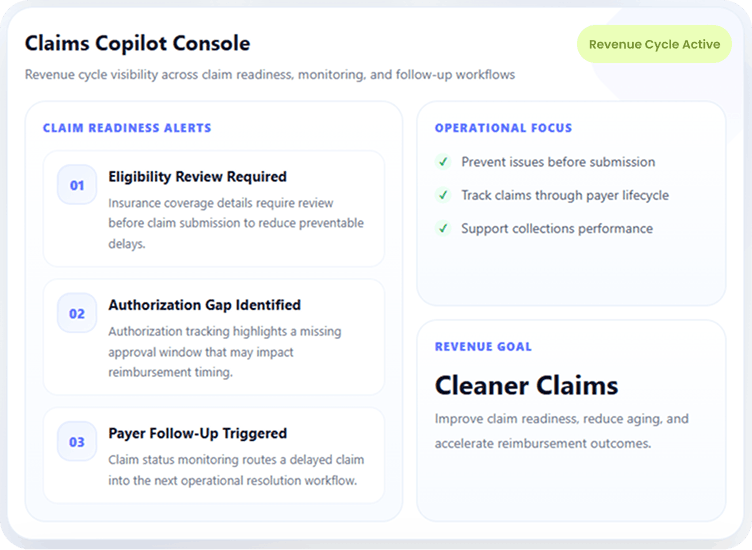
Pre-Submission Readiness
Catch eligibility, authorization, payer, and documentation issues before claims go out.
Lifecycle Claim Monitoring
Track claims after submission with rejection management, status visibility, and aging oversight.
Operational Performance
Support clean claim performance, reduce aged claims, and improve collections visibility.
Behavioral Health Focused
Designed for therapy, medication management, SUD, IOP/PHP, community support, and more.
Built for Behavioral Health
Designed for Behavioral Health
Revenue Cycle Workflows
Whether your organization provides therapy, medication management, IOP,
PHP, SUD treatment, case management, community support, or residential
services, Claims Copilot is built around the operational and reimbursement
realities of behavioral health.

Behavioral health support areas
Claims Copilot is positioned to support behavioral health organizations that need stronger claim readiness, reimbursement visibility, and operational follow-up across complex service lines.
Prevent Problems Before Claims Are Submitted
Address Revenue Cycle Breakdowns
Before They Turn Into Denials or Delays
Most claim problems begin long before a claim is submitted. Claims Copilot helps practices identify and
resolve those issues earlier so reimbursement performance is not undermined later.

Verify Insurance Eligibility
Confirm insurance coverage details early to reduce preventable reimbursement delays and billing confusion.

Review Insurance Information & ID Cards
Validate insurance information and supporting details so claims are built on more accurate payer data.

Track Authorizations
Monitor authorization requirements and approval status to reduce avoidable denials tied to missing coverage approvals.

Monitor Provider Credentialing Requirements
Support awareness of credentialing-related payer requirements that can affect billing and reimbursement workflows.

Identify Claim Issues Before Submission
Catch missing information, workflow gaps, and other claim barriers before the claim enters the payer lifecycle.

Improve Documentation-to-Billing Alignment
Route messages and requests to the appropriate team, department, or follow-up queue.
How Claims Copilot Works
A continuous workflow built to
support prevention, monitoring, and resolution.
Claims Copilot doesn’t stop at submission. It supports the operational work needed before the claim goes out, then continues
tracking activity through the payer lifecycle to help teams reduce delays, aging, and reimbursement bottlenecks.
1
Review claim readiness before submission
Insurance, eligibility, authorization, and workflow details are reviewed to identify claim risks before they become downstream reimbursement problems.
2
Submit claims and monitor payer activity
Once claims are submitted, Claims Copilot supports visibility into rejections, claim status, aging, and other signals that indicate a claim may require action.
3
Route follow-up through the right workflow
Operational tasks can be prioritized based on the issue—whether the next step involves internal follow-up, claim correction, payer research, or payment posting support.
From prevention to reimbursement performance.
Claims Copilot is designed to help organizations manage the full payer journey—not just claim submission. The result is a more proactive revenue cycle process with clearer visibility and fewer avoidable surprises.

Before submission:
improve readiness across insurance, authorizations, and documentation alignment

After submission:
monitor claim status, rejections, denial patterns, and aging across the payer lifecycle.

Operationally:
help teams reduce aging, recover delayed payments, and improve turnaround performance.
Monitor Claims Through the Entire Payer Lifecycle
Submitting claims is only the beginning.
Claims Copilot continuously tracks claim progress and supports the workflows needed to identify
reimbursement issues, respond to payer friction, and keep claims moving toward payment.

Claim Submission & Rejection Visibility
Support clean electronic claim submission while maintaining visibility into rejections and claim issues that need attention after submission.
- Electronic claim submission
- Rejection management support
- Visibility into claim readiness breakdowns

Status Monitoring & Aging Analysis
Track claims after submission to identify delays, payer inactivity, unresolved statuses, and aging trends that can impact collections.
- Claim status monitoring
- Aging analysis and prioritization
- Operational follow-up workflow visibility

Denials, Follow-Up & Payment Support
Improve follow-through on denied or delayed claims by supporting structured next steps across payer follow-up, resolution activity, and payment posting workflows.
- Denial tracking
- Follow-up workflow support
- Payment posting support
Reduce Aging and Improve Collections
Give your organization earlier visibility, better follow-through, and fewer preventable delays.
Many behavioral health organizations struggle with growing accounts receivable because claim issues are discovered too late. Claims Copilot helps teams stay ahead of the work required to keep reimbursement moving.

Reduce aged claims
improve readiness across insurance, authorizations, and documentation alignment.

Recover delayed payments
Identify unresolved payer issues sooner and reduce the amount of time claims spend waiting without meaningful action.

Improve turnaround and clean claim performance
Support stronger revenue cycle performance by reducing preventable breakdowns before and after submission.
A Partnership Approach
Successful revenue cycle management requires operational collaboration.
Many behavioral health organizations struggle with growing accounts receivable because claim issues are discovered too late. Claims Copilot helps teams stay ahead of the work required to keep reimbursement moving.

Before submission:
improve readiness across insurance, authorizations, and documentation alignment.

After submission:
monitor claim status, rejections, denial patterns, and aging across the payer lifecycle.

Operationally:
help teams reduce aging, recover delayed payments, and improve turnaround performance.
Included With DENmaar
Claims Copilot is part of the DENmaar
Behavioral Productivity Platform.
When DENmaar manages your insurance billing, your organization also gains access to the broader operational and clinical
platform that supports scheduling, documentation, reporting, and patient management workflows.

Behavioral Health EHR
Clinical and operational workflows designed around behavioral health documentation and care delivery.

Scheduling
Integrated scheduling workflows to support patient flow, operational visibility, and billing readiness.

Documentation Tools
Clinical notes, treatment plans, and documentation workflows that support stronger operational alignment.

AI-Assisted Notes
Support documentation efficiency while maintaining professional review and oversight workflows.

Treatment Plans
Behavioral health planning tools that connect care planning with documentation and operational workflows.

Clinical Workflows
Support multidisciplinary behavioral health processes with connected operational and clinical workflows.

Reporting
Visibility into productivity, claim performance, and operational trends across the platform.

Patient Management Tools
Connected workflows for patient registration, intake coordination, operational follow-up, and practice support.
Request an
AI Notes Trial
See how DENmaar AI Notes can help your clinicians reduce documentation time while improving
Request a demonstration or pilot program today.
Request Information
TESTIMONIALS
WHAT OUR CLIENTS SAY
On behalf of everyone at Meadowlark Counseling Services, I want to extend our sincere thanks for the continued improvements you and your team have made to the DENMaar EMR platform. We have been consistently impressed with both the functionality and user-friendly design of the system, which has made a meaningful difference in our day-to-day operations. The intuitive layout and ease of use have allowed our staff to spend less time navigating the system and more time focusing on client care. The regular updates and enhancements reflect your commitment to meeting the evolving needs of providers in the behavioral health and substance use treatment fields. We genuinely look forward to the new features introduced each month and appreciate how responsive the platform has been to the demands of clinical workflows. We have been so pleased with our experience that we’ve taken the opportunity to recommend DENMaar to other professionals in Pennsylvania who are working in the SUD field. Thank you again for your ongoing support and partnership. We are grateful to be working with a company that truly understands the needs of its users. KIndly, Becky Parks on behalf of the entire team at Meadowlark Counseling Services
I referred one of my colleagues Dr Aaron to you he is just starting g his psychology private practice and looking at where to start. I told him hands down you guys are the best billers and have a great EMR and team. He said he reached out just wanted to let you know!
FANTASTIC job keeping things rolling along with any and all of our billing concerns as well as responding to other issues which may well have been out of your wheelhouse. We are VERY grateful to have you and the crew in our corner.
I appreciate you all so much and DENmaar has been such a blessing Donna to our overall operations and success as an expanding company—allowing us to ultimately operate more efficiently, get our claims paid more consistently, ad stay on top of the critical credentialing piece, among other things. Teamwork does in fact, make the dream work. I’ll loop Chris/Isabella in on this message thread too, as I want All of your team to be aware of how much we appreciate our working relationship with DENmaar
Thank you for your diligence!! I appreciate it so much. Thank you Edwina…
Thank you so much Amy! I will be referring to DENmaar as often as I am asked about credentialing services.
Our Latest Blogs
A Quick Guide to Behavioral Health Practitioner Credentialing
The following article will tell everything you need to know about successfully getting on an insurance panel as a mental health practitioner.
This goes without saying but getting on an insurance panel is no easy task and can be incredibly frustrating, especially for mental health practitioners with already a lot on their plate. One way to make the credentialing process less overwhelming would involve being aware of certain fundamentals related to the arduous but necessary task.
That is exactly what we at DENmaar aim to do with the help of the below guide. So, without much further ado, let’s get started.
Finding Reputable Insurance Panels
By now you must be aware of all the health insurance companies active in your city and state. From large brands like Cigna to national entities like Medicare, it would be wise to keep a note of all these names before you start the credentialing process.
We would recommend making a spreadsheet that includes all of these companies. Moreover, expand your search by contacting your professional network. If you aren’t sure how many insurance companies are active in your state, then doing a quick Google search will provide the answers you need.
Make sure you note down the contact and address info of each of the insurance companies you find online. Save this information on your spreadsheet. Learn about the conditions regarding provider credentialing that apply to each specific company and make a note of them as well.
Learn About the Requirements of Insurance Companies.
Insurance companies are constantly on the lookout for reliable practitioners for their panels. You must make a good case about your skills and strengths as a mental health practitioner in your application.
Below are a few things that insurance panels seek in their applicants.
1. Location
Insurance companies look favorably upon practitioners who are actively serving patients in an under-served location. Your chances of getting on an insurance panel skyrocket if you are operating a clinic or practice in an area where that isn’t adequately populated with healthcare providers like you offering their services.
2. Cultural Diversity
Do not forget to mention your ethnic background, especially if you belong to an atypical one. Also mention if you speak multiple languages. These defining characteristics will increase your chances of getting on an insurance panel.
3. Qualities and Specialty
Make sure to emphasize the training and educational qualifications you possess. Do not forget to mention your specialties, especially when you specialize in offering healthcare to kids, elders, and LGBT or minority members of society.
4. Crisis Therapy
Insurance Panels are likely to look favorably upon healthcare providers that respond to emergencies quickly.
The above factors make you stand-out, and as such, should be emphasized in your application to increase your chances of getting successfully credentialed. We recommend making a list of everything that makes you stand out among other mental health practitioners in your vicinity before undertaking the credentialing process.
Create a Good Resume and Letter of Intent
You need a good, comprehensive resume that highlights your skills and accomplishments. Follow the below pointers to create a compelling resume and letter of intent.
- • Make sure your resume is short. One page is more than enough
- • Focus on things that make you unique rather than mentioning things that anyone can do.
- • Always use short sentences
- • Form sentences in active voice
- • Do not misrepresent your skills or lie. Also, do not undersell yourself.
The following format will make for an ideal resume:
- • Contact information, License number with date of issue.
- • Statement of intent
- • Credentials, skills, specialties, educational qualifications
- • Mention job experience. Include references to the organizations you’ve worked with, in the past.
- • Include additional skills like the ability to speak multiple languages, etc.
The letter of intent is another thing you must be careful about when composing. You want to be distinguishable while portraying yourself in good light. The below format would make for an ideal letter of intent.
- • Clearly state the name of the insurance panel you want to be on.
- • Mention your credentials and educational qualifications
- • Explain what makes you stand out among your peers. This could be language, culture, availability, etc.
- • Mention if you have clients that are already on that panel and are being billed out of network.
- • Close your letter by letting your intentions and desire to join the panel crystal clear.
Finally, Apply to the Insurance Panels
Now that you are prepared, it’s finally time to submit your application.
- • Mail your resume along with the letter of intent to the appropriate application address.
- • Note down the date on which you applied.
- • Call the application office exactly one week after submission for confirmation. Note down the name of the representative that answered your call for follow-up and mention the date you called on.
- • Confirm the next steps and also ask when you can follow up next.
- • If for some reason your application is rejected. Do not be heartbroken and be ready to re-apply immediately.
Conclusion
Getting on an insurance panel is tough but not impossible. The above guide will considerably simplify the process for you. To make the process even more hassle-free, we recommend you give us at DENmaar a call. We are home to the credentialing experts and resources needed to help you get on an insurance panel effectively and efficiently.
You can explore our website or contact us now to learn more about how we can help with mental health insurance credentialing.
How to overcome the challenges in medical credentialing
How to overcome the challenges that medical credentialing faces?
Medical credentialing is one of the most critical compliance issues in medical practice today. However, this is a time-consuming and complex process to do it properly. A poor medical credential can lead to registration problems and legal and financial complications. Do you know what weakens the medical credentialing process? Here are the top 4 most common medical credentialing challenges that every practitioner should be aware of and solutions to overcome those challenges in the credentialing process.
What is medical credentialing?
Medical credentialing is the process of verifying and evaluating the eligibility of a healthcare provider with educational qualifications, employment history, training experience, special resident certificates, licenses, and other eligibility details.
Challenges in Medical Credentialing
1. Lack of staff to verify credentials.
The medical credentialing process requires an expert team or organization to provide credentials to each healthcare provider providing services to patients. Do you know whose credentials should be checked? The list includes doctors, nurses, physicians, assistants, therapists, and every other provider. For each individual, their full educational qualifications, employment history, training certificates, residence, licenses, and any board-issued certificates in the provider’s specialization area should be carefully checked. So it will consume more teamwork to handle this big operation properly without any error.
Not allocating enough resources or staff to complete the medical credentialing process – is a common mistake due to some methods. This reduces revenue and creates work stress for the limited team available. In addition, when employees make mistakes with the application and the insurance provider does not accept the application, it delays the payment process.
What is the solution?
Outsourcing the medical credentialing process to the medical billing service providers will help you overcome this challenge easily because a reputable organization retains responsible and expert staff for the credentialing process. So the team will handle everything smoothly and on time without any errors, which will save valuable time and money.
2. Incomplete application of service provider
Provider registration applications are essential for completing the medical credentialing process. So it should be done correctly with all the necessary information. Unfortunately, some methods may fail to do so accurately without losing any data fields, resulting in payment delays and rejection of claims.
What is the solution?
Human errors are common when working on provider registration applications. To avoid this error, software based on advanced credentials will help you do it right. In addition, this automated process usually requires less administrative effort – it eliminates human errors, which saves you time, money, and resources.
3. Update the information
Access to applicant information is a significant challenge for healthcare organizations. An excellent medical credentialing process ensures that the healthcare provider is up to date with board certificates and licenses. All healthcare providers must regularly renew their licenses and credentials and keep them updated. About 85% of approval requests contain incorrect, missing, or outdated information. Even small changes, such as an address or phone number, must be re-authenticated in the CAQH database before the system can process the application.
What is the solution?
The doctor’s contact information and other relevant data are readily available to help you speed up the credentialing process. The re-credentialing process will also take a long time. The law will also reduce such recognition issues.
4. Deadline
The medical credentialing process plays an essential role in the revenue cycle of your healthcare organization. The end-to-end process will only take 90 days for the organization to review the application. However, when considering additional stakeholders such as insurance providers – the process can take up to six months – adding to your organization’s downtime.
What is the solution?
Give priority to safety, and spend as much time as possible. If it takes less time, you will be ahead of schedule.
DENmaar’s Medical Credential Services – The right choice to make your credentialing process more accessible.
What do we do?
- Collects and reviews all necessary documents to ensure completeness and accuracy before submitting payment
- Relieves staff and service providers from the time-consuming task of registering and re-credentialing with government and commercial paying agencies.
- Ensures timely approval to all service providers to avoid payment delay or loss of payment
- Liaises with thousands of payments across all states and manages all communications and follow-up through an application approval
- Works with our billing team to monitor any denials and communicate with fee payers for immediate resolution
Where to get the best credentialing service?
We, DENmaar, are the home for credentialing professionals to help you manage and navigate all the paperwork without any hassle. Since we take care of the entire credentialing process from start to finish, you will have time to focus on patient care.
Expansion of Telehealth to Make it Part of The Permanent Workflow by CIOS
Telehealth has rapidly evolved from a temporary healthcare solution into a permanent part of modern healthcare delivery. During the COVID 19 pandemic, hospitals and healthcare systems implemented telemedicine technologies to maintain patient care while reducing in person interactions.
Today, healthcare organizations are no longer treating telehealth as a short term solution. Instead, hospitals, healthcare providers, and Chief Information Officers (CIOs) are integrating virtual care into long term operational workflows to improve patient access, streamline communication, and increase healthcare efficiency.
The Growing Importance of Telehealth in Healthcare
Telehealth has transformed how healthcare providers deliver medical services. From virtual consultations to remote patient monitoring, healthcare systems are now combining in person and virtual care to create a more connected patient experience.
Healthcare organizations are investing in scalable telemedicine technologies that support long term digital healthcare strategies and improve operational efficiency.
Why Hospitals Are Integrating Telehealth Into Permanent Workflows
Improved Patient Accessibility
Telehealth allows patients to connect with healthcare providers remotely, reducing travel time and improving access to care for rural and underserved communities.
Better Patient Engagement
Integrated telehealth platforms create a seamless digital experience that improves communication between patients and providers throughout the care journey.
Increased Operational Efficiency
Virtual care solutions help hospitals reduce administrative burdens, improve scheduling workflows, and optimize resource management.
Enhanced Care Coordination
Unified telehealth systems allow healthcare teams to collaborate more effectively by combining messaging, video appointments, patient records, and scheduling into a single platform.
Financial and Operational Benefits
Healthcare organizations adopting telehealth technologies often experience improved patient satisfaction, stronger brand reputation, and increased efficiency in care delivery.
The Role of CIOs in Telehealth Expansion
Chief Information Officers and healthcare IT leaders are responsible for integrating telehealth technologies across healthcare systems while ensuring compliance, security, and workflow efficiency.
Their focus includes:
- Implementing secure telemedicine platforms
- Integrating telehealth with existing EHR systems
- Improving digital patient experiences
- Streamlining provider workflows
- Expanding virtual care capabilities across departments
Healthcare leaders are increasingly viewing telehealth as an essential component of enterprise healthcare operations.
Embedding Telehealth Into Everyday Healthcare Operations
Modern healthcare systems are integrating telehealth directly into clinical workflows to improve care coordination and simplify administrative processes.
A unified telehealth platform allows healthcare providers to:
- Access patient records quickly
- Conduct secure video consultations
- Manage virtual appointments efficiently
- Improve communication between healthcare teams
- Reduce the need for multiple software systems
Virtual Patient Care Inside Hospitals
Telehealth technology is no longer limited to remote appointments. Hospitals are now using virtual care systems inside patient rooms to improve efficiency and patient engagement.
Virtual Nursing Units
Virtual nursing technology allows healthcare providers to complete non bedside tasks remotely, including:
- Patient education
- Medication reviews
- Documentation support
- Discharge coordination
This approach helps bedside nurses focus more on direct patient care while reducing administrative workload.
In Room Virtual Communication
Telehealth systems installed in patient rooms allow social workers, family members, and healthcare providers to communicate safely and efficiently with patients during hospital stays.
This improves patient satisfaction and supports collaborative care delivery.
Benefits of Unified Telehealth Platforms
Healthcare organizations are moving toward centralized telehealth systems that combine multiple functions into one secure platform.
Benefits include:
- Fewer software logins and administrative steps
- Better patient data accessibility
- Improved provider collaboration
- Faster communication between departments
- Streamlined patient care workflows
Learn how our EHR and EMR solutions support integrated telehealth workflows and healthcare efficiency
Why HIPAA Compliant Telehealth Matters
Security and compliance are critical when implementing telemedicine technology. Healthcare organizations must use HIPAA compliant telehealth platforms to protect patient information and maintain healthcare privacy standards.
Secure telehealth systems ensure safe communication, encrypted patient data, and reliable virtual care delivery.
The Future of Telehealth in Healthcare
Telehealth, telemedicine, and virtual nursing are reshaping the future of healthcare delivery. As healthcare systems continue investing in digital transformation, virtual care will remain a permanent and essential part of patient care strategies.
Healthcare organizations that adopt integrated telehealth technologies today will be better positioned to improve patient outcomes, increase efficiency, and support long term healthcare innovation.
Frequently Asked Questions
What is telehealth in healthcare?
Telehealth is the use of digital communication technologies such as video calls and remote monitoring tools to deliver healthcare services virtually.
Why are hospitals integrating telehealth into permanent workflows?
Hospitals are integrating telehealth to improve patient access, streamline operations, enhance care coordination, and increase healthcare efficiency.
What role do CIOs play in telehealth expansion?
CIOs manage the implementation, integration, security, and optimization of telehealth systems within healthcare organizations.
What are virtual nursing units?
Virtual nursing units use telehealth technology to support non bedside nursing tasks such as patient education, documentation, and discharge coordination.
Why is HIPAA compliance important in telehealth?
HIPAA compliance protects patient privacy and ensures secure communication between healthcare providers and patients during virtual care sessions.
Our Partners






Ready to get started?
Feel free to reach out if you have any questions.
