

- Therapy and medication management
- IOP, PHP, and SUD treatment programs
- Case management, community support, and residential services
DENmaar Revenue Cycle Intelligence
Claims Copilot ™
Stop Chasing Claims.
Start Preventing Problems.
Claims Copilot is DENmaar’s behavioral health revenue cycle solution
designed to help practices prevent claim issues before submission, reduce
aging, accelerate reimbursement, and improve operational performance.

Pre-Submission Claim Readiness

Payer Lifecycle Monitoring

Aging & Collections Visibility
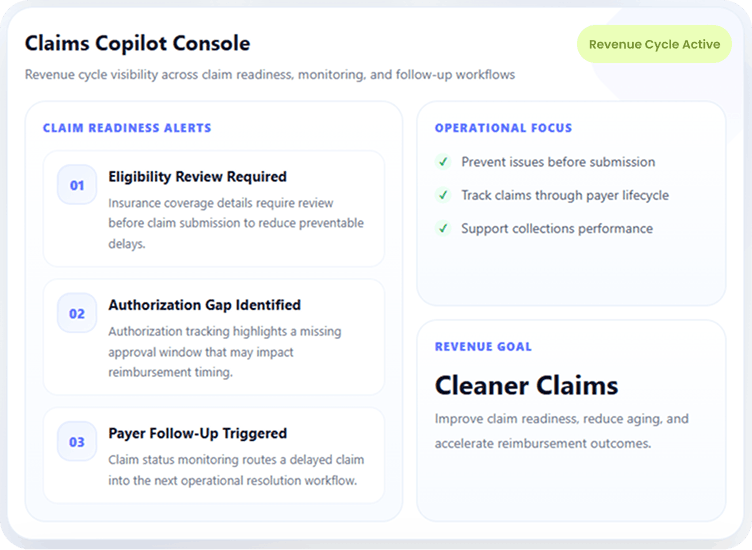
Pre-Submission Readiness
Catch eligibility, authorization, payer, and documentation issues before claims go out.
Lifecycle Claim Monitoring
Track claims after submission with rejection management, status visibility, and aging oversight.
Operational Performance
Support clean claim performance, reduce aged claims, and improve collections visibility.
Behavioral Health Focused
Designed for therapy, medication management, SUD, IOP/PHP, community support, and more.
Built for Behavioral Health
Designed for Behavioral Health
Revenue Cycle Workflows
Whether your organization provides therapy, medication management, IOP,
PHP, SUD treatment, case management, community support, or residential
services, Claims Copilot is built around the operational and reimbursement
realities of behavioral health.

Behavioral health support areas
Claims Copilot is positioned to support behavioral health organizations that need stronger claim readiness, reimbursement visibility, and operational follow-up across complex service lines.
Prevent Problems Before Claims Are Submitted
Address Revenue Cycle Breakdowns
Before They Turn Into Denials or Delays
Most claim problems begin long before a claim is submitted. Claims Copilot helps practices identify and
resolve those issues earlier so reimbursement performance is not undermined later.

Verify Insurance Eligibility
Confirm insurance coverage details early to reduce preventable reimbursement delays and billing confusion.

Review Insurance Information & ID Cards
Validate insurance information and supporting details so claims are built on more accurate payer data.

Track Authorizations
Monitor authorization requirements and approval status to reduce avoidable denials tied to missing coverage approvals.

Monitor Provider Credentialing Requirements
Support awareness of credentialing-related payer requirements that can affect billing and reimbursement workflows.

Identify Claim Issues Before Submission
Catch missing information, workflow gaps, and other claim barriers before the claim enters the payer lifecycle.

Improve Documentation-to-Billing Alignment
Route messages and requests to the appropriate team, department, or follow-up queue.
How Claims Copilot Works
A continuous workflow built to
support prevention, monitoring, and resolution.
Claims Copilot doesn’t stop at submission. It supports the operational work needed before the claim goes out, then continues
tracking activity through the payer lifecycle to help teams reduce delays, aging, and reimbursement bottlenecks.
1
Review claim readiness before submission
Insurance, eligibility, authorization, and workflow details are reviewed to identify claim risks before they become downstream reimbursement problems.
2
Submit claims and monitor payer activity
Once claims are submitted, Claims Copilot supports visibility into rejections, claim status, aging, and other signals that indicate a claim may require action.
3
Route follow-up through the right workflow
Operational tasks can be prioritized based on the issue—whether the next step involves internal follow-up, claim correction, payer research, or payment posting support.
From prevention to reimbursement performance.
Claims Copilot is designed to help organizations manage the full payer journey—not just claim submission. The result is a more proactive revenue cycle process with clearer visibility and fewer avoidable surprises.

Before submission:
improve readiness across insurance, authorizations, and documentation alignment

After submission:
monitor claim status, rejections, denial patterns, and aging across the payer lifecycle.

Operationally:
help teams reduce aging, recover delayed payments, and improve turnaround performance.
Monitor Claims Through the Entire Payer Lifecycle
Submitting claims is only the beginning.
Claims Copilot continuously tracks claim progress and supports the workflows needed to identify
reimbursement issues, respond to payer friction, and keep claims moving toward payment.

Claim Submission & Rejection Visibility
Support clean electronic claim submission while maintaining visibility into rejections and claim issues that need attention after submission.
- Electronic claim submission
- Rejection management support
- Visibility into claim readiness breakdowns

Status Monitoring & Aging Analysis
Track claims after submission to identify delays, payer inactivity, unresolved statuses, and aging trends that can impact collections.
- Claim status monitoring
- Aging analysis and prioritization
- Operational follow-up workflow visibility

Denials, Follow-Up & Payment Support
Improve follow-through on denied or delayed claims by supporting structured next steps across payer follow-up, resolution activity, and payment posting workflows.
- Denial tracking
- Follow-up workflow support
- Payment posting support
Reduce Aging and Improve Collections
Give your organization earlier visibility, better follow-through, and fewer preventable delays.
Many behavioral health organizations struggle with growing accounts receivable because claim issues are discovered too late. Claims Copilot helps teams stay ahead of the work required to keep reimbursement moving.

Reduce aged claims
improve readiness across insurance, authorizations, and documentation alignment.

Recover delayed payments
Identify unresolved payer issues sooner and reduce the amount of time claims spend waiting without meaningful action.

Improve turnaround and clean claim performance
Support stronger revenue cycle performance by reducing preventable breakdowns before and after submission.
A Partnership Approach
Successful revenue cycle management requires operational collaboration.
Many behavioral health organizations struggle with growing accounts receivable because claim issues are discovered too late. Claims Copilot helps teams stay ahead of the work required to keep reimbursement moving.

Before submission:
improve readiness across insurance, authorizations, and documentation alignment.

After submission:
monitor claim status, rejections, denial patterns, and aging across the payer lifecycle.

Operationally:
help teams reduce aging, recover delayed payments, and improve turnaround performance.
Included With DENmaar
Claims Copilot is part of the DENmaar
Behavioral Productivity Platform.
When DENmaar manages your insurance billing, your organization also gains access to the broader operational and clinical
platform that supports scheduling, documentation, reporting, and patient management workflows.

Behavioral Health EHR
Clinical and operational workflows designed around behavioral health documentation and care delivery.

Scheduling
Integrated scheduling workflows to support patient flow, operational visibility, and billing readiness.

Documentation Tools
Clinical notes, treatment plans, and documentation workflows that support stronger operational alignment.

AI-Assisted Notes
Support documentation efficiency while maintaining professional review and oversight workflows.

Treatment Plans
Behavioral health planning tools that connect care planning with documentation and operational workflows.

Clinical Workflows
Support multidisciplinary behavioral health processes with connected operational and clinical workflows.

Reporting
Visibility into productivity, claim performance, and operational trends across the platform.

Patient Management Tools
Connected workflows for patient registration, intake coordination, operational follow-up, and practice support.
Request an
AI Notes Trial
See how DENmaar AI Notes can help your clinicians reduce documentation time while improving
Request a demonstration or pilot program today.
Request Information
TESTIMONIALS
WHAT OUR CLIENTS SAY
On behalf of everyone at Meadowlark Counseling Services, I want to extend our sincere thanks for the continued improvements you and your team have made to the DENMaar EMR platform. We have been consistently impressed with both the functionality and user-friendly design of the system, which has made a meaningful difference in our day-to-day operations. The intuitive layout and ease of use have allowed our staff to spend less time navigating the system and more time focusing on client care. The regular updates and enhancements reflect your commitment to meeting the evolving needs of providers in the behavioral health and substance use treatment fields. We genuinely look forward to the new features introduced each month and appreciate how responsive the platform has been to the demands of clinical workflows. We have been so pleased with our experience that we’ve taken the opportunity to recommend DENMaar to other professionals in Pennsylvania who are working in the SUD field. Thank you again for your ongoing support and partnership. We are grateful to be working with a company that truly understands the needs of its users. KIndly, Becky Parks on behalf of the entire team at Meadowlark Counseling Services
I referred one of my colleagues Dr Aaron to you he is just starting g his psychology private practice and looking at where to start. I told him hands down you guys are the best billers and have a great EMR and team. He said he reached out just wanted to let you know!
FANTASTIC job keeping things rolling along with any and all of our billing concerns as well as responding to other issues which may well have been out of your wheelhouse. We are VERY grateful to have you and the crew in our corner.
I appreciate you all so much and DENmaar has been such a blessing Donna to our overall operations and success as an expanding company—allowing us to ultimately operate more efficiently, get our claims paid more consistently, ad stay on top of the critical credentialing piece, among other things. Teamwork does in fact, make the dream work. I’ll loop Chris/Isabella in on this message thread too, as I want All of your team to be aware of how much we appreciate our working relationship with DENmaar
Thank you for your diligence!! I appreciate it so much. Thank you Edwina…
Thank you so much Amy! I will be referring to DENmaar as often as I am asked about credentialing services.
Our Latest Blogs

What tools are used for medical billing to manage behavioral and psychiatry medical billing services?
DENmaar provides a suite of mHealth IT solutions and services.
Since 2008 DENmaar’s sole objective has been to provide mental healthcare providers and practices with valuable services and tools to enable increased revenue, decreased administration time, and improved patient engagement experience. Utilizing internally designed IT systems built explicitly for the mental healthcare specialty
What tools are used for medical billing to manage behavioral and psychiatry medical billing services?
The field of psychiatry, medical billing, and mental health is unlike any other medical field. But analysis and diagnosis in the context of mental illness and treatment are more complicated to understand. Because of the complexities involved in treating mental and behavioral health problems, medical billing for psychiatry has become more complex than for other practices or fields. To effectively manage behavioral and mental health practices, it is necessary to know the various aspects and adjust the required tools and resources to help your billing team be available to patients who need them.
Having the right medical billing software is vital to ensure accurate billing. With the right tools, providers can streamline medical and behavioral billing requirements. It is also essential to note that there is no one-size-fits-all solution. Programs designed to meet specific practice needs enhance RCM and clinical practice.
DENmaar Revenue Cycle Management
Our behavioral health billing software harbors an RCM claims engine that allows mental and behavioral health practices to handle their revenue cycle management in a manner that ensures successful claims submissions and timely reimbursements.
Psychiatric medical billing services use the following tools:
Special coding
Medical billing for psychiatric and behavioral health uses special codes to ensure accurate billing. Codes created are not used by mental health professionals and are not included in the mental health billing process.
Sometimes systems slow down the billing process because medical health billing requirements are bypassed with previously submitted irrelevant information or data that cannot be used at the time of billing. The program, designed specifically for behavioral health and medical billing, comes with a list of frequently used codes. The program keeps updating codes that you don’t use for your practice. These codes are not completely deleted from the system but are acceptable when the invoice is issued.
Custom dashboard
In addition to prioritizing billing codes under a billing specialty program designed explicitly for behavioral, psychological, and mental health, billers must offer specific dashboards. Customized billing reports will show how your practice is progressing and how much effort it takes to create accurate billing that improves your practice’s efficiency.
Claim advertising tools
The more organized your claim, the quicker they will respond. As insurance companies begin to consider patients’ mental illness diagnoses, medical billing causes providers to accept insurance options for billing. High-quality software designed to meet the necessities of professional offer tools to ensure accurate billing for clean claim submissions, allow payment options for practitioners and verify insurance coverage before submitting the process.
Special services
Mental health clinic staff are often young, so outsourcing psychiatric billing claims to behavioral health may be the best option to focus more on patient health.
Coding expert
Suppose psychiatric medical billing coding is contracted to a trusted third party. It means you delegate billing authority to psychiatry professionals who are well-versed and knowledgeable.
Depending on your needs, programming experts are trained to provide up-to-date medical and behavioral health codes. When your staff is tired of billing for specific coding practices and meeting required standards, shifting the workload to your billing partner will help you stay on the cutting edge of technology.
Eliminate administrative responsibilities
Keeping billing staff in-house is expensive, and billing structures demand administrative responsibilities that require quick and often time-consuming actions. Outsourcing your medical billing to a trusted party removes the complexity of managing an in-house billing staff and allows you to focus your entire mental health on patients and services.
Claim Management
Medical-behavioral and psychiatric billing outsourcing enable first-time access to accurate claims, submission, reimbursement, or denial management. They open a single window for complete claims management that meets timely payment process optimization needs, ensuring that even rejected claims can be safely resubmitted when the entire billing process is handed over to a trusted party.
Outsourcing invoice approval services uses real-time claim tracking and filtering tools that don’t count rejected claims after course correction. After the separation of denial claims, corrections are made promptly to resubmit them before expiration.
DENmaar uses all the necessary tools for medical billing to manage behavioral and mental health. Full-service Revenue Cycle Billing services, authorization assistance, claims rejection, and denial resolution.
844-727-3627 Insurance Credentialing & Mental Health Billing Services (denmaar.com)

What is an EMR system? What are the types, benefits, and features of an EMR system?
Electronic medical records
Electronic Medical Records (EMR) stores and retrieves patient records from your server, eliminating hundreds of manual files from your filing cabinet.
Electronic medical records (EMR) make it easy for doctors, nurses, and patients to access information quickly. You may think digital records are less secure than manual records, and you couldn’t be wrong. Since passwords and biometric scanners can be used to restrict access, documents become more confident. Recent growth in the use of electronic medical records (EMRs) has led to the development of services to transfer records from paper to digital files, which can be uploaded to the EMR system.
In general, EMR software records digital data that can be used to monitor and track patient health. Additionally, EMR systems provide the opportunity to review files remotely, with multiple people reviewing charts simultaneously, so that handwriting or other confusions that occurred in the past are no longer a concern.
How is it different from electronic health records?
Contrary to popular misconception, an electronic medical record (EMR) is not an electronic health record (EHR). Although both systems are similar in use and capabilities, they are not interchangeable for the needs of clinicians. An electronic health record focuses on the overall health of your patients. Electronic medical records usually do not comprehensively capture a patient’s medical history.
If patients change hospitals, clinics, or doctors outside their current network, they may not be able to bring their electronic medical records.
Medical offices can keep better and more secure records with the help of electronic medical record systems. Unlike electronic health record software, electronic medical records cannot be easily transferred. Compared to more robust EHR software systems, EMRs come with lower costs and fewer implementation challenges.
The choice between electronic medical and health records depends on which functions are most useful for the hospital, office, or clinic.
Main functions of EMR
Doctors and clinicians have more ways to record and use patient information with electronic medical records. Clinics and hospitals better control health data by replacing paper records with digital software. Electronic medical records (EMR) systems have several key features for physicians and their patients.
Simplified Charting: The information is stored in a secure digital space when a new diagnosis is made. You don’t need to manage multiple plans for multiple patient appointments. Additionally, you can read digital records more accurately and clearly.
Electronic Prescriptions: Most electronic medical records have electronic prescribing functionality, allowing pharmacies to receive prescriptions faster. Doctors can also get suggestions about drug interactions and dosage amounts with this feature.
Patient Portal: Medical information from electronic medical records can be directly accessed by patients. The most effective EMR systems provide secure online access to patients’ medical history, medications, lab results, and past hospital and clinic visits.
Decision Support: Most EMRs can benefit from a helpful patient portal built into them, with various functions that help patients manage specific aspects of their health care. The patient is informed about upcoming treatments, recommendations for particular procedures, and reminders about scheduled treatments.
Order Entry: Electronic medical records help physicians store and distribute lab test orders. With electronic medical records (EMR) systems, the system is less likely to be misplaced. Additionally, errors are filtered out of the system before they become problems. Healthcare organizations and patients save money and time in the long run by not having to repeat tests.
Advantages of electronic medical records
Healthcare providers can take advantage of the many benefits that electronic medical records provide. While this list is not exhaustive, it gives an idea of how electronic medical record software can improve patient care and record management.
Coordination of Care: The EMR allows providers to track patients’ progress from their first visit to their follow-up appointment. This picture is necessary for coordinating medication, therapy, and laboratory tests. All medical records will be available to patients to coordinate care with other clinics if required.
Improve patient care: Unlike paper records, doctors using EMR records can view patient information differently. Patient health outcomes are expected to improve in the long term. Weight, cholesterol levels, blood pressure, and other health data can be used to generate valuable charts through electronic medical records. The better information a doctor gathers over time, the better they can diagnose potential health problems.
Minimal Medical Errors: Patients and doctors can rest assured that their information is the most up-to-date and accurate with electronic records. Conversely, paper records can become missing or illegible, leading to misdiagnosis or incorrect prescriptions.
Efficiency: Healthcare facilities and clinics can operate more efficiently with electronic medical records. Administrative staff no longer need to file and store large documents in a safe and secure location.
EMRs also prevent doctors from recommending unnecessary tests to their patients. This simplification of information saves patients and providers money and time.
Types of EMR Software
Any hospital or medical provider can easily accept electronic medical records. You can choose from a range of electronic medical record system options. The choice of an EMR system ultimately depends on medical providers’ individual needs and capabilities.
Conclusion
Healthcare is an ever-evolving technology industry. Electronic medical record systems represent a way to improve the quality of medical care for many physicians and health care providers.
Although EHRs are more comprehensive than EMRs, EMRs improve health outcomes for patients. Doctors can periodically monitor patient data, schedule preventive appointments, manage medical treatments and monitor chronic diseases.
DENmaar’s medical EMR and EHR systems provide all the above benefits. Call us now!

Top 10 advantages of outsourcing your behavioral health billing
Why Outsourcing Your Behavioral Health Billing Is Beneficial
Healthcare is complicated, especially with many regulations that constantly add additional layers. Healthcare providers spend more time and resources organizing patient care and can use this time better. Using a qualified, outsourced behavioral security billing company can serve you well while reducing your workload, experiencing less disruption, and increasing your profitability.
10 Benefits of Outsourcing Your Behavioral Health Bills
1. Reduce staff costs.
When you outsource behavioral/mental health billing, you are not responsible for employee health care, acquisition costs, PTO (Paid Time Off), and other employee costs. The resources required to manage the behavioral health insurance process are high. Another point of using this behavioral billing solution is the cost-sharing model. It allows billing costs based on your size and revenue. It is advantageous if you have a low-income month; no fixed price will be associated with your billing.
2. Improve the revenue cycle.
As behavioral health providers’ legal and administrative terms grow and the claims process becomes more complex, working with a skilled and trained behavioral health billing company can provide significant relief. RCM, or Behavioral Health Revenue Cycle Management, is a specific application explicitly designed for practices that treat patients with behavioral issues. It helps with payment methods and claims processing more than a generic billing app. It will significantly improve revenue cycle management.
3. Keep patient data secure.
Internet security is one of the main concerns preventing doctors from outsourcing medical billing. Protecting patient and practice data is critical. All professional medical billing companies are responsible for safeguarding all patient information (HIPAA compliance).
4. Reduce employee errors.
Even the most minor fatal mistake can cause an insurance company to deny a medical billing claim; someone on your staff will correct the error, resubmit the application and wait for the revised application to be accepted and processed. Working with a specialized provider reduces employee errors, as they have more experience working with invoicing and have gone through a much greater training process than your in-house team.
5. More consistency.
Due to unplanned staff changes or staff absences, internal billing is at high risk of disrupting your practice revenue. Our outsourced medical billing services provide an entire team of experienced people to ensure your claims are prepared efficiently, reducing the likelihood of disruption to your practice cash flow.
6. Better handling of claims.
Prompt and accurate payment of each insurance claim is essential to optimizing the medical office’s cash flow. Time is precious, and healthcare workers typically do not have the luxury of reviewing and following up on every claim. Let’s face it, healthcare professionals and their support staff are often pulled in different directions. But you must submit these claims as quickly and accurately as possible the first time. Otherwise, unpaid claims can quickly deprive the office of resources you can apply elsewhere. Forcing you to make numerous phone calls to insurance providers only wastes more time and increases frustration. Healthcare providers should consider outsourcing this function to reduce the administrative burden on support staff. Good medical billing companies are quick, consistent, and accurate in filing and processing insurance claims.
7. Transparency.
Others think outsourcing billing means relinquishing control and power to your practice, but that’s only partially true. When you outsource billing, you get more control and transparency. You may review the data collected or monitor the processing at any time at your discretion. It gives you an up-to-date assessment of how and when to handle your clinic bills.
8. Increase profits.
Due to inefficient, inadequate, or incorrect claims, medical providers lose revenue. However, this is not the case if you outsource billing to a pool of eligible behavioral health billers.
These outpatient behavioral health billing professionals are simply experts and far more skilled than your in-house staff. They are adept at handling appeals and reversing denials. They have the insight and experience to identify specific areas of weakness, reduce recurring claims errors and ensure more claims are completed (paid) on the first attempt.
9. Knowledgeable.
Behavioral health external billing solutions come with a wealth of knowledge. They understand the various intricacies of invoicing insurance and know to check trends and spot industry shifts. Longevity is not unusual in this niche area; However, it is necessary. The results from longevity and experience are priceless. Understanding historical trends for each insurance company, the amount paid, accurate printing of documents, etc., can significantly impact your BHO’s ability to collect insurance.
10. Fast action.
Automating routine administrative tasks makes your work more productive and valuable. Automating the same-day claims submission process will increase cash flow. A certified paper claim can take at least two months to travel through all channels before you receive payment. Submitting a clean claim, properly coded for maximum benefit and supported with electronic health records, can result in full reimbursement in a shorter period.
Conclusion
There are many great reasons to outsource your behavioral health bills to a professional group. It makes sense to outsource revenue cycle management services to a third party, which puts less strain on your internal resources. DENmaar provides behavioral/mental health billing services to many behavioral health treatment centers and has many years of experience.
We, DENmaar, can provide these services quickly and affordably, with all kinds of benefits that will accrue to your practice. It has a skilled team of billing and certification professionals dedicated to your medical practice with the expertise in medical billing, accreditation, EMR, and EHR you need. Call us now!
Our Partners






Ready to get started?
Feel free to reach out if you have any questions.
