

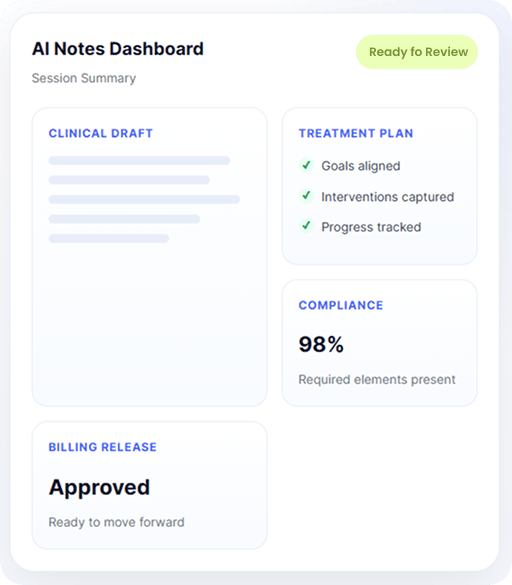
- Presenting problem identified
- Functional impairment documented
- Service is reasonable and necessary
- Treatment is expected to improve condition
AI Notes for Behavioral Health
Spend Less Time Writing Notes.
Spend More Time With Clients
Behavioral health providers face increasing documentation requirements while
trying to maintain quality care. Progress notes, treatment plans, assessments,
supervision documentation, and compliance requirements can consume hours
every week. DENmaar AI Notes helps clinicians complete documentation faster
while maintaining clinical accuracy and professional oversight.

Behavioral Health Focused

Clinical Accuracy & Oversight

Billing Workflow Ready

Reduce Documentation Time
Clinicians save hours each week on documentations.

Improve Note Consistency
AI-powered drafts improve quality and consistency.

Support Compliance Workflows
Build-in guidance for required documentation elements

Connect Notes to billing
Seamless integration with billing and operational workflows.
SUPPORTED DOCUMENTATION
Built Specifically for Behavioral Health
Unlike generic AI scribes, DENmaar AI Notes is designed for behavioral health workflows and
documentation requirements.
Individual Therapy
Family Therapy
Group Therapy
Substance Use Treatment
Case Management
Medication Management
Crisis Intervention
Clinical Supervision
Treatment Plans
Assessments and Reviews
AI NOTES WORKFLOW
How It Works
From captured session details to reviewed, billable documentation.

Record or Capture
Session Information
Patient check-in and
visit completed.

AI Generates a
Clinical Draft
AI Notes generate
structured documentation.

Review and Approve
Claim is created and
scrubbed for accuracy.

Release for Billing
Claim submitted to
the payer
DESIGNED FOR COMPLIANCE
Clinical Documentation with Compliance in Mind
AI Notes helps behavioral health providers document medical necessity, align treatment goals, identify
interventions, and support supervisor review workflows.
Compliance Support
Medical necessity documentation
Goal and treatment plan alignment
Intervention identification
Progress tracking
Required behavioral health documentation elements
Supervisor review workflows
Complete
Medical Necessity Documentation
Documentation supports the medical necessity of services provided and reflects the client’s ongoing treatment needs.
Evidence in Note
Aligned
Goal & Treatment Plan Alignment
Clinical documentation connects session content to active treatment goals and supports continuity across the plan of care.
Evidence in Note
- Active treatment goal referenced
- Session objectives tied to treatment plan
- Interventions support documented goals
- Progress linked back to care plan
Verified
Intervention Identification
Notes clearly identify the therapeutic interventions used during the session and how they relate to the client’s needs.
Evidence in Note
- Therapeutic intervention documented
- Intervention matched to presenting concerns
- Clinician actions clearly described
- Modality or technique identified where appropriate
Reviewed
Progress Tracking
Session documentation captures the client’s response to treatment and tracks change over time to support clinical decision-making.
Evidence in Note
- Client response to intervention documented
- Progress toward goals addressed
- Barriers or setbacks identified
- Ongoing symptoms or improvements noted
Included
Required Documentation Elements
Behavioral health notes include the core documentation elements needed for completeness, consistency, and payer readiness.
Evidence in Note
- Session date, duration, and service type included
- Relevant clinical observations documented
- Risk, safety, or notable concerns addressed when applicable
- Required note structure completed for the encounter
Available
Supervisor Review Workflow
Documentation can support internal review and approval workflows, helping supervisors monitor quality, accuracy, and compliance.
Evidence in Note
- Draft available for supervisor review
- Revisions or feedback can be incorporated
- Approval status is clearly tracked
- Final documentation is released after sign-off
MORE THAN A SCRIBE
Documentation Connected to the Rest of Your Workflow
Documentation can connect directly to scheduling, treatment plans, assessments, billing workflows, claims validation,
and provider productivity reporting.

Scheduling

Assessments

Claims Validation

DENmaar AI
Notes
Notes

Treatment Plans

Billing Workflows

Productivity Reporting
WHY ORGANIZATIONS CHOOSE DENMAAR
Built for Behavioral Health Teams and Organizations
DENmaar AI Notes is designed to support real-world clinical documentation and operational workflows.

Behavioral Health Focused
Customizable behavioral health workflows including therapy, psychiatry, substance use treatment, and multidisciplinary care models.

Scheduling & Operational Workflows
Integrated scheduling designed to support provider productivity, patient flow, authorization tracking, and claims readiness.

Supervisor Workflows
Built-in workflow logic designed to improve claim accuracy before submission through integrated operational checks and billing intelligence.

Eligibility & Insurance Verification
Integrated eligibility workflows designed to support Medicaid, commercial insurance, carve-outs, and behavioral health payer complexity.

Patient Engagement
Patient portal, intake workflows, secure communication, reminders, and measurement-based care tools.

Request an
AI Notes Trial
See how DENmaar AI Notes can help your clinicians reduce documentation time while improving
Request a demonstration or pilot program today.
Request Information
TESTIMONIALS
WHAT OUR CLIENTS SAY
On behalf of everyone at Meadowlark Counseling Services, I want to extend our sincere thanks for the continued improvements you and your team have made to the DENMaar EMR platform. We have been consistently impressed with both the functionality and user-friendly design of the system, which has made a meaningful difference in our day-to-day operations. The intuitive layout and ease of use have allowed our staff to spend less time navigating the system and more time focusing on client care. The regular updates and enhancements reflect your commitment to meeting the evolving needs of providers in the behavioral health and substance use treatment fields. We genuinely look forward to the new features introduced each month and appreciate how responsive the platform has been to the demands of clinical workflows. We have been so pleased with our experience that we’ve taken the opportunity to recommend DENMaar to other professionals in Pennsylvania who are working in the SUD field. Thank you again for your ongoing support and partnership. We are grateful to be working with a company that truly understands the needs of its users. KIndly, Becky Parks on behalf of the entire team at Meadowlark Counseling Services
I referred one of my colleagues Dr Aaron to you he is just starting g his psychology private practice and looking at where to start. I told him hands down you guys are the best billers and have a great EMR and team. He said he reached out just wanted to let you know!
FANTASTIC job keeping things rolling along with any and all of our billing concerns as well as responding to other issues which may well have been out of your wheelhouse. We are VERY grateful to have you and the crew in our corner.
I appreciate you all so much and DENmaar has been such a blessing Donna to our overall operations and success as an expanding company—allowing us to ultimately operate more efficiently, get our claims paid more consistently, ad stay on top of the critical credentialing piece, among other things. Teamwork does in fact, make the dream work. I’ll loop Chris/Isabella in on this message thread too, as I want All of your team to be aware of how much we appreciate our working relationship with DENmaar
Thank you for your diligence!! I appreciate it so much. Thank you Edwina…
Thank you so much Amy! I will be referring to DENmaar as often as I am asked about credentialing services.
Our Latest Blogs

Strategies for Success: Enhancing Financial Performance through Healthcare Revenue Cycle Optimization
Discover strategies for success through healthcare revenue cycle optimization and improve your financial performance in healthcare. By identifying improvement opportunities, you can enhance your financial outcomes. Let us explore the latest trends and innovations in revenue cycle optimization, providing you with the tools you need to succeed. Don’t miss out on maximizing your financial potential. Take control of your healthcare revenue cycle today.
Introduction
When implementing healthcare revenue cycle optimization, understanding the importance of an efficient and streamlined process is crucial to maximizing financial performance. Efficient revenue cycle management is essential for healthcare organizations to thrive in today’s complex financial landscape. The impact of technology can’t be overlooked, as it has revolutionized how revenue cycles are managed. However, with the benefits of technology come challenges such as increased complexity and the need for continuous adaptation. These revenue cycle challenges can negatively impact financial performance if not addressed effectively. To overcome these challenges and optimize financial performance, healthcare organizations must employ various strategies. These include implementing automated billing and coding systems and streamlining workflows through process optimization. Healthcare organizations can achieve sustainable success by focusing on efficiency and leveraging technology. Understanding the healthcare revenue cycle is the first step towards implementing effective optimization strategies.
Understanding the Healthcare Revenue Cycle
The revenue cycle encompasses all the steps from patient registration to final payment collection. Critical challenges in revenue cycle management include insurance claim denials, delayed reimbursements, and billing errors.
Definition and components of the healthcare revenue cycle
The healthcare revenue cycle refers to generating revenue for healthcare organizations, from patient registration, insurance verification, and preauthorization to claims submission, payment posting, and denial management. It encompasses all the steps involved in billing and collecting payments for healthcare services offered to patients. The key stakeholders in this process include patients, healthcare providers, insurance companies, and government payers. Best practices for optimizing the healthcare revenue cycle include:
- Implementing efficient and seamless electronic health record systems.
- Streamlining billing and coding processes.
- Conducting regular audits and training to ensure accuracy and compliance.
- Leveraging technology to automate and streamline revenue cycle management tasks.
Key challenges and common pain points in revenue cycle management
Managing the healthcare revenue cycle can be challenging. There are several vital obstacles and common pain points that healthcare organizations must navigate. One of the significant revenue cycle challenges is payment delays. These delays can significantly impact a healthcare organization’s cash flow. They can result from various factors, such as insurance verification, claim errors, or denials. Another challenge is ensuring data accuracy throughout the revenue cycle process. Inaccurate data can lead to claim denials, payment delays, and compliance issues. Denial management is another pain point. Healthcare organizations struggle to identify and address denied claims promptly and effectively. Process bottlenecks, such as inefficient workflows and lack of automation, can also hinder revenue cycle management. Addressing these issues is crucial for healthcare organizations to optimize their revenue cycle and enhance financial performance.
Identifying Opportunities for Improvement
To identify opportunities for improvement in your healthcare revenue cycle, you need to conduct a comprehensive assessment of the entire process. It involves analyzing current processes to identify bottlenecks and areas of inefficiencies. Knowing the impact of technology on revenue cycle optimization is crucial, as leveraging the right tools and systems can significantly enhance financial performance.
Conducting a comprehensive assessment of the revenue cycle
First, identify the critical areas for improvement in your healthcare revenue cycle. Conducting a comprehensive revenue cycle assessment is essential to find areas where performance can be enhanced. This assessment involves revenue cycle analysis, performance evaluation, and process improvement. By thoroughly evaluating each step of the revenue cycle, you can pinpoint bottlenecks, inefficiencies, or non-compliance areas impacting your financial performance. Look for opportunities to optimize your revenue cycle by implementing strategies such as streamlining workflows, automating manual processes, and enhancing revenue capture and denial management. Utilize data-driven insights to prioritize improvement efforts and measure the impact of optimization strategies. A comprehensive assessment will help you identify areas where changes can be made to enhance financial performance and overall revenue cycle efficiency.
Analyzing current processes and identifying bottlenecks
By conducting a thorough current process analysis and data analysis, you can identify areas that are causing delays or hindering the flow of revenue. Here are three essential steps to consider:
- Identify key bottlenecks: Look for areas with significant delays or inefficiencies in your revenue cycle. It could be in patient registration, claim submission, or payment collection processes.
- Determine root causes: Once you’ve identified the bottlenecks, analyze the underlying causes. Is it due to outdated technology, lack of staff training, or inefficient workflows? Understanding the root causes will assist you in developing targeted solutions.
- Implement process improvement strategies: Use the data analysis to prioritize improvements and implement changes. It could involve streamlining workflows, investing in new technology, or enhancing staff training.
Understanding the impact of technology on revenue cycle optimization
Improve your revenue cycle optimization by recognizing the impact of technology on identifying opportunities for improvement. Technology is crucial in streamlining and enhancing revenue cycle processes in the healthcare industry. One of the key benefits of automation is the reduction of manual tasks, allowing for increased efficiency and accuracy. Healthcare organizations can collect, process, and analyze large volumes of data through automated systems, leading to valuable insights. Data analytics tools enable organizations to identify trends, patterns, and areas for improvement, such as reducing claim denials or optimizing reimbursement rates. However, implementing technology in revenue cycle optimization does come with its challenges, including the need for staff training and resistance to change. Nevertheless, the future holds promising technological advancements like artificial intelligence, which can revolutionize revenue cycle optimization.
Strategies for Enhancing Financial Performance
To enhance your financial performance in healthcare, focus on streamlining front-end processes for accurate patient data collection. By implementing effective coding and documentation practices, you can ensure proper billing and reduce the risk of claim denials. Optimizing claims management and denial prevention, leveraging technology solutions, and enhancing the patient financial experience and collections will contribute to a more efficient revenue cycle and improved financial outcomes.
Streamlining front-end processes for accurate patient data collection
When streamlining front-end processes for accurate patient data collection, it’s essential to prioritize efficiency and accuracy to optimize financial performance. Accurate data validation and collection improvement are crucial for ensuring patient information accuracy and reducing errors. To achieve front-end optimization, consider the following strategies:
- Implement automated data capture tools: Utilize technology to streamline data collection and reduce manual errors. Automated tools can extract patient information from various sources and validate it against existing records, improving accuracy and efficiency.
- Standardize data entry protocols: Establish protocols for data entry to ensure consistency and accuracy. It includes using standardized codes, formats, and terminology to minimize errors and facilitate data analysis.
- Train staff on accurate data collection: Provide comprehensive training to front-end staff on the importance of accurate data collection and validation. It includes educating them on data quality standards, proper documentation techniques, and error correction procedures.
Implementing effective coding and documentation practices
Implementing effective coding and documentation practices is essential to optimize financial performance and streamline front-end processes for accurate patient data collection. Achieving coding accuracy and documentation improvement is crucial for reimbursement optimization and maintaining compliance standards. Accurate coding ensures medical services are correctly classified and billed, maximizing revenue potential. Documentation improvement focuses on capturing complete, detailed patient information, enabling accurate code assignment. This comprehensive documentation also supports audit readiness, reducing the risk of compliance violations and financial penalties.
Optimizing claims management and denial prevention
By optimizing claims management and prevention of denials, you can significantly enhance your healthcare organization’s financial performance and ensure maximum revenue capture. Claims processing and denial management are critical aspects of revenue cycle optimization. Here are three strategies to help you optimize these processes:
- Streamline claims processing: Implement efficient workflows and leverage technology solutions to automate and expedite claims submission. It reduces errors, accelerates reimbursement, and minimizes revenue leakage.
- Proactive denial management: Analyze denial patterns to identify root causes and implement corrective actions. You can prevent denials and improve reimbursement rates by addressing common denial reasons, such as incomplete documentation or coding errors.
- Reimbursement optimization: Stay updated with payer policies and regulations to ensure accurate coding and billing. Conduct regular audits to identify opportunities for optimization and revenue enhancement.
Leveraging technology solutions for efficient revenue cycle management
Implementing technology solutions such as revenue cycle automation and data analytics can provide significant efficiency benefits to your organization. By automating tasks like claims processing and denial management, you can optimize workflows and reduce the time and effort required for manual intervention. It improves the speed and accuracy of revenue cycle processes and frees up valuable resources to focus on other critical tasks.
Enhancing patient financial experience and collections
Improve the patient’s financial experience and collections process by implementing strategies that leverage technology solutions for efficient revenue cycle management. Enhancing the patient’s financial experience is crucial for increasing patient satisfaction and ensuring timely payment. Here are three key strategies to achieve this:
- Offer flexible payment options: Provide patients with various payment options, like online payment portals and installment plans, to accommodate their financial situations and improve their overall experience.
- Provide financial counseling: Offer financial counseling services to patients to help them understand their bills, navigate insurance coverage, and explore available assistance programs. It can alleviate their financial concerns and improve their satisfaction with the healthcare organization.
- Enhance cost transparency: Increase transparency by providing patients with accurate cost estimates upfront, preventing unexpected financial burdens.
Future Trends and Innovations in Revenue Cycle Optimization
As you explore the future trends and innovations in revenue cycle optimization, it’s important to consider emerging technologies and their impact on revenue cycle management. Artificial intelligence and automation can streamline processes in healthcare organizations.
Exploring emerging technologies and their impact on revenue cycle management
You can actively enhance your healthcare revenue cycle management by regularly exploring emerging technologies and their impact on future trends and innovations in revenue cycle optimization. Here are three areas where emerging technologies can make a significant impact:
- Automation and Artificial Intelligence (AI): AI-powered solutions can automate repetitive tasks like coding and billing, reducing errors and improving efficiency. These technologies can also analyze large volumes of data to find patterns and trends, enabling organizations to make data-driven decisions.
- Telehealth and Virtual Care: The adoption of telehealth allows healthcare providers to deliver remote care. Telehealth technologies can streamline billing and reimbursement, reducing administrative burdens and improving revenue cycle efficiency.
Role of AI and automation in streamlining processes
Healthcare organizations can automate coding and billing processes by leveraging AI-powered tools, reducing errors and speeding up revenue collection. AI can analyze data to find patterns, enabling organizations to make decisions and optimize revenue cycles. The benefits of automation include increased productivity, reduced costs, and improved patient satisfaction. Streamlining processes with AI and optimizing revenue cycles with automation are vital strategies for healthcare organizations looking to enhance their financial performance and stay ahead in an increasingly competitive industry.
Predicting future challenges and opportunities in healthcare revenue cycle optimization
Healthcare revenue cycle optimization faces future challenges and opportunities in emerging trends and innovations. As the industry evolves, predictive analysis will be crucial in identifying obstacles and opportunities in revenue cycle optimization. Organizations can strategically plan for the future by leveraging data and industry insights, ensuring financial success. Here are three key areas to focus on:
- Integration of advanced technologies: Embracing innovative technologies like machine learning and automation can streamline revenue cycle processes, reducing errors and improving efficiency.
- Patient-centric approach: In an era of consumerism, healthcare organizations must prioritize patient satisfaction and engagement. Implementing user-friendly portals and personalized communication channels can enhance the revenue cycle experience for patients.
- Regulatory compliance: Staying up-to-date with evolving regulations is essential for revenue cycle optimization. Organizations should invest in robust compliance programs and constantly monitor changes to avoid penalties and revenue loss.
Recap of the importance of healthcare revenue cycle optimization for financial success
Maximize your financial success by prioritizing healthcare revenue cycle optimization. Implementing revenue cycle optimization can have significant benefits and outcomes for your organization. Here are three key areas to focus on:
- Best practices: Implementing the best practices for revenue cycle optimization can streamline processes, reduce errors, and improve efficiency. It includes standardizing workflows, leveraging technology solutions, and training staff on proper documentation and coding practices.
- Measuring and tracking financial performance: Establishing key performance indicators (KPIs) and regularly monitoring them can help measure the success of your revenue cycle management efforts. Tracking metrics such as days in accounts receivable, denial rates, and clean claim rates can provide valuable data to identify areas for improvement and track progress over time.
Encouragement to implement strategies
While implementing these strategies may come with its fair share of challenges, such as overcoming resistance and managing change, the benefits far outweigh the difficulties. By addressing implementation challenges head-on and effectively managing resistance, healthcare organizations can create a culture that embraces change and drives continuous improvement. Additionally, it’s crucial to measure the success of these strategies through key performance indicators and data-driven analysis. It will provide valuable insights into the effectiveness of the implemented changes and help identify areas for further improvement.
Call to action for healthcare organizations to prioritize revenue cycle optimization for enhanced financial performance
By prioritizing optimization, you can maximize revenue, improve efficiency, reduce costs, and ultimately achieve your financial goals. Here are three essential steps to take:
- Streamline processes:
- Identify bottlenecks in your revenue cycle and implement strategies to streamline workflows.
- This can include automating manual tasks, improving documentation accuracy, and enhancing department communication.
- Invest in staff training:
- Equip your team with the required skills and knowledge to navigate the complexities of the revenue cycle.
- Provide ongoing training on industry best practices, coding guidelines, and compliance regulations.
Conclusion
In conclusion, organizations can significantly enhance their financial performance by implementing effective revenue cycle optimization strategies in healthcare. The future trends and innovations in this field offer promising opportunities for further improvement. Healthcare providers can identify and address areas for enhancement with a data-driven approach, leading to increased revenue generation. By optimizing the revenue cycle, healthcare organizations can achieve financial success and provide better care to their patients.
We at DENmaar provide Healthcare Revenue Cycle Management at the best prices. Our health billing software has an RCM claims engine that permits health practices to handle their revenue cycle management to ensure successful claims submissions and timely reimbursements. Call us now at 844-727-3627.

From Paperwork to Profitability: Enhancing Billing with EHR Integration
Introduction
Efficient billing processes are crucial in the healthcare industry to ensure timely payments and financial stability. You may be tired of drowning in paperwork and struggling to make your billing process efficient. Consider integrating electronic health records (EHR) into billing systems. EHR integration streamlines the billing process by automating data entry, minimizing errors, and improving overall efficiency. By streamlining your billing processes and leveraging the power of technology, you can boost profitability and save valuable time.
Importance of efficient billing processes in healthcare
Healthcare providers must implement efficient billing processes to ensure optimal profitability. Efficient billing processes are essential for accurate healthcare reimbursement and effective revenue cycle management. By streamlining the billing process, multi-provider group practices can reduce errors and delays, leading to faster payment and improved cash flow. One key component of efficient billing processes is the integration of electronic health records (EHR). EHR integration allows seamless communication between healthcare providers and billing departments, ensuring that all relevant information is captured and billed accurately. With EHR integration, healthcare providers can automate billing tasks, such as coding and claim submission, reducing the time and effort required for manual data entry.
Introduction to Electronic Health Records (EHR) integration
Integrating electronic health records (EHR) enhances billing efficiency and profitability. The benefits of EHR integration are numerous. It allows for streamlined data management, reducing the need for manual paperwork and increasing accuracy. By automating billing processes, healthcare providers can save time and reduce errors, resulting in faster payment turnaround. However, implementing EHR integration does come with challenges. Factors for successful EHR integration include compatibility with existing systems, data security, and staff training. Maximizing profitability through EHR integration involves optimizing revenue cycle management and utilizing data analytics to identify trends and opportunities. Overcoming obstacles in EHR integration requires careful planning, clear communication, and ongoing support from vendors. By overcoming these challenges, healthcare organizations can unlock the full potential of EHR integration, improving billing processes and ultimately increasing profitability.
Understanding the challenges of traditional paperwork-based billing
Traditional paperwork-based billing poses several challenges regarding time-consuming and error-prone manual processes. It becomes difficult to track and manage billing data accurately, leading to inaccuracies and delays in payment. Additionally, the lack of integration between different systems further complicates the billing process, making it inefficient and prone to errors.
Time-consuming and error-prone manual processes
Using a manual paperwork-based billing system can be time-consuming and prone to errors. This approach’s lack of tracking efficiency and data accuracy can hinder revenue optimization. Billing processes become tedious and error-prone without a streamlined system that integrates with electronic health records (EHR). Staff education becomes even more critical due to the complexities of navigating multiple systems and ensuring data accuracy. Moreover, system compatibility issues between various software used for billing and EHR can further exacerbate the challenges. These manual processes require significant time and effort to manage, leading to delays in billing and revenue loss.
Difficulty in tracking and managing billing data
To effectively manage billing data, you need to overcome the challenges of manual paperwork-based systems, ensuring accurate tracking and efficient management. Traditional paperwork-based billing processes often have difficulty tracking and managing billing data, leading to low tracking efficiency, accuracy, and productivity enhancement. With manual systems, keeping track of patient information, insurance claims, and payment records becomes increasingly challenging. This lack of tracking efficiency can delay billing and revenue management issues. Moreover, the manual nature of these processes makes them prone to errors and inconsistencies, further impacting billing accuracy. Implementing an EHR system can address these challenges by automating the billing process, centralizing data, and offering real-time access to accurate and up-to-date information. However, EHR implementation challenges, such as data migration and staff training, must be carefully managed to ensure a smooth transition and optimize the benefits of enhanced billing practices.
Lack of integration between different systems
Overcoming the lack of integration between different systems is essential for effectively managing traditional paperwork-based billing processes. Integration challenges often lead to system inefficiencies, data inconsistencies, manual errors, and tracking difficulties. Here are some key challenges faced in traditional paperwork-based billing:
– Integration Challenges: The lack of integration between different systems makes sharing and accessing information difficult, leading to inefficiencies in the billing process.
– System Inefficiencies: Without integration, multiple systems need to be manually updated and reconciled, resulting in delays and errors in billing operations.
– Data Inconsistencies: Different systems may store data in different formats or have conflicting data, making it challenging to ensure accuracy and consistency in billing information.
– Manual Errors: With manual entry and processing of billing data, the chances of errors increase, leading to billing discrepancies and financial losses.
Exploring the benefits of EHR integration for billing
Regarding EHR integration for billing, there are several key benefits to consider.
- It streamlines the billing process by automating tasks and reducing the need for manual input. It not only saves time but also reduces errors and improves accuracy.
- EHR integration enhances efficiency and productivity by offering a centralized patient and billing data management system.
- It improves revenue cycle management by streamlining the reimbursement process and ensuring timely payments.
Streamlining the billing process
Streamline your billing process by integrating your EHR system for improved efficiency and profitability. Incorporating your electronic health record (EHR) system with your billing software can optimize revenue and enhance productivity. Here are the benefits of EHR integration for billing:
– Improving Efficiency: EHR integration avoids manual data entry, minimizes errors, and conserves time.
– Reducing Errors: With automated workflows, the chances of errors in billing are significantly reduced, ensuring accurate and timely submissions.
– Optimizing Revenue: By integrating your EHR system, you can capture all billable services and ensure proper coding, leading to increased revenue.
– Enhancing Productivity: EHR integration automates claims submission and follow-up tasks, freeing up staff time to focus on patient care.
Integrating your EHR system with your billing process streamlines operations, reduces errors, optimizes revenue, and enhances productivity, ultimately contributing to improved profitability for your healthcare organization.
Reducing errors and improving accuracy
Enhance accuracy and minimize errors by integrating your EHR system with your billing process. By leveraging the power of EHRs, you can significantly reduce errors and improve the overall accuracy of your billing operations. There are several error reduction strategies and accuracy improvement techniques you can implement. One key strategy is the automation of data entry. By integrating your EHR system with your billing software, you can avoid manual data entry, reducing the risk of transcription errors and ensuring accurate and consistent information.
Additionally, implementing validation checks and alerts within your billing software can help identify errors before they occur, enhancing accuracy. Furthermore, integrating your EHR system with your billing process allows for real-time data synchronization. Ensures that any updates or changes made in the EHR system are immediately reflected in the billing system, minimizing the possibility of discrepancies or outdated information.
Enhancing efficiency and productivity
Boost your practice’s efficiency and productivity with the seamless integration of EHR into your billing process. By implementing this integration, group practices can enhance accuracy, increase revenue, optimize workflows, and reduce errors. Here are the benefits of EHR integration for billing:
– Enhancing accuracy: EHR integration reduces the chances of human error and ensures accurate billing information.
– Increasing revenue: With EHR integration, you can streamline the billing process, resulting in faster claim submissions and reimbursements, ultimately increasing your group practice’s revenue.
– Optimizing workflows: Integrating EHR with billing allows for a smooth flow of patient information, eliminating the need for duplicate data entry and reducing administrative tasks.
– Reducing errors: By automating the billing process through EHR integration, you can minimize errors caused by manual calculations or missed documentation, improving overall accuracy and reducing claim denials.
Improving revenue cycle management
Improve your revenue cycle management with the seamless integration of EHR into your billing process. Integrating electronic health records (EHR) with your billing system can optimize revenue and reduce errors while streamlining workflows and enhancing productivity. Integrating EHR with your billing process allows for automated capture of patient encounter data, eliminating the need for manual entry and reducing the potential for errors. This integration also enables real-time access to patient information, improving efficiency and accuracy in coding, billing, and claims submission. Furthermore, EHR integration provides a centralized platform for managing the entire revenue cycle, allowing for better coordination and communication between different departments involved in the billing process. This streamlines workflows reduces redundant tasks, and enhances productivity.
Key considerations for successful EHR integration for billing
There are several key considerations to remember regarding successful EHR integration for billing.
- The right EHR system is crucial to ensure it meets your billing needs. Compatibility and interoperability with other systems is another critical factor, as it allows for seamless data exchange.
- Providing training and education for staff members, as well as implementing effective data migration strategies, can help optimize the integration process and ensure a smooth transition.
Selecting the right EHR System
Choose an EHR system that meets your needs and requirements to integrate EHR with billing. Here are some key considerations to keep in mind during the EHR system selection process:
– Implementation Challenges: Understand the challenges during the implementation phase, such as system downtime and workflow disruptions. Choose the EHR system from DENmaar because it provides comprehensive support and resources for group practices to overcome these challenges.
– Staff Training: Consider the training requirements for your staff members to use the new EHR system effectively. Look for a solution that offers comprehensive training programs and ongoing support to ensure a smooth transition.
– Data Migration Strategies: Evaluate the data migration strategies offered by different EHR systems. Choosing a system that ensures seamless and secure transfer of patient data from your existing billing system is crucial.
– System Compatibility: Ensure that your selected EHR system is compatible with your prevailing infrastructure and integrates smoothly with your current billing processes. Compatibility issues can lead to inefficiencies and increased costs.
Ensuring compatibility and interoperability
Prioritizing compatibility and interoperability with your existing systems is essential to ensure successful EHR integration with your billing process. Compatibility challenges may arise when attempting to integrate different systems, such as EHR and billing software, due to variations in data formats, protocols, and structures. However, interoperability solutions can help overcome these challenges and ensure seamless processes. System integration is crucial in enabling data exchange between EHR and billing systems. This integration allows for efficient data tracking, enabling accurate and timely billing. Interoperability solutions facilitate the smooth flow of information between systems. Healthcare organizations can streamline billing processes and optimize revenue generation by ensuring compatibility and interoperability.
Training and education for staff members
Ensure all staff members receive comprehensive training and education to successfully integrate EHR into the billing processes. Staff development is crucial in optimizing electronic health records (EHR) for billing purposes. Here are critical considerations for practical training and education initiatives:
– Implement training programs that cover the functionality and features of the EHR system.
– Provide hands-on practice sessions to enhance staff members’ skills in using the EHR for billing tasks.
– Offer education initiatives focusing on understanding billing regulations, coding requirements, and documentation standards.
– Facilitate knowledge acquisition through workshops, webinars, and online resources.
By investing in staff development, organizations can ensure their employees have the necessary skills and knowledge to seamlessly integrate EHR into the billing processes. It will ultimately contribute to improved efficiency, accuracy, and revenue generation.
Implementing effective data migration strategies
Data migration can present various challenges, such as ensuring data integrity and accuracy during the transfer process. It’s crucial to employ data mapping techniques to overcome these challenges. It involves creating a clear and detailed plan for mapping data elements from the legacy system to the new EHR system. Additionally, implementing data validation methods is essential to verify the accuracy and fulfillment of the migrated data. It can include running comprehensive data validation checks and using automated tools to identify inconsistencies or errors. Lastly, employing data cleansing strategies, such as removing duplicate or outdated records, can help improve the quality and reliability of the migrated data.
Best practices for maximizing the profitability of billing through EHR integration
To maximize the profitability of billing through EHR integration, you should start by automating your billing processes and workflows. It will help streamline the billing process, reduce errors, and improve efficiency. Additionally, utilizing your EHR system’s analytics and reporting capabilities will provide valuable insights into your billing performance, allowing you to identify improvement areas and optimize your group practices’ revenue cycle. Lastly, implementing effective coding and documentation practices will ensure accurate and complete billing, minimizing denials and maximizing reimbursements. Regularly reviewing and optimizing your billing performance will help you stay on top of any changes or trends in the industry and maintain a profitable billing operation.
Automating billing processes and workflows
Maximize your billing profitability by automating processes and workflows through EHR integration. You can improve revenue management and optimize billing processes by implementing automated billing software and streamlining workflows. DENmaar offers advanced billing services and software solutions for MHSA and ABA group practices. Here are some best practices to consider:
– Utilize electronic billing solutions: Electronic billing solutions allow for efficient and accurate submission of claims, reducing the risk of errors and delays.
– Implement automated coding and charge capture: You can ensure accurate billing and prevent missed charges by automating coding and charge capture processes.
– Integrate EHR with billing systems: Integrating your EHR with your billing systems allows for seamless transfer of patient data, reducing manual data entry and minimizing errors.
– Monitor and analyze billing data: Regularly monitor and analyze your billing data to identify trends, spot problems, and make informed decisions to improve profitability.
Utilizing analytics and reporting capabilities
To maximize the profitability of billing through EHR integration, you can utilize the analytics and reporting capabilities available. By utilizing analytics, you can attain valuable insights into your billing processes, allowing you to identify areas for improvement and optimize revenue generation. These analytics can help you identify patterns and trends, enabling you to make data-driven decisions for improving efficiency and enhancing productivity. With the help of reporting capabilities, you can generate detailed reports on several aspects of your billing operations, including revenue, collections, and reimbursement rates. This information can be used to track performance, identify bottlenecks, and implement strategies for maximizing profitability.
Implementing effective coding and documentation practices
One way to maximize the profitability of billing through EHR integration is by implementing effective coding and documentation practices. Multi-provider healthcare group practices can ensure they capture all the necessary information to support proper billing by improving coding accuracy and following documentation best practices. Here are some coding compliance strategies and revenue optimization techniques to consider:
– Conduct regular coding and documentation audits to identify any areas of improvement and ensure compliance with coding guidelines.
– Train staff on proper coding and documentation techniques to reduce errors and inaccuracies.
– Implement coding templates and standardized documentation formats to streamline the coding process.
– Utilize EHR features such as coding prompts, alerts, and templates to improve coding accuracy and ensure complete documentation.
Regularly reviewing and optimizing billing performance
Improve your billing performance by regularly reviewing and fine-tuning your processes for maximum profitability through EHR integration. Regularly reviewing your billing performance is essential to identify areas of improvement and overcome challenges. Tracking data allows you to analyze claim rejection rates, denial reasons, and reimbursement trends. This data-driven approach allows you to identify patterns and make informed decisions to optimize your group practices’ billing processes. Reviewing performance also helps you identify any coding or documentation issues affecting your reimbursement. By addressing these issues, you can ensure accurate and timely billing, leading to higher profitability. Additionally, regularly reviewing your billing performance allows you to adapt to changing regulations and payer requirements, maximizing your profitability in an ever-evolving healthcare landscape.
Overcoming challenges and obstacles in EHR integration for billing
When integrating EHR systems for billing, you may encounter resistance to change among staff members. It’s essential to address this by providing comprehensive training and support to ensure smooth adoption. Technical issues and system compatibility challenges may arise, requiring careful planning and testing to mitigate disruptions. Finally, addressing privacy and security concerns is crucial to maintaining patient trust and compliance with regulations.
Resistance to change and staff training
To overcome potential challenges and obstacles in EHR integration for billing, your staff’s willingness to embrace change and undergo training is essential. Resistance to change is a common hurdle that organizations face when implementing new systems. Here are some key strategies to address this resistance and ensure successful integration:
– Change management: Create a comprehensive change management plan that includes clear communication, involvement of key stakeholders, and a phased implementation approach.
– Employee engagement: Involve your staff in the decision-making process and provide opportunities for feedback and input. It will help them feel valued and invested in the transition.
– Training and education: Conduct thorough training sessions to equip your staff with the skills to navigate the new EHR system efficiently.
– Ongoing support: Offer ongoing support with the help of DENmaar to address challenges that arise during the integration process.
Technical issues and system compatibility
Overcome technical issues and ensure seamless system compatibility by thoroughly testing and implementing necessary updates. Integration challenges and technical issues may arise when integrating electronic health record (EHR) systems with billing processes. One of the primary concerns is system compatibility, as different EHR systems may have varying interfaces and data formats. It can lead to interoperability concerns and difficulties in transferring data between systems. To overcome these obstacles, it’s crucial to thoroughly assess the compatibility of the EHR system with the billing software before integration. It includes conducting rigorous testing to identify technical issues and implementing the necessary updates to enhance system compatibility. Healthcare organizations can proactively streamline their billing processes and enhance efficiency by addressing these challenges.
Addressing privacy and security concerns
To address privacy and security concerns in EHR integration for billing, you must prioritize data protection and implement robust security measures. Safeguarding patient information is crucial to maintain trust and comply with regulatory requirements. Here are some critical steps to enhance privacy and security in EHR integration:
– Implement strong data encryption: Encrypting sensitive patient data ensures it remains unreadable and protected from unauthorized access.
– Enforce access controls: Implement strict access controls that restrict system and data access to authorized personnel only. It helps prevent unauthorized individuals from accessing patient information.
– Focus on data breach prevention: Regularly monitor systems for vulnerabilities and take necessary steps to prevent data breaches.
– Obtain patient consent: Ensure that patients are fully informed and consent before integrating their EHR data for billing purposes.
– Maintain regulatory compliance: Stay updated with relevant privacy and security regulations to ensure compliance and avoid penalties.
Recap of the benefits and importance of EHR integration for billing
You’ll see the value and advantages of integrating EHR into your billing process. EHR integration offers several benefits and is crucial for optimizing revenue and streamlining billing practices. Here’s a recap of why EHR integration is essential:
– Automation: EHR integration automates the billing process, minimizing manual entry requirements and errors. It saves time and improves accuracy.
– Revenue Optimization: By integrating EHR with billing systems, you can effectively track and manage claims, ensuring timely reimbursement and minimizing revenue leakage.
– Data Analysis: EHR integration allows for comprehensive analysis of billing data, enabling you to identify trends, monitor performance, and make informed decisions to enhance financial outcomes.
– Staff Efficiency: With EHR integration, your staff can focus on higher-value tasks, as administrative burdens are reduced. It improves productivity and enables your team to provide better patient care.
Encouragement for healthcare organizations to embrace this technology
Embrace the technology and revolutionize your billing process by integrating EHR into your healthcare organization. The benefits and success stories of EHR integration in healthcare organizations are well-documented. By streamlining the billing process, healthcare organizations can reduce manual errors, improve accuracy, and expedite reimbursement. Case studies have shown that implementing EHR integration for billing has improved profitability. Healthcare organizations have experienced increased revenue, reduced administrative costs, and improved cash flow. Overcoming resistance and encouraging the adoption of EHR integration can be achieved through effective communication, training, and addressing concerns about data security with the help of DENmaar.
Furthermore, EHR integration can lead to significant cost savings and efficiency gains. By eliminating paper-based processes and automating billing, healthcare organizations can reduce administrative overhead and increase operational efficiency. Additionally, EHR integration is crucial in improving patient satisfaction and overall healthcare experience. Patients can better understand their healthcare costs with easy access to accurate billing information, increasing trust and satisfaction.
Final thoughts on the future of billing processes in the healthcare industry
To ensure future success in the healthcare industry, healthcare organizations must adapt their billing processes to the evolving landscape. Several factors, including future innovations and technological advancements, will shape the future of billing processes. Here are some final thoughts on the future of billing processes in the healthcare industry:
– Future innovations: As technology advances, we expect new and innovative billing solutions that streamline processes and improve accuracy.
– Technological advancements: Integrating electronic health records (EHRs) is just the beginning. Future advancements include automated billing systems and artificial intelligence-driven tools.
– Financial implications: Implementing advanced billing processes can have significant financial implications for healthcare organizations. They can increase revenue, reduce billing errors, and improve financial performance.
– Industry-wide adoption: As more organizations realize the benefits of advanced billing processes, we can expect to see industry-wide adoption of these technologies.
– Regulatory compliance: With the evolving regulatory landscape, healthcare organizations must ensure that their billing processes remain compliant with industry regulations.
Conclusion
By streamlining the billing process, integrating EHR can revolutionize your multi-provider group practices’ profitability, accuracy, and efficiency. Embracing this technology is crucial for staying competitive in the ever-changing healthcare industry. As we look to the future, it’s clear that EHR integration will continue to revolutionize billing processes, paving the way for a more efficient and effective healthcare system. Remember, you can overcome any challenges and obstacles with careful consideration and effective implementation. So, contact DENmaar for EHR integration and watch your billing soar to new heights.
Our EHR integration allows you to access treatment plans, progress notes, and homework assignments. DENmaar’s medical EHR software also acts as an intelligent virtual assistant that helps organize and prioritize multi-provider group practices’ workflow. Call us now at 844-727-3627.

Get Ahead of the Competition: Level Up with Expert Insurance Credentialing Services
With insurance credentialing services, you can navigate the complex world of insurance credentialing, streamline the process, and ensure you get the coverage you need. Choosing the exemplary service is essential, and we’re here to help. Let us explore the advantages of outsourcing your insurance credentialing and the common challenges you may face. Don’t let the paperwork overwhelm you – let us guide you towards a smoother credentialing experience.
If you’re considering joining insurance networks, it’s crucial to understand the process of insurance credentialing. Insurance credentialing is the process of verifying and assessing the qualifications, experience, and credentials of healthcare providers to ensure they meet the standards set by insurance companies. This process is of utmost importance as it allows healthcare providers to become in-network with insurance companies, enabling them to receive reimbursement for their services. The steps involved in insurance credentialing include completing applications, submitting required documents, and undergoing a thorough evaluation by the insurance company. Errors in the application process can lead to delays or denials in credentialing, so avoiding common mistakes such as incomplete documentation or inaccuracies is essential. Many healthcare providers outsource their insurance credentialing to specialized companies to streamline this process. Outsourcing insurance credentialing can save time and resources, permitting healthcare providers to concentrate on patient care while ensuring a smooth reimbursement process.
What are Insurance Credentialing Services?
Insurance credentialing services refer to the process of verifying and validating the credentials of healthcare providers. These services play a crucial role in the healthcare industry by ensuring that providers meet the requirements to participate in insurance networks.
Definition of insurance credentialing
You must understand insurance credentialing services’ fundamental concept and purpose. Insurance credentialing refers to evaluating the qualifications and credentials of healthcare providers to ensure their eligibility to participate in insurance networks. It’s an essential step for healthcare providers to establish relationships with insurance companies and receive reimbursement for their services.
Here are three key aspects of insurance credentialing:
- Insurance credentialing benefits
Credentialing allows healthcare providers to expand their patient base by accepting insurance plans. It also ensures that providers meet quality standards and comply with regulatory requirements. - Selecting insurance credentialing
Providers must choose the insurance networks they want to join based on patient population, reimbursement rates, and administrative requirements. - Outsourcing insurance credentialing
Many healthcare providers outsource the credentialing process to specialized companies. It can save time and resources, as experts handle the complex paperwork and follow up with insurance companies.
Role of insurance credentialing services in the healthcare industry
As a healthcare provider, you can depend on insurance credentialing services to streamline verifying and evaluating your qualifications and credentials for participation in insurance networks. Insurance credentialing can be complex and time-consuming, requiring you to submit various documents and undergo extensive background checks. You can save valuable time by outsourcing credentialing services to a specialized company. Insurance credentialing services offer numerous benefits to healthcare providers. They have expertise in navigating the credentialing process and can ensure that all necessary paperwork is completed accurately and efficiently. Additionally, they can help you select the most suitable insurance credentialing service based on your specific needs and requirements.
Benefits of using Insurance Credentialing Services for healthcare providers
You can frequently benefit from using insurance credentialing services as a healthcare provider. These services streamline provider enrollment, ensuring you can join insurance networks and expand your patient base. The credentialing process is handled by experts who navigate the complex requirements and paperwork on your behalf, saving you time and effort. By completing credentialing, you can get into insurance contracts, which provide financial security and stability for your practice. Insurance credentialing services also play a crucial role in ensuring timely and accurate provider reimbursement, reducing the administrative burden, and improving your cash flow.
How to Choose the Right Insurance Credentialing Service
When choosing an insurance credentialing service, there are several factors to consider.
Factors to consider when selecting an insurance credentialing service
- First, you should look at their expertise in the industry to ensure they have the necessary knowledge to handle your credentialing needs.
- Additionally, it’s essential to consider their reputation and client reviews to understand their track record and customer satisfaction.
- Lastly, you should evaluate the services they offer, their pricing structure, and the turnaround time for the credentialing process.
Expertise
Here are three key factors to consider:
- Years of experience
Look for a credentialing service provider with extensive experience in the insurance industry. Their knowledge and understanding of the credentialing process will ensure an efficient process for your practice. - Specialized expertise
Determine if the company has expertise in your specific area of healthcare. It will ensure they have the necessary knowledge and understanding of the unique challenges and obstacles that may arise during the credentialing process. - Reputation and client satisfaction
Research the company’s reputation and satisfaction rate. Check for testimonials and reviews from other healthcare providers to gauge their professionalism and customer service. A reputable company with high client satisfaction will deliver the benefits you seek in an insurance credentialing service.
Reputation and client reviews
Consider the reputation and client reviews of insurance credentialing services to decide on selecting the right provider for your practice. Reputation management is crucial in healthcare, and client satisfaction is an essential factor to consider. Look for online reviews, provider feedback, and customer testimonials to gauge the quality of service the credentialing service provides. Now, let’s move on to discussing the services offered and pricing.
Services offered and pricing
You should evaluate the services and pricing to choose the right insurance credentialing service. Here are some factors to consider:
- Pricing transparency
Look for a service outlining fees and additional costs in the credentialing process. - Insurance network participation
Ensure the service provider has experience working with the insurance networks you want to participate in.
- Provider enrollment
Check if the service provider assists with the enrollment process and provides ongoing support.
These factors will help you find an insurance credentialing service that meets your needs and budget.
Turnaround time for the credentialing process
Evaluate the turnaround time for the credentialing process when selecting an insurance credentialing service. Reducing wait times is crucial in today’s fast-paced healthcare industry. Look for a service that improves efficiency and optimizes workflow to ensure a smooth and timely credentialing process. A reliable service should also have a track record of enhancing provider enrollment and streamlining documentation. Considering these factors, you can minimize delays and ensure a seamless credentialing experience.
Questions to ask insurance credentialing service providers
When choosing an insurance credentialing service, it’s important to ask potential providers a few key questions.
- Firstly, inquire about their industry experience and how long they’ve been in the business.
- Additionally, ask for references from satisfied clients to ensure their credibility.
- It’s also crucial to discuss their fees, what services are included, and the typical timeframe for the credentialing process.
These questions will help you decide and find the right insurance credentialing service for your needs.
How long have you been in the industry?
Consider the experience of insurance credentialing service providers when selecting the right one for your needs. When evaluating providers, ask them how long they’ve been in the industry. It will give you an idea of their experience duration and industry expertise. Look for providers with extensive industry knowledge and a track record of client satisfaction. Additionally, consider their cost efficiency in delivering their services.
Can you provide references from satisfied clients?
To assess the credibility of potential insurance credentialing service providers, ask them for references from satisfied clients. Client references and customer testimonials can provide valuable insights into the quality of their services. Requesting references allows you to hear directly from clients who’ve worked with the provider, giving you an idea of their level of satisfaction and the provider’s track record. Client feedback is essential in making an informed decision when choosing an insurance credentialing service.
What are your fees, and what services are included?
To determine the right insurance credentialing service for you, ask providers about their fees and the services they include in their packages. Here are three key points to consider:
- Insurance Credentialing Process
Ask the provider to outline their step-by-step process for credentialing. It will help you understand the level of detail and efficiency they bring.
- Importance of Insurance Credentialing
Inquire about their understanding of the importance of credentialing in ensuring compliance and reimbursement for healthcare providers. - Credentialing Service Fees
Request a breakdown of their fees, including any upfront costs, recurring fees, and additional charges for specific services. It will help you evaluate the affordability and value of their services.
Outsourcing this service can bring numerous benefits, including time and cost savings, allowing you to focus on providing quality healthcare services.
How long does the credentialing process typically take?
As you continue evaluating insurance credentialing service providers, it’s essential to inquire about the typical duration of the credentialing process. The average duration can vary depending on various factors affecting the timeline, such as the complexity of your application and the responsiveness of insurance companies. Some providers may offer expedited credentialing options for a faster process. However, delays in the credentialing process can occur due to missing or incomplete documentation. Discussing strategies for speeding up credentialing with service providers is crucial.
Benefits of Outsourcing Insurance Credentialing Services
By outsourcing, you can save time and reduce costs associated with the credentialing process. Additionally, outsourcing can minimize errors and avoid delays in the credentialing process, ensuring that you can start providing services to patients more quickly. Moreover, outsourcing gives you access to industry knowledge and expertise, allowing you to streamline the credentialing process and focus on delivering high-quality care.
Time and cost savings for healthcare providers
Save time and money by outsourcing your insurance credentialing services. By utilizing insurance credentialing services, healthcare providers can benefit from the following:
- Cost-effectiveness
Outsourcing insurance credentialing saves providers money by avoiding the need for additional staff and resources dedicated to the credentialing process. It frees up financial resources for other vital areas of the practice. - Time efficiency
Insurance credentialing can be time-consuming, requiring attention to detail and adherence to credentialing requirements. Outsourcing this task allows healthcare providers to concentrate on patient care, saving valuable time. - Insurance network participation
Working with a credentialing service ensures that healthcare providers are enrolled in the necessary insurance networks. It increases their patient base and expands their reach within the healthcare industry.
Minimizing errors and avoiding credentialing delays
By utilizing insurance credentialing services, you can minimize errors and avoid credentialing delays, ensuring a smooth and efficient process for your healthcare practice. Outsourcing this task to experts who are well-versed in insurance network participation and documentation requirements can significantly minimize the chances of errors occurring during the credentialing process. These professionals are trained to handle complex paperwork and navigate the intricacies of insurance contract negotiation, ensuring that all necessary documents are accurately completed and submitted on time. Additionally, they can expedite the credentialing process by promptly following up with insurance companies and providing any additional information required.
Access to industry knowledge and expertise
When outsourcing insurance credentialing services, you gain access to industry knowledge and expertise that can streamline the process and ensure optimal results for your healthcare practice. Here are three benefits of accessing industry expertise through outsourcing:
- In-depth understanding of credentialing requirements
Professional credentialing services have extensive knowledge of insurance companies and regulatory bodies’ complex and ever-changing regulations. This expertise allows them to navigate the credentialing process more efficiently, minimizing errors and avoiding delays. - Efficient and accurate application submission
Insurance credentialing services are well-versed in the intricacies of the application process. They know what information is required, how it should be presented, and which supporting documents are necessary. It ensures that your application is complete, accurate, and submitted promptly.
- Ongoing support and guidance
By choosing a reputable credentialing service, you can access ongoing support and guidance throughout the credentialing process. It can provide valuable advice and assistance in maintaining up-to-date credentials, resolving issues or discrepancies, and staying compliant with industry regulations.
Outsourcing insurance credentialing services saves you time and effort and provides access to industry expertise that can enhance the efficiency of your credentialing process.
Streamlining the credentialing process
Outsourcing insurance credentialing services can streamline the credentialing process by providing efficient and expert assistance. By utilizing the services of a specialized credentialing company, you can experience a significant improvement in streamlining efficiency. These companies have the resources and expertise to handle the complex credentialing paperwork, simplifying your process. It helps reduce the administrative burden on your organization, allowing you to focus on other essential tasks. Moreover, outsourcing ensures accuracy in the credentialing process, as these companies thoroughly understand the requirements and regulations.
Common Challenges in Insurance Credentialing
Many providers face common challenges during credentialing, such as lengthy application processes, complex paperwork, and frequent changes in insurance requirements. However, insurance credentialing services can help alleviate these obstacles by providing expertise and guidance. Additionally, by following some tips and best practices, healthcare providers can navigate the credentialing process more effectively and ensure a smoother experience.
Overview of common obstacles faced during the credentialing process
During the credentialing process, you may encounter several common obstacles due to the complexity of insurance requirements. To help you navigate through these challenges, here is an overview of the most common pitfalls and practical solutions:
- Credentialing delays
Delays in the credentialing process can occur due to missing or incomplete documentation, outdated forms, or errors in the application. To avoid these delays, thoroughly review and submit all required documents, double-check the accuracy of your application, and stay proactive in following up with the insurance companies. - Provider preparation
Insufficient preparation can lead to rejections or credential delays. Before starting the process, gather all necessary information, such as education, training, and licenses. Additionally, staying organized is essential; keeping track of all required forms and deadlines can streamline the process. - Proven strategies and practical solutions
Engaging the services of a professional credentialing company can be a valuable strategy to overcome common obstacles. These companies have expertise in navigating complex insurance requirements, ensuring accurate and timely submissions, and providing ongoing support throughout credentialing.
How insurance credentialing services can help overcome these challenges
To overcome the common challenges in insurance credentialing, you can benefit from the assistance of insurance credentialing services. These services are designed to streamline processes and improve the efficiency of credentialing. By employing these services, you can overcome provider enrollment challenges and enhance your provider networks. Insurance credentialing services have the expertise and resources to navigate the complex credentialing process, ensuring that all documents are completed accurately and submitted promptly. Additionally, these services can help you improve reimbursement rates by ensuring that all necessary information is provided to insurance companies. With their assistance, you can increase your chances of getting approved as a provider and receiving reimbursements more quickly.
Tips for healthcare providers to navigate the credentialing process more effectively
You can navigate the credentialing process more effectively by following these tips:
- Efficient credentialing
Streamline the process by gathering all necessary documents and information ahead of time. It includes your education, training, licensure, certifications, and references. - Navigating insurance contracts
Familiarize yourself with the terms and conditions of the insurance contracts you’re applying for. Understand the reimbursement rates, billing guidelines, and specific requirements or restrictions. - Ensuring accurate documentation
Pay attention to detail when completing credentialing applications. Provide accurate information and double-check your submissions to avoid delays or rejections.
Understanding and meeting the credentialing requirements can expedite the process and reduce the chances of errors or omissions. Building strong provider networks can also help, as recommendations from other established providers strengthen your application.
We’ve discussed the importance of insurance credentialing for healthcare providers. By going through the credentialing process, providers can gain access to a broader network of patients and increase their revenue potential. Insurance credentialing also significantly impacts patient satisfaction, ensuring that providers meet specific standards of quality and competence. Insurance credentialing services are expected to play an essential role in the healthcare industry as the demand for high-quality healthcare grows. The benefits of utilizing insurance credentialing services far outweigh the challenges, making it a valuable investment for healthcare providers. While some may argue that it’s more cost-effective to handle credentialing in-house, the reality is that outsourcing allows for greater efficiency and expertise. By partnering with our reputable insurance credentialing service, healthcare providers can concentrate on delivering quality patient care while leaving the complex and time-consuming credentialing task to the professionals. It ultimately leads to smoother operations, increased revenue, and reduced administrative burden.
At DENmaar, our Insurance Credentialing Services can help healthcare providers solve their credentialing challenges by streamlining the process, ensuring accuracy, and saving valuable time and resources. We provide automated PAR status updates and expiring document alerts. We help you create and update CAQH. To know more about how our services can benefit your practice, Contact us now at 844-727-3627 for a consultation.
Our Partners





Ready to get started?
Feel free to reach out if you have any questions.
