

- Presenting problem identified
- Functional impairment documented
- Service is reasonable and necessary
- Treatment is expected to improve condition
AI Notes for Behavioral Health
Spend Less Time Writing Notes.
Spend More Time With Clients
Behavioral health providers face increasing documentation requirements while
trying to maintain quality care. Progress notes, treatment plans, assessments,
supervision documentation, and compliance requirements can consume hours
every week. DENmaar AI Notes helps clinicians complete documentation faster
while maintaining clinical accuracy and professional oversight.

Behavioral Health Focused

Clinical Accuracy & Oversight

Billing Workflow Ready
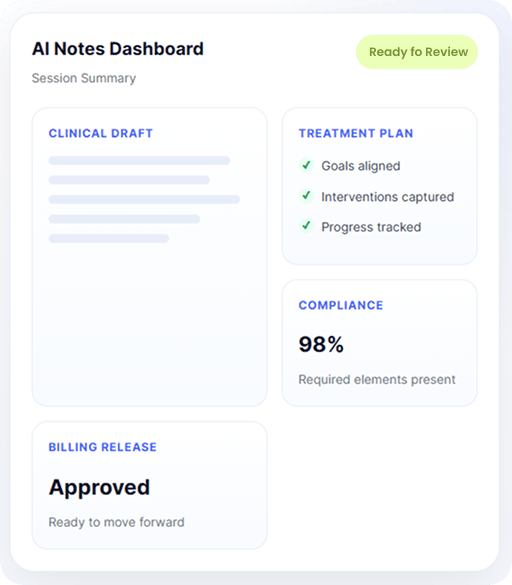

Reduce Documentation Time
Clinicians save hours each week on documentations.

Improve Note Consistency
AI-powered drafts improve quality and consistency.

Support Compliance Workflows
Build-in guidance for required documentation elements

Connect Notes to billing
Seamless integration with billing and operational workflows.
SUPPORTED DOCUMENTATION
Built Specifically for Behavioral Health
Unlike generic AI scribes, DENmaar AI Notes is designed for behavioral health workflows and
documentation requirements.
Individual Therapy
Family Therapy
Group Therapy
Substance Use Treatment
Case Management
Medication Management
Crisis Intervention
Clinical Supervision
Treatment Plans
Assessments and Reviews
AI NOTES WORKFLOW
How It Works
From captured session details to reviewed, billable documentation.

Record or Capture
Session Information
Patient check-in and
visit completed.

AI Generates a
Clinical Draft
AI Notes generate
structured documentation.

Review and Approve
Claim is created and
scrubbed for accuracy.

Release for Billing
Claim submitted to
the payer
DESIGNED FOR COMPLIANCE
Clinical Documentation with Compliance in Mind
AI Notes helps behavioral health providers document medical necessity, align treatment goals, identify
interventions, and support supervisor review workflows.
Compliance Support
Medical necessity documentation
Goal and treatment plan alignment
Intervention identification
Progress tracking
Required behavioral health documentation elements
Supervisor review workflows
Complete
Medical Necessity Documentation
Documentation supports the medical necessity of services provided and reflects the client’s ongoing treatment needs.
Evidence in Note
Aligned
Goal & Treatment Plan Alignment
Clinical documentation connects session content to active treatment goals and supports continuity across the plan of care.
Evidence in Note
- Active treatment goal referenced
- Session objectives tied to treatment plan
- Interventions support documented goals
- Progress linked back to care plan
Verified
Intervention Identification
Notes clearly identify the therapeutic interventions used during the session and how they relate to the client’s needs.
Evidence in Note
- Therapeutic intervention documented
- Intervention matched to presenting concerns
- Clinician actions clearly described
- Modality or technique identified where appropriate
Reviewed
Progress Tracking
Session documentation captures the client’s response to treatment and tracks change over time to support clinical decision-making.
Evidence in Note
- Client response to intervention documented
- Progress toward goals addressed
- Barriers or setbacks identified
- Ongoing symptoms or improvements noted
Included
Required Documentation Elements
Behavioral health notes include the core documentation elements needed for completeness, consistency, and payer readiness.
Evidence in Note
- Session date, duration, and service type included
- Relevant clinical observations documented
- Risk, safety, or notable concerns addressed when applicable
- Required note structure completed for the encounter
Available
Supervisor Review Workflow
Documentation can support internal review and approval workflows, helping supervisors monitor quality, accuracy, and compliance.
Evidence in Note
- Draft available for supervisor review
- Revisions or feedback can be incorporated
- Approval status is clearly tracked
- Final documentation is released after sign-off
MORE THAN A SCRIBE
Documentation Connected to the Rest of Your Workflow
Documentation can connect directly to scheduling, treatment plans, assessments, billing workflows, claims validation,
and provider productivity reporting.

Scheduling

Assessments

Claims Validation

DENmaar AI
Notes
Notes

Treatment Plans

Billing Workflows

Productivity Reporting
WHY ORGANIZATIONS CHOOSE DENMAAR
Built for Behavioral Health Teams and Organizations
DENmaar AI Notes is designed to support real-world clinical documentation and operational workflows.

Behavioral Health Focused
Customizable behavioral health workflows including therapy, psychiatry, substance use treatment, and multidisciplinary care models.

Scheduling & Operational Workflows
Integrated scheduling designed to support provider productivity, patient flow, authorization tracking, and claims readiness.

Supervisor Workflows
Built-in workflow logic designed to improve claim accuracy before submission through integrated operational checks and billing intelligence.

Eligibility & Insurance Verification
Integrated eligibility workflows designed to support Medicaid, commercial insurance, carve-outs, and behavioral health payer complexity.

Patient Engagement
Patient portal, intake workflows, secure communication, reminders, and measurement-based care tools.

Request an
AI Notes Trial
See how DENmaar AI Notes can help your clinicians reduce documentation time while improving
Request a demonstration or pilot program today.
Request Information
TESTIMONIALS
WHAT OUR CLIENTS SAY
On behalf of everyone at Meadowlark Counseling Services, I want to extend our sincere thanks for the continued improvements you and your team have made to the DENMaar EMR platform. We have been consistently impressed with both the functionality and user-friendly design of the system, which has made a meaningful difference in our day-to-day operations. The intuitive layout and ease of use have allowed our staff to spend less time navigating the system and more time focusing on client care. The regular updates and enhancements reflect your commitment to meeting the evolving needs of providers in the behavioral health and substance use treatment fields. We genuinely look forward to the new features introduced each month and appreciate how responsive the platform has been to the demands of clinical workflows. We have been so pleased with our experience that we’ve taken the opportunity to recommend DENMaar to other professionals in Pennsylvania who are working in the SUD field. Thank you again for your ongoing support and partnership. We are grateful to be working with a company that truly understands the needs of its users. KIndly, Becky Parks on behalf of the entire team at Meadowlark Counseling Services
I referred one of my colleagues Dr Aaron to you he is just starting g his psychology private practice and looking at where to start. I told him hands down you guys are the best billers and have a great EMR and team. He said he reached out just wanted to let you know!
FANTASTIC job keeping things rolling along with any and all of our billing concerns as well as responding to other issues which may well have been out of your wheelhouse. We are VERY grateful to have you and the crew in our corner.
I appreciate you all so much and DENmaar has been such a blessing Donna to our overall operations and success as an expanding company—allowing us to ultimately operate more efficiently, get our claims paid more consistently, ad stay on top of the critical credentialing piece, among other things. Teamwork does in fact, make the dream work. I’ll loop Chris/Isabella in on this message thread too, as I want All of your team to be aware of how much we appreciate our working relationship with DENmaar
Thank you for your diligence!! I appreciate it so much. Thank you Edwina…
Thank you so much Amy! I will be referring to DENmaar as often as I am asked about credentialing services.
Our Latest Blogs

AI Mental Health Progress Notes: A New Era
As a mental health therapist, you must be spending a lot of your time writing and managing therapy notes. Trust us, you aren’t alone in this.
Writing therapy notes leads to administrative fatigue and diverts your focus from clients. However, to address that, many AI tools are emerging to streamline therapy notes documentation.
With AI mental health progress notes, the overall note-taking is quite simplified, and the chances of error are reduced. But there are some challenges as well.
In a survey conducted of over 800 psychiatrists, it was found that 75% believe AI is likely to perform medical documentation, and 36% of these people trust AI to be beneficial for this purpose.
So, in this article, we will have a balanced overview of using AI in taking therapy notes and conclude whether it’s a recommended approach for your practice.
What Are Progress Notes in Mental Health?

What Are Progress Notes in Mental Health?
Before we discuss the use of AI mental health progress notes, let’s first discuss what progress notes are.
We are sure that you must already be aware of progress notes, also known as therapy notes. However, it’s essential to have a surface-level overview to ensure we are on the same page.
Therapy notes or progress notes are the private notes that mental health professionals take during or after the session for their judgment of a person’s mental health and behavior.
The primary objective of progress notes is to develop a better understanding of the patient’s condition and ensure continuity between different sessions.
Progress notes vary with therapists, as the objective conclusion is often drawn based on subjective thoughts, feelings, and impressions of mental health professionals about the client’s behavior.
These notes generally include:
- Insights about the therapeutic relationship
- Emotional tone
- Potential underlying issues
These notes are useful in making insightful treatment decisions, supporting clinical judgement, and providing a room for therapists to reflect on the session’s deeper meaning.
These notes are part of the client’s official media records and can be accessed by other medical practices, insurance companies, and legal entities as needed.
Challenges of Manual Note-Taking for Therapists
Maintaining accurate and timely progress notes manually is an ongoing challenge that therapists regularly face. This leads to a bigger challenge, which is the quality of therapy and the well-being of the clinician.

Challenges of Manual Note-Taking for Therapists
If we explore the challenges in detail, here are the primary ones:
Time-Consuming Paperwork
Writing detailed notes during the therapy can be quite a task, and most therapists choose to write them after the sessions. However, if there are clients one after another, documentation can spill over into evenings and weekends.
If therapists had to spend less time on writing the documentation, they could take up more clients and achieve their financial potential.
Administrative Burnout
Writing progress notes is a repetitive task that requires more effort than the therapy session itself. Due to that, therapists experience mental tiredness and burnout, leading to a decrease in output.
Inconsistency and Human Error
When therapists try to write progress notes during the session, there are chances of missing out on quite a few things as they have to converse and write the notes at the same time. Therefore, many therapists do the writing after the session, but in that case, they miss out on important details as they write the notes based on their memory of the session.
This even gets worse when there’s an upcoming appointment and you have limited time.
Because of improper therapy notes, the agenda of therapy itself dilutes. As the progress notes are incorrect, it leads to missed patterns in client behavior and important event details, causing incorrect treatment.
Compliance and Legal Risk
It can not only cause issues to the patient but therapists as well. It’s essential for mental health practitioners that therapy notes meet the clinical, ethical, and legal standards.
When progress notes are written poorly, it can cause issues during audits, insurance claims, and legal proceedings.
The Role of AI Mental Health Progress Notes

The Role of AI Mental Health Progress Notes
AI mental health progress notes play a significant role for therapists as well as patients. It not only simplifies but also enhances the documentation process at the same time. In this section, we will see the application of AI in documenting mental health notes.
AI-Powered Transcription and Summarization
With AI-powered transcription and summarization software, the therapy session’s conversation gets converted into written text. Some applications can process the speech in real-time and convert it into text right away, and others record the conversation first and process it after it ends.
In both cases, therapists get ready-to-review drafts. Besides the complete transcription, they also provide the therapists with a session summary highlighting the key points based on the standardized format selected (SOAP, DAP, or BIRP).
Natural Language Processing (NLP)
With the use of natural language processing, AI can understand the emotional tone of the session and extract relevant clinical information. They can even highlight patterns, behaviors, and symptoms of different mental health conditions.
This improves the quality of AI mental health progress notes and can be reviewed by mental health practitioners. Based on the review, practitioners can draw conclusions, suggest treatment, and develop a more insightful roadmap for the patient.
Smart Prompts and Auto-Completion
After you review the AI mental health therapy notes, you can edit them as per your understanding and insights. Then, let the AI process it again. It will use its smart prompt tech to suggest improvements, make sentence corrections, and detect missed insights.
In case if their any repeated info or unnecessary details, the tool can highlight that as well. After which, you can give a final review of the document and finalize it.
Custom Templates and Learning Capability
Many AI tools come with predefined templates that can be further customized. For instance, whether you follow CBT, DBT, or trauma-informed care therapy notes structure, AI mental health therapy notes will be written accordingly.
Further, the AI tool continuously learns and improves as per your therapy style and preferred documentation structure, leading to more intuitive and personalized output.
Seamless Integration with Practice Management Systems
Many AI tools integrate with ERHs and practice management tools. Such a capability helps therapists manage notes, billing, and scheduling from one place.
In case of manual therapy notes, the mental health practitioner needed to upload the documentation manually and manage the administrative task without an application. Now, with this feature, documentation itself gets aligned with the practice management system, making the data organization easier.
Maintains Therapist Control
AI can’t replace therapists in any way. Consider it as an assistant to the therapist who writes the therapy notes, while they are in charge of the session.
Therapists still need to review, edit, and approve all the notes to ensure their credibility and accuracy.
Benefits of AI Mental Health Progress Notes
When it comes to the benefits of AI mental health progress notes, it is not only for therapists and clients; it raises the overall quality of mental health therapy. Now, let’s check its benefits in detail.
Significant Time Savings
When you have AI mental health progress notes by your side, you don’t need to spend time writing the documentation between the sessions, after the day ends, or on weekends, as it’ll automatically be completed during the session or immediately after it.
Reduces Cognitive Load and Burnout
As it saves time, it improves work-life balance for sure. Another way by which AI therapy notes achieve it is by saving the therapist from burnout. By automating repetitive tasks, AI helps therapists save their mental energy.
Improves Accuracy and Completeness
AI mental health progress notes eliminate the errors that humans make. The documentation is free from vague language, missed details, and formatting errors. Besides that, they ensure therapy notes meet the required standards and all essential components of the session are captured.
Enhances Clinical Consistency
Mental health practitioners can maintain consistent language, structure, and documentation practices across clients. It improves communication with supervisors, peers, or insurers.
Supports Legal and Ethical Compliance
When AI tools take mental health therapy notes, they come with built-in prompts for required information, time-stamping (when the session is taken), and audit-ready formats.
Generally, the tools are designed to comply with HIPAA, GDPR, and insurance regulations. While going for an AI tool, it’s important to ensure that it complies with the state regulations as well.
How DENmaar Can Help You in AI Mental Health Progress Notes?
DENmaar is a state-of-the-art application that goes beyond simple documentation. Our powerful, integrated application is designed for mental health practitioners and substance abuse professionals.
From customer AI mental health progress notes to automating the administrative tasks, DENmaar aims to eliminate repetitive tasks and provide a significant boost to your mental health practice.
Specifically speaking of DENmaar’s ability in AI-enhanced progress notes, you get personalized, compliant, and intuitive progress notes, tailored to your unique clinical style.
What’s our impact?
We help you save hours of manual entry, reduce errors, and maintain consistent, accurate documentation across sessions.
Besides this feature, DENmaar also offers exceptional workflow optimization features such as:
- Automating tasks: appointment scheduling, reminders, and staff assignments.
- Create practice-specific workflows
- Centralized messaging and real-time alerts.
Conclusion
The approach of mental health professionals towards therapy notes is transforming and getting better. It used to consume a lot of time, and repetitive tasks led to burnout; there was no work-life balance. However, with the introduction of AI mental health progress notes, they are now able to take more patients and put better focus.
Platforms like DENmaar show how AI tools for therapy notes are a crucial part of integral systems. When multiple apps, such as CRM, workflow automation, billing services, and AI documentation tools, combine, it can elevate both the clinical and business side of mental health practices.
Frequently Asked Questions
Is AI-generated documentation HIPAA compliant?
Yes, when you use a reputable platform, AI-generated progress notes are written, considering HIPAA compliance. You must ensure that your platform has secure data encryption, access controls, and audit trails to protect client confidentiality and ensure legal compliance.
Will AI replace therapists in clinical documentation?
No, AI is only to assist the therapists, and it can’t replace them. It supports mental health practitioners by automating repetitive tasks, suggesting patterns, detecting insights, and ensuring compliance. In the end, therapists need to review, edit, and make the final judgment.

Healthcare Revenue Cycle Management: Benefits, Stages, and Best Practices
Healthcare Revenue Cycle Management is a financial process in which healthcare providers track the patients’ lifecycle from initial registration to the final payment.
RCM makes billing, tracking, and collecting payments from patients efficient. It also minimizes errors and saves time.
The primary aim of revenue cycle management is to improve financial operations.
That’s done by reducing errors and speeding up the process related to revenue generation.
What are the Revenue Cycle Management (RCM) benefits for Healthcare Operations?
There are several benefits that healthcare providers receive from RCM. We are going to discuss the top ones for which RCM is implemented.
Improved Efficiency
After introducing RCM in your healthcare organization, all your revenue-related operations and financial operations become efficient.
It allows healthcare providers to:
- Verify patient insurance
- Take care of billing
- Promptly collect the amount for the services provided
Saves Time and Reduces Cost
Revenue Cycle Management Tools can automate several administrative duties. For instance, staff won’t need to manually handle appointments, send reminders, etc.
Handle Claims Better
The healthcare provider can provide all the required information to the payer. The RCM helps in keeping things clear and avoiding revision and resubmission.
Even then, if the claim isn’t accepted, the insurance providers clearly state the reason for it. It allows the healthcare provider to rectify the issue immediately. Overall, it saves the patient money by making claim handling efficient.
Improved Patient Experience
When there’s a prominent RCM implemented:
- The billing process gets smoother
- The payment processing gets simplified
- Claim approval gets easier
All this makes the overall experience better for sure.
Components and Stages of Healthcare Revenue Cycle

The healthcare revenue cycle consists of multiple stages, and healthcare revenue cycle management must cover all of these to maximize its efficiency.
Pre-registration and Scheduling
You can collect patients’ demographics, such as age and gender, as well as insurance details, to initiate the process even before they arrive. Additionally, RCM includes scheduling patient appointments, ensuring they never miss a visit. When you schedule the appointments reduces no-shows, and merging it with reminders can further improve the turnout rates. Patients will be able to keep their appointments in consideration while planning their schedule.
You can also streamline this process by using a tool like DENmaar to efficiently manage and complete scheduling tasks. Ultimately, as the turnouts improve, it has a positive impact on the other stages of the RCM by making it easier to verify insurance coverage, submit claims, and receive payment.
Registration
This includes general patient information along with the medical history to ensure tailored treatment.
Verifying insurance coverage
The medical provider communicates with the insurance provider. It’s done to verify the correctness of the details provided by the patient and get the necessary approval.
Documenting services and their respective billing codes
All the services and procedures performed have a predefined billing code.
Under this step:
- Everything is documented
- Translated into the billing codes
- Shared with the insurance provider for the claim
The billing codes define how much a healthcare provider will be reimbursed against every service and procedure.
Submitting an insurance claim
After you submit the insurance claim to the provider, they will check all the codes. It’s done to see whether they align with the terms and conditions or not. Based on that, the provider decides how much payment they need to make or entirely deny the claim.
Claim denial management
In case the claim is denied, the payer will mention the reason. It allows the healthcare provider to check the issue and rectify it if possible. Between 5% and 10% of healthcare claims are rejected every year, causing a loss of up to $262 billion. You can avoid your loss with optimized RCM.
Claim payment
Payment is made by the payer is added to the patient’s account by the healthcare provider.
Patient billing
You need to bill the patients if there are any services and procedures that:
- Can’t be added to the claim
- For which the claim is denied
Collecting the pending amount
Once you submit the payment request to the clients, you may require following up and sending payment reminders.
Generating reports
Reporting is essential to understand the overall performance of RCM. It gives access to various key performance indicators and identifies room for improvement for each stage.
Best Practices of Revenue Cycle Management

There are several best practices that help you bring out the best in your healthcare revenue cycle management process. We have listed the important ones here:
- The data collection should be comprehensive and accurate. You must collect personal information, medical history, and insurance details accurately through digital tools to speed up the process while minimizing errors.
- Use a real-time verification app to verify the patient’s insurance details. It will ensure that the patient is eligible for the claim, which reduces claim rejections.
- Stay compliant by strictly following all relevant laws and regulatory requirements. Safeguard yourself from legal issues and penalties.
- Healthcare providers must conduct proper training regarding all stages of the RCM.
- Keep your staff updated regarding the code information. Let them know if there are any changes. They must know how to document accurate codes to avoid claim denials and resubmissions. You must provide an additional check on overall claim submission. You can use automated claim-scrubbing tools for this purpose. They will help you identify and correct data-entry errors.
- There must be a robust tracking system to check the real-time status of submitted claims. It will also help your staff to address denials promptly. This ensures that the revenue streams stay uninterrupted.
- There should be transparent patient communication. You must provide them with a complete overview of the costing, procedure, and payment-related aspects.
- The billing and payment process should be easy for customers. Give them detailed bills so that they can understand why they are charged. You must also provide them with multiple payment processing options, making things flexible for them.
- Use SaaS based applications such as DENmaar to simplify revenue cycle management. It also helps you automate manual tasks and reduce human errors.
- You must regularly check the performance of your revenue management cycle. Checking insights for every stage will help you improve the process.
How Revenue Cycle Management Process Affect Revenue?
In this section, we will examine how each stage contributes to minimizing costs and optimizing revenue.
RCM Stage | Its Effect on Revenue |
Pre-registration | Accurate pre-registration saves patients’ time, improving the overall experience and leading to trustworthy engagement, affecting revenue. |
Patient registration | RCM improves accuracy, minimizing claim denials and billing issues. Hence, reducing the overall costs. |
Claim Management | Manually handling communication regarding insurance claims can lead to more time due to inaccuracy. However, RCM ensures timely claim processing with minimal back-and-forth. This optimizes revenue by saving staff time and rapid reimbursement. |
Billing and Payments | RCM allows you to share detailed billing and payment obligations. It develops transparency, encouraging clients to comply with their payment obligations faster and hence improving the revenue. |
Reporting and Analytics | It allows you to find areas of improvement, which directly improve various stages, and finally, make a positive impact on the revenue. |
Stay Compliant | One of the biggest perks of revenue cycle management is avoiding compliance and legal issues. When you stay compliant, you save on penalties, and in one way, it’s optimizing revenue. |
How DENmaar Can Provide You with Efficient Healthcare Revenue Cycle Management?
DENmaar is a unified platform that helps healthcare providers and mental health specialists streamline their administrative tasks and billing process. With DENmaar having your back, you can significantly optimize your healthcare revenue cycle management. It will help you digitalise the information collection and patient registration.
Free RCM Software and Expert Claims Handling
DENmaar gives you FREE access to its powerful RCM software. Unlike other solutions that only offer software, Denmaar’s offers much more.
Our dedicated Expect Claim Management team handles claims issues. We deliver tailored solutions that tackle complex claim challenges head-on, helping reduce denials, speed up reimbursements, and significantly boost collections and revenue.
It makes it easier to communicate with the insurance provider and manage the claims.
The All-in-One Advantages that You Only Get with DENmaar
Even the overall billing and payment processing can be handled through DENmaar. Therefore, it’s your go-to tool when you want to improve RCM without juggling between multiple apps.
We offers a truly all-in-one solution that combines expert services with free software, simplifying your operations, reducing vendor complexity, and ultimately producing a better outcome for your practice.
Frequently Asked Questions: Healthcare Revenue Cycle Management
What is healthcare revenue cycle management?
Healthcare revenue cycle management is the financial process where the healthcare provider manages the complete revenue generation cycle for each patient from pre-registration to payment. The primary aim of RCM is to optimize revenue generation by speeding up the tasks, minimizing errors, and improving patient experience.
What are the steps in RCM?
These are the following RCM Steps:
- Pre-registration
- Registration
- Verifying insurance coverage
- Documenting services and their respective billing codes
- Submitting insurance claims
- Claim denial management
- Claim payment
- Billing for the services
- Collecting the pending amount
- Generating reports
What is charge entry in the RCM cycle?
In Revenue Cycle Management (RCM), charge entry is the process of accurately documenting and recording the costs associated with medical services provided to a patient.

Mental Health Awareness Month and the Role of Therapists
The importance of mental health is recognized, and it is considered an important pillar of overall well-being. For that reason, the world celebrates Mental Health Awareness Month in May every year. The awareness month was started in 1949 by the organization Mental Health America. Since then, it has grown into an essential annual observance globally.
This month gives room for people to talk about mental illness, wellness, stigma, and mental health support. At the same time, it also provides an opportunity for therapists and mental health practitioners to step up and be advocates, educators, and changemakers in the field of mental well-being.
Importance of Mental Health Awareness Month
Despite society being actively working to improve mental well-being, many individuals still face barriers in communicating their mental health problems. Mental Health Awareness Month brings the spotlight on the topic and gives a way to communicate, exchange knowledge, and understand various mental illness issues. It serves several key purposes:
- Reducing Stigma: Though millions of people are affected by mental illness, it continues to carry a stigma. Almost sixteen percent of youth in the United States experience mental illness. However, only half of them receive treatment.
- Encouraging Early Intervention: The awareness month increases awareness and helps the public understand early signs of mental health issues, promoting early intervention and preventing escalation.
- Legal and System Improvements: The month provides a platform for therapists to highlight issues and suggest improvements in policies related to insurance, access to treatment, and mental health funding.
- Reduce disparity: Mental Health Awareness Month gives everyone an opportunity to understand the experience of marginalized and excluded communities, which allows to expand the conversation around mental health issues.
Understanding the History and Evolution of Mental Health Awareness Month
As mentioned before, Mental Health America, the national association for mental health, started the awareness month 76 years ago.
In the initial years, the awareness month primarily aimed to educate people regarding mental illness and early detection and prevention. Later, it expanded to more people, covering various communities and a larger aim to provide everyone with access to treatment.
The 1960s and 70s was an important period, where focus was given to understanding psychiatric conditions, the deinstitutionalization movement, and the importance of community-based care. The 1990s saw a shift toward integrating mental health into broader public health efforts.
Previously, the campaigns were promoted by printed media, various social groups, and healthcare institutions. By the start of the 21st century, digital campaigns took the driving seat, leading to an expanded reach of mental health awareness.
How Can Therapists Contribute During Mental Health Awareness Month?
Whenever an individual faces mental health challenges, the therapist should be the first point of contact. However, people are often reluctant to open the therapy room door. Mental Health Awareness Month is a time for therapists to bridge this gap, spread awareness, and encourage individuals to improve their mental health. They can share insights and opinions during public speaking events, run campaigns, and engage with communities on a personal level.

Therapists must not confine their roles to diagnosis and treatment; they should also be the educators and advocates who can normalize day-to-day mental health conversations.
- Community Engagement: It’s for sure that community-based outreach is one of the most efficient ways therapists can make a difference. Under this, therapists can host workshops, Q&A sessions, provide discounted telehealth service, and host webinars on mental health-related topics. To organize such events, they can partner with schools, community centers, and various organizations.
- Public Education: Therapists own credibility in the field of mental health. They can educate the public through various means such as blogs, social media, and booklets. They can be speakers for improvements in mental health policies and bring critical change. Many organizations, such as NAMI and Mental Health America, offer advocacy toolkits that therapists can use to get started.
- Practice Level Initiative: The awareness month gives you the option to engage with existing clients and prospects on a different level by offering them resource kits, mental health books, and self-help material. You can also keep a weekly theme for your patients, group therapy activities, and much more.
Improve Client Care Through DENmaar’s Innovative Solutions
DENmaar aims to reduce the administrative burden of therapists and provide them with operational efficiency. With DENmaar, you can automate tasks such as scheduling and staff duties.
It also helps you to track the client’s progress and tailor the treatment accordingly. With DENmaar’s features, you can improve the value provided to clients, delivering greater benefits and strengthening your relationship with them.
Get in touch with us and book a demo to learn more about us.
Final Words
Mental Health Awareness Month isn’t only a public campaign. It provides a stage for therapists to improve the mental well-being of people by educating and encouraging them to take therapy sessions.
Rather than providing just symbolic support, you can be an active lead and speaker. Take the benefit and show the world that mental health is as important as physical health, requiring the same visibility and attention. Be the part, educate the public, and let their mental health journey start with you.
Play Your Role in Mental Health Awareness
Be the Voice That Helps Break the Stigma
Our Partners






Ready to get started?
Feel free to reach out if you have any questions.
