

- Session transcription
- DAP, SOAP, and BIRP progress notes
- Psychiatry and medication-management documentation
- Biopsychosocial assessments
- Individualized treatment plans
- Measurable goals and objectives
- Group and multidisciplinary documentation
- Integration of clinical assessments and outcome measures
- Continuity between the treatment plan and subsequent notes
AI Notes for Behavioral Health
AI Built Into the
Work of the Practice.
From the first patient call through documentation, claims, and payment.
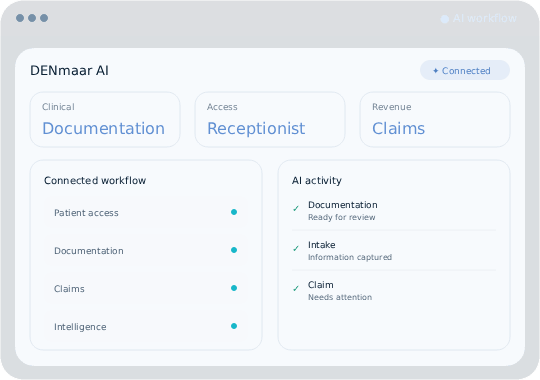
DENmaar applies AI across the connected workflow of a behavioral health practice—not only to generate progress notes.
Because DENmaar brings the EHR, scheduling, billing, credentialing, and operational support into one platform, AI can help move work forward across the entire organization.
One platform. One connected workflow. AI where the work actually happens.

Behavioral Health Focused

Clinical Accuracy & Oversight

Billing Workflow Ready
AI Notes
More Than an AI Note Generator
Most healthcare AI products solve one isolated task. They may transcribe a session, generate a note, answer a call, or analyze a claim—but the practice is still responsible for connecting those tools.
DENmaar takes a different approach.
We are building AI directly into the clinical, administrative, and financial workflows already used by the practice.
Information collected during intake can support documentation. Documentation can help prepare the claim. Claim information can guide billing follow-up. Operational data can help leadership see where work is becoming delayed.
The result is not simply more AI features. It is a more connected practice.
How DENmaar Uses AI
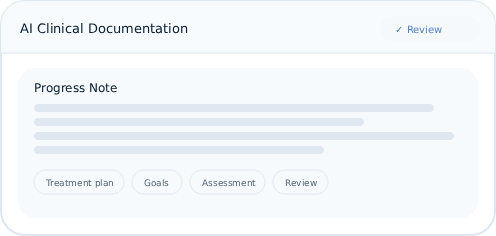
AI Clinical Documentation
Create behavioral health documentation using information already available within the patient record.
Providers remain in control. AI-generated content can be reviewed, edited, and approved by the clinician before it becomes part of the signed record.
How DENmaar Uses AI
AI Receptionist
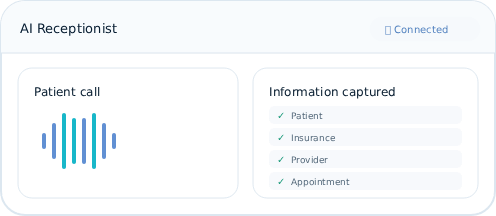
Respond to patients and prospective patients even when staff members are unavailable.
The DENmaar AI Receptionist is being designed around the real intake and scheduling needs of behavioral health organizations.
- Immediate call response
- New-patient information collection
- Appointment requests
- Rescheduling requests
- Common practice questions
- Insurance-information collection
- Provider and location routing
- After-hours coverage
- Call summaries and recommended follow-up
Because the AI Receptionist is connected to the DENmaar platform, the information it collects can become part of the practice workflow instead of remaining inside a separate answering service.
How DENmaar Uses AI
Claims Copilot
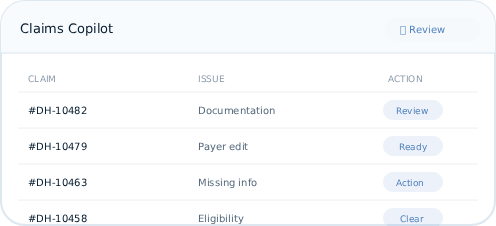
Help staff identify potential claim problems before they become lost revenue.
Claims Copilot brings AI and operational intelligence into the revenue-cycle workflow. It is designed to help billing teams understand what needs attention, why it needs attention, and what should happen next.
- Reviewing claims for missing or inconsistent information
- Identifying documentation and billing dependencies
- Highlighting claims that require follow-up
- Organizing work by urgency and financial impact
- Supporting denial and rejection analysis
- Recommending the next action
- Surfacing recurring payer or workflow problems
- Helping prevent avoidable delays before submission
Claims Copilot does not replace billing judgment. It gives the billing team better information and a clearer path through the work.
How DENmaar Uses AI
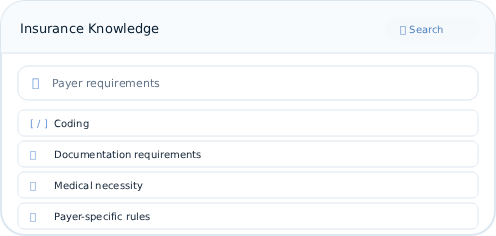
Insurance Knowledge
Turn years of behavioral health billing experience into accessible guidance.
Insurance requirements change constantly and often vary by payer, plan, state, provider type, and service. DENmaar is developing an expanding insurance knowledge resource informed by real behavioral health billing situations.
It can support questions involving:
- Coding
- Prior authorization
- Medical necessity
- Documentation requirements
- Claim resolution
- Credentialing
- Telehealth requirements
- Payer-specific rules
- Billing best practices
Instead of leaving practices to search scattered payer manuals or depend on disconnected information, DENmaar brings insurance knowledge closer to the workflow where decisions are made.
How DENmaar Uses AI
Intelligent Provider Workflow
Help every provider understand what requires attention next.
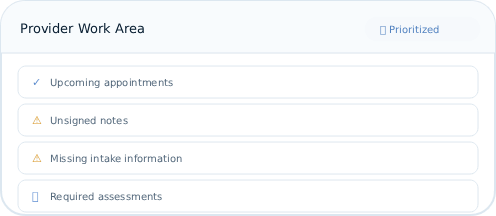
DENmaar’s Provider Work Area is being developed to organize clinical and administrative responsibilities into a single, prioritized view.
It will help providers identify:
- Upcoming appointments
- Missing intake information
- Eligibility or insurance concerns
- Incomplete documentation
- Unsigned notes
- Required assessments
- Treatment-plan updates
- Supervisor review requirements
- Other actions that could delay care or billing
The goal is simple: providers should not have to search through multiple screens to discover what they need to do.
How DENmaar Uses AI
Practice and Revenue Intelligence
Give leadership a clearer view of how the organization is operating.
By bringing scheduling, clinical documentation, provider activity, claims, and collections together, DENmaar can help practice leaders identify:
- Provider utilization
- Unfinished clinical work
- Workflow bottlenecks
- Claims waiting on documentation
- Recurring insurance problems
- Revenue-cycle exceptions
- Operational trends requiring attention
AI becomes most valuable when it helps the organization recognize problems earlier and take action before those problems affect patients, providers, or revenue.
Connected Patient Journey
One Patient Journey.
One Connected System.
The value of DENmaar’s AI is not limited to any single feature.
ONE CONNECTED WORKFLOW
AI working across the practice, from first contact through revenue-cycle operations.
01
PATIENT ACCESS
A prospective patient contacts the practice.
02
AI RECEPTIONIST
The AI Receptionist collects information and helps move the request into the appropriate scheduling or follow-up workflow.
03
INTAKE
The patient completes registration, insurance information, and assessments.
04
DOCUMENTATION
The provider uses those records and the session information to prepare clinical documentation.
05
BILLING READINESS
The completed documentation supports claim creation and billing readiness.
06
CLAIMS COPILOT
Claims Copilot helps identify exceptions and directs the billing team toward the next action.
07
PRACTICE INTELLIGENCE
Practice leadership can see where clinical, administrative, or financial work is becoming delayed.
THE CONNECTED OUTCOME
That is AI working across the practice—not another application working by itself.
Practice & Revenue Intelligence
AI That Helps the Organization
See What's Next
Connected data gives DENmaar more context about where work is happening, where it is delayed, and where
attention can have the greatest operational impact.
Prioritize Work
Surface the tasks and exceptions that need attention instead of making staff hunt for them.
Find Bottlenecks
Identify recurring workflow problems across clinical, administrative, and revenue-cycle operations.
Act Earlier
Recognize patterns before unfinished work becomes a patient-access, billing, or revenue problem.
Support Providers
Give clinicians a clearer view of documentation and administrative responsibilities.
Keep Humans in Control
AI assists the work while clinicians and staff retain responsibility for decisions.
Connect the Workflow
Use information already present in the DENmaar platform rather than recreating it in another tool.
Behavioral Healthcare
Designed for Behavioral Healthcare
DENmaar’s AI capabilities are built around the needs of behavioral health organizations, including:
Therapy
Psychiatry
Substance use disorder treatment
Group services
Multidisciplinary care
Multi-provider and multi-location practices
AI assists the work, but clinicians and staff retain responsibility for reviewing information and making clinical, administrative, and billing decisions.
DENmaar AI
Built Today. Expanding Continuously.
DENmaar is introducing AI carefully across the platform. Some capabilities are available today, while others are in development or being expanded through controlled pilots.
During a demonstration, we will show you what is currently available, explain what is being developed, and evaluate which DENmaar workflows fit the needs of your organization.
No inflated promises. No disconnected AI tools. A practical path toward a more intelligent behavioral health practice.
Available today
Controlled pilots
Expanding continuously
Request an
AI Notes Trial
See how DENmaar AI Notes can help your clinicians reduce documentation time while improving
Request a demonstration or pilot program today.
Request Information
TESTIMONIALS
WHAT OUR CLIENTS SAY
On behalf of everyone at Meadowlark Counseling Services, I want to extend our sincere thanks for the continued improvements you and your team have made to the DENMaar EMR platform. We have been consistently impressed with both the functionality and user-friendly design of the system, which has made a meaningful difference in our day-to-day operations. The intuitive layout and ease of use have allowed our staff to spend less time navigating the system and more time focusing on client care. The regular updates and enhancements reflect your commitment to meeting the evolving needs of providers in the behavioral health and substance use treatment fields. We genuinely look forward to the new features introduced each month and appreciate how responsive the platform has been to the demands of clinical workflows. We have been so pleased with our experience that we’ve taken the opportunity to recommend DENMaar to other professionals in Pennsylvania who are working in the SUD field. Thank you again for your ongoing support and partnership. We are grateful to be working with a company that truly understands the needs of its users. KIndly, Becky Parks on behalf of the entire team at Meadowlark Counseling Services
I referred one of my colleagues Dr Aaron to you he is just starting g his psychology private practice and looking at where to start. I told him hands down you guys are the best billers and have a great EMR and team. He said he reached out just wanted to let you know!
FANTASTIC job keeping things rolling along with any and all of our billing concerns as well as responding to other issues which may well have been out of your wheelhouse. We are VERY grateful to have you and the crew in our corner.
I appreciate you all so much and DENmaar has been such a blessing Donna to our overall operations and success as an expanding company—allowing us to ultimately operate more efficiently, get our claims paid more consistently, ad stay on top of the critical credentialing piece, among other things. Teamwork does in fact, make the dream work. I’ll loop Chris/Isabella in on this message thread too, as I want All of your team to be aware of how much we appreciate our working relationship with DENmaar
Thank you for your diligence!! I appreciate it so much. Thank you Edwina…
Thank you so much Amy! I will be referring to DENmaar as often as I am asked about credentialing services.
Our Latest Blogs

Why Does Patient Scheduling Needs An Upgrade?
Healthcare providers can take these necessary actions for the patients in scheduling appointments.
Patients always look for convenient and flexible access to healthcare, and for many, this means looking for self-care options. In addition, healthcare approaches influence digital experiences in other industries, including hospitality and travel, in many ways.
For example, self-scheduling bypasses common barriers to access, such as working hours and waiting times. In addition, by enabling patients to schedule their services, physicians build commitment, which has been shown to bridge the gap in care.
The experience of digital patient participation has evolved significantly during the Covid-19 pandemic. With asynchronous symptom screening tools that can be deployed with the help of cloud-based platforms like DENmaar, the care experience can start online quickly. Moreover, the patient’s scheduling is particularly strong during the vaccination process.
When the COVID-19 vaccine became available in late 2020, thousands of people were at risk of overwhelming the health system due to the need to vaccinate quickly and efficiently. The automated self-scheduling process reduced the burden on healthcare workers and enabled patients to choose visits for themselves, allowing healthcare workers to focus on other priorities.
According to a study, about 80 percent of patients prefer doctors who offer online scheduling. Also, a 2019 survey found that 70 percent of patients said they would choose providers who would send emails or texts to take preventive or follow-up care.
Healthcare systems need to evaluate their scheduling options to avoid long waiting times and poor patient experiences because it can affect their ability to attract new patients and retain existing patients. Moreover, patients and staff will benefit from investing in better digital solutions, such as scheduling options.
While making scheduling more straightforward and accessible for patients will help fill out calendars, canceling appointments and no-shows can create vacancies at the back-end of the scheduling process. Patients cancel or miss medical visits for various reasons, but good patient participation strategies can help providers move forward and keep up with the scheduling software.
Here are the top four reasons why patients cancel medical visits and what providers can do to address these issues:
1. Anxiety before an appointment due to unknown fears
For many, the fear and apprehension of seeing a doctor can cause visits to be avoided, delayed, or cancelled. Patients fear the bad news, are reprimanded for postponing treatment, and are uncertain about their financial responsibility. Patients may wait for the visit to avoid a blood test or some tests and procedures. Concerns about exposure to Covid-19 have also increased over the past year, resulting in more patients postponing care or cancelling visits.
Helping patients understand what to expect during their visit helps reduce the fear. In addition, offering virtual care services such as video visits and remote patient monitoring is an excellent option for patients in times of global health crisis.
2. Concerns about high financial costs
Out-of-pocket expenses and employer deductions are higher than usual. According to a poll, many say they do not receive the medical care they need because of the cost. Twenty-two percent of those surveyed stopped treating a severe condition because of the cost.
Helping patients understand their financial responsibilities and educating them about payment plans and their financial options can help reduce cancellations. In addition, using automated digital recording and recording software can help medical office staff gather information about early payments on a patient’s journey and help them have a better conversation about financial resources and responsibilities before a visit.
3. No convenient schedule
Studies show that people work longer hours per week. Challenging work schedules, family lifestyles, and personal commitments make it difficult for some to prioritize their health. When the consequences of taking a break from a workday to see a doctor seem more severe than a health problem, it is easier for patients to prioritize meetings and tasks than their scheduled doctor’s visit, especially if they are not seriously ill.
The availability of flexible scheduling options and virtual care can play a role in helping patients prioritize their health, even in their busy schedules. Also, updated integrations in EHR with video conferencing tools can enable seamless and secure digital encounters for patients.
4. Unavailability of appointment
Increased queues and waiting times can significantly affect cancellation rates. Sick patients, frustrated by waiting so long for an appointment, are more likely to have it cancelled and taken care of in an emergency or retail clinic.
Keeping a small percentage of appointments for daily visits and offering virtual care to visually impaired patients make’s it easier for patients to remain loyal to their known providers and reduces the likelihood of intermittent care elsewhere. Automated waiting list software can help medical offices fill out cancelled visits of patients expecting an early visit. Features that allow patients to schedule for several weeks or even months can help keep patients well and promote a good schedule.
Expecting and working with patient barriers can help providers build a system that works for patients and lead to better financial, operational, and clinical outcomes. When appointment scheduling revolves around patient access and convenience, healthcare providers and staff also reap the benefits of efficient processing.
Who can take care of your patient scheduling?
The DENmaar Scheduler offers several key features that you should look for when analyzing the quality of a patient scheduling system. The DENmaar schedule may be available to operating staff, but they may not have access to the patient’s complete medical information. This feature helps reduce the risk of any privacy and security breaches.
DENmaar Scheduler is a one-click system for adding, removing, or editing visits, thus reducing the possibility of human error.
Since DENmaar scheduler providers have remote access to their patient portal schedule, it is helpful for them to adjust visits or availability as needed.

How to Handle Claim Denials and Maximize your Reimbursements
Medical billing claim denials are one of the biggest challenges healthcare providers face today. Frequent denied claims can delay payments, reduce cash flow, and negatively impact the financial performance of healthcare practices.
Effective denial management is essential for maintaining a healthy revenue cycle and ensuring healthcare organizations receive accurate reimbursements for the services they provide.
In this guide, we’ll explain the most common causes of claim denials, strategies to reduce them, and how healthcare providers can improve reimbursement rates through efficient medical billing practices.
What Is a Claim Denial in Medical Billing
A claim denial occurs when an insurance company refuses to process or pay a submitted medical claim. Denials can happen for multiple reasons, including incorrect patient information, coding errors, eligibility issues, or missing documentation.
If not addressed quickly, claim denials can create significant financial losses for healthcare providers and disrupt revenue cycle management.
Common Reasons for Claim Denials
Missing or Incorrect Patient Information
Errors in patient demographics, insurance details, or documentation often lead to denied claims.
Eligibility Verification Issues
Claims may be denied if the patient’s insurance eligibility or coverage details are not verified before treatment.
Incorrect Medical Coding
Using inaccurate CPT, ICD 10, or HCPCS codes can result in claim rejection or payment delays.
Duplicate Claims Submission
Submitting the same claim multiple times can trigger denial from insurance providers.
Non Covered Services
Insurance companies may deny claims for services that are not included in the patient’s coverage plan.
Delayed Claim Submission
Missing payer deadlines for filing claims can lead to automatic denials.
Lack of Medical Necessity
Claims may be denied if the insurance provider believes the treatment or procedure was not medically necessary.
How to Reduce Claim Denials and Improve Reimbursements
Build a Strong Denial Management Process
Healthcare organizations should establish a dedicated denial management workflow to identify, analyze, and resolve denied claims efficiently.
A specialized team can review denials, submit appeals promptly, and identify recurring billing issues that affect reimbursements.
Identify the Root Cause of Denials
Tracking and categorizing claim denials helps practices understand recurring issues and improve billing accuracy.
Common denial categories may include:
- Coding errors
- Missing documentation
- Eligibility issues
- Authorization problems
- Timely filing errors
By identifying patterns, healthcare providers can improve internal billing processes and reduce future denials.
Verify Insurance Eligibility Before Service
Eligibility verification is one of the most effective ways to reduce claim denials. Providers should confirm insurance coverage, co-pays, deductibles, and authorization requirements before patient appointments.
Submit Appeals Quickly
Denied claims should be reviewed and appealed immediately. Delays in resubmission can result in permanent claim rejection and lost revenue.
A fast response improves the chances of successful reimbursement recovery.
Monitor Revenue Cycle Performance
Healthcare providers should regularly analyze denial trends, reimbursement rates, and billing efficiency through financial reporting and revenue cycle monitoring.
Visual reports and dashboards help identify weaknesses in the billing process and support data driven improvements.
Benefits of Outsourcing Medical Billing Services
Outsourcing medical billing and denial management can significantly reduce administrative burden for healthcare organizations.
Professional billing partners help practices by:
- Improving claim accuracy
- Reducing denial rates
- Managing appeals and follow ups
- Ensuring compliance with payer requirements
- Optimizing revenue cycle management
This allows healthcare providers to focus more on patient care while improving financial performance.
Best Practices for Preventing Claim Denials
Healthcare providers can reduce denials by implementing these best practices:
- Verify patient insurance before appointments
- Submit claims accurately and on time
- Train staff on medical coding updates
- Maintain complete patient documentation
- Monitor billing performance regularly
- Use modern EHR and medical billing systems
- Stay updated on payer policy changes
Conclusion
Claim denials can create major financial challenges for healthcare organizations, but proactive denial management strategies can significantly improve reimbursement outcomes.
By verifying patient eligibility, improving coding accuracy, monitoring billing performance, and using reliable healthcare technology solutions, providers can reduce denied claims and strengthen their revenue cycle management process.
Partnering with experienced medical billing professionals can further simplify denial management and help practices maximize reimbursements efficiently.
Frequently Asked Questions
What causes medical claim denials?
Medical claim denials are commonly caused by coding errors, missing documentation, incorrect patient information, eligibility issues, and delayed claim submissions.
How can healthcare providers reduce claim denials?
Providers can reduce denials by verifying insurance eligibility, improving coding accuracy, submitting claims on time, and monitoring denial trends regularly.
What is denial management in healthcare?
Denial management is the process of identifying, analyzing, correcting, and appealing denied insurance claims to recover reimbursements.
Why is eligibility verification important in medical billing?
Eligibility verification confirms insurance coverage before treatment, reducing the risk of denied claims and payment delays.
Can outsourcing medical billing improve reimbursements?
Yes, outsourcing medical billing services can improve claim accuracy, reduce denials, speed up reimbursements, and optimize revenue cycle management.

How to Expand Private Practice with Telemedicine
Telemedicine has transformed the healthcare industry by making medical and behavioral health services more accessible, efficient, and convenient. During the COVID 19 pandemic, virtual healthcare became essential for millions of patients who needed safe access to medical care while maintaining social distancing protocols.
Today, telemedicine continues to play a major role in modern healthcare delivery. From mental health counseling to remote patient monitoring, private practices can significantly improve patient engagement, expand their reach, and increase operational efficiency by adopting secure telehealth solutions.
What Is Telemedicine
Telemedicine allows healthcare providers to deliver medical and behavioral health services remotely using secure video conferencing, phone calls, and digital communication platforms.
It enables patients to connect with doctors, therapists, psychiatrists, and healthcare professionals without visiting a physical clinic.
According to industry reports, virtual healthcare adoption has continued to grow rapidly, making telemedicine a valuable long term investment for private practices.
Benefits of Telemedicine for Private Practices
Increased Patient Convenience
Patients can attend appointments from their homes without spending time traveling or waiting in crowded clinics. This improves appointment attendance and patient satisfaction.
Expanded Access to Healthcare
Telemedicine allows providers to reach patients in rural and underserved communities where access to healthcare services may be limited.
Improved Behavioral Health Access
Virtual care has significantly improved access to mental health and behavioral health services, especially for patients who prefer remote therapy sessions.
Reduced Operational Costs
Telemedicine can reduce administrative overhead, optimize scheduling, and improve workflow efficiency for healthcare providers.
Better Patient Monitoring
Remote monitoring tools help providers track patient progress and maintain consistent communication between visits.
Faster Appointment Scheduling
Virtual consultations offer more flexible scheduling options, helping practices accommodate more patients efficiently.
How Private Practices Can Successfully Adopt Telemedicine
Ensure HIPAA Compliance
Security and patient privacy should be the top priority when implementing telemedicine services. Healthcare providers must use HIPAA compliant telehealth platforms that protect patient data and ensure secure communication.
Free video conferencing tools may not provide the necessary healthcare compliance standards required for medical practices.
Explore secure and HIPAA compliant telehealth solutions for modern healthcare practices.
Partner With an Experienced Telehealth Provider
Most private practices do not have the in house resources needed to develop a secure telemedicine platform. Partnering with an experienced healthcare technology provider can simplify implementation and improve efficiency.
Learn how our behavioral health technology solutions support healthcare providers and virtual care delivery
Test the Platform Before Launch
Before offering virtual care services to patients, practices should thoroughly test the telemedicine platform to identify technical issues, improve usability, and ensure smooth communication between providers and patients.
Testing helps practices deliver a better patient experience and avoid disruptions during virtual appointments.
Why Telemedicine Is Essential for Behavioral Health Practices
Behavioral health providers have seen significant improvements in patient accessibility through telemedicine. Virtual therapy and psychiatric consultations make it easier for patients to receive care consistently, especially those dealing with anxiety, depression, or transportation challenges.
Telehealth also supports continuity of care by enabling regular follow up appointments and flexible scheduling.
How DENmaar Supports Telemedicine Growth
DENmaar provides secure and efficient telehealth solutions designed specifically for healthcare and behavioral health providers. Our platform simplifies virtual care delivery while ensuring compliance, security, and ease of use.
The system enables providers to conduct teletherapy sessions, manage patient communication, and streamline healthcare operations through an integrated digital platform.
Frequently Asked Questions
What is telemedicine in healthcare?
Telemedicine is the delivery of healthcare services remotely through secure video calls, phone consultations, and digital communication platforms.
How does telemedicine help private practices?
Telemedicine helps private practices improve patient access, reduce operational costs, increase appointment flexibility, and enhance patient engagement.
Is telemedicine secure for patient care?
Yes, HIPAA compliant telemedicine platforms are designed to protect patient privacy and ensure secure communication between providers and patients.
Why is telemedicine important for behavioral health?
Telemedicine improves access to therapy and psychiatric services, allowing patients to receive consistent care remotely and conveniently.
Can telemedicine improve patient satisfaction?
Yes, virtual healthcare appointments reduce travel time, eliminate long wait times, and provide more convenient scheduling options for patients.
Our Partners






Ready to get started?
Feel free to reach out if you have any questions.
