

- Scheduling
- Eligibility
- Provider workflow
- Patient communication
- AI Receptionist
- Task automation
Behavioral Health Practice Operating System
Manage the Complete
Patient-to-Payment Cycle
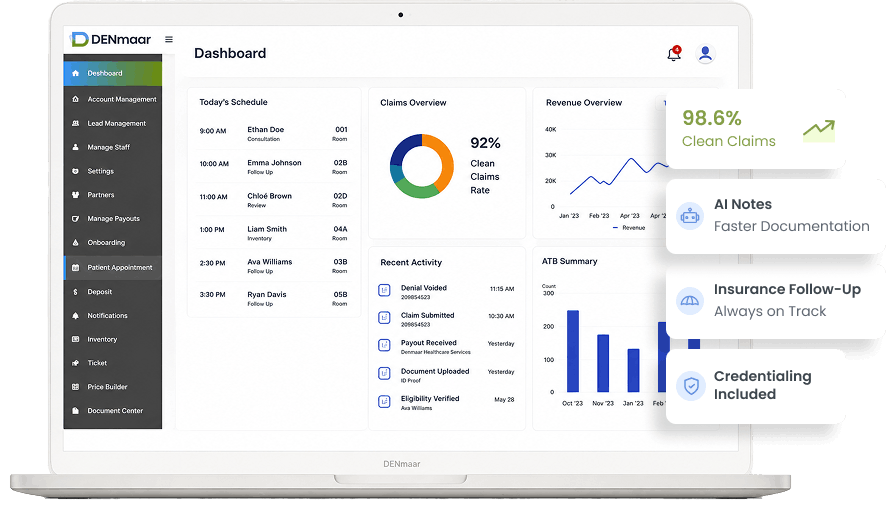
From the first patient call through scheduling, documentation, claims, and payment, DENmaar connects the work of your practice and automates routine steps.

Run your entire practice from one intelligent platform backed by behavioral health expertise.

AI-powered workflows
Behavioral health expertise
ONE INTEGRATED PLATFORM
Four Solutions. One Platform.
Everything growing behavioral healthcare organizations need to run a modern practice.
AI Clinical Documentation
Create therapy, psychiatry, group, and multidisciplinary documentation in minutes with AI designed specifically for behavioral healthcare.
Revenue Cycle Management
Professional insurance billing, payment posting, denial management, patient responsibility, eligibility verification, credentialing, and financial reporting.
More than software.
A complete revenue cycle solution.

AI Practice Automation
Administrative work should happen automatically whenever possible.
Insurance Knowledge Team
Healthcare reimbursement is constantly changing. DENmaar includes access to an expanding insurance knowledge platform built specifically for behavioral healthcare.
Get guidance on:
- Coding
- Prior authorization
- Documentation
- Claim resolution
- Medical necessity
- Credentialing
- Insurance requirements
- Best practices
Built from thousands of real-world behavioral health billing scenarios.

BUILT TO SCALE WITH YOU
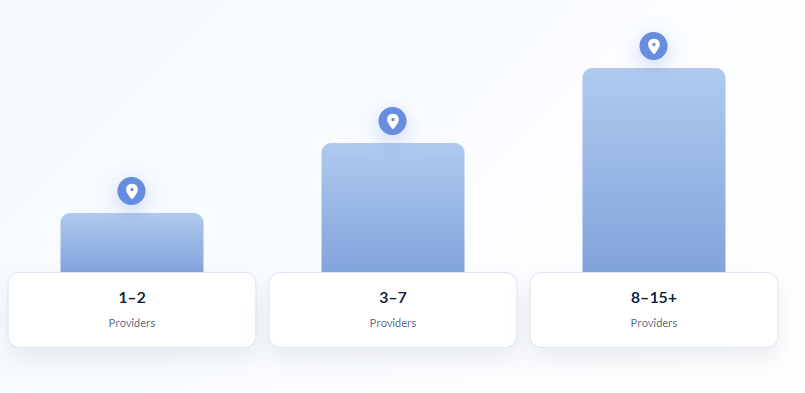
Designed for Growing Practices
Whether you’re adding your second provider or expanding into multiple locations, DENmaar grows with your organization.
Start simple.
Get up and running quickly with the essentials.
Add capabilities
Unlock advanced features as your needs grow.
Never outgrow
A platform that scales with your vision.
THE DENMAAR DIFFERENCE
Why DENmaar?
Most vendors sell software. Others sell billing services. DENmaar combines technology, AI, revenue
cycle management, and behavioral health expertise into one integrated platform.
Most vendors sell software.
Technology without the operational expertise to connect the pieces.
Others sell billing services.
Services without the intelligent platform to automate your practice.
DENmaar combines it.
Technology, AI, revenue cycle management, and behavioral health expertise into one integrated platform.
Enterprise Capability.
Small Practice Simplicity.
Schedule Your Personalized Demo
See how DENmaar can help your practice grow with confidence.
Let’s Determine Whether There Is Operational Alignment
We begin with a discussion focused on:
- Organizational structure
- Insurance workflows
- Operational goals
- Implementation fit
Request Information
Capterra, Software Advice And Get App 2023 / 25
Best Of Badges Awarded To DENmaar
2023 / 25 “Best of” badge winners = DENmaar Neuro has earned a well-deserved Best Value Badge.
See our reviews for our software being recognized as an impactful solution for your business.





Our Latest Blogs

Letter of Interest for Insurance Credentialing -Tips To Mind
A letter of Interest is practically a letter you send to an insurance company of your Interest in hopes of getting paneled with them. Now, a letter of Interest in many ways is similar to a cover letter with one significant difference.
A cover letter is what you send before applying for a job at a specific point of time, whereas a letter of interest can be submitted at any time. Now, a letter of Interest with respect to credentialing should be sent keeping specific requirements in mind.
You are making an appeal to be welcomed as an in-network provider with an insurance company. Hence, it is essential to know how to approach a letter of Interest to make a compelling appeal to an insurance company.
Click here to get started with Credentialing
Tips for Writing a Letter of Interest.
When a letter of Interest is written compellingly, it can become a powerful tool to persuade a payer to offer access to their network.
1) Identifying Information
As a provider, you must provide information that matches the enrollment application. Information like Name, NPI number, Tax ID, CAQH Number, the specialty and services provided by your company are all vital information to disclose in the letter of Interest.
2) Special Attributes
Don’t forget to mention any unique attributes associated with your practice. Any defining features like whether your business is family-owned or corporation, whether it is a minority or women-owned small business. Small details like these can be instrumental in enhancing your appeal.
3) Unique Services
Highlighting a service, your practice offers that your competitor doesn’t is also a good addition to your letter of Interest.
4) Geographical Locations
Specify your practice’s geographical location. State whether you work in rural or urban areas.
5) Patient Demographics
It is essential to define the kind of patients your practice caters to on a regular basis. Bunch them to include patient groups by age, income group, gender, etc.
6) Referring Services
You can also mention the services you offer which are available for referral. Services such as durable medical requirements, home health, and hospice care.
7) Competitive Rates
Mention your competitor’s rate in comparison to yours as well. Mention if the competitors provide a rate slightly less than the competition. This bit of information can make you more appealing than to the insurance company.
8) Information on Test Programs
Panels are always at a risk of being full. They won’t accept a new practitioner to their already crowded network unless you entice them with something like test or trial programs of your services.
Click here to get started with Credentialing
The other information you need to mention in a letter of Interest are as follows:
- IRS Form W9
- Applicable Licensure
- Marketing material or brochure
- Top billing codes or desired rates.
- Sample claim forms
- Invoice on products.
While writing the letter of Interest, do some due diligence, and find out the name and address of key decision-makers. Address the letter to them. Once you the information you need to send them the letter along with the application and any other attachments.
Make sure to address why you, as a provider, are unique and different from others in the market.

Challenges in Nurse Practitioner Credentialing
Insurance credentialing for nurse practitioners is as vital as for other practitioners in the field. However, the dynamics of credentialing is quite different for nurse practitioners than others. Its challenges are different and can cause a lot of distress for the uninformed.
In this article, we will look at some of the challenges faced by nurse practitioners that are exclusive to their faction. It is essential to know the hurdles you face, so when the time comes, you can jump over them with ease.
Challenges with Insurance Credentialing For Nurse Practitioners
Restrictions with License
Nurse practitioners throughout America have to go through various forms of restrictions when it comes to licensure. It varies from state to state. Some states allow Full Practice license to nurse practitioners. This means that they are allowed to evaluate, diagnose, interpret diagnostic tests, initiate or manage treatments and prescribe medications in accordance with the exclusive licensure authority.
Read More: Importance of Nurse Practioner Credentialing for Nurses and Healthcare Organizations
In reduced practice states nurse practitioners require a regulated collaborative agreement with a physician. The collaborative agreement is mandatory if NP’s wish to offer patient care in these states. Without the above formalities, there is no chance for a nurse practitioner to ever get credentialed to undertake practice. It is highly recommended for nurse practitioners in these states to have the necessary collaborative agreements in place when the need arises.
And finally, we have “Restricted.” This kind of practice states requires thorough supervision, delegation, or team management by an outside health discipline for nurse practitioners to practice health care.
Admitting Privileges
Many insurance plans require practitioners to have to admit privileges at an in-network facility. If a practitioner does not have the required admitting privileges then he/she need to prove an “admitting relationship” with another provider.
The requirement can be frustrating for many practitioners who work in a setting that does not have situations that require admissions requirement. As we mentioned, the “admitting relationship” should be in the form of a letter, on the letterhead of the concerned physician who states that the physician in question will handle all inpatient admissions for the patients when necessary.
There is no way you can skip this requirement. Nurse practitioners must keep this requirement ready when undertaking the credentialing process.
Credentialing File
It is highly recommended for nurse practitioners to keeps their files ready. All the credentialing documents and copies that will be required need to filed and available. Documents will always be needed for assessment, whether it is for credentialing or re-credentialing.
Here is a list of documents that you need for credentialing
- State License
- Current CV
- Professional liability insurance
- Current Drivers license
- Collaborative Agreement
- DEA/CSR
- Board Certificate
- Admitting Arrangement Letter
- Prescribing Arrangement letter
- Copy of diploma from the highest level of education.
Get Ahead of the Curve
Credentialing is not a piece of cake and can go on for a better period of a year. If you are starting a new practice or hiring nurse practitioners for your practice, then be ready with all the necessary documents and copies needed. Prepare a credentialing packet for your nurse’s so that they can arrange for the required documents without any confusion.

Bankers Life Insurance Credentialing – Getting on the Panel
Let’s discuss the process of Banker’s life insurance credentialing.
Bankers Life insurance credentialing is a subsidiary of the very popular CNO financial group. CNO is a part of the fortune 1000 company list. As of 2019, Bankers life has around 1.4 million policyholders. It offers a variety of different insurance products like long term care, and life insurance, annuities, Medicare products including supplement lines, Medicare advantage plans, and Medicare part D prescription coverage and critical illness insurance.
Bankers Life Insurance credentialing has also partnered with Humana to provide vision and dental plans to their clients. They sell their plans with assistance from a network of over 5000 insurance agents based in over 320 offices throughout America.
As we mentioned, Banker’s life has over 1.4 million policyholders. Practitioners who want to tap into its client base need to get in-network with the credentialing process.
So let’s discuss the process of Bankers Life Insurance Provider Credentialing
1. Getting Your Information in Order
As we mentioned before, Bankers Life insurance credentialing requires a lot of information and documents from the practitioner. They are:
- Licensure Information
- NPI Number
- Resume
- Proof of Malpractice Insurance
- Taxonomy Code
- Proof of Liability Insurance from Landlord (Applicable on if you are renting)
- Credentialing Paperwork
2. Fill Out Your CAQH
You will find many companies who use the Council of Affordable Quality Healthcare for the purpose of credentialing. Before filling out the CAQH form, you are required to hold an authentic resume with no gaps in employment. The application is supposed to be completed online via the CAQH hub.
The entire process can be extremely confusing to follow, but we at DENmaar assist you till the end.
3. Contact provider Relations
Once you have gone through the CAQH process, you are now afforded the liberty of choosing which insurance panel you want to be on. The insurance companies you choose may vary in the department of reimbursement rates, provider friendliness, payment speeds, etc.
Some companies may have their own sets of rules and requirements to apply. Now here you might face an issue of rejection, or not being accepted because the panel is full.
In such cases, you can do the following to build relationships with networks to gain access for future openings:
- Evening and Weekend Availability
- Experience with special populations
- Crisis services
- Handicap accessible facilities
- Being located in an underserved area
- Multilingual fluency
- Having an in-network referral source.
4. Submit Application
Once you have taken care of the documentation and decided on which insurance panel to join, it’s time to submit the application and wait. The entire process of getting paneled is relatively swift, culminating within 9-10 hours.
All you have to do now is a follow-up. You have to keep tabs on the status of your application. Chances are it might expire while still in the process if taken too long, and you don’t want to start again. The insurance companies have to be notified every time you submit a document to ensure it has reached them.
5. Review after Approval
Once you have received approval, it is still not an appropriate time to celebrate. Do the following to be on the safer side.
- Review your contract carefully before signing
- Keep a file with the agreement and any addendums ready for future reference.
- Learn more about the insurance provider’s portal on its official website.
- Collect a list of phone numbers for the claims department, pre-authorization department, and provider relations.
Being a Bankers Life in-network provider can be a very long and tedious process. The entire process requires at least 90 – 120 days to be completed and approved. There is a lot of paperwork, which makes the whole process quite frustrating for medical practitioners who want to accept clients with medical insurance.
Bankers Life’s network is extensive and harbors other insurance companies as well. You can get Meritain insurance credentialing, Coventry insurance credentialing services, etc. with the help of Bankers Life. That is where the professional assistance of DENmaar comes into play. With the help of our credentialing experts, we can walk you through the entire process without complications and hassle so that you can work on other core areas of your medical practice.
Our Partners






Ready to get started?
Feel free to reach out if you have any questions.
