

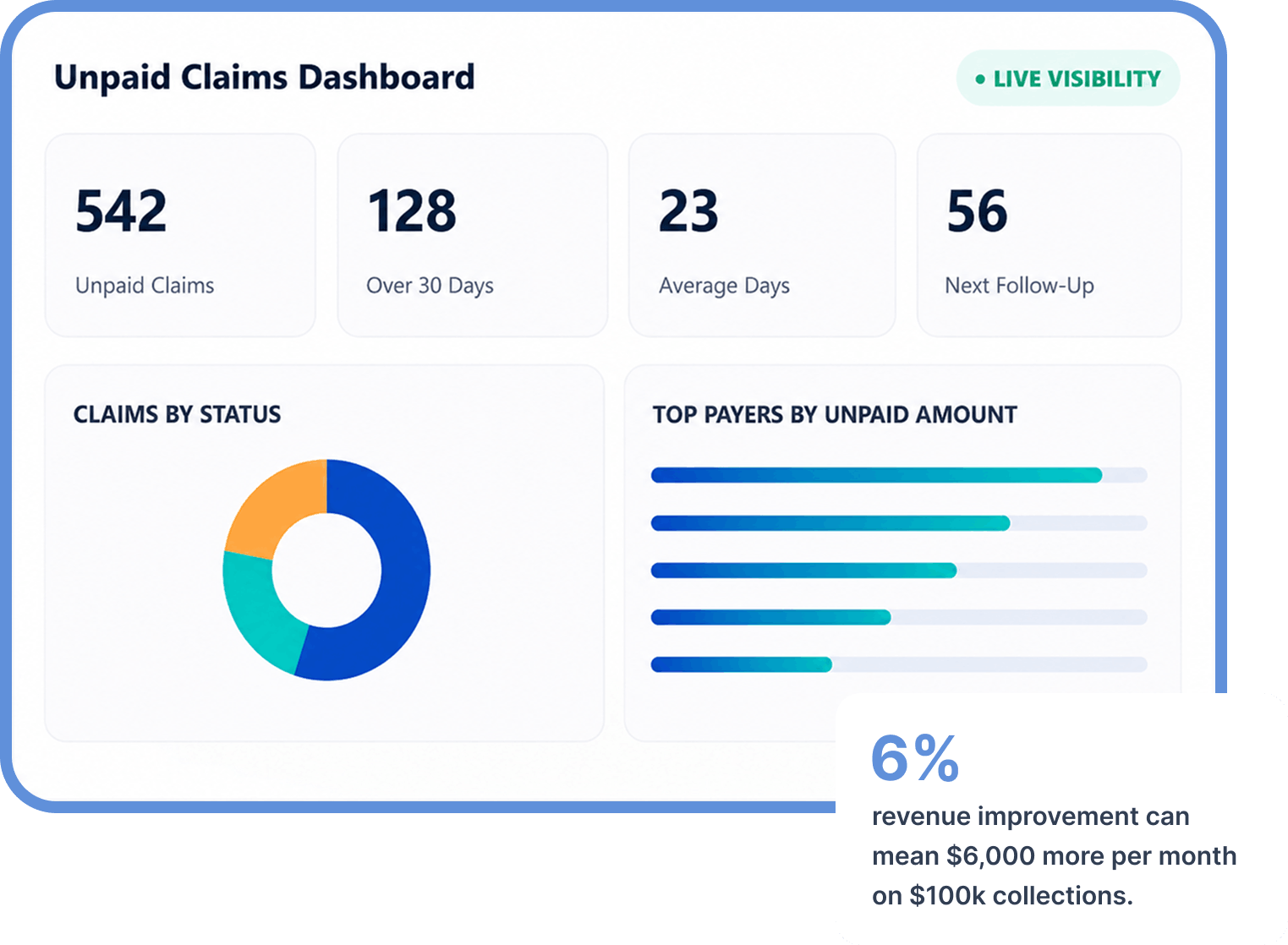
We don’t just submit claims. We create visibility and accountability around every unpaid claim—so management knows what’s being worked, what’s stuck, and why.
Know What’s Happening With Every Unpaid Claim
Behavioral health billing with complete visibility and accountability

98.1%
Clean Claim Rate
1.47%
Rejection Rate
0.32%
Denial Rate
5–10%
Denial Rate
10–20%
Average Revenue
Improvement
$0
EHR Software Fee
With Billing Services
With Billing Services
CLAIMS VISIBILITY
Your Claims May Be Getting
Submitted. But Are They Getting Paid?
Submitting a claim is only the beginning.
Your Claims May Be Getting
Submitted. But Are They Getting Paid?
Revenue is lost when rejected claims aren’t corrected, denials aren’t resolved, authorizations expire, payer requests go unanswered, and unpaid claims disappear into spreadsheets and work queues.
DENmaar gives behavioral health practices a clear view of:
- Which claims remain unpaid
- Why each claim is stuck
- What action has been taken
- Who is responsible for the next step
- When follow-up is due
- What the payer said during the last follow-up
- Which payers and problems are creating the most lost revenue
You no longer have to accept, “We’re working on it.”
You can see exactly what is being worked, what happened and what comes next.
The Improvement in Claims Can Pay for DENmaar
any practices are already losing more money through preventable claim problems than they would spend fixing them.
For a practice collecting $100,000 per month
6% = +$6,000 / month
in realized insurance revenue
That improvement alone could offset the cost of DENmaar’s billing services.
- Behavioral health EHR software at no additional cost
- Claims Copilot
- Eligibility and insurance workflows
- Payment posting
- Rejection and denial management
- Aging-claim follow-up
- Reporting and management visibility
- Support from DENmaar’s Insurance Knowledge Team
Claim Lifecycle
Every Claim Has an Owner, a Status
and a Next Action
DENmaar creates a structured process for managing the entire claim lifecycle—from appointment readiness
through final payment.
01
Prevent Problems Before Submission
Eligibility, payer, authorization, credentialing and documentation issues are identified before they become rejected or denied claims.
02
Submit Clean Claims
Claims are reviewed for common errors and payer requirements before submission.
03
Monitor the Payer Lifecycle
Claims are tracked after submission so unresolved claims don’t quietly disappear into aging.
04
Assign the Next Action
Every problem claim has a clear status, responsible team member and required next step.
05
Document Every Follow-Up
Management can see when follow-up occurred, what the payer said and what must happen next.
06
Escalate Unresolved Claims
Claims receive additional attention before filing limits or appeal deadlines are missed.
07
Measure Performance
Monitor clean claims, rejections, denials and aging by payer, provider, location, service and responsible team member.
Management Visibility
Your Billing Operation Shouldn’t Be a
Black Box
Monthly reports tell you what has already happened. DENmaar provides visibility into
what is happening now.
Visibility creates accountability.
A practice should not have to wait until collections fall to discover that claims aren’t being worked effectively.
- Whether claims are being worked consistently
- Whether follow-up is producing results
- Why claims remain unpaid
- Whether the same errors keep recurring
- Where responsibility for the next action sits
- Which workflows or team members need support
- Which payers are causing the most problems
- How much revenue remains at risk
Visibility creates accountability.
Accountability creates action.
Action moves claims toward payment.
Improve the Team You Have—or Let DENmaar Manage the Process
Some practices already have an internal billing team but lack the technology, payer knowledge and management visibility required to oversee it. Others want an experienced partner to manage the entire revenue cycle.
OPTION 01
Claims Copilot for Your Existing Team
Give your billing staff the structured workflows, claim intelligence and accountability tools needed to manage unpaid claims more effectively. Management gains visibility without immediately replacing the internal team.
OPTION 02
Full Revenue Cycle Management
Let DENmaar manage claim creation and submission, rejection correction, payment posting, denial resolution, insurance follow-up, aging claims, payer escalation, patient balances and revenue-cycle reporting.
Either way, management gains control over the revenue cycle.
Behavioral Health Expertise
Built Specifically for Behavioral Health
Behavioral health billing requires more than generic claim submission.
Mental health therapy
Psychiatry and medication management
Substance-use treatment
Intensive outpatient and partial hospitalization programs
Community behavioral health
Multidisciplinary practices
Telehealth billing
Time and unit requirements
Rejections and denials
Built Specifically for Behavioral Health
- Behavioral health payer carve-outs
- Eligibility and benefit verification
- Prior authorizations
- Provider credentialing
- Therapy and psychiatric coding
- Same-day services
- Telehealth billing
- Missing or incomplete documentation
- Coordination of benefits
- Rejections and denials
- Aging insurance balances
Before Billing Begins
Problems Are Often Created Before Billing Begins
Many claim problems originate before the claim reaches the billing team.
An appointment may be scheduled with the wrong payer. Eligibility may not be verified. An authorization may be missing. Documentation may not support the code or units billed. A provider may not be enrolled correctly.
DENmaar connects scheduling, eligibility, authorizations, documentation and billing in one operational system.
This helps prevent bad claims—not merely work them after they fail.
Prevent the problem upstream.
01
Scheduling
Right payer • right workflow
02
Eligibility & Authorization
Verify before service
03
Documentation
Support code and units
03
Billing
Submit cleaner claims
More Than Billing
Technology, Insurance Expertise and
Human Follow-Through
Most billing companies provide reports. Most software companies provide tools. DENmaar combines:
Technology, Insurance Expertise and
Human Follow-Through
You get a system designed to improve the financial performance of your behavioral health practice.
Enterprise capability with small-practice simplicity.
- Behavioral health EHR technology
- Claims Copilot
- Revenue-cycle services
- Insurance knowledge
- Human payer follow-up
- Management visibility
- Operational accountability
Billing Review
See What Better Claims Performance Could Mean for Your Practice
If too many claims are rejected, denied, aging or simply unexplained, let’s look at the process together.
Current monthly insurance revenue
Baseline performance
Clean-claim rate
Rejection and denial rates
Claims over 30 days
Value of unpaid and aging claims
Follow-up process
Where accountability is breaking down
Let’s Determine Whether There Is Operational Alignment
We begin with a discussion focused on:
- Organizational structure
- Insurance workflows
- Operational goals
- Implementation fit
Request Information
Capterra, Software Advice And Get App 2023 / 25
Best Of Badges Awarded To DENmaar
2023 / 25 “Best of” badge winners = DENmaar Neuro has earned a well-deserved Best Value Badge.
See our reviews for our software being recognized as an impactful solution for your business.





Our Latest Blogs

Claims Hygiene: How DENmaar Prevents Rejections Across Therapy, Medication Management, SUD, IOP, and Community-Based Care
In behavioral health billing, most revenue problems do not start with denials. They start earlier at submission with claims that are structurally valid but misaligned with payer expectations for the specific service being delivered.
At DENmaar, we address this upstream through a discipline we call claims hygiene. Claims hygiene is the systematic validation of insurance, provider, diagnosis, service type, and documentation data to ensure a claim is payer aligned and submission ready before it ever leaves the system.
This article explains how DENmaar applies claims hygiene across different behavioral health service lines and how we use the Change Healthcare API as a final structural validator, not a decision engine.
What Claims Hygiene Means at DENmaar
Claims hygiene is not denial management.
It is not resubmission work.
It is not a clearinghouse dependency.
Claims hygiene is prevention by design.
Before a claim is submitted, DENmaar evaluates whether:
- The insurance configuration is correct
- The provider is properly aligned and enrolled
- The diagnosis supports the service
- The service type is billed the way the payer expects
- The claim is structurally valid as an 837
If any of these fail, the claim does not advance.
This approach is foundational to how a behavioral health EHR built for complex care environments supports clean claims and predictable Medicaid behavioral health reimbursement.
Claims Hygiene Is Service Line Specific
A critical mistake many systems make is treating all behavioral health services the same. They are not.
Each service line therapy, medication management, SUD, IOP, and community based care has distinct payer logic, especially in Medicaid and managed care. Claims hygiene must account for that.
This same operational depth is required in advanced care models such as professional inpatient psychiatry, where complexity outweighs volume.
Therapy Billing Claims Hygiene
Therapy (Individual, Family, Group)
For therapy services, claims hygiene focuses on:
- Correct CPT selection for individual, family, and group therapy
- Modifier logic including telehealth and state specific rules
- Units and duration alignment
- Diagnosis compatibility with psychotherapy services
- Rendering provider scope and licensure
- Telehealth rules by payer and state
Many therapy rejections occur not because therapy was inappropriate, but because format, modifiers, or diagnosis pairing did not meet payer rules. Claims hygiene prevents those upfront, supporting therapy practice management software designed for Medicaid and commercial payers.
Medication Management and Psychiatry Claims Hygiene
Medication management introduces a different hygiene profile:
- E and M code selection and level alignment
- New versus established patient logic
- Diagnosis requirements for psychiatric E and M
- Time based versus complexity based billing validation
- Prescribing provider credentials and enrollment
- Telehealth E and M restrictions by payer
DENmaar evaluates whether an E and M service is billable in context, not just whether the code exists. This is essential for psychiatry billing Medicaid and multi payer environments.
Substance Use Disorder Billing Claims Hygiene
SUD billing is highly sensitive to payer and program structure. Claims hygiene here evaluates:
- Whether the payer expects CPT or HCPCS
- Diagnosis restrictions tied to SUD services
- Program specific coverage including outpatient versus structured programs
- Frequency and unit limitations
- Required modifiers and service classifications
Many SUD rejections stem from using the right code in the wrong program context. Claims hygiene blocks those before submission, strengthening substance use treatment billing accuracy.
Intensive Outpatient Program Billing Claims Hygiene
IOP introduces institutional and hybrid billing considerations. Claims hygiene ensures:
- Proper classification of the service as IOP
- Correct claim type professional versus institutional
- Alignment between diagnosis, level of care, and frequency
- Group versus individual service differentiation
- Documentation readiness tied to level of care
IOP claims are often structurally valid but rejected because the payer expected a different service framework. Claims hygiene prevents those mismatches and supports compliant behavioral health revenue cycle management.
Community Based and Rehabilitative Services Claims Hygiene
Community based services are among the most complex to bill. Claims hygiene evaluates:
- Program eligibility and payer authorization expectations
- HCPCS versus CPT requirements
- Diagnosis restrictions tied to state and program
- Provider role alignment
- Claim form and submission expectations
These services fail when systems treat them like outpatient therapy. DENmaar does not.
Diagnosis Hygiene Across All Behavioral Health Services
Across every service line, diagnosis hygiene is enforced. DENmaar validates:
- ICD 10 validity and effective dates
- Diagnosis to service compatibility
- Primary versus secondary diagnosis rules
- Program specific diagnosis requirements
Diagnosis feedback returned during scrubbing is normalized and used to strengthen upstream prevention, not ignored. This is a critical component of behavioral health compliance.
The Role of the Change Healthcare API
After a claim passes DENmaar internal claims hygiene across insurance, provider, diagnosis, and service specific logic, it is submitted as a JSON based claim payload to the Change Healthcare API.
Change Healthcare is used for:
- Structural and schema validation
- Required field enforcement
- Standard EDI edits
- Diagnosis and procedure edit feedback
Change is not used to decide whether a service should be billed or how it should be classified. All business logic remains inside DENmaar EHR and mental health EHR software.
Why Claims Hygiene Matters
When claims hygiene is applied uniformly, complex services break.
When claims hygiene is service aware:
- First pass acceptance rates increase
- Rejections drop across all service lines
- Billing labor per claim decreases
- Payment timelines stabilize
- Cash flow becomes predictable
Billing teams stop fixing preventable errors and start managing real exceptions using behavioral health billing services built for complexity.
Why We Built It This Way
DENmaar was designed for practices delivering:
- Therapy and psychiatry
- SUD and higher levels of care
- Community based and Medicaid heavy services
- Multi state and multi payer operations
That environment demands claims hygiene that understands the service, not just the code.
This is reinforced by AI documentation for behavioral health, including compliant AI progress notes aligned with billing logic.
Revenue cycle efficiency does not come from working claims faster.
It comes from sending the right claims, for the right service, the right way, on the first attempt.
That is claims hygiene.
And it is foundational to how DENmaar operates.
Frequently Asked Questions
Is professional inpatient psychiatry a profitable market?
It is not high volume, but when supported correctly it protects revenue, reduces compliance risk, and strengthens long term practice stability.
Why do outpatient-focused EHRs struggle with inpatient psychiatry?
They are not designed for daily inpatient billing rules, place of service enforcement, discharge logic, or hospital credentialing workflows.
How does inpatient psychiatry affect behavioral health billing?
Errors in inpatient billing can lead to denied claims, audits, and revenue loss, making accurate documentation and billing workflows essential.
Why does inpatient capability matter for EHR platforms?
Supporting inpatient psychiatry signals operational maturity and the ability to handle complex payer and care models without breaking workflows.

Is Professional Inpatient Psychiatry a Small Market?
Yes and That Is Exactly Why It Matters
As behavioral health practices evolve, many eventually ask the same question: Is professional inpatient psychiatry worth supporting?
The short answer is yes, it is a smaller market than outpatient psychiatry. The more important answer is why that does not make it insignificant and why, from a systems and operations perspective, it actually matters more than its raw size suggests.
Organizations evaluating behavioral health EHR platforms built for complex care environments often discover this question late in their growth cycle
The Honest Market Reality
Professional inpatient psychiatry, where a psychiatrist or psychiatric nurse practitioner bills professional services for seeing patients admitted to a hospital, is not a volume driven market.
Compared to outpatient behavioral health:
- There are fewer clinicians
- Fewer billable days per patient
- Less claim volume overall
- Many providers are salaried or hospital employed and never bill independently
If you measure opportunity purely by claim count, it is a small slice of the behavioral health ecosystem. That is the truth.
Why Smaller Does Not Mean Unimportant
Where professional inpatient psychiatry does matter is complexity.
This work sits at the intersection of:
- Hospital workflows
- Daily inpatient evaluation and management billing rules
- Authorization dependencies
- Strict place of service logic
- Discharge day coding requirements
In other words, it is where systems and billing teams break first.
Most outpatient first platforms struggle here because they were not designed to handle:
- One billable encounter per provider per patient per day
- Inpatient evaluation and management code families
- Place of service 21 enforcement
- Discharge day logic
- Hospital credentialing nuances
Supporting this correctly is not about volume. It is about operational maturity.
Practices running into these challenges often encounter limitations in mental health EHR software not designed for inpatient workflows
Higher Friction, Higher Stickiness
Practices that do professional inpatient psychiatry successfully do not switch systems casually.
Why?
- The workflows are fragile
- Billing errors are expensive
- Compliance mistakes create audit exposure
- Re training teams is painful
When a platform does handle this well, it becomes deeply embedded. That creates retention, not churn.
This is especially true when inpatient workflows must align with behavioral health billing services and clean claims management
This Is Rarely A Standalone Business
Almost no one builds a company around only professional inpatient psychiatry.
Instead, it shows up as:
- An extension of an outpatient psychiatry practice
- Hospital rounding for existing patients
- On call or coverage arrangements
- Moonlighting or part time inpatient work
Which means its real value is adjacent, not isolated.
It protects and expands existing practices rather than replacing their core business, particularly for organizations managing psychiatry billing under Medicaid and commercial payers.
Why This Matters for Integrated Platforms
For systems that combine EHR, billing, and operational rules into one environment, professional inpatient psychiatry is a stress test.
If a platform can support:
- Outpatient psychiatry
- Inpatient professional services
- Community based care
- Higher levels of care
- Complex payer rules
It signals something important.
The system was built for growth, not just simplicity.
This same logic applies to platforms that can handle CMS 1500 vs UB 04 billing across behavioral health services
The Takeaway
Yes, professional inpatient psychiatry is a small market by volume.
But strategically, it plays an outsized role:
- It hardens systems
- Increases client retention
- Enables practices to grow without switching vendors
- Signals real operational depth
For platforms built to scale with practices, not just onboard them, that matters.
And for practices expanding into more complex care environments, it is often the difference between growth that is sustainable and growth that breaks the backend.
Documentation accuracy and workflow integrity are often reinforced through tools like AI progress notes aligned with inpatient and Medicaid billing logic
Frequently Asked Questions
Is professional inpatient psychiatry a profitable market?
It is not high volume, but when supported correctly it protects revenue, reduces compliance risk, and strengthens long term practice stability.
Why do outpatient-focused EHRs struggle with inpatient psychiatry?
They are not designed for daily inpatient billing rules, place of service enforcement, discharge logic, or hospital credentialing workflows.
How does inpatient psychiatry affect behavioral health billing?
Errors in inpatient billing can lead to denied claims, audits, and revenue loss, making accurate documentation and billing workflows essential.
Why does inpatient capability matter for EHR platforms?
Supporting inpatient psychiatry signals operational maturity and the ability to handle complex payer and care models without breaking workflows.
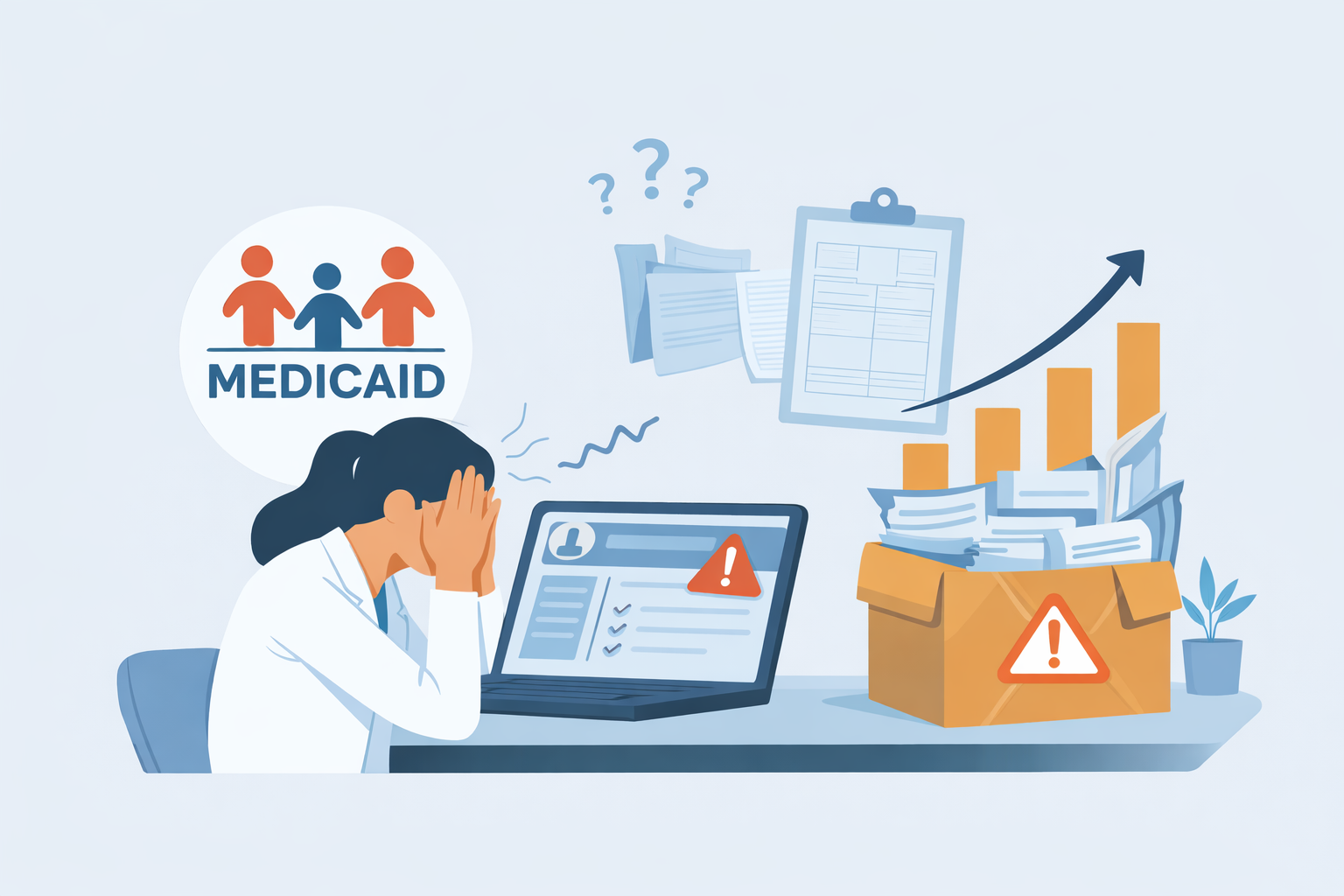
Why Medicaid Heavy Behavioral Health Practices Are Being Forced to Outgrow Their EHRs
Behavioral health practices did not suddenly become “too complex”. The system around them did.
Over the last several years, outpatient therapy and substance use disorder organizations, especially those serving Medicaid populations, have been pushed into operating models their software was never designed to handle. What used to work for low volume, private pay therapy breaks quickly once programs, units, authorizations, and state rules enter the picture.
That is why many Medicaid heavy practices are quietly outgrowing their EHRs. Not because they want more features, but because they need systems that reflect reality.
Many organizations discover this gap only after running into limitations with their existing behavioral health EHR platforms built for Medicaid complexity.
The Shift No One Planned For
Most behavioral health EHRs were built around a simple assumption.
- One provider
- One session
- One CPT code
That assumption no longer holds.
Today’s Medicaid dominant therapy and substance use disorder practices operate with:
- Multiple service lines including therapy, groups, substance use disorder care, and case management
- Unit based billing tied to time, staffing, and programs
- Authorizations that govern what can be billed, when, and how often
- State specific Medicaid rules layered on top of managed care organization requirements
- CMS-1500 and UB-04 billing existing side by side
None of this is edge case behavior. It is the default for serious outpatient Medicaid care.
Organizations navigating this shift often encounter confusion around CMS-1500 vs UB-04 billing for behavioral health organizations.
Where Traditional EHRs Start To Fail
Most EHRs do not break all at once. They fail quietly, in predictable ways.
Documentation Is Not Billing Aware
Progress notes are treated as clinical artifacts, not revenue drivers. Units, modifiers, place of service, and enrollment logic live outside the note, usually in spreadsheets or billing staff memory.
This disconnect creates friction between clinical teams and behavioral health billing services for Medicaid programs.
Medicaid Is Treated As A Payer, Not A System
Checking a Medicaid friendly box does not account for:
- State program enrollment requirements
- HCPCS driven services
- Group and per diem logic
- Hybrid billing models
What is required by the Centers for Medicare and Medicaid Services at a policy level looks very different when executed by states and managed care organizations.
Growth Exposes Operational Ceilings
As volume increases, practices feel it:
- Claims slow down
- Denials rise
- Staff productivity drops
- Founders become the bottleneck
The issue is not demand. The issue is that the system was never built to scale Medicaid complexity.
The Hidden Cost of Workarounds
Most practices do not replace their EHR immediately. They adapt around it.
They add:
- Manual billing checks
- Custom spreadsheets
- Staff tribal knowledge
- Rework after rejections
- Founder oversight to keep things moving
This works until it does not.
Every workaround introduces risk:
- Compliance drift
- Revenue leakage
- Burnout
- Inconsistent outcomes
Eventually, the practice hits a ceiling that has nothing to do with clinical quality and everything to do with system design.
What Medicaid Ready Systems Actually Need To Do
A system built for Medicaid heavy behavioral health must:
- Understand units, groups, and programs natively
- Tie documentation directly to billing logic
- Support CMS-1500 and UB-04 workflows without forcing a choice
- Adapt to state specific rules instead of ignoring them
- Reduce dependency on hero staff and founder intervention
This is not about adding more buttons. It is about embedding institutional knowledge into software.
Practices exploring modern mental health EHR software for complex care models often discover this requirement too late.
The Future Systems and Insurance Intelligence
The next generation of behavioral health platforms will not win on user interface alone.
They will win by:
- Increasing claims velocity
- Reducing denials before submission
- Shortening onboarding and credentialing timelines
- Making compliance invisible instead of manual
In Medicaid heavy environments, software without insurance intelligence becomes a liability. Practices are starting to recognize that documentation must also support billing logic through tools like AI progress notes aligned with Medicaid billing requirements.
A Quiet but Important Realization
Many therapy and substance use disorder organizations are not outgrowing their EHRs because they have become too ambitious.
They are outgrowing them because they are finally operating at the scale Medicaid care requires.
The practices that succeed long term will not be the ones with the most features. They will be the ones whose systems tell the truth about how Medicaid behavioral health actually works.
Frequently Asked Questions
Why do Medicaid behavioral health practices outgrow traditional EHRs?
Most legacy systems were built for simple outpatient therapy and cannot handle unit based billing, program enrollment, and state specific Medicaid rules.
Why is CMS-1500 vs UB-04 important in behavioral health billing?
CMS-1500 supports provider delivered services, while UB-04 is required for program based Medicaid services such as substance use disorder treatment, IOP, PHP, and rehabilitative care.
Can one EHR support both billing models?
Only Medicaid ready behavioral health EHRs can support both claim types without relying on spreadsheets, manual billing checks, or external systems.
How does documentation impact Medicaid reimbursement?
Documentation must align with authorizations, program requirements, and billing units. When it does not, claims are delayed or denied.
Is DENmaar built for Medicaid billing complexity?
Yes. DENmaar supports program-based services, AI documentation, billing workflows, and credentialing across multiple levels of care.
Our Partners






Ready to get started?
Feel free to reach out if you have any questions.
