

We don’t just submit claims. We create visibility and accountability around every unpaid claim—so management knows what’s being worked, what’s stuck, and why.
Know What’s Happening With Every Unpaid Claim
Behavioral health billing with complete visibility and accountability

98.1%
Clean Claim Rate
1.47%
Rejection Rate
0.32%
Denial Rate
5–10%
Denial Rate
10–20%
Average Revenue
Improvement
$0
EHR Software Fee
With Billing Services
With Billing Services
CLAIMS VISIBILITY
Your Claims May Be Getting
Submitted. But Are They Getting Paid?
Submitting a claim is only the beginning.
Your Claims May Be Getting
Submitted. But Are They Getting Paid?
Revenue is lost when rejected claims aren’t corrected, denials aren’t resolved, authorizations expire, payer requests go unanswered, and unpaid claims disappear into spreadsheets and work queues.
DENmaar gives behavioral health practices a clear view of:
- Which claims remain unpaid
- Why each claim is stuck
- What action has been taken
- Who is responsible for the next step
- When follow-up is due
- What the payer said during the last follow-up
- Which payers and problems are creating the most lost revenue
You no longer have to accept, “We’re working on it.”
You can see exactly what is being worked, what happened and what comes next.
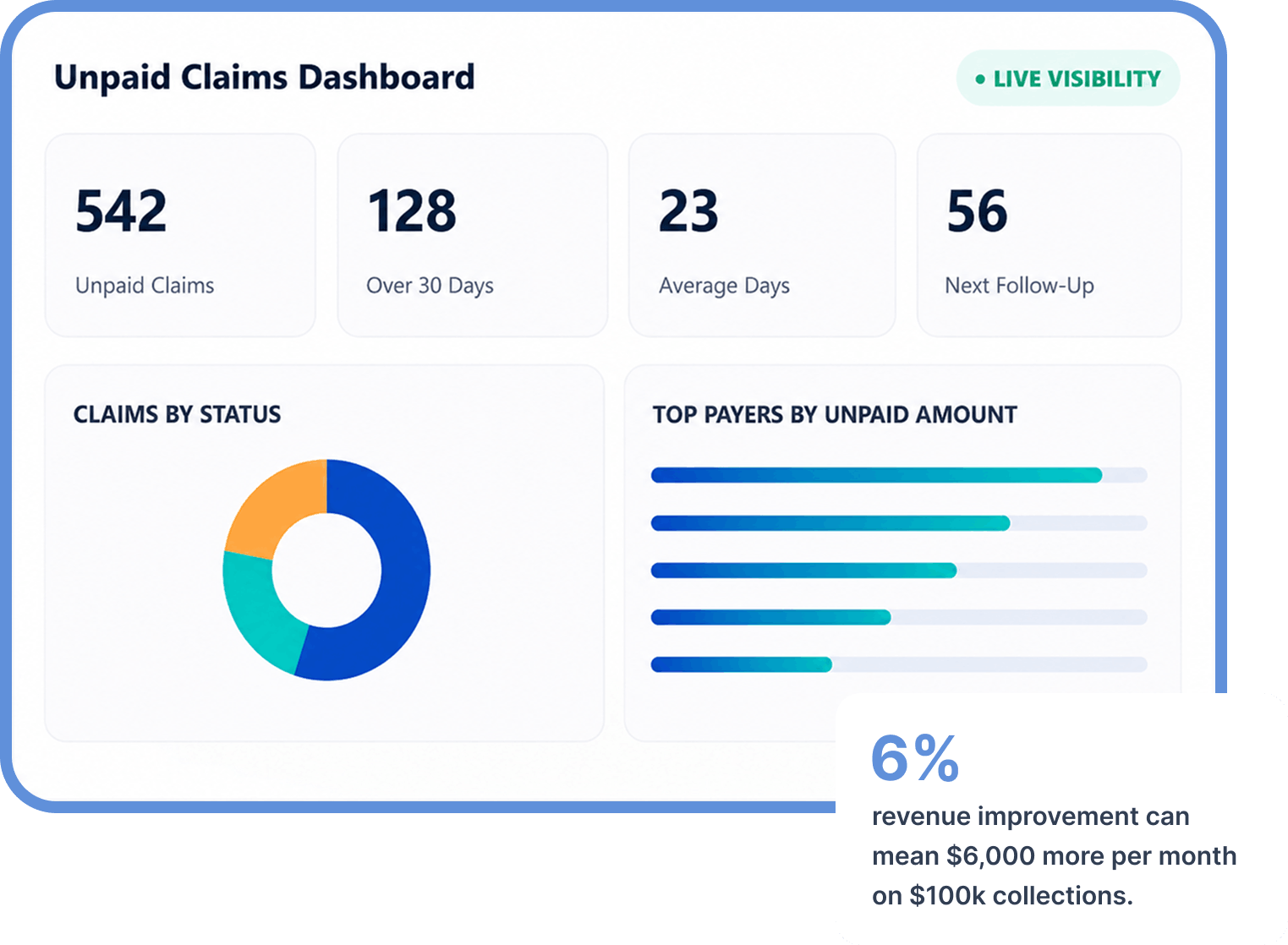
The Improvement in Claims Can Pay for DENmaar
any practices are already losing more money through preventable claim problems than they would spend fixing them.
For a practice collecting $100,000 per month
6% = +$6,000 / month
in realized insurance revenue
That improvement alone could offset the cost of DENmaar’s billing services.
- Behavioral health EHR software at no additional cost
- Claims Copilot
- Eligibility and insurance workflows
- Payment posting
- Rejection and denial management
- Aging-claim follow-up
- Reporting and management visibility
- Support from DENmaar’s Insurance Knowledge Team
Claim Lifecycle
Every Claim Has an Owner, a Status
and a Next Action
DENmaar creates a structured process for managing the entire claim lifecycle—from appointment readiness
through final payment.
01
Prevent Problems Before Submission
Eligibility, payer, authorization, credentialing and documentation issues are identified before they become rejected or denied claims.
02
Submit Clean Claims
Claims are reviewed for common errors and payer requirements before submission.
03
Monitor the Payer Lifecycle
Claims are tracked after submission so unresolved claims don’t quietly disappear into aging.
04
Assign the Next Action
Every problem claim has a clear status, responsible team member and required next step.
05
Document Every Follow-Up
Management can see when follow-up occurred, what the payer said and what must happen next.
06
Escalate Unresolved Claims
Claims receive additional attention before filing limits or appeal deadlines are missed.
07
Measure Performance
Monitor clean claims, rejections, denials and aging by payer, provider, location, service and responsible team member.
Management Visibility
Your Billing Operation Shouldn’t Be a
Black Box
Monthly reports tell you what has already happened. DENmaar provides visibility into
what is happening now.
Visibility creates accountability.
A practice should not have to wait until collections fall to discover that claims aren’t being worked effectively.
- Whether claims are being worked consistently
- Whether follow-up is producing results
- Why claims remain unpaid
- Whether the same errors keep recurring
- Where responsibility for the next action sits
- Which workflows or team members need support
- Which payers are causing the most problems
- How much revenue remains at risk
Visibility creates accountability.
Accountability creates action.
Action moves claims toward payment.
Improve the Team You Have—or Let DENmaar Manage the Process
Some practices already have an internal billing team but lack the technology, payer knowledge and management visibility required to oversee it. Others want an experienced partner to manage the entire revenue cycle.
OPTION 01
Claims Copilot for Your Existing Team
Give your billing staff the structured workflows, claim intelligence and accountability tools needed to manage unpaid claims more effectively. Management gains visibility without immediately replacing the internal team.
OPTION 02
Full Revenue Cycle Management
Let DENmaar manage claim creation and submission, rejection correction, payment posting, denial resolution, insurance follow-up, aging claims, payer escalation, patient balances and revenue-cycle reporting.
Either way, management gains control over the revenue cycle.
Behavioral Health Expertise
Built Specifically for Behavioral Health
Behavioral health billing requires more than generic claim submission.
Mental health therapy
Psychiatry and medication management
Substance-use treatment
Intensive outpatient and partial hospitalization programs
Community behavioral health
Multidisciplinary practices
Telehealth billing
Time and unit requirements
Rejections and denials
Built Specifically for Behavioral Health
- Behavioral health payer carve-outs
- Eligibility and benefit verification
- Prior authorizations
- Provider credentialing
- Therapy and psychiatric coding
- Same-day services
- Telehealth billing
- Missing or incomplete documentation
- Coordination of benefits
- Rejections and denials
- Aging insurance balances
Before Billing Begins
Problems Are Often Created Before Billing Begins
Many claim problems originate before the claim reaches the billing team.
An appointment may be scheduled with the wrong payer. Eligibility may not be verified. An authorization may be missing. Documentation may not support the code or units billed. A provider may not be enrolled correctly.
DENmaar connects scheduling, eligibility, authorizations, documentation and billing in one operational system.
This helps prevent bad claims—not merely work them after they fail.
Prevent the problem upstream.
01
Scheduling
Right payer • right workflow
02
Eligibility & Authorization
Verify before service
03
Documentation
Support code and units
03
Billing
Submit cleaner claims
More Than Billing
Technology, Insurance Expertise and
Human Follow-Through
Most billing companies provide reports. Most software companies provide tools. DENmaar combines:
Technology, Insurance Expertise and
Human Follow-Through
You get a system designed to improve the financial performance of your behavioral health practice.
Enterprise capability with small-practice simplicity.
- Behavioral health EHR technology
- Claims Copilot
- Revenue-cycle services
- Insurance knowledge
- Human payer follow-up
- Management visibility
- Operational accountability
Billing Review
See What Better Claims Performance Could Mean for Your Practice
If too many claims are rejected, denied, aging or simply unexplained, let’s look at the process together.
Current monthly insurance revenue
Baseline performance
Clean-claim rate
Rejection and denial rates
Claims over 30 days
Value of unpaid and aging claims
Follow-up process
Where accountability is breaking down
Let’s Determine Whether There Is Operational Alignment
We begin with a discussion focused on:
- Organizational structure
- Insurance workflows
- Operational goals
- Implementation fit
Request Information
Capterra, Software Advice And Get App 2023 / 25
Best Of Badges Awarded To DENmaar
2023 / 25 “Best of” badge winners = DENmaar Neuro has earned a well-deserved Best Value Badge.
See our reviews for our software being recognized as an impactful solution for your business.





Our Latest Blogs
Medicaid Billing Isn’t One System
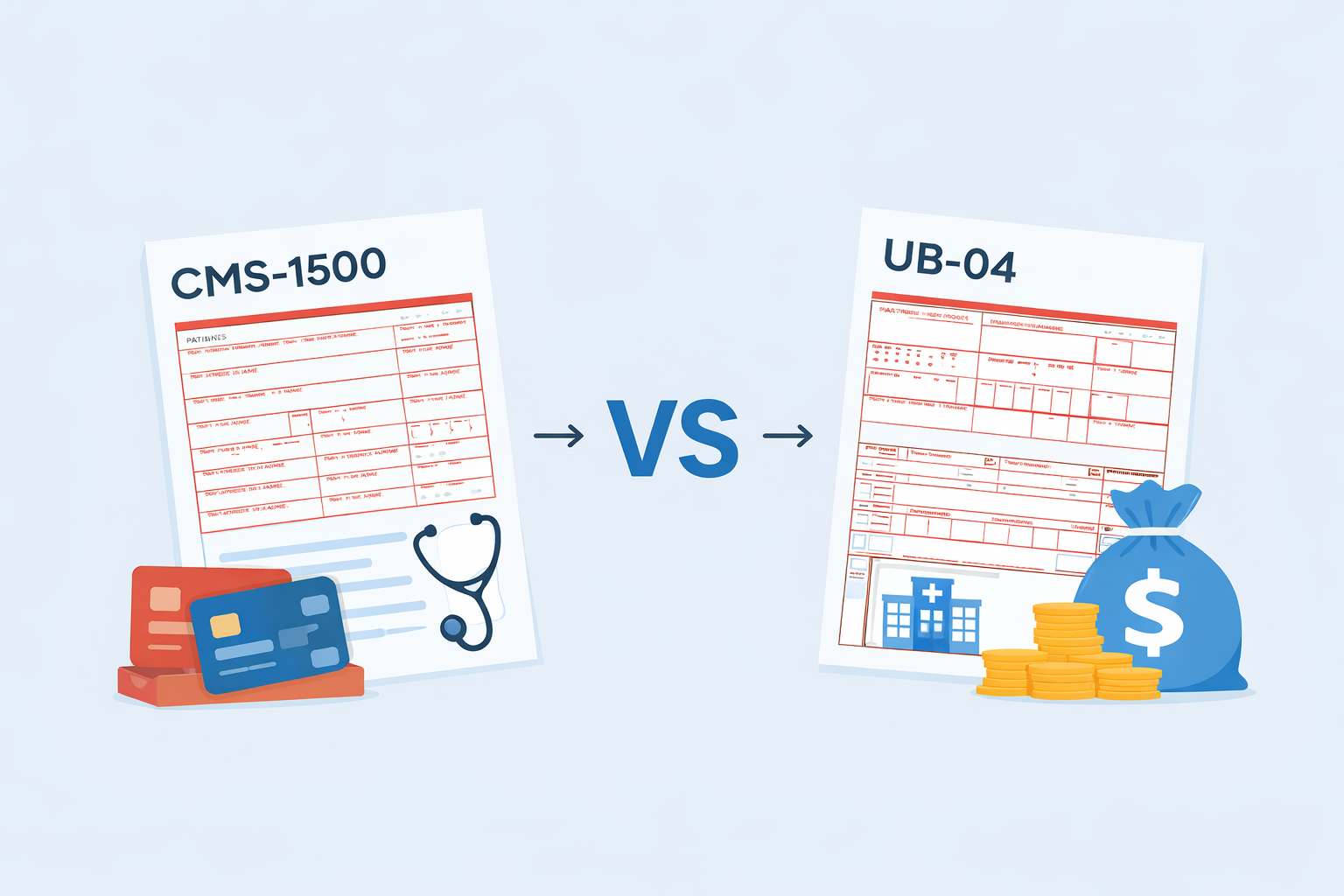
Understanding CMS-1500 vs UB-04 and the Services Behind Them
One of the biggest mistakes behavioral health organizations make with Medicaid is assuming that billing works the same way across services.
It doesn’t.
Medicaid behavioral health operates in two fundamentally different billing worlds, and most EHR platforms only support one of them. Understanding the difference between CMS-1500 and UB-04, and the services tied to each, is essential if your organization plans to grow beyond basic outpatient therapy.
The Two Medicaid Claim Types That Matter
CMS-1500: Professional Billing
CMS-1500 is used for clinician-delivered, outpatient services.
This is where most EHRs stop.
Typical services billed on CMS-1500 include:
- Individual psychotherapy (90832, 90834, 90837)
- Family and group therapy (90847, 90853)
- Diagnostic assessments (90791, 90792)
- Psychiatry and medication management (99202–99215)
- Psychotherapy add-on codes (90833–90838)
These services are:
- Provider-centric
- Session-based
- Not tied to program certification
- Familiar to most outpatient practices
For organizations offering only these services, CMS-1500 coverage may be sufficient.
Medicaid, however, extends far beyond this level of care.
UB-04: Institutional and Program-Based Billing
UB-04 is required for program-based Medicaid services, the services that operate under organizational enrollment, certification, and authorization rules.
These services typically use HCPCS codes, not CPT, and include:
- Adult rehabilitative or psychosocial rehabilitation services (H2015, H2017, H0036)
- Children’s therapeutic or wraparound services (H2019, H2021)
- Case management and care coordination (T1016, H0032)
- Substance use disorder treatment (H0001, H0004, H0005, H0015)
- Intensive outpatient and partial hospitalization programs
- Residential treatment services (H2036, H0018, H0019)
- Assertive Community Treatment (H0039, H0040)
- Day treatment and structured programs
- Crisis stabilization and crisis intervention services
These services are:
- Program-enrolled, not just provider-enrolled
- Authorization-driven
- Unit-based or per-diem
- Highly state-specific
- Often required to be billed on UB-04
This is where many EHR systems fail, not because the services are rare, but because they don’t fit a simple outpatient billing model.
The Real Challenge: Hybrid Organizations
Many behavioral health organizations operate both models at the same time.
A single organization may:
- Bill CMS-1500 for therapy and psychiatry
- Bill UB-04 for rehabilitative, substance use disorder, or higher levels of care
- Treat the same patient under both billing structures
- Employ clinicians who work across programs
Most systems cannot handle this cleanly.
The result is often:
- Separate EHRs
- External billing vendors
- Manual spreadsheets
- Claims held or denied due to enrollment mismatches
- Revenue leakage that isn’t obvious until months later
This complexity isn’t accidental. It is how Medicaid is designed.
Why Codes Alone Don’t Tell the Whole Story
A common misconception is that:
- CPT always equals CMS-1500
- HCPCS always equals UB-04
In reality:
- Program enrollment determines the claim form
- The same HCPCS code may be billed differently depending on:
- State rules
- Program certification
- Level of care
- Authorization structure
This is why Medicaid billing cannot be configured once and forgotten.
What a Medicaid-Ready Platform Must Handle
To properly support Medicaid services across levels of care, a platform must understand:
- Service type, professional versus program-based
- Program enrollment and certification status
- Claim-type logic, CMS-1500 versus UB-04
- Authorization requirements and unit limits
- Documentation standards tied to the service, not just the code
- State-specific compliance rules
Without this foundation, billing accuracy depends entirely on manual work.
See how AI-enabled documentation supports this logic:
AI documentation designed for behavioral health programs
Automated progress notes tied to treatment plans
Why This Matters for Growing Organizations
Organizations that plan to:
- Add rehabilitative services
- Expand into substance use disorder, intensive outpatient, or residential care
- Operate multiple programs
- Rely heavily on Medicaid revenue
Need systems built for Medicaid operations, not just documentation.
At that stage, the question is no longer:
Can this EHR create a note?
It becomes:
Can this system get us paid consistently and compliantly across all our services?
Explore Behavioral health billing built for program-based services
Credentialing support required for Medicaid billing
A Different Way to Think About Medicaid EHRs
Most EHRs are built around visits.
Medicaid requires systems built around:
- Programs
- Enrollment
- Authorization
- Claim logic
- Revenue integrity
That difference becomes visible only when organizations move beyond outpatient therapy.
Final Thought
If your organization bills, or plans to bill, services that extend beyond standard outpatient care, understanding CMS-1500 vs UB-04 is not optional.
It is the difference between
- Scaling confidently
- And fighting your system every month
Learn A behavioral health EHR built for complex Medicaid services
Frequently Asked Questions
What is the difference between CMS-1500 and UB-04 billing?
CMS-1500 is used for professional outpatient services. UB-04 is required for program-based and institutional Medicaid services.
Why do most behavioral health EHRs struggle with UB-04 billing?
Most EHRs are designed for visit-based workflows and lack program enrollment, authorization tracking, and claim logic.
Can one organization bill both CMS-1500 and UB-04?
Yes. Many behavioral health organizations operate hybrid models and must support both claim types simultaneously.
How does Medicaid billing affect revenue cycle management?
Incorrect claim types, enrollment mismatches, or missing authorizations lead to denials and long-term revenue leakage.
Is DENmaar built for Medicaid billing complexity?
Yes. DENmaar supports program-based services, AI documentation, billing workflows, and credentialing across multiple levels of care.

Do Modern Behavioral Health EHRs Use AI for BPS Assessments, Treatment Plans & Progress Notes?
The behavioral health world is changing fast. Providers are burned out by documentation, payers demand tighter clinical alignment, and practices are under more pressure than ever to prove outcomes. This has pushed a new question into the spotlight:
Do any EHR systems actually incorporate AI into biopsychosocial assessments, treatment planning, and progress notes?
The answer is yes — and it’s transforming the way behavioral health organizations operate.
AI-enabled EHRs are becoming the new standard for practices that want to reduce administrative burden, improve clinical quality, and increase reimbursement. Let’s break down what AI-powered documentation looks like — and why the next generation of EHRs is built around it.
Why Traditional EHRs Fall Short
Most behavioral health EHRs were designed 10–20 years ago. They follow the same pattern:
- Long forms
- Manual data entry
- Copy-and-paste notes
- Treatment plans that rarely connect to daily practice
- Documentation that does not support payers’ Golden Thread requirement
The result?
- Providers spend 25–40% of their clinical time documenting instead of treating.
- Practices lose revenue because documentation doesn’t meet payer standards.
- Clinical quality becomes inconsistent.
AI is closing this gap fast.
How AI Is Being Integrated Into Behavioral Health EHRs
1. AI-Generated Biopsychosocial (BPS) Assessments
With AI, the BPS assessment becomes dynamic instead of rigid. Modern AI-enabled EHRs can:
- Pull patient history forward
- Convert intake responses into structured BPS summaries
- Recommend risk factors, strengths, and key problem areas
- Automatically align the BPS with medical-necessity standards
This eliminates repetitive typing and creates clinically stronger assessments that support authorization and billing.
2. AI-Powered Treatment Planning
This is where AI shines. Advanced EHRs can generate:
- SMART goals based on the BPS
- Linked interventions by specialty (CBT, ACT, EMDR, SUD, Psychiatry, etc.)
- Measurable outcomes tied to MBC
- Suggested frequencies and durations based on payer expectations
- Automatic updates when symptoms change
Instead of manually writing and rewriting plans every 90 days, AI helps clinicians maintain a living treatment plan that stays synchronized with actual care.
3. AI-Enhanced Progress Notes
More practices now rely on AI to generate or accelerate routine note-writing. AI can:
- Auto-populate subjective and objective fields
- Recommend interventions based on treatment-plan goals
- Pull forward prior note themes
- Ensure documentation meets payer requirements
- Reduce note-writing time from 8–12 minutes down to 1–2 minutes
The biggest benefit?
AI maintains the Golden Thread — the alignment between assessment → goals → interventions → progress notes.
This is critical to reducing denials and supporting medical necessity.
Explore AI Progress Notes for Mental Health Providers
4. Measurement-Based Care + AI: A New Standard
Leading EHRs are embedding Measurement-Based Care (MBC) directly into the clinical workflow. AI helps:
- Score PHQ-9, GAD-7, C-SSRS, PTSD scales, and more
- Detect symptom trends
- Recommend treatment-plan updates
- Provide documentation prompts based on severity
- Produce outcomes dashboards for payers and accreditation
Over time, AI builds a clinical profile that helps providers make better decisions with less effort.
See How AI Can Fix Your MBC Workflow
5. Billing and Compliance Tightly Connected to AI Documentation
This is where most EHRs fail — but AI-enabled systems don’t. AI can:
- Flag documentation gaps before claims are sent
- Recommend CPT codes based on session data
- Detect missing treatment-plan links
- Reduce rejection and denial rates
- Provide real-time compliance alerts
For practices, this means:
- Fewer denials
- Cleaner claims
- 10–20% increases in revenue when billing and documentation are integrated
Reduce Administrative Stress with end-to-end Behavioral Health Billing and grow your client base with fast, accurate Insurance Credentialing.
Which EHRs Are Leading This AI Shift?
A handful of modern behavioral health platforms are doing meaningful work with AI:
- Systems with AI-powered progress notes
- Systems with AI-assisted treatment plans
- Systems offering BPS assessment generation
- Platforms integrating MBC + AI insights
- EHRs embedding AI workflows directly into billing and RCM
Most legacy EHRs are still years behind. The future belongs to fully integrated EHRs where AI handles documentation and providers focus on care.
Why AI-Enabled EHRs Are Becoming the New Standard
Behavioral health is entering a new era:
- Payers demand stronger documentation
- Providers demand less administrative burden
- Practices must operate leaner and more efficiently
- Outcomes are becoming a requirement, not a bonus
AI-driven documentation is no longer optional — it is the foundation of the next generation behavioral health EHR.
It reduces burnout. It improves compliance. It increases revenue. And it elevates clinical quality across entire organizations.
Conclusion
Yes — modern EHRs do incorporate AI into biopsychosocial assessments, treatment planning, and progress notes, and the systems that adopt these tools now will have the most clinically efficient and financially successful practices over the next decade.
Frequently Asked Questions
1. What is an AI-powered behavioral health EHR?
An AI-powered behavioral health EHR uses artificial intelligence to streamline documentation, automate treatment planning, enhance progress notes, and improve clinical and billing workflows.
2. How does AI help therapists and psychiatrists with documentation?
AI reduces manual typing, auto-generates clinical summaries, and helps maintain payer-required Golden Thread alignment across assessments, plans, and notes.
3. Can AI improve behavioral health billing and RCM?
Yes. AI flags documentation gaps, recommends CPT codes, reduces denials, and supports clean-claim submission for better revenue capture.
4. Does AI support measurement-based care (MBC)?
Absolutely. AI scores assessments, detects trends, suggests treatment updates, and generates outcomes dashboards for reporting.
5. Is DENmaar EHR an AI-enabled system?
DENmaar integrates AI-driven tools for documentation, progress notes, billing workflows, credentialing, and more, making it one of the most advanced behavioral health EHR options available.
Why Measurement-Based Care Is Failing — And How AI Fixes It
Measurement-Based Care (MBC) was supposed to transform behavioral health. On paper, it made perfect sense: give providers simple tools to measure symptoms, track progress over time, and adjust treatment based on data.
In reality, the industry has spent nearly a decade pushing MBC without solving the core problem: MBC requires time, structure, and technology that most practices simply don’t have.
And because of that mismatch between clinical ideal and operational reality, MBC has quietly been failing.
It isn’t failing because providers don’t want better outcomes. It’s failing because the system around them still runs on clipboards, PDFs, and outdated EHR workflows.
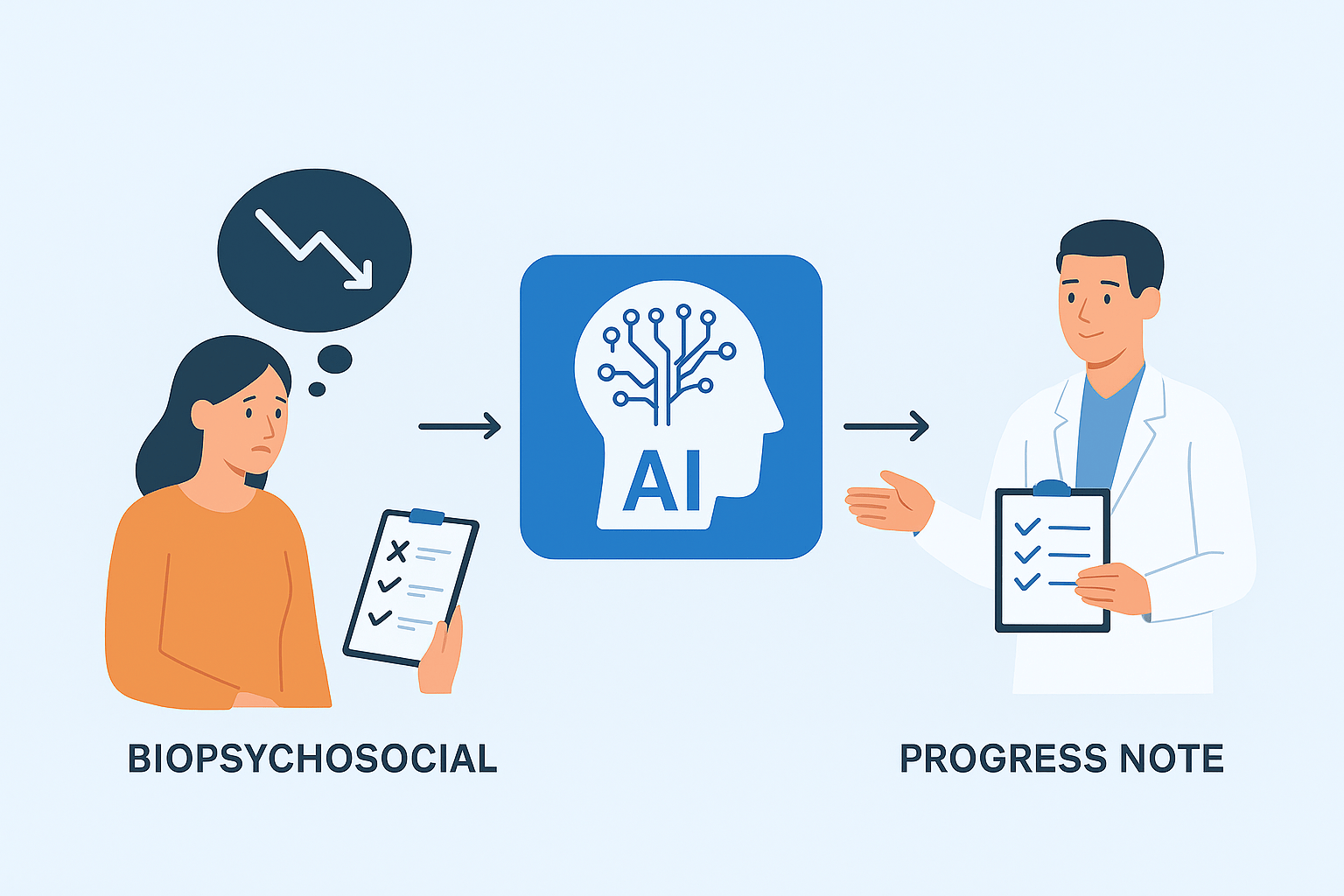
But in 2025, the emergence of AI-driven systems is changing the conversation. What used to be a burden is becoming an automated standard. And this shift is about far more than patient surveys — it’s the beginning of Measurement-Based Services (MBS): a full, end-to-end ecosystem of care powered by intelligent tools.
Let’s break down why MBC has stagnated, and how AI is going to fix it permanently.
-
MBC Has Failed Because It Adds Work — Instead of Removing It
Ask any clinician what gets in the way of MBC and you’ll hear the same answers:
- “I forgot to send the assessments.”
- “Patients don’t complete them.”
- “The scores don’t integrate into my notes.”
- “The EHR doesn’t do anything with the data.”
The truth is simple:
✔ MBC creates work
✘ EHRs don’t automate that work
✘ Billing doesn’t reward the work unless properly documented
✘ Providers don’t have time to manually chase down PHQ-9s and GAD-7s
This turns MBC into a compliance checkbox rather than a real clinical tool.
Legacy EHRs offer MBC as a feature, but not a workflow. That distinction matters.
-
MBC Fails Because Scores Don’t Drive Clinical Decisions
Even when assessments are completed, most systems treat them as data islands.
- The PHQ-9 score sits in one tab.
- The treatment plan sits in another.
- The progress note sits somewhere else entirely.
Nothing connects.
Providers are expected to manually:
- Read the score
- Interpret the change
- Adjust goals
- Update interventions
- Reflect all of that in their clinical note
The cognitive load alone ensures that MBC will never scale manually.
Without automation, MBC is just more paperwork.
-
Billing Doesn’t Align With the Clinical Work Being Done
This is the elephant in the room.
Most practices don’t use MBC because:
- Nobody tells them how to bill for 96127
- They don’t have workflows that document correctly
- They lose money on missed or rejected add-on codes
- The EHR doesn’t push them toward compliant, billable patterns
And yet:
When MBC is done correctly, practices can increase insurance revenue immediately and ethically.
The problem isn’t the clinical model — it’s the infrastructure.
For billing support, see Behavioral & Mental Health Billing Services.
-
AI Turns MBC Into MBS: Measurement-Based Services
This is where the future begins.
AI doesn’t just “score forms.” That’s old news.
AI can now:
- Auto-send assessments before each visit
Based on diagnosis, treatment goals, level of care, or payer requirements. - Auto-interpret the scores
Highlighting risk, change over time, severity thresholds, or clinical deterioration.
- Auto-update the treatment plan
Goals and interventions dynamically shift based on measurable patient response. - Auto-populate the progress note
The AI writes the MBC-aligned section of the note, incorporating PHQ/GAD changes, clinician wording, and new directions in the plan.
- Suggest clinically appropriate codes
Including when to add 96127, when to re-evaluate, and what documentation is required.
This is the foundation of Measurement-Based Services, the next evolution of clinical care.
Instead of assessments floating around in a tab, MBS means: Treatment plans, interventions, notes, billing, authorizations, and payer compliance – all connected to one automated system – this is what DENmaar is building.
Explore related innovations: AI Receptionist for Behavioral Health.
-
AI Fixes What Human Workflow Can’t
AI becomes the “clinical operations layer” that legacy EHRs never built.
It ensures:
- Every patient receives standardized assessments
- Every score is interpreted consistently
- Every note reflects evidence-based practice
- Every billable service is supported
- Every payer requirement is met
- Every clinician keeps their autonomy
AI is not replacing the provider, it is replacing the administrative drag that prevented MBC from ever reaching scale.
-
For Practices, the Impact Is Immediate
- Better Clinical Outcomes
True MBC improves remission rates, reduces crisis events, and improves care continuity. - Faster, Cleaner Billing
When evidence-based documentation is embedded into the workflow, claims become cleaner. (Your 98.1% clean claims rate is a direct reflection of this philosophy.)
- Higher Revenue
The combination of: 96127, documented severity, aligned treatment planning, and accurate coding – translates into 10–20% higher insurance collections for most practices. - Provider Retention
Clinicians stay longer when documentation is simpler and more meaningful. - Scalable Care Models
Group practices can finally standardize care — without endless training or meetings.
-
The Next Frontier: Diagnosis-to-Assessment Mapping
Your newest focus — diagnosis-to-assessment mapping — is where the industry is truly heading.
AI will soon:
- Attach the right assessments to each diagnosis
- Determine when they should recur
- Match severity to interventions
- Update risk stratification automatically
- Feed all of it into treatment plans and progress notes
This is the beginning of AI-powered clinical governance, something no legacy EHR offers.
DENmaar isn’t “adding MBC.”
You’re building the first automated MBS platform designed for real clinical operations.
Conclusion: MBC Didn’t Fail — The Tools Failed It
The vision behind Measurement-Based Care is correct. The execution has been impossible, until now.
AI takes the burden off clinicians, connects the clinical and billing worlds, and turns assessments into actionable, billable, automated workflows.
This is not the future of behavioral health. It’s the present — and DENmaar is building it.
Explore more at www.denmaar.com.
Frequently Asked Questions
1. Why is Measurement-Based Care failing in behavioral health?
MBC fails because practices lack automated workflows, integrated EHR tools, and billing alignment. Without AI, MBC becomes extra work — not better care.
2. How does AI improve Measurement-Based Care?
AI automates assessment delivery, scoring, treatment planning, and documentation, turning MBC into actionable Measurement-Based Services.
3. Can AI support billing for codes like 96127?
Yes. AI can recommend when to bill 96127, generate proper documentation, and align clinical notes with payer requirements.
4. What is Measurement-Based Services (MBS)?
MBS is an AI-powered model where assessments, treatment plans, notes, billing, and authorizations are fully integrated into one automated system.
5. Does DENmaar support automated MBC/MBS workflows?
Yes. DENmaar’s platform integrates AI-driven assessments, treatment planning, billing support, and automated workflows across behavioral health practices.
Our Partners






Ready to get started?
Feel free to reach out if you have any questions.
