

We don’t just submit claims. We create visibility and accountability around every unpaid claim—so management knows what’s being worked, what’s stuck, and why.
Know What’s Happening With Every Unpaid Claim
Behavioral health billing with complete visibility and accountability

98.1%
Clean Claim Rate
1.47%
Rejection Rate
0.32%
Denial Rate
5–10%
Denial Rate
10–20%
Average Revenue
Improvement
$0
EHR Software Fee
With Billing Services
With Billing Services
CLAIMS VISIBILITY
Your Claims May Be Getting
Submitted. But Are They Getting Paid?
Submitting a claim is only the beginning.
Your Claims May Be Getting
Submitted. But Are They Getting Paid?
Revenue is lost when rejected claims aren’t corrected, denials aren’t resolved, authorizations expire, payer requests go unanswered, and unpaid claims disappear into spreadsheets and work queues.
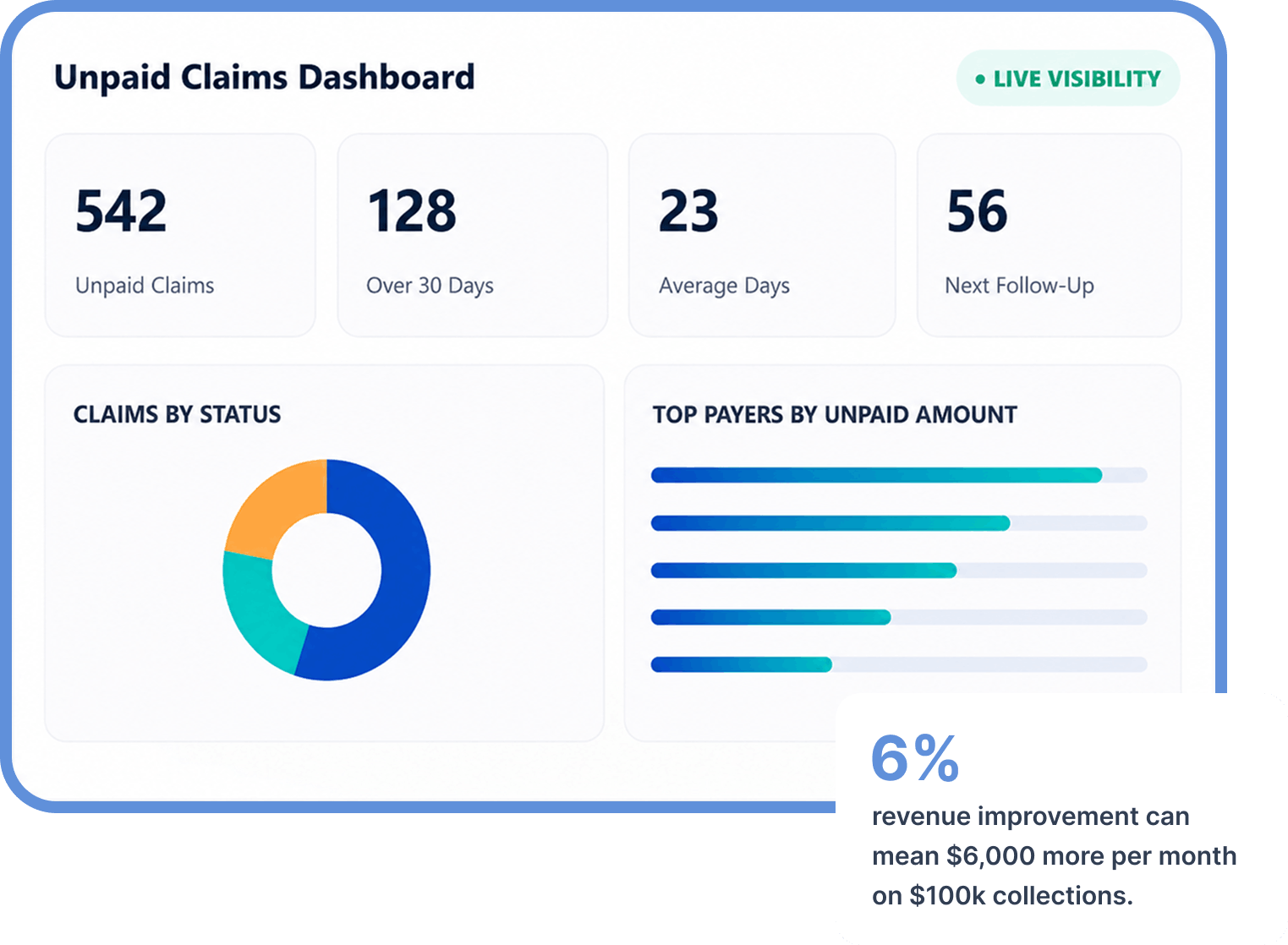
DENmaar gives behavioral health practices a clear view of:
- Which claims remain unpaid
- Why each claim is stuck
- What action has been taken
- Who is responsible for the next step
- When follow-up is due
- What the payer said during the last follow-up
- Which payers and problems are creating the most lost revenue
You no longer have to accept, “We’re working on it.”
You can see exactly what is being worked, what happened and what comes next.
The Improvement in Claims Can Pay for DENmaar
any practices are already losing more money through preventable claim problems than they would spend fixing them.
For a practice collecting $100,000 per month
6% = +$6,000 / month
in realized insurance revenue
That improvement alone could offset the cost of DENmaar’s billing services.
- Behavioral health EHR software at no additional cost
- Claims Copilot
- Eligibility and insurance workflows
- Payment posting
- Rejection and denial management
- Aging-claim follow-up
- Reporting and management visibility
- Support from DENmaar’s Insurance Knowledge Team
Claim Lifecycle
Every Claim Has an Owner, a Status
and a Next Action
DENmaar creates a structured process for managing the entire claim lifecycle—from appointment readiness
through final payment.
01
Prevent Problems Before Submission
Eligibility, payer, authorization, credentialing and documentation issues are identified before they become rejected or denied claims.
02
Submit Clean Claims
Claims are reviewed for common errors and payer requirements before submission.
03
Monitor the Payer Lifecycle
Claims are tracked after submission so unresolved claims don’t quietly disappear into aging.
04
Assign the Next Action
Every problem claim has a clear status, responsible team member and required next step.
05
Document Every Follow-Up
Management can see when follow-up occurred, what the payer said and what must happen next.
06
Escalate Unresolved Claims
Claims receive additional attention before filing limits or appeal deadlines are missed.
07
Measure Performance
Monitor clean claims, rejections, denials and aging by payer, provider, location, service and responsible team member.
Management Visibility
Your Billing Operation Shouldn’t Be a
Black Box
Monthly reports tell you what has already happened. DENmaar provides visibility into
what is happening now.
Visibility creates accountability.
A practice should not have to wait until collections fall to discover that claims aren’t being worked effectively.
- Whether claims are being worked consistently
- Whether follow-up is producing results
- Why claims remain unpaid
- Whether the same errors keep recurring
- Where responsibility for the next action sits
- Which workflows or team members need support
- Which payers are causing the most problems
- How much revenue remains at risk
Visibility creates accountability.
Accountability creates action.
Action moves claims toward payment.
Improve the Team You Have—or Let DENmaar Manage the Process
Some practices already have an internal billing team but lack the technology, payer knowledge and management visibility required to oversee it. Others want an experienced partner to manage the entire revenue cycle.
OPTION 01
Claims Copilot for Your Existing Team
Give your billing staff the structured workflows, claim intelligence and accountability tools needed to manage unpaid claims more effectively. Management gains visibility without immediately replacing the internal team.
OPTION 02
Full Revenue Cycle Management
Let DENmaar manage claim creation and submission, rejection correction, payment posting, denial resolution, insurance follow-up, aging claims, payer escalation, patient balances and revenue-cycle reporting.
Either way, management gains control over the revenue cycle.
Behavioral Health Expertise
Built Specifically for Behavioral Health
Behavioral health billing requires more than generic claim submission.
Mental health therapy
Psychiatry and medication management
Substance-use treatment
Intensive outpatient and partial hospitalization programs
Community behavioral health
Multidisciplinary practices
Telehealth billing
Time and unit requirements
Rejections and denials
Built Specifically for Behavioral Health
- Behavioral health payer carve-outs
- Eligibility and benefit verification
- Prior authorizations
- Provider credentialing
- Therapy and psychiatric coding
- Same-day services
- Telehealth billing
- Missing or incomplete documentation
- Coordination of benefits
- Rejections and denials
- Aging insurance balances
Before Billing Begins
Problems Are Often Created Before Billing Begins
Many claim problems originate before the claim reaches the billing team.
An appointment may be scheduled with the wrong payer. Eligibility may not be verified. An authorization may be missing. Documentation may not support the code or units billed. A provider may not be enrolled correctly.
DENmaar connects scheduling, eligibility, authorizations, documentation and billing in one operational system.
This helps prevent bad claims—not merely work them after they fail.
Prevent the problem upstream.
01
Scheduling
Right payer • right workflow
02
Eligibility & Authorization
Verify before service
03
Documentation
Support code and units
03
Billing
Submit cleaner claims
More Than Billing
Technology, Insurance Expertise and
Human Follow-Through
Most billing companies provide reports. Most software companies provide tools. DENmaar combines:
Technology, Insurance Expertise and
Human Follow-Through
You get a system designed to improve the financial performance of your behavioral health practice.
Enterprise capability with small-practice simplicity.
- Behavioral health EHR technology
- Claims Copilot
- Revenue-cycle services
- Insurance knowledge
- Human payer follow-up
- Management visibility
- Operational accountability
Billing Review
See What Better Claims Performance Could Mean for Your Practice
If too many claims are rejected, denied, aging or simply unexplained, let’s look at the process together.
Current monthly insurance revenue
Baseline performance
Clean-claim rate
Rejection and denial rates
Claims over 30 days
Value of unpaid and aging claims
Follow-up process
Where accountability is breaking down
Let’s Determine Whether There Is Operational Alignment
We begin with a discussion focused on:
- Organizational structure
- Insurance workflows
- Operational goals
- Implementation fit
Request Information
Capterra, Software Advice And Get App 2023 / 25
Best Of Badges Awarded To DENmaar
2023 / 25 “Best of” badge winners = DENmaar Neuro has earned a well-deserved Best Value Badge.
See our reviews for our software being recognized as an impactful solution for your business.





Our Latest Blogs

The Future of Treatment Planning: How DENmaar’s AI Connects Intake, Progress, and Outcomes
In behavioral healthcare, one of the greatest inefficiencies happens in the gap between a patient’s intake, their treatment plan, and the progress notes that follow. Every provider knows that consistency, documentation accuracy, and clinical compliance are critical — yet many systems silo these steps, forcing clinicians to repeat data entry and lose valuable clinical context along the way.
At DENmaar, we’re changing that with AI-powered treatment planning software designed for behavioral health professionals.
Building Intelligence Into the Golden Thread
Our upcoming AI-driven treatment planning engine bridges the full “Golden Thread” of care — from the initial biopsychosocial assessment to the treatment plan and each progress note thereafter.
When a new patient is onboarded, clinicians or intake staff complete a biopsychosocial that captures the person’s history, risk factors, strengths, and presenting issues.
DENmaar’s AI for behavioral health then translates that information into a clinically structured treatment plan — automatically generating goals, objectives, and interventions tailored to the diagnosis and patient narrative.
Each subsequent progress note intelligently references those treatment goals, allowing providers to document progress with precision while maintaining CMS and insurance compliance.
How AI Treatment Planning Works
1. Intake: From Data to Structure
A patient’s biopsychosocial becomes structured data — not static text. The AI parses key domains such as presenting problems, history, strengths, and risks.
2. Treatment Plan Creation
DENmaar’s AI-powered treatment planning software suggests SMART goals, measurable objectives, and evidence-based interventions that clinicians can review and approve. No more writing plans from scratch — only refining and personalizing them.
3. Progress Note Integration
When writing notes, the system automatically surfaces relevant treatment objectives, MBC scores (like PHQ-9 or GAD-7), and goal progress. Providers can document with full context, reducing note time by over 50%.
Explore how our AI clinical notes system links treatment plans to documentation and supports audit-ready compliance.
4. Continuous Learning & Insights
As more data accumulates, the AI becomes smarter — recommending updated interventions, flagging stalled progress, and syncing insights directly with outcome tracking dashboards.
Rolling Out Across Therapy, Psychiatry, and SUD
We’re implementing this technology in phases to ensure clinical precision and behavioral health compliance:
- Therapy: Automating plan-to-note linkage and embedding Measurement-Based Care (MBC) outcomes tracking.
- Psychiatry: Expanding to include medication management, mental status exams, and outcome correlation.
- Substance Use Disorder (SUD): Integrating ASAM dimensions, relapse-prevention metrics, and group-session analytics.
Each phase builds on the previous one, creating a unified ecosystem that supports multi-provider behavioral health practices from intake to billing.
Check out how DENmaar’s full range of practice management and EHR solutions span intake, billing, documentation and beyond.
Why AI-Driven Treatment Planning Matters
This innovation isn’t just about efficiency — it’s about better patient care.
When clinicians spend less time typing and more time understanding, patients benefit. And when treatment plans are directly tied to measurable outcomes, payers and providers finally share the same language of progress.
At DENmaar, our mission is to create a behavioral health platform where clinical documentation, billing, and AI intelligence work in harmony.
See how our AI-enhanced progress notes help therapists capture and report outcomes with precision and speed.
The result: a faster, smarter, and more connected path to patient success.

A “Game Changer” in Clinical Documentation: How AI Notes Are Saving Time and Elevating Compliance
When behavioral health practices describe a tool as a “game changer,” it’s not because of hype — it’s because it changes their daily reality.
That’s exactly what we’ve heard from teams using DENmaar’s Structured Progress Note 3.0 (AI version).
“The note is very sophisticated and references the objectives. We’ve gotten very positive feedback. It’s been described as a game changer and is working very well.”
— Dr. Erin Jenkins Baker, Licensed Psychologist, HSPP, Auxilium Psychological Services
AI That Understands the Clinical Flow
Denmaar AI note doesn’t just generate text — it mirrors how clinicians actually think and document:
- Structured to CMS guidelines: The note follows a logical, CMS-compliant progression of Assessment → Intervention → Progress → Plan, incorporating required medical necessity and measurable objectives.
- Objective-referenced narrative: Each section dynamically references active treatment objectives, ensuring continuity and compliance with supervision and audit standards.
Time-coded alignment: The AI calculates and aligns documentation with CPT-based service parameters, eliminating common audit risks.
The result: notes that are clinically valid, auditor-friendly, and take a fraction of the time.
Explore how our AI-powered EHR software supports compliant, audit-ready documentation.
Saving Hours, Protecting Compliance
Clinicians spend an average of 25–35% of their week on documentation. With AI-driven notes, that time drops by more than half — while accuracy and compliance go up.
DENmaar AI Notes are trained to:
- Recognize clinically relevant interventions based on the session’s type and goals
- Flag missing or inconsistent data points (e.g., objective not referenced, plan not updated)
- Auto-populate recurring patient details while prompting for unique updates required by CMS and payer audits
- Maintain audit-ready structure without sacrificing clinical voice
This means clinicians can sign off faster — and confidently.
CMS Compliance Built In
Unlike generic AI tools, DENmaar’s documentation engine is rooted in CMS compliance standards for medical necessity, continuity of care, and measurable progress.
Each note includes:
- Objective alignment: Ensuring interventions tie directly to measurable goals
- Medical necessity justification: Automatically summarized in context
- Plan progression tracking: Carrying forward treatment adjustments per CMS’s “ongoing care” expectation
- Supervision-ready structure: Supporting licensed oversight and trainee review requirements
These are the same standards that protect clinicians during audits and sustain payer confidence — without extra effort.
See how DENmaar’s credentialing and billing services help ensure end-to-end compliance.
The New Standard of Throughput
For a growing practice, compliance and efficiency are not opposites. They’re the same goal.
The AI note is not replacing clinicians — it’s removing friction:
- Less typing, more clinical judgment
- Less time explaining compliance, more time delivering care
- Less rework, more revenue through clean documentation
Building Toward $100M in Annual Revenue
Every automation at DENmaar ties back to one mission:
To make behavioral health self-sustaining through intelligent systems that eliminate waste.
AI documentation is one of the most powerful levers toward that future — saving hours per clinician, improving compliance confidence, and accelerating revenue flow.
That’s how we’ll reach $100M:
Not by selling software, but by engineering systems that multiply provider time and compliance integrity.
Conclusion: The Future of Documentation in Behavioral Health
With AI-powered clinical documentation, measurement-based care, and EHR automation, compliance becomes effortless — and productivity thrives.
DENmaar continues to set the standard for mental health EHR software, helping clinicians focus on what matters most: better outcomes and sustainable practice growth.

Clinical Documentation Compliance in Behavioral Health
The New Compliance Reality
In behavioral health, clinical documentation has always been the backbone of care, but today, it’s also the backbone of insurance compliance.
Payers are tightening audit criteria, requiring EHR documentation that clearly demonstrates medical necessity, progress toward measurable treatment goals, and evidence of ongoing outcome assessment.
For many mental health practices, that means treatment plans and progress notes can no longer be purely narrative, they must tie directly into quantifiable, data-driven outcomes supported by measurement-based care (MBC).
1. The Shift: From Clinical to Clinically Compliant
During a recent discussion with a partner clinic, the conversation turned toward treatment plan design and how it must now align with insurance compliance requirements.
The reality is:
- Insurers want clear, quantifiable goals.
- They want evidence of progress toward those goals.
- And they want it in a consistent, audit-ready format.
That’s where many EHR software systems fail — they are designed for data storage, not data compliance.
The need now is for behavioral health documentation software that integrates measurement-based care, turning every note into a compliance-ready record.
2. Where Measurement-Based Care (MBC) Changes Everything
Measurement-Based Care (MBC) brings structure and defensibility to clinical documentation.
When you connect outcome measures (like PHQ-9, GAD-7, ASRS, etc.) directly to the treatment plan, every progress note and goal update becomes measurable, defensible, and audit-ready.
This transforms compliance from an afterthought into a built-in system:
- Assessments inform treatment goals.
- Treatment goals flow into progress notes.
- Notes link directly to payer-recognised outcomes through your mental health EHR software.
With MBC, documentation does not just prove care was delivered; it proves care was effective. It is the foundation of data-driven behavioral health practice management.
3. The AI Advantage: Audit-Ready Without the Burden
At DENmaar, we’re extending Measurement-Based Care into AI-powered clinical documentation to make compliance seamless and efficient:
- AI-assisted treatment planners that recommend measurable objectives based on diagnosis and level of care.
- Automated progress note generation that ties interventions and outcomes to those objectives.
- Real-time compliance alerts that flag missing or outdated assessments before audits do.
The result: clinicians can document faster, stay insurance-compliant, and focus on patient care — not paperwork.
Our mental health practice management software blends AI, MBC, and compliance tools to keep practices efficient and audit-ready by default.
Why This Matters for Practice Growth
Practices that master documentation compliance are not just avoiding denials, they are building credibility with payers and scalability in operations.
Insurance-compliant documentation reduces rework, protects revenue, and strengthens trust that accelerates credentialing and reimbursement cycles.
MBC-driven compliance is no longer optional, it is the new framework for sustainable practice management in behavioral health.
Conclusion: Turning Compliance Into Confidence
The best systems do not just collect data — they use it to prove clinical and financial integrity.
At DENmaar, we’re aligning Measurement-Based Care (MBC), AI automation, and EHR documentation design to make every treatment plan and note insurance-compliant by default — not by extra effort.
With DENmaar’s mental health EHR software, compliance becomes confidence, and every documentation step becomes a driver of growth.
Our Partners






Ready to get started?
Feel free to reach out if you have any questions.
