

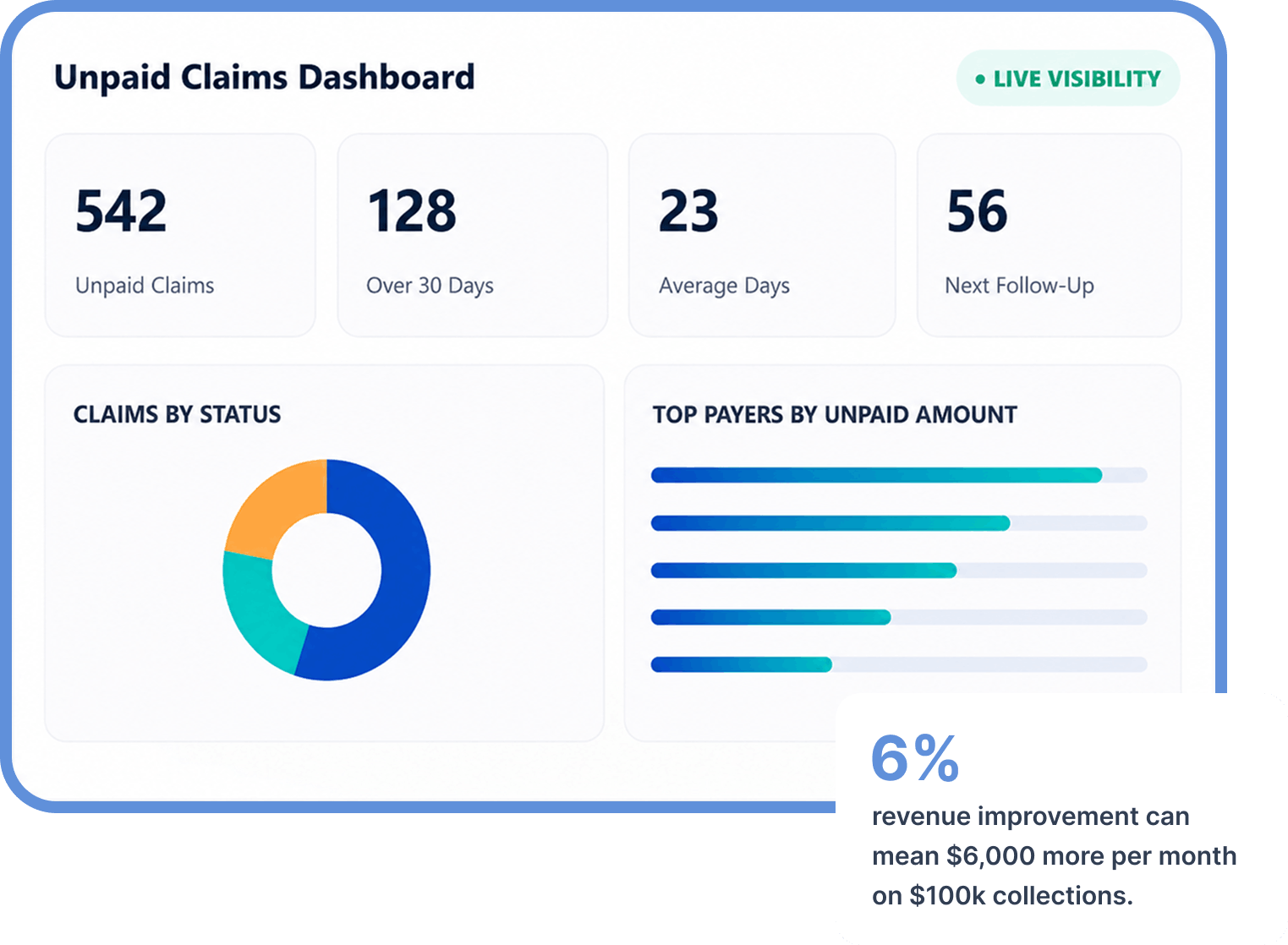
We don’t just submit claims. We create visibility and accountability around every unpaid claim—so management knows what’s being worked, what’s stuck, and why.
Know What’s Happening With Every Unpaid Claim
Behavioral health billing with complete visibility and accountability

98.1%
Clean Claim Rate
1.47%
Rejection Rate
0.32%
Denial Rate
5–10%
Denial Rate
10–20%
Average Revenue
Improvement
$0
EHR Software Fee
With Billing Services
With Billing Services
CLAIMS VISIBILITY
Your Claims May Be Getting
Submitted. But Are They Getting Paid?
Submitting a claim is only the beginning.
Your Claims May Be Getting
Submitted. But Are They Getting Paid?
Revenue is lost when rejected claims aren’t corrected, denials aren’t resolved, authorizations expire, payer requests go unanswered, and unpaid claims disappear into spreadsheets and work queues.
DENmaar gives behavioral health practices a clear view of:
- Which claims remain unpaid
- Why each claim is stuck
- What action has been taken
- Who is responsible for the next step
- When follow-up is due
- What the payer said during the last follow-up
- Which payers and problems are creating the most lost revenue
You no longer have to accept, “We’re working on it.”
You can see exactly what is being worked, what happened and what comes next.
The Improvement in Claims Can Pay for DENmaar
any practices are already losing more money through preventable claim problems than they would spend fixing them.
For a practice collecting $100,000 per month
6% = +$6,000 / month
in realized insurance revenue
That improvement alone could offset the cost of DENmaar’s billing services.
- Behavioral health EHR software at no additional cost
- Claims Copilot
- Eligibility and insurance workflows
- Payment posting
- Rejection and denial management
- Aging-claim follow-up
- Reporting and management visibility
- Support from DENmaar’s Insurance Knowledge Team
Claim Lifecycle
Every Claim Has an Owner, a Status
and a Next Action
DENmaar creates a structured process for managing the entire claim lifecycle—from appointment readiness
through final payment.
01
Prevent Problems Before Submission
Eligibility, payer, authorization, credentialing and documentation issues are identified before they become rejected or denied claims.
02
Submit Clean Claims
Claims are reviewed for common errors and payer requirements before submission.
03
Monitor the Payer Lifecycle
Claims are tracked after submission so unresolved claims don’t quietly disappear into aging.
04
Assign the Next Action
Every problem claim has a clear status, responsible team member and required next step.
05
Document Every Follow-Up
Management can see when follow-up occurred, what the payer said and what must happen next.
06
Escalate Unresolved Claims
Claims receive additional attention before filing limits or appeal deadlines are missed.
07
Measure Performance
Monitor clean claims, rejections, denials and aging by payer, provider, location, service and responsible team member.
Management Visibility
Your Billing Operation Shouldn’t Be a
Black Box
Monthly reports tell you what has already happened. DENmaar provides visibility into
what is happening now.
Visibility creates accountability.
A practice should not have to wait until collections fall to discover that claims aren’t being worked effectively.
- Whether claims are being worked consistently
- Whether follow-up is producing results
- Why claims remain unpaid
- Whether the same errors keep recurring
- Where responsibility for the next action sits
- Which workflows or team members need support
- Which payers are causing the most problems
- How much revenue remains at risk
Visibility creates accountability.
Accountability creates action.
Action moves claims toward payment.
Improve the Team You Have—or Let DENmaar Manage the Process
Some practices already have an internal billing team but lack the technology, payer knowledge and management visibility required to oversee it. Others want an experienced partner to manage the entire revenue cycle.
OPTION 01
Claims Copilot for Your Existing Team
Give your billing staff the structured workflows, claim intelligence and accountability tools needed to manage unpaid claims more effectively. Management gains visibility without immediately replacing the internal team.
OPTION 02
Full Revenue Cycle Management
Let DENmaar manage claim creation and submission, rejection correction, payment posting, denial resolution, insurance follow-up, aging claims, payer escalation, patient balances and revenue-cycle reporting.
Either way, management gains control over the revenue cycle.
Behavioral Health Expertise
Built Specifically for Behavioral Health
Behavioral health billing requires more than generic claim submission.
Mental health therapy
Psychiatry and medication management
Substance-use treatment
Intensive outpatient and partial hospitalization programs
Community behavioral health
Multidisciplinary practices
Telehealth billing
Time and unit requirements
Rejections and denials
Built Specifically for Behavioral Health
- Behavioral health payer carve-outs
- Eligibility and benefit verification
- Prior authorizations
- Provider credentialing
- Therapy and psychiatric coding
- Same-day services
- Telehealth billing
- Missing or incomplete documentation
- Coordination of benefits
- Rejections and denials
- Aging insurance balances
Before Billing Begins
Problems Are Often Created Before Billing Begins
Many claim problems originate before the claim reaches the billing team.
An appointment may be scheduled with the wrong payer. Eligibility may not be verified. An authorization may be missing. Documentation may not support the code or units billed. A provider may not be enrolled correctly.
DENmaar connects scheduling, eligibility, authorizations, documentation and billing in one operational system.
This helps prevent bad claims—not merely work them after they fail.
Prevent the problem upstream.
01
Scheduling
Right payer • right workflow
02
Eligibility & Authorization
Verify before service
03
Documentation
Support code and units
03
Billing
Submit cleaner claims
More Than Billing
Technology, Insurance Expertise and
Human Follow-Through
Most billing companies provide reports. Most software companies provide tools. DENmaar combines:
Technology, Insurance Expertise and
Human Follow-Through
You get a system designed to improve the financial performance of your behavioral health practice.
Enterprise capability with small-practice simplicity.
- Behavioral health EHR technology
- Claims Copilot
- Revenue-cycle services
- Insurance knowledge
- Human payer follow-up
- Management visibility
- Operational accountability
Billing Review
See What Better Claims Performance Could Mean for Your Practice
If too many claims are rejected, denied, aging or simply unexplained, let’s look at the process together.
Current monthly insurance revenue
Baseline performance
Clean-claim rate
Rejection and denial rates
Claims over 30 days
Value of unpaid and aging claims
Follow-up process
Where accountability is breaking down
Let’s Determine Whether There Is Operational Alignment
We begin with a discussion focused on:
- Organizational structure
- Insurance workflows
- Operational goals
- Implementation fit
Request Information
Capterra, Software Advice And Get App 2023 / 25
Best Of Badges Awarded To DENmaar
2023 / 25 “Best of” badge winners = DENmaar Neuro has earned a well-deserved Best Value Badge.
See our reviews for our software being recognized as an impactful solution for your business.





Our Latest Blogs
Why Most Behavioral Health Practices Don’t Have a Billing Problem They Have a Claims Communication Problem
Behavioral Health Revenue Cycle Management Requires Better Claims Communication
Behavioral health leaders often assume their revenue challenges come down to billing performance:
“Our billing team isn’t following up enough.”
“We need better denial management.”
“A/R is creeping up—we need more staff.”
Those assumptions feel logical. They’re also usually wrong.
What most practices actually have is a claims communication problem—and until that’s addressed, no amount of staffing, outsourcing, or software switching will consistently fix revenue.
The Illusion of Billing Issues
On the surface, the symptoms point to billing:
- Denials increasing
- Claims sitting unresolved
- Cash flow lagging
So the response becomes:
- Add more follow-up
- Send more emails
- Hire more billers
But step inside the workflow, and a different pattern emerges.
- A denial comes in.
- Someone interprets it.
- A message gets sent.
- The practice is unsure what to do.
- Time passes.
- The claim stalls.
The issue isn’t effort—it’s translation.
The Real Bottleneck: Fragmented Communication
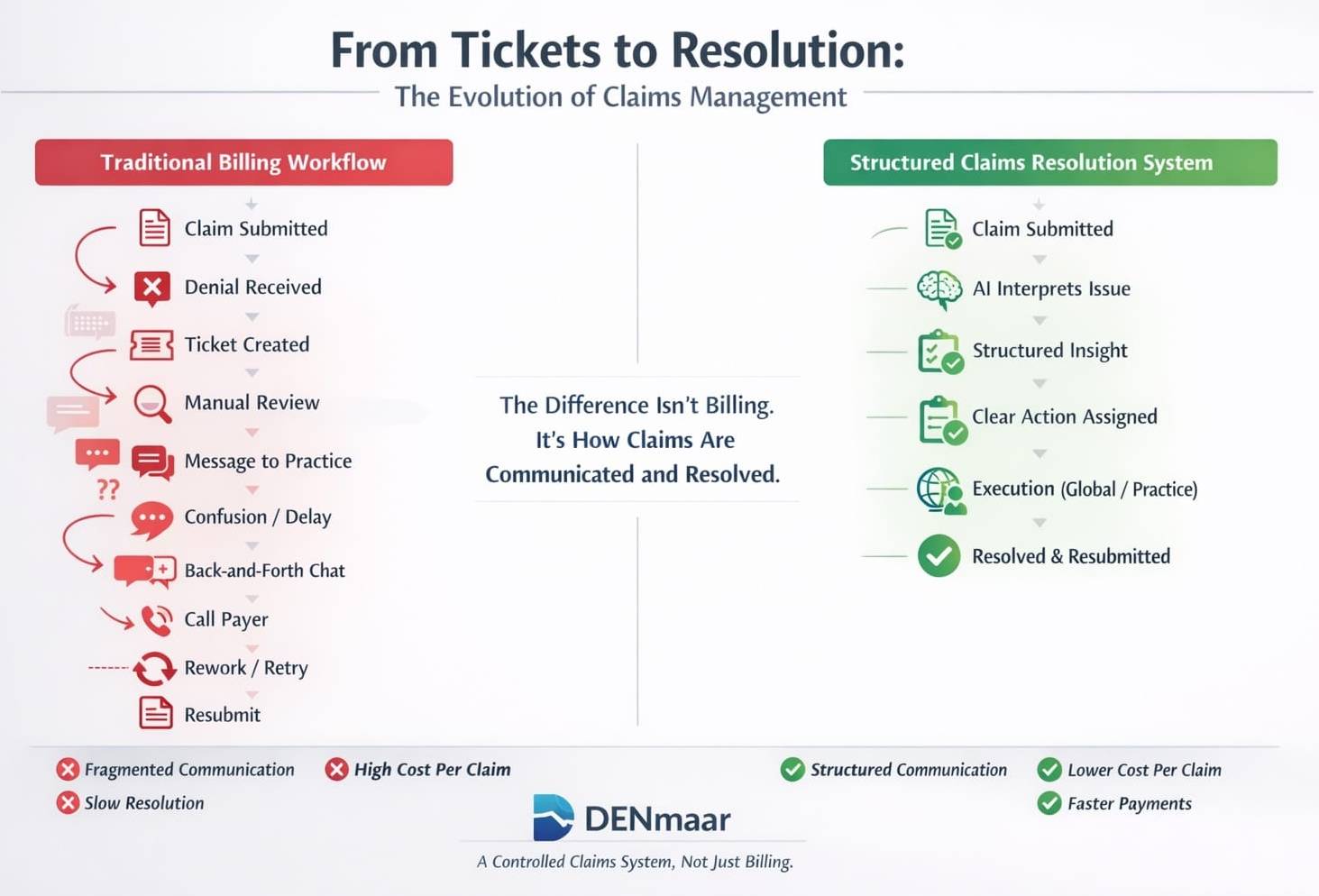
In most systems today, the claims lifecycle looks like this:
- Claim is submitted
- Denial or issue is returned
- A ticket is created
- A team member reviews it
- A message is sent to the practice
- The practice tries to interpret and respond
At each step, context is lost.
A denial code might say one thing—but the actual issue is something else entirely:
- A COB denial that’s really an eligibility sequencing issue
- An authorization denial that should have been caught pre-submission
- A request to “verify insurance” with no explanation of why
So the practice delays, asks questions, or takes the wrong action.
Meanwhile, the claim sits.
Claims don’t stall because they’re complex.
They stall because no one translates them into clear, actionable steps.
The Hidden Cost of Chat and Tickets
Most organizations rely on some combination of:
- Slack or Teams
- Ticketing systems
These tools create the appearance of activity—but they introduce significant inefficiencies:
- Multiple back-and-forth messages per claim
- Repeated explanations of the same issue
- Offshore teams calling payers without full context
- Senior staff acting as translators instead of operators
The result:
- Higher cost per claim
- Slower resolution times
- Increased write-offs
- Frustration across teams
This is where revenue quietly leaks—not from lack of effort, but from lack of structure.
What High-Performance Claims Systems Actually Do
High-performing revenue cycle operations don’t rely on more communication.
They rely on better-structured communication.
That means:
- Every claim has a clear status
- Every issue has a defined root cause
- Every action is explicitly guided
- Every team member sees the same information
Instead of asking:
“What should we do with this claim?”
The system answers:
“Here’s the issue. Here’s why it happened. Here’s the next step.”
From Tickets to Resolution Systems
Consider the difference:
Traditional Ticket
“Please verify insurance.”
Structured Claims Communication
“Secondary insurance detected. Primary payer likely changed.
Action: Contact patient to confirm active plan and update payer sequence before resubmission.”
One creates confusion.
The other drives resolution.
This shift—from vague tickets to structured, claim-specific guidance—is where performance changes.
Where AI Actually Fits in Behavioral Health Billing
There’s a lot of noise around AI in healthcare right now. Most of it misses the point.
AI is not valuable because it replaces people.
It’s valuable because it standardizes interpretation and accelerates decision-making.
In the claims lifecycle, that means:
- Translating denial codes into real-world causes
- Identifying patterns across payer behavior
- Recommending next steps based on historical outcomes
- Reducing unnecessary payer calls
AI becomes the interpreter and guide, not the operator.
Learn how this works in AI behavioral health billing and clean claims systems.
Why This Breaks at Scale
At low volume, teams can “manage through it.”
At higher volume, the cracks widen:
- 500 claims/month → manageable
- 5,000+ claims/month → breakdown
More claims mean:
- More variability
- More payer nuance
- More communication points
Without a structured system, complexity compounds—and revenue suffers.
What works for a small practice doesn’t scale to a growing group.
The Shift: From Billing to Controlled Claims Systems
The most important shift isn’t hiring more staff or switching vendors.
It’s moving from:
Reactive billing workflows
To:
Controlled claims systems with embedded communication logic
At DENmaar, that’s been the focus:
Not just submitting claims—but controlling the entire lifecycle:
From scheduling
To documentation
To claim generation
To post-submission resolution
With structured communication and embedded intelligence at every step.
This includes:
- Behavioral health EHR software
- Mental health billing services
- Claims hygiene workflows
- AI progress notes for behavioral health
- AI front door patient intake systems
Final Thought
If your team is spending more time explaining claims than resolving them,
you don’t have a staffing issue.
You have a system issue.
And fixing that changes everything:
- Faster payments
- Lower cost per claim
- Less friction across teams
- Stronger, more predictable revenue
That’s where the real leverage is.
Frequently Asked Questions
What is a claims communication problem in behavioral health billing?
A claims communication problem happens when denials, payer issues, and claim tasks are poorly explained across teams, causing delays and lost revenue.
How can behavioral health practices reduce claim delays?
Practices can reduce delays by using structured claims workflows, AI-driven billing intelligence, and integrated revenue cycle management systems.
Does AI replace billing teams?
No. AI improves billing team efficiency by translating denial codes, prioritizing actions, and reducing repetitive manual tasks.
Why do claims problems increase as practices grow?
As claim volume rises, payer complexity, denial volume, and communication bottlenecks increase. Manual systems do not scale efficiently.
What helps improve clean claims rates?
Integrated EHR systems, claims hygiene, payer rule validation, structured documentation, and proactive billing workflows all improve clean claims rates.
Why Behavioral Health Practices Don’t Need an AI Receptionist Anymore
A Better Front Door for Behavioral Health Revenue Cycle Management
Behavioral health organizations have been trying to solve access with the wrong tools.
AI receptionists.
Chatbots.
Call routing systems.
All attempting to replicate a front desk—just with automation.
But here’s the issue:
The problem was never the front desk. It was the model.
The Old Model: Wait for the Patient to Call
Traditional systems assume:
- A patient calls or submits a form
- Staff responds
- Intake is scheduled
- Care begins
AI receptionists simply try to make that process faster.
But they don’t fix the core issue:
Many patients never call in the first place.
The Shift: Patients Enter Care Differently Now
Modern behavioral health demand looks different:
- Patients want privacy
- They explore care before committing
- They engage digitally first
- They decide later whether to identify themselves
This is where platforms like Anonymous Health change the equation.
They don’t wait for the patient to call.
They meet the patient earlier—when they’re still deciding.
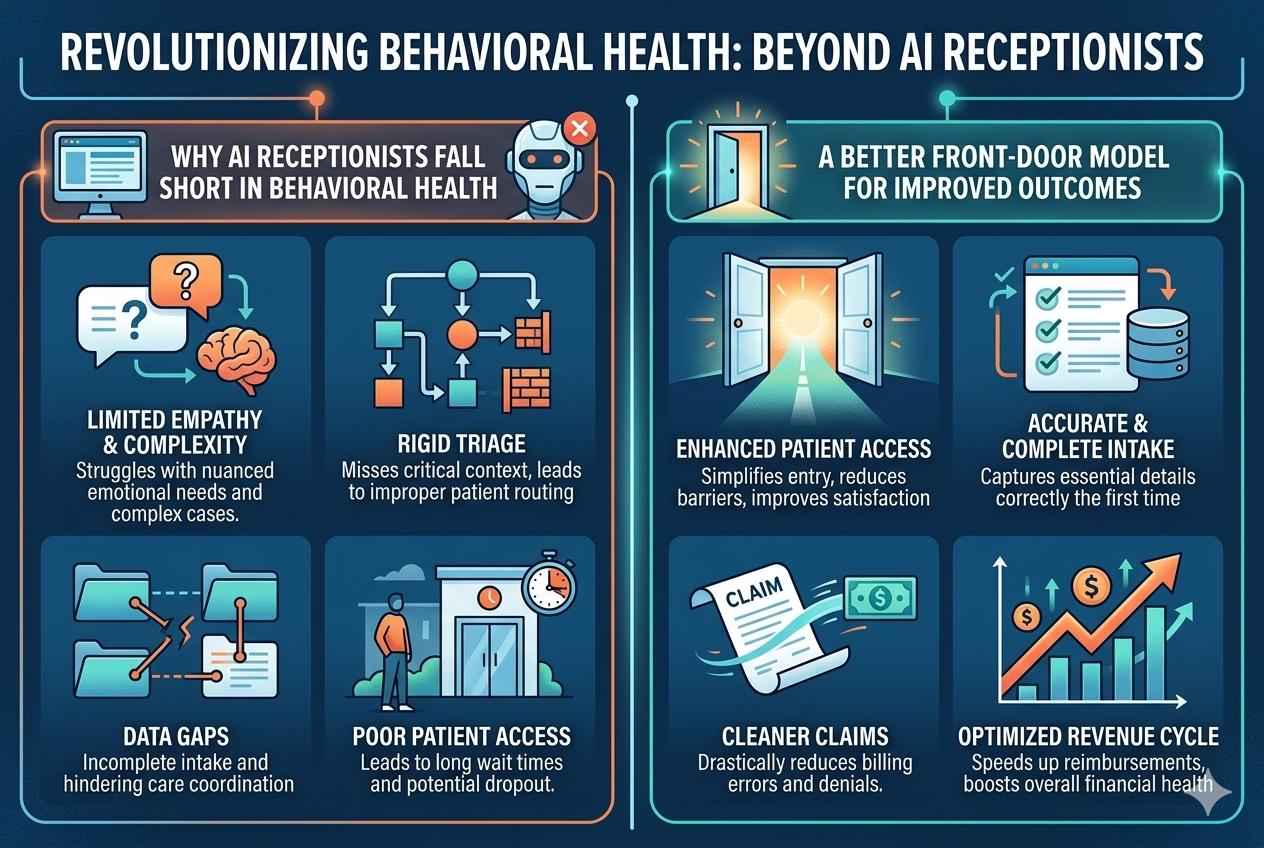
Why AI Receptionists Fall Short in Behavioral Health
AI receptionist platforms still depend on:
- A triggered interaction (call, chat, form)
- A known patient identity
- A defined intake path
They operate inside the old funnel.
So even if optimized, they only improve:
What’s already happening—not what’s missing
The Real Gap: Anonymous Demand to Structured Care
There is a growing layer of demand that never reaches your system:
- Patients browsing silently
- Patients unsure about treatment
- Patients unwilling to identify yet
If your system can’t capture that:
- It never becomes a scheduled visit
- It never becomes a documented session
- It never becomes a claim
A Different Approach: Digital Engagement as the Front Door
At DENmaar, we’ve taken a different approach.
Instead of replacing front desk workflows, we rethink the entry point.
By working with technology partners like Anonymous Health, practices can:
- Capture patient engagement earlier
- Allow anonymous exploration
- Build trust before intake
This is not about automation.
It’s about access transformation.
From Engagement to Revenue: Where Most Systems Break
Most platforms stop at engagement.
They don’t answer:
- How does this patient get scheduled?
- How is care documented?
- How does this become a clean claim?
This is where fragmentation happens.
The DENmaar Model: Close the Loop
DENmaar is designed to connect the entire process through an integrated behavioral health EHR and mental health billing services:
- Digital engagement (including anonymous entry)
- Structured intake → schedulable patient
- AI-supported documentation using AI progress notes
- Claim generation → submission → follow-up powered by AI in behavioral health billing
Every step is tied to revenue.
This model also integrates upstream validation through claims hygiene in behavioral health billing, ensuring clean claims and reducing denials.
Additionally, intake intelligence powered by an AI insurance card reader ensures accurate payer routing and Medicaid billing alignment from the start.
Explore the full system at DENmaar.
What This Replaces
When implemented correctly, this model replaces:
- AI receptionist platforms
- Intake coordination tools
- Disconnected patient engagement systems
Because instead of patching the front desk, you now have:
A system that converts demand directly into billable care
Why This Matters for Growing Practices
For multi-provider behavioral health groups, this shift drives:
- Faster time to first claim
- Higher conversion rates
- Increased provider utilization
- More predictable revenue growth
Who This Is Designed For
This approach is built for practices that are:
- Scaling to multiple providers
- Managing insurance-based revenue
- Looking to grow efficiently—not just add tools
It is not designed for:
- Solo-only providers
- Low-volume, self-pay-only models
Final Thought
AI receptionists try to optimize the front desk.
But behavioral health doesn’t need a better front desk.
It needs a better front door.
And once that door is open, it needs a system that can turn engagement into revenue.
That’s where the real advantage is.
Frequently Asked Questions
Do behavioral health practices need AI receptionists?
Not necessarily. AI receptionists improve response time, but they do not capture anonymous demand or solve upstream revenue cycle issues.
What is the better alternative to AI receptionists?
A digital front-door model that captures early patient engagement and connects it to scheduling, documentation, and billing workflows.
How does this impact behavioral health revenue cycle management?
By connecting engagement to claims, practices improve clean claim rates, reduce denials, and increase revenue without adding more patients.
How does AI help in behavioral health billing?
AI supports claims hygiene, payer routing, documentation accuracy, and pre-submission validation to ensure claims are clean and payable.
Why is early patient engagement important in mental health services?
Because many patients explore care anonymously first. Capturing that stage increases conversion into billable services.
AI Insurance Card Intelligence in Behavioral Health Billing and Revenue Cycle Management
Behavioral health revenue doesn’t break at claim submission. It breaks at intake.
The insurance ID card is the first point of truth in the revenue cycle, yet most systems treat it as a passive data entry step. In reality, this single artifact contains the routing logic that determines whether a claim gets paid or rejected.
For behavioral health practices, especially those operating across therapy, psychiatry, SUD, and higher levels of care, the complexity increases due to mental health carve-outs. These carve-outs separate behavioral health benefits from medical coverage, often assigning them to entirely different payers.
If that distinction is not identified at intake, the downstream impact is immediate: claims are sent to the wrong payer, rejected, corrected, and resubmitted, delaying revenue and increasing administrative burden.
DENmaar approaches this differently by treating the ID card as a structured data source and a decision engine for payer routing.
Practices using modern behavioral health EHR systems and integrated behavioral health billing services increasingly rely on intelligent intake infrastructure to ensure payer accuracy before claims ever reach the clearinghouse.
Learn more about how preventative claims infrastructure for behavioral health billing improves revenue cycle outcomes.
The Core Problem Mental Health Carve Outs Disrupt Standard Billing Logic
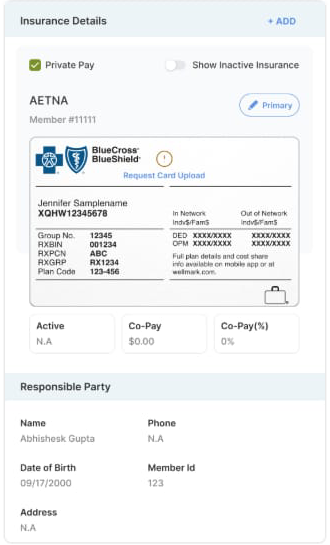
Traditional EHR systems capture insurance data in flat fields: payer name, member ID, and group number. This approach assumes that the payer listed on the card is the correct destination for all services.
In behavioral health, that assumption is frequently wrong.
A single insurance card may represent:
- A medical payer such as Blue Cross Blue Shield or Aetna
- A behavioral health carve-out managed by a third party such as Carelon, Optum, or Magellan
- Separate claims addresses or submission pathways depending on service type
Without identifying these distinctions, practices unknowingly submit behavioral health claims to the medical payer. The result is predictable: rejections for incorrect payer routing.
This is not a billing issue. It is an intake intelligence issue.
You can explore how this problem affects claims performance in behavioral health billing revenue cycle failures.
Step 1 Structured Data Extraction Not Basic OCR
Most OCR tools simply convert images into text. That is insufficient for healthcare workflows.
DENmaar’s ID card reader performs structured extraction. It identifies and categorizes specific data elements, including:
- Payer name
- Member ID
- Group number
- RX BIN, PCN, and RX Group
- Plan identifiers
- Claims submission addresses
- Network indicators
Instead of returning raw text, the system maps this information into discrete, usable data fields within the platform.
This creates a normalized dataset that can be used downstream for validation, eligibility checks, and payer routing inside a modern behavioral health EHR platform.
Learn how behavioral health EHR and mental health EHR software integrates these workflows.
Step 2 Carve Out Detection and Interpretation
The critical layer is not extraction. It is an interpretation.
DENmaar analyzes the extracted data for carve-out indicators, including:
- Keywords such as behavioral health, mental health services, or managed by
- Differences in claims addresses that suggest separate submission entities
- Plan structures tied to subcontracted behavioral health networks
- Logo and branding recognition that signal payer relationships
Based on these signals, the system determines whether behavioral health services should be routed to a different payer than the one prominently displayed on the card.
The output is not just a flag, but a routing recommendation embedded into the workflow.
This intelligence contributes to stronger clean claims performance in behavioral health revenue cycle management.
See how this connects to claims hygiene in behavioral health billing.
Step 3 Real Time Payer Routing Within the Workflow
Once a carve-out is detected, that intelligence is applied across the entire revenue cycle.
At the scheduling level, the system associates the correct payer with the appointment based on service type. Therapy, medication management, and higher levels of care can each trigger different routing logic.
At the documentation level, diagnoses and service codes are validated against the expected payer structure to ensure consistency.
AI driven documentation systems also help standardize billing alignment through AI documentation for behavioral health and AI progress notes.
At the daysheet level, where claims are finalized, the system enforces the correct payer destination before submission.
This eliminates one of the most common sources of claim rejection: sending claims to the wrong payer.
Step 4 Alignment with Eligibility and Authorization
Correct payer identification at intake ensures that all subsequent processes are aligned.
Eligibility checks are performed against the appropriate behavioral health payer rather than the medical plan.
Authorization requirements are tracked under the correct entity, preventing mismatches between approved services and submitted claims.
Patient responsibility calculations, including copays and coinsurance, reflect the actual behavioral health benefits rather than generalized medical coverage.
This is particularly important for Medicaid billing behavioral health, psychiatry billing Medicaid, and substance use treatment billing, where carve-outs are common and rules are highly specific.
Organizations managing these workflows often combine EHR infrastructure with behavioral health billing services and mental health billing services.
Step 5 Continuous Learning through Claim Outcomes
DENmaar’s system does not rely solely on static rules. It incorporates feedback from real claim outcomes.
When a claim is rejected due to incorrect payer routing, that data is captured and used to refine future routing decisions.
When a claim is successfully processed and paid, it reinforces the accuracy of the existing logic.
Over time, this creates a continuously improving payer intelligence layer that adapts to real-world variations across plans and regions.
This adaptive intelligence is a core component of RCM for behavioral health and clean claims optimization.
More about the platform approach can be found at:
www.denmaar.com
Financial Impact Why Accurate Payer Routing Matters
Accurate payer routing at intake has a direct and measurable impact on revenue performance.
Practices using an integrated system like DENmaar typically experience:
- A 10 to 20 percent increase in insurance revenue
- Significantly higher clean claim rates
- Reduced administrative time spent on corrections and resubmissions
- Faster reimbursement cycles
These outcomes are not driven by post submission follow up. They are achieved by preventing errors before the claim is ever created.
The Intake to Claim Flywheel
DENmaar’s ID card reader is not an isolated feature. It is the entry point into a larger system designed to optimize claims performance.
The workflow operates as a continuous cycle:
- ID card capture and structured extraction
- Carve out detection and payer interpretation
- Eligibility and authorization alignment
- Scheduler, documentation, and daysheet enforcement
- Clean claim submission
- Feedback loop from claim outcomes
By embedding intelligence at the very beginning of the process, the system ensures that every downstream step operates with accurate, actionable data.
Conclusion
Most systems treat the insurance card as a static input. DENmaar treats it as a dynamic source of payer logic.
By extracting, interpreting, and operationalizing the information contained on the card, the platform ensures that behavioral health claims are routed correctly before submission.
This approach transforms intake from a clerical task into a core component of revenue optimization.
DENmaar does not just read insurance cards. It interprets payer logic in real time, ensuring that every behavioral health claim is sent to the right payer from the start.
Frequently Asked Questions
Why are mental health carve outs important in behavioral health billing?
Mental health carve outs separate behavioral health benefits from medical insurance coverage. If a practice submits claims to the medical payer instead of the behavioral health payer, the claim is often rejected. Correct carve out detection ensures accurate payer routing and higher clean claim rates.
How does AI improve behavioral health revenue cycle management?
AI improves behavioral health revenue cycle management by analyzing payer rules, validating documentation, detecting billing inconsistencies, and ensuring claims are routed to the correct payer before submission.
What is the role of an insurance card reader in behavioral health billing?
An AI insurance card reader extracts structured payer data from insurance cards, detects behavioral health carve outs, and ensures claims are routed correctly. This reduces administrative work and improves Medicaid behavioral health reimbursement.
Why do behavioral health claims get rejected due to payer routing?
Claims are often rejected when the payer responsible for behavioral health services differs from the medical payer on the card. Without carve out detection and payer intelligence, claims may be submitted to the wrong payer.
Our Partners






Ready to get started?
Feel free to reach out if you have any questions.
