

- Respond to callers when staff are busy or unavailable
- Reduce missed opportunities from after-hours and weekend calls
- Provide a more consistent intake and scheduling experience
- Keep communication workflows moving without depending on office hours alone
AI RECEPTIONIST FOR BEHAVIORAL HEALTH
Never Miss a Call, Intake
Opportunity, or Scheduling
Request.
Behavioral health practices lose potential clients every day because calls go
unanswered, staff are busy, or intake requests arrive after hours. DENmaar AI
Receptionist helps practices capture opportunities, improve responsiveness,
and reduce administrative workload.

Immediate Call Response

Behavioral Health Workflows

Integrated Scheduling & Intake
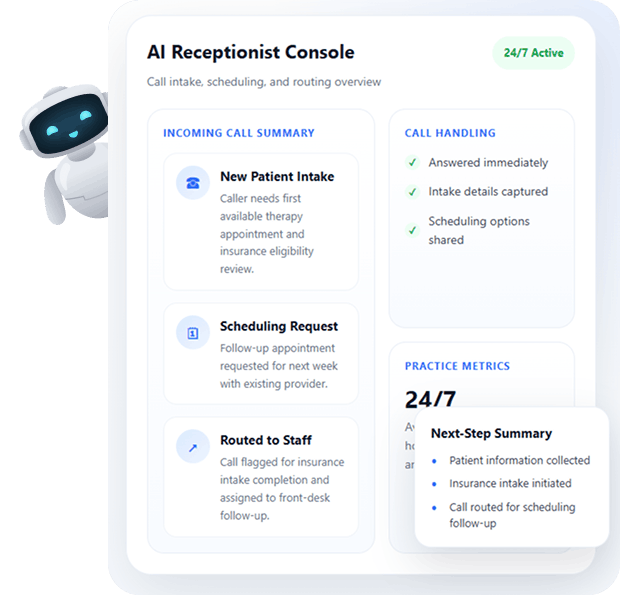
Supported functions include
Built for Behavioral Health Organizations
Unlike generic answering services, DENmaar AI Receptionist is designed specifically for behavioral
health workflows and patient communication needs.
01
New patient intake
Capture initial caller details and support first-contact intake workflows for prospective patients.
02
Appointment Scheduling
Help callers request available appointments and move scheduling requests into the right workflow.
03
Appointment Rescheduling
Support reschedule requests without requiring every call to be handled directly by staff.
04
Frequently Asked Questions
Provide helpful responses to common patient questions about practice operations, locations, or services.
05
Insurance Intake Collection
Collect insurance-related details needed for intake workflows and claims readiness preparation.
06
Message Routing
Route messages and requests to the appropriate team, department, or follow-up queue.
07
After-Hours Call Handling
Respond to callers outside business hours so opportunities are not lost overnight or on weekends.
08
Call Summaries
Provide staff with a concise summary of the call, captured details, and recommended next steps.
09
Provider & Location Routing
Direct patients to the right provider, office, or service line based on their needs and request type.
HOW IT WORKS
From Incoming Call to Actionable Next Step
AI Receptionist helps practices respond quickly, collect the right information, and move requests into
scheduling, routing, or follow-up workflows.

Patient calls your practice

AI Receptionist answers immediately

Information is collected and documented

Calls are routed, scheduled, or assigned for follow-up

Staff receive a summary and next steps
AVAILABLE 24/7
Support Call Handling During Business Hours, Evenings, Weekends, and Holidays
The AI Receptionist can answer calls during business hours, evenings, weekends, and holidays, helping ensure every caller receives a professional response and every opportunity has a better chance of being captured.
Coverage Overview
24/7 Support
Business Hours
Support routine call handling, intake questions, and appointment scheduling requests during the workday.
Evenings
Respond to callers outside traditional office hours when prospective patients are often more available.
Weekends
Capture new opportunities and requests that might otherwise wait until Monday or go unanswered.
Holidays
Maintain a professional first response experience even when the office is closed or staff availability is limited.
INTEGRATED WITH THE DENMAAR PLATFORM
Integrated with the DENmaar Platform
Documentation can connect directly to scheduling, treatment plans, assessments, billing workflows,
claims validation, and provider productivity reporting.

Scheduling

Patient Registration

Insurance Intake

DENmaar AI
Receptionist
Receptionist

Documentation Workflows

Billing Operations

Provider Assignments
WHY ORGANIZATIONS CHOOSE DENMAAR
Built to Improve Responsiveness, Reduce Workload, and Support Better Intake Operations
DENmaar AI Receptionist is designed to help behavioral health organizations respond faster, route requests more effectively, and reduce front-desk strain.
- Immediate Call Response
- Reduced Front Desk Workload
- Improved Patient Experience
- Better Intake Consistency
- Behavioral Health Focused Workflows
- Fully Integrated Platform
Request an
AI Receptionist Demo
Experience how DENmaar AI Receptionist can help your organization capture more opportunities,
- Improve responsiveness
- Streamline intake operations.
Request Information
TESTIMONIALS
WHAT OUR CLIENTS SAY
On behalf of everyone at Meadowlark Counseling Services, I want to extend our sincere thanks for the continued improvements you and your team have made to the DENMaar EMR platform. We have been consistently impressed with both the functionality and user-friendly design of the system, which has made a meaningful difference in our day-to-day operations. The intuitive layout and ease of use have allowed our staff to spend less time navigating the system and more time focusing on client care. The regular updates and enhancements reflect your commitment to meeting the evolving needs of providers in the behavioral health and substance use treatment fields. We genuinely look forward to the new features introduced each month and appreciate how responsive the platform has been to the demands of clinical workflows. We have been so pleased with our experience that we’ve taken the opportunity to recommend DENMaar to other professionals in Pennsylvania who are working in the SUD field. Thank you again for your ongoing support and partnership. We are grateful to be working with a company that truly understands the needs of its users. KIndly, Becky Parks on behalf of the entire team at Meadowlark Counseling Services
I referred one of my colleagues Dr Aaron to you he is just starting g his psychology private practice and looking at where to start. I told him hands down you guys are the best billers and have a great EMR and team. He said he reached out just wanted to let you know!
FANTASTIC job keeping things rolling along with any and all of our billing concerns as well as responding to other issues which may well have been out of your wheelhouse. We are VERY grateful to have you and the crew in our corner.
I appreciate you all so much and DENmaar has been such a blessing Donna to our overall operations and success as an expanding company—allowing us to ultimately operate more efficiently, get our claims paid more consistently, ad stay on top of the critical credentialing piece, among other things. Teamwork does in fact, make the dream work. I’ll loop Chris/Isabella in on this message thread too, as I want All of your team to be aware of how much we appreciate our working relationship with DENmaar
Thank you for your diligence!! I appreciate it so much. Thank you Edwina…
Thank you so much Amy! I will be referring to DENmaar as often as I am asked about credentialing services.
Our Latest Blogs
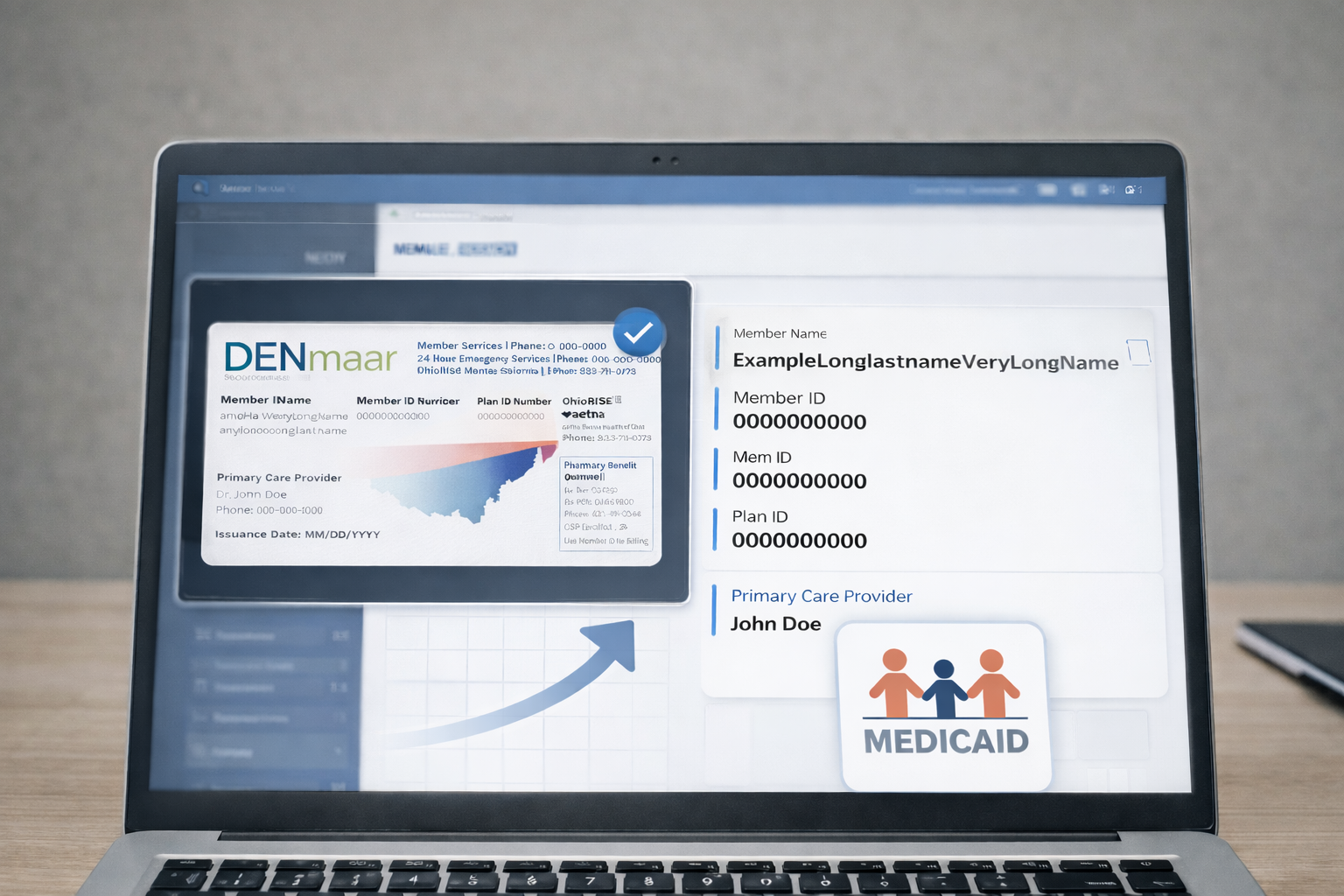
AI Insurance ID Card Reader for Mental Health Carve-Outs and Medicaid MCOs
Behavioral health billing has many pain points—documentation, coding, authorizations—but one of the most persistent is the insurance ID card itself.
Mental health benefits are often carved out from the medical plan. Medicaid members may be assigned to a medical MCO that is not the behavioral health payer. Insurance cards frequently list multiple phone numbers and logos with little clarity on who actually pays for services.
This is exactly the problem DENmaar’s AI Insurance ID Card Reader is designed to solve.
The Core Problem With Insurance ID Cards in Behavioral Health
In behavioral health, the payer printed on the insurance card is often not the payer you should bill.
Common scenarios include:
-
Commercial medical plans where mental health benefits are administered by Carelon Behavioral Health or Optum Behavioral Health
-
Medicaid members enrolled in a medical MCO while behavioral health is carved out to a separate entity
-
State-specific Medicaid structures where:
-
Physical health is billed to one payer
-
Mental health is billed to another
-
Substance use services may be billed to a third
-
Traditional EHR systems treat the insurance card as a static image. DENmaar treats it as structured intelligence.
How the AI Insurance ID Card Reader Works
When an insurance card is uploaded or captured, DENmaar’s AI does more than store it—it interprets it.
Automated Data Extraction
The AI reader extracts:
-
Payer name and plan name
-
Member ID and group number
-
Plan type (Medicaid, commercial, Medicare)
Behavioral Health Intelligence
The system:
-
Detects behavioral health carve-out indicators
-
Flags when the listed payer is medical-only
-
Triggers automated downstream verification logic
This transforms the insurance card into the first step of a clean claims workflow, not a future problem.
Mental Health Carve-Out Detection (The Key Differentiator)
DENmaar’s AI is trained specifically on behavioral health carve-out patterns, not generic eligibility rules.
Examples include:
-
Anthem or Blue Cross medical cards with mental health routed to Carelon
-
UnitedHealthcare medical plans with behavioral health managed by Optum
-
Medicaid MCO cards where behavioral health is administered by a state-designated carve-out entity
Instead of discovering these issues after denials, the system:
-
Flags carve-outs during intake
-
Assigns the correct behavioral health payer automatically
-
Prevents claims from being submitted to the wrong entity
This alone eliminates a large percentage of avoidable payer rejections.
Medicaid MCO Detection and Multi-Payer Awareness
Medicaid is where most EHRs struggle.
DENmaar’s AI Insurance ID Card Reader:
-
Recognizes state-specific Medicaid MCO card formats
-
Identifies when the MCO covers medical services only
-
Routes mental health services to the correct payer
-
Supports multi-payer logic across:
-
Therapy services
-
Psychiatry
-
Community-based care
-
Higher levels of care
-
This is critical for behavioral health organizations operating across multiple states with varying Medicaid rules.
Operational Impact for Behavioral Health Practices
For practices, this translates into:
-
Fewer intake errors
-
Cleaner eligibility records
-
Accurate payer mapping from day one
-
Fewer denials due to incorrect payer submission
-
Less staff time spent calling payers just to find the correct number
For DENmaar, it reinforces a core principle: save time while staying compliant.
Built for Scalable Behavioral Health Organizations
This system is not designed for one-off workflows or solo workarounds. It is built for:
-
Multi-provider practices
-
Multi-state behavioral health organizations
-
Medicaid-heavy patient populations
-
Teams that prioritize predictable cash flow over constant cleanup
For organizations planning to scale, this level of automation is no longer optional.
The Bigger Picture: Intake-to-Billing Intelligence
The AI Insurance ID Card Reader is not a standalone feature. It is a gateway to:
-
Accurate eligibility verification
-
Correct behavioral health payer assignment
-
Clean claims submission
-
Scalable, denial-resistant billing operations
It represents where DENmaar is headed: intake-to-billing intelligence built for how behavioral health actually works.

Leaning Into DENmaar, Not Leaning On It
A Balanced Platform, Backed by Real Services
In behavioral health technology, there is a distinction that matters more than most people realize.
There is a difference between leaning into a system and leaning on it.
At DENmaar, this distinction is foundational, not just to our technology, but to how our services team operates alongside it.
The Risk of Leaning On Technology Alone
Many platforms sell the idea that software, by itself, will solve operational complexity. The implication is:
Once it is turned on, the system will take care of everything.
In real-world healthcare operations, this creates fragility:
- Automation without context
- Black box workflows no one owns
- Errors that surface downstream instead of being prevented upstream
- Teams reacting to problems instead of steering outcomes
Behavioral health, especially in Medicaid, Medicare, and multi-payer environments, does not tolerate that kind of opacity.
What It Means to Lean Into DENmaar
Leaning into DENmaar means treating it as an engineered operating system, supported by people who understand both the technology and the work.
This looks like:
- Workflows designed to match real clinical and billing behavior
- Payer logic made explicit, not assume
- Automation that flags, routes, and clarifies, not hides
- Human oversight where judgment is required
Technology does the heavy lifting.
People ensure correctness.
Technology Backed by a Services Team
This is the balance many platforms miss.
DENmaar is not software only, and it is not services first. It is a tightly integrated model where each reinforces the other.
Our behavioral health billing services team:
- Actively monitors claims performance
- Reviews and corrects issues before submission
- Aligns documentation with payer expectations
- Feeds real-world edge cases back into the system
At the same time, the DENmaar behavioral health EHR platform:
- Reduces manual effort for the services team
- Standardizes decisions so fixes are repeatable
- Prevents the same issues from recurring
- Scales knowledge across every account
This prevents heroics. The system improves instead.
Balance Over Automation Theater
DENmaar is built at the intersection of:
- Clinical compliance
- Behavioral health revenue cycle management
- Operational efficiency
Leaning too hard on any single dimension creates risk:
- Compliance without efficiency leads to burnout
- Efficiency without oversight leads to denials
- Revenue focus without clinical grounding leads to audits and instability
Our rule is simple:
If automation removes friction and preserves correctness, it belongs in the system.
If it obscures accountability, it does not.
That is why our platform is paired with a services team that understands how payers behave in practice, not just how they behave on paper.
Where We Apply Leverage
We lean in where leverage compounds:
- Claims hygiene before submission
- Structured, payer-aligned documentation
- Eligibility and authorization logic upstream
- Automation that drives clear next actions
- Human review where payers are inconsistent or subjective
We do not lean on technology to:
- Mask broken workflows
- Replace operational ownership
- Handle edge cases without review
- Chase novelty at the expense of stability
Built for Operators, Not Passivity
DENmaar is designed for practices that are building something durable:
- Multi-provider organizations
- Programs with payer complexity
- Leaders who value predictability over hype
The platform does not replace teams. It supports disciplined teams with better systems, including AI-powered progress notes that remain payer-aware and compliant.
The Long View
Strong healthcare platforms age well.
They become more valuable over time because:
- Errors are eliminated at the source
- Knowledge is retained in the system
- Services and software evolve together
- Operators spend less time reacting and more time leading
That is what it means to lean into DENmaar, not lean on it.
And that balance, technology backed by a services team, is how durability is built.
Frequently Asked Questions
What makes DENmaar different from software-only behavioral health platforms?
DENmaar combines behavioral health EHR technology with hands-on billing and services support to prevent errors before claims are submitted, rather than reacting after denials occur.
Does DENmaar support Medicaid and multi-payer environments?
Yes. DENmaar is built for Medicaid-heavy behavioral health practices and supports payer-specific logic, compliance requirements, and clean claims workflows.
How does DENmaar improve clean claim rates?
Through upstream claims hygiene, payer-aligned documentation, and service-aware automation supported by human review.
Is DENmaar suitable for growing behavioral health organizations?
DENmaar is designed for practices scaling across providers, services, and payers that need predictable revenue cycle performance.

Claims Hygiene: How DENmaar Prevents Rejections Across Therapy, Medication Management, SUD, IOP, and Community-Based Care
In behavioral health billing, most revenue problems do not start with denials. They start earlier at submission with claims that are structurally valid but misaligned with payer expectations for the specific service being delivered.
At DENmaar, we address this upstream through a discipline we call claims hygiene. Claims hygiene is the systematic validation of insurance, provider, diagnosis, service type, and documentation data to ensure a claim is payer aligned and submission ready before it ever leaves the system.
This article explains how DENmaar applies claims hygiene across different behavioral health service lines and how we use the Change Healthcare API as a final structural validator, not a decision engine.
What Claims Hygiene Means at DENmaar
Claims hygiene is not denial management.
It is not resubmission work.
It is not a clearinghouse dependency.
Claims hygiene is prevention by design.
Before a claim is submitted, DENmaar evaluates whether:
- The insurance configuration is correct
- The provider is properly aligned and enrolled
- The diagnosis supports the service
- The service type is billed the way the payer expects
- The claim is structurally valid as an 837
If any of these fail, the claim does not advance.
This approach is foundational to how a behavioral health EHR built for complex care environments supports clean claims and predictable Medicaid behavioral health reimbursement.
Claims Hygiene Is Service Line Specific
A critical mistake many systems make is treating all behavioral health services the same. They are not.
Each service line therapy, medication management, SUD, IOP, and community based care has distinct payer logic, especially in Medicaid and managed care. Claims hygiene must account for that.
This same operational depth is required in advanced care models such as professional inpatient psychiatry, where complexity outweighs volume.
Therapy Billing Claims Hygiene
Therapy (Individual, Family, Group)
For therapy services, claims hygiene focuses on:
- Correct CPT selection for individual, family, and group therapy
- Modifier logic including telehealth and state specific rules
- Units and duration alignment
- Diagnosis compatibility with psychotherapy services
- Rendering provider scope and licensure
- Telehealth rules by payer and state
Many therapy rejections occur not because therapy was inappropriate, but because format, modifiers, or diagnosis pairing did not meet payer rules. Claims hygiene prevents those upfront, supporting therapy practice management software designed for Medicaid and commercial payers.
Medication Management and Psychiatry Claims Hygiene
Medication management introduces a different hygiene profile:
- E and M code selection and level alignment
- New versus established patient logic
- Diagnosis requirements for psychiatric E and M
- Time based versus complexity based billing validation
- Prescribing provider credentials and enrollment
- Telehealth E and M restrictions by payer
DENmaar evaluates whether an E and M service is billable in context, not just whether the code exists. This is essential for psychiatry billing Medicaid and multi payer environments.
Substance Use Disorder Billing Claims Hygiene
SUD billing is highly sensitive to payer and program structure. Claims hygiene here evaluates:
- Whether the payer expects CPT or HCPCS
- Diagnosis restrictions tied to SUD services
- Program specific coverage including outpatient versus structured programs
- Frequency and unit limitations
- Required modifiers and service classifications
Many SUD rejections stem from using the right code in the wrong program context. Claims hygiene blocks those before submission, strengthening substance use treatment billing accuracy.
Intensive Outpatient Program Billing Claims Hygiene
IOP introduces institutional and hybrid billing considerations. Claims hygiene ensures:
- Proper classification of the service as IOP
- Correct claim type professional versus institutional
- Alignment between diagnosis, level of care, and frequency
- Group versus individual service differentiation
- Documentation readiness tied to level of care
IOP claims are often structurally valid but rejected because the payer expected a different service framework. Claims hygiene prevents those mismatches and supports compliant behavioral health revenue cycle management.
Community Based and Rehabilitative Services Claims Hygiene
Community based services are among the most complex to bill. Claims hygiene evaluates:
- Program eligibility and payer authorization expectations
- HCPCS versus CPT requirements
- Diagnosis restrictions tied to state and program
- Provider role alignment
- Claim form and submission expectations
These services fail when systems treat them like outpatient therapy. DENmaar does not.
Diagnosis Hygiene Across All Behavioral Health Services
Across every service line, diagnosis hygiene is enforced. DENmaar validates:
- ICD 10 validity and effective dates
- Diagnosis to service compatibility
- Primary versus secondary diagnosis rules
- Program specific diagnosis requirements
Diagnosis feedback returned during scrubbing is normalized and used to strengthen upstream prevention, not ignored. This is a critical component of behavioral health compliance.
The Role of the Change Healthcare API
After a claim passes DENmaar internal claims hygiene across insurance, provider, diagnosis, and service specific logic, it is submitted as a JSON based claim payload to the Change Healthcare API.
Change Healthcare is used for:
- Structural and schema validation
- Required field enforcement
- Standard EDI edits
- Diagnosis and procedure edit feedback
Change is not used to decide whether a service should be billed or how it should be classified. All business logic remains inside DENmaar EHR and mental health EHR software.
Why Claims Hygiene Matters
When claims hygiene is applied uniformly, complex services break.
When claims hygiene is service aware:
- First pass acceptance rates increase
- Rejections drop across all service lines
- Billing labor per claim decreases
- Payment timelines stabilize
- Cash flow becomes predictable
Billing teams stop fixing preventable errors and start managing real exceptions using behavioral health billing services built for complexity.
Why We Built It This Way
DENmaar was designed for practices delivering:
- Therapy and psychiatry
- SUD and higher levels of care
- Community based and Medicaid heavy services
- Multi state and multi payer operations
That environment demands claims hygiene that understands the service, not just the code.
This is reinforced by AI documentation for behavioral health, including compliant AI progress notes aligned with billing logic.
Revenue cycle efficiency does not come from working claims faster.
It comes from sending the right claims, for the right service, the right way, on the first attempt.
That is claims hygiene.
And it is foundational to how DENmaar operates.
Frequently Asked Questions
Is professional inpatient psychiatry a profitable market?
It is not high volume, but when supported correctly it protects revenue, reduces compliance risk, and strengthens long term practice stability.
Why do outpatient-focused EHRs struggle with inpatient psychiatry?
They are not designed for daily inpatient billing rules, place of service enforcement, discharge logic, or hospital credentialing workflows.
How does inpatient psychiatry affect behavioral health billing?
Errors in inpatient billing can lead to denied claims, audits, and revenue loss, making accurate documentation and billing workflows essential.
Why does inpatient capability matter for EHR platforms?
Supporting inpatient psychiatry signals operational maturity and the ability to handle complex payer and care models without breaking workflows.
Our Partners






Ready to get started?
Feel free to reach out if you have any questions.
