

- Therapy and medication management
- IOP, PHP, and SUD treatment programs
- Case management, community support, and residential services
DENmaar Revenue Cycle Intelligence
Claims Copilot ™
Stop Chasing Claims.
Start Preventing Problems.
Claims Copilot is DENmaar’s behavioral health revenue cycle solution
designed to help practices prevent claim issues before submission, reduce
aging, accelerate reimbursement, and improve operational performance.

Pre-Submission Claim Readiness

Payer Lifecycle Monitoring

Aging & Collections Visibility
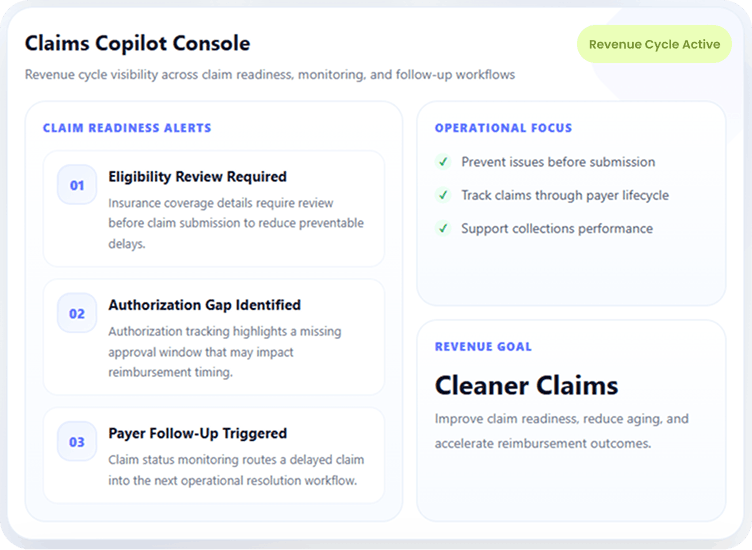
Pre-Submission Readiness
Catch eligibility, authorization, payer, and documentation issues before claims go out.
Lifecycle Claim Monitoring
Track claims after submission with rejection management, status visibility, and aging oversight.
Operational Performance
Support clean claim performance, reduce aged claims, and improve collections visibility.
Behavioral Health Focused
Designed for therapy, medication management, SUD, IOP/PHP, community support, and more.
Built for Behavioral Health
Designed for Behavioral Health
Revenue Cycle Workflows
Whether your organization provides therapy, medication management, IOP,
PHP, SUD treatment, case management, community support, or residential
services, Claims Copilot is built around the operational and reimbursement
realities of behavioral health.

Behavioral health support areas
Claims Copilot is positioned to support behavioral health organizations that need stronger claim readiness, reimbursement visibility, and operational follow-up across complex service lines.
Prevent Problems Before Claims Are Submitted
Address Revenue Cycle Breakdowns
Before They Turn Into Denials or Delays
Most claim problems begin long before a claim is submitted. Claims Copilot helps practices identify and
resolve those issues earlier so reimbursement performance is not undermined later.

Verify Insurance Eligibility
Confirm insurance coverage details early to reduce preventable reimbursement delays and billing confusion.

Review Insurance Information & ID Cards
Validate insurance information and supporting details so claims are built on more accurate payer data.

Track Authorizations
Monitor authorization requirements and approval status to reduce avoidable denials tied to missing coverage approvals.

Monitor Provider Credentialing Requirements
Support awareness of credentialing-related payer requirements that can affect billing and reimbursement workflows.

Identify Claim Issues Before Submission
Catch missing information, workflow gaps, and other claim barriers before the claim enters the payer lifecycle.

Improve Documentation-to-Billing Alignment
Route messages and requests to the appropriate team, department, or follow-up queue.
How Claims Copilot Works
A continuous workflow built to
support prevention, monitoring, and resolution.
Claims Copilot doesn’t stop at submission. It supports the operational work needed before the claim goes out, then continues
tracking activity through the payer lifecycle to help teams reduce delays, aging, and reimbursement bottlenecks.
1
Review claim readiness before submission
Insurance, eligibility, authorization, and workflow details are reviewed to identify claim risks before they become downstream reimbursement problems.
2
Submit claims and monitor payer activity
Once claims are submitted, Claims Copilot supports visibility into rejections, claim status, aging, and other signals that indicate a claim may require action.
3
Route follow-up through the right workflow
Operational tasks can be prioritized based on the issue—whether the next step involves internal follow-up, claim correction, payer research, or payment posting support.
From prevention to reimbursement performance.
Claims Copilot is designed to help organizations manage the full payer journey—not just claim submission. The result is a more proactive revenue cycle process with clearer visibility and fewer avoidable surprises.

Before submission:
improve readiness across insurance, authorizations, and documentation alignment

After submission:
monitor claim status, rejections, denial patterns, and aging across the payer lifecycle.

Operationally:
help teams reduce aging, recover delayed payments, and improve turnaround performance.
Monitor Claims Through the Entire Payer Lifecycle
Submitting claims is only the beginning.
Claims Copilot continuously tracks claim progress and supports the workflows needed to identify
reimbursement issues, respond to payer friction, and keep claims moving toward payment.

Claim Submission & Rejection Visibility
Support clean electronic claim submission while maintaining visibility into rejections and claim issues that need attention after submission.
- Electronic claim submission
- Rejection management support
- Visibility into claim readiness breakdowns

Status Monitoring & Aging Analysis
Track claims after submission to identify delays, payer inactivity, unresolved statuses, and aging trends that can impact collections.
- Claim status monitoring
- Aging analysis and prioritization
- Operational follow-up workflow visibility

Denials, Follow-Up & Payment Support
Improve follow-through on denied or delayed claims by supporting structured next steps across payer follow-up, resolution activity, and payment posting workflows.
- Denial tracking
- Follow-up workflow support
- Payment posting support
Reduce Aging and Improve Collections
Give your organization earlier visibility, better follow-through, and fewer preventable delays.
Many behavioral health organizations struggle with growing accounts receivable because claim issues are discovered too late. Claims Copilot helps teams stay ahead of the work required to keep reimbursement moving.

Reduce aged claims
improve readiness across insurance, authorizations, and documentation alignment.

Recover delayed payments
Identify unresolved payer issues sooner and reduce the amount of time claims spend waiting without meaningful action.

Improve turnaround and clean claim performance
Support stronger revenue cycle performance by reducing preventable breakdowns before and after submission.
A Partnership Approach
Successful revenue cycle management requires operational collaboration.
Many behavioral health organizations struggle with growing accounts receivable because claim issues are discovered too late. Claims Copilot helps teams stay ahead of the work required to keep reimbursement moving.

Before submission:
improve readiness across insurance, authorizations, and documentation alignment.

After submission:
monitor claim status, rejections, denial patterns, and aging across the payer lifecycle.

Operationally:
help teams reduce aging, recover delayed payments, and improve turnaround performance.
Included With DENmaar
Claims Copilot is part of the DENmaar
Behavioral Productivity Platform.
When DENmaar manages your insurance billing, your organization also gains access to the broader operational and clinical
platform that supports scheduling, documentation, reporting, and patient management workflows.

Behavioral Health EHR
Clinical and operational workflows designed around behavioral health documentation and care delivery.

Scheduling
Integrated scheduling workflows to support patient flow, operational visibility, and billing readiness.

Documentation Tools
Clinical notes, treatment plans, and documentation workflows that support stronger operational alignment.

AI-Assisted Notes
Support documentation efficiency while maintaining professional review and oversight workflows.

Treatment Plans
Behavioral health planning tools that connect care planning with documentation and operational workflows.

Clinical Workflows
Support multidisciplinary behavioral health processes with connected operational and clinical workflows.

Reporting
Visibility into productivity, claim performance, and operational trends across the platform.

Patient Management Tools
Connected workflows for patient registration, intake coordination, operational follow-up, and practice support.
Request an
AI Notes Trial
See how DENmaar AI Notes can help your clinicians reduce documentation time while improving
Request a demonstration or pilot program today.
Request Information
TESTIMONIALS
WHAT OUR CLIENTS SAY
On behalf of everyone at Meadowlark Counseling Services, I want to extend our sincere thanks for the continued improvements you and your team have made to the DENMaar EMR platform. We have been consistently impressed with both the functionality and user-friendly design of the system, which has made a meaningful difference in our day-to-day operations. The intuitive layout and ease of use have allowed our staff to spend less time navigating the system and more time focusing on client care. The regular updates and enhancements reflect your commitment to meeting the evolving needs of providers in the behavioral health and substance use treatment fields. We genuinely look forward to the new features introduced each month and appreciate how responsive the platform has been to the demands of clinical workflows. We have been so pleased with our experience that we’ve taken the opportunity to recommend DENMaar to other professionals in Pennsylvania who are working in the SUD field. Thank you again for your ongoing support and partnership. We are grateful to be working with a company that truly understands the needs of its users. KIndly, Becky Parks on behalf of the entire team at Meadowlark Counseling Services
I referred one of my colleagues Dr Aaron to you he is just starting g his psychology private practice and looking at where to start. I told him hands down you guys are the best billers and have a great EMR and team. He said he reached out just wanted to let you know!
FANTASTIC job keeping things rolling along with any and all of our billing concerns as well as responding to other issues which may well have been out of your wheelhouse. We are VERY grateful to have you and the crew in our corner.
I appreciate you all so much and DENmaar has been such a blessing Donna to our overall operations and success as an expanding company—allowing us to ultimately operate more efficiently, get our claims paid more consistently, ad stay on top of the critical credentialing piece, among other things. Teamwork does in fact, make the dream work. I’ll loop Chris/Isabella in on this message thread too, as I want All of your team to be aware of how much we appreciate our working relationship with DENmaar
Thank you for your diligence!! I appreciate it so much. Thank you Edwina…
Thank you so much Amy! I will be referring to DENmaar as often as I am asked about credentialing services.
Our Latest Blogs
The only Physician Credentialing Process Checklist You’ll Need in 2022
Understanding the process of credentialing is simple. It is a process that entails the procurement and verification of information that ascertains whether or not a physician is capable of fulfilling his or her medical obligations. The process is fundamental for everyone involved with the healthcare industry. This includes the practitioners, nurses, and of course, the patients.
The credentialing process in itself, however, is burdensome, to say the least. A typical credentialing process can take 90 to 150 days to conclude. Hurdles like missing or incorrect information in the applications submitted can result in claim denials, which essentially means you’ll have to undergo the entire process all over again, costing you both valuable money and precious time.
That being said, you can’t simply ignore the process either. Credentialing is important for a variety of reasons.
- • It can help build patient trust
- • It lowers the risk of medical errors.
- • It helps medical organizations from losing revenue
- • It improves a practitioner’s reputation.
- • It can help you save costs
- • It protects healthcare organizations from future lawsuits.
Needless to say, the credentialing process is too valuable to pass. Yes, it can be uniquely frustrating to perform. However, we believe the following checklist can guide you competently for a smoother credentialing process.
So without much further, allow us to acquaint you with the only Physician credentialing process checklist you’ll need for a seamless experience.
Physician Credentialing Process Checklist
The very first thing to do when starting the credentialing process is to make sure you are always one step ahead. The way to ensure that is by starting as early as possible. With that out of the way, you can begin the process.
1. Submit the Pre-Application
It won’t take you time to notice or experience how tedious the credentialing process can be. To begin with, you will need to submit a pre-application based on the healthcare facility or insurance network you want to join. It is at this juncture in the process that insurance companies weed out applicants that are not eligible for credentialing.
This step involves a background check. You will be checked for:
- • Board Certifications
- • Criminal Records
- • Record of disciplinary action taken against you or your practice.
If any issues arise here, you will be asked to submit further information. If there aren’t any issues, then you move on to the next step.
2. Submitting the Applications
This step forms the actual meat of the process. You will be required to submit all information possible that vouch for your legitimacy as a healthcare provider. The most fundamental checklist will be as follows:
- • Transcripts and educational history
- • DEA registration
- • Board certification
- • Medical license
- • Continual malpractice coverage
- • Work history
- • Professional and personal reference
- • Explanation of gaps in work history
- • Personal immunization record
- • Personal health history
- • CAQH Enrollment
- • Hospital affiliation
All of the above information must be backed by solid documentation and relevant letters of recommendation.
3. Receipt Verification
Once the application is submitted, you might feel inclined to take a sigh of relief. However, it will be too early to do so. In fact, we recommend constant follow-ups via call and emails to confirm that your application has been received and is under review. The credentialing board may reach out to you for further information. If that does happen, we recommend submitting the information as quickly as possible. Make sure you have copies of all the documents submitted ready at a moment’s notice.
The above procedure entails the checklist for a traditional physician credentialing process. Medical practices may need to work with a new checklist to assist them in adding new providers. So if you are someone who runs a medical practice and wants to add a new provider to your staff, then the following checklist is for you.
Checklist for adding a new provider
- You will need to provide an updated CAQH profile with a new practice affiliation. Also, make sure the provider’s driving license and DEA are updated with the new state if the affiliation is different from their previous one.
- The group that will be adding the new provider will be required to supplement a list of payers that they are currently affiliated with. This will include Medicaid HMOs, worker’s compensation, Tricare, Medicare advantage, etc.
- Update your practice’s CAQH profile and supply tax companies with your Tax ID.
- You will be required to submit a new and updated malpractice policy and also update it in your CAQH profile.
- You will be required to provide the practice’s primary billing type. This information will be listed on your application with Tax ID.
- Mention Medicare’s PTAN that you plan to be included on. This information will be listed on the Medicare application of the new provider linked to your group.
- The following Documentation will be mandatory.
- • Professional State License
- • Board Certification
- • CAQH Login and Password
- • PECOS Login and Password
- • PLI Certification
- • Professional School Diploma
- • State Medicaid Login and Password
- • Current CV with precise beginning and end date
- • Hospital Admitting Privilege
- • Certification of completing internships, fellowships, etc.
The Bottom Line
Credentialing demands a plethora of information from practitioners. So much so that the whole process might feel a tad bit overwhelming. It also counts that all the information you do gather is complete and accurate. The consequences of failing to ensure that can be disastrous.
So if you are still confused about the process and have no idea what information to carry, then we suggest you give our physician credentialing specialists at DENmaar a call. We are at your service whenever you need us. We’ll assist you with the entire process as well, making sure you make it on a payer’s network without a hassle.
Contact us now to learn more.

Provider Re-credentialing – Explained
You would be wrong to assume that the credentialing process is over once a provider has been accepted into a payer’s network. In fact, providers are required to undergo routine screening and license verification to maintain compliance and provide quality care to their patients. This process that involves periodic screening and verification is what we call recredentialing.
Recredentialing process is done to verify the training and qualifications of a provider and notify healthcare organizations if fraud or abuse is found. Now it is no secret that undertaking the credentialing process is no easy task. It can be time-consuming and burdensome. However, the cost of neglecting the procedure can be much direr.
Hospitals and similar healthcare organizations are staring at revenue losses in the upwards of millions on litigation, delayed payments, and civil monetary penalties without recredentialing.
Now that you know how important the process of recredentialing is, we will take a deep dive into the subject to make sure you learn everything there is to know about it.
So without much further ado, let’s get started.
Read More on Importance of Medical Credentialing
How Many Time Does a Provider Need to Be Recredentialed?
The answer to this question will vary from state to state. In most American states, the provider must be credentialed immediately when hired. Later, they must undergo re-credentialing every two years. There are exceptions to this rule, however, as some states like Illinois require providers to be recredentialed every three years.
To know exactly how often a provider needs to be recredentialed, it would be wise to check state laws and regulations that apply to your healthcare organization.
The Initial Requirements for Recredentialing
First and foremost, it is the responsibility of the healthcare organization to notify the doctors and nurses working under them at least 60 days before the recredentialing due date. Providers should be given access to all applications online. Remember, the recredentialing process varies from state to state and can take months to conclude.
To expedite the process, we recommend keeping the necessary documentation on file. We also suggest preparing organization-specific requirements well ahead of time. If the process is too overwhelming to handle, we recommend you give us at DENmaar a call and our credentialing specialists will be happy to shoulder the recredentialing process on your behalf.
Information Verified During Recredentialing
A traditional recredentialing process will entail the verification of the following documents:
- • Drug Enforcement Administration or Controlled Dangerous Substances Certification
- • State Licenses
- • Board Certification
- • Malpractice Claims History
- • Work History
- • Recent Malpractice Insurance Coverage
- • Medicare and Medicaid Sanctions
- • National Provider Identifier Number (NPI)
- • State Sanctions and Restrictions on Licensure and Limitations on Scope of Practice.
What Happens When an Application is denied?
A provider is notified with a written notice that includes the reason for denial in case their application is rejected by the credentialing committee. Providers have the right to submit an appeal contesting the denial. The provider must request reconsideration in writing within 30 days of receiving a denial.
The written request must be submitted along with the necessary documents. The reconsideration will be scheduled within 60 days. Remember, the provider has no further option if his or her claim is denied a second time.
Learn More on How to Avoid Payer Rejection During Enrollment
Getting Recredentialed Without a Hassle
Issues with recredentialing are more common than you would assume. That being said, there are ways by which you can make sure those issues never arise during your procedure. To begin with, healthcare organizations should maintain evidence of a provider’s application in a secure credentials file. They should also adopt a system that keeps all relevant information current.
However, the only guaranteed way to make sure you don’t fail with recredentialing is to seek help from credentialing specialists in the industry like DENmaar. DENmaar has been helping healthcare organizations across the United States with credentialing provider enrollment for decades now. As such, we have the talent, resources, and insight needed to handle the complex process of credentialing at the behest of your healthcare organization.
You can get in touch with us now to learn more about DENmaar’s recredentialing services.

Best Practices to Avoid Payer Rejection During Enrollment
Getting enrolled into an insurance company’s network isn’t an easy task. Throughout the process, you’ll find that you have very little control over the outcome of the entire proceedings. You’ll find yourself at odds with the insurance companies whose network you so desperately want to join. Chances are that things might not pan out as you’d hoped.
Payer rejection is a reality that most providers do not want to ever encounter. Sadly, hearing a straightforward ‘No’ from payers after a very lengthy application process is more common than you can imagine. Most of the times providers have no clue what led to the rejection. What exactly went wrong that warranted the denial of an application? You’ll probably never know.
You can take solace in the fact that you are not the only healthcare provider in America that had to go through this ordeal. Getting paneled is not easy. It isn’t impossible either or as complicated as most people spell it out to be. There are a few steps or measures a provider can take to overcome a denial during enrollment.
This article will give you a peek at those tips, but first… let’s understand why application denials even happen in the first place.
Reasons for Insurance Panel Denials
You have to understand that insurance companies have the ultimate power to set and adjust the number of providers they accommodate into their network. Payers want to save costs for themselves while at the same time trying to fulfill the promise of better healthcare that they’ve made to their enrollees. As such, payers have a plethora of reasons to deny applications.
They can reject an application because of an error in the application, wrong or missing information, or if the provider doesn’t meet the dictated qualification criteria. Payers may also reject an application if they are currently not accepting providers belonging to a specific demographic.
Read More: Importance of Medical Credentialing
Other typical reasons for payer rejection maybe because of the following:
- • Failure to meet provider standards as dictated by the payer.
- • Over-saturation of a provider type pertaining to a service area or community.
- • The provider failed to comply with the payer’s conditions of participation.
- • The provider failed to meet requirements pertaining to out-of-state enrollments.
Persistence is Key to Overcoming Payer Rejection
Normally it’s typical of providers to simply give up once their application has been rejected. However, what they aren’t aware of is that they still have time to turn the tides in their favor. There are, in fact, a ton of things you can resort to in a bid to overturn your rejection. We know this can be daunting. As such, we highly recommend hiring a credentialing specialist to advocate at the behest of your case in front of the payers.
To begin with, try to request a face-to-face meeting or a conference call with the decision-makers to clearly convey your case. Remember, persistence is the key. Do not take ‘no’ for an answer. Reach out to the authorized personnel in the payer’s office to understand why your application was rejected and what you can do to fix the situation.
You can use LinkedIn to find the right people to talk to. For instance, go to LinkedIn and search employee titles under the payer’s company name. Try to connect with provider management representatives and initiate a conversation with them.
Most of the time, the reason behind denials has to do with the provider type. In such a scenario, providing more information even though the payers haven’t asked for it can make a lot of difference. Convey the demographic and the patient population you serve as a healthcare provider. This is more important if the demographic is related to any of the following:
- • Non-English-speaking communities.
- • Rural
- • Disabled
- • Geriatric
- • Pediatric
- • Chronic Condition
Steps to Take for Simple Provider Enrollment
You can try several things to get yourself enrolled successfully on the insurance company’s panel. A few of the things you can try are as follows:
- • Get letters that convey support from the community you serve.
- • Seek a second-level appeal from a decision-maker or manager of the insurance company.
- • Suggest a trial period where you will only serve a select number of patients, offering free comparison analysis when that period has concluded.
- • Make use of a phone instead of email or letters to clearly convey your message.
- • Request a face-to-face meeting and set up a conference call.
- • Compose a letter that shines a positive spotlight on the services of your practice or clinic.
- • Host an in-service visit to help payers better understand your services.
Learn more on Medical Credentialing Process
Getting paneled with an insurance company is no child’s play. It is an excruciatingly long process with multiple moving parts. One wrong move and you must undertake the entire enrollment process all over again, which can be both time-consuming and costly. As such, it is in your best interest to seek the help of credentialing specialists to guide you throughout the process.
This is where DENmaar’s provider credentialing services come into play. DENmaar is home to highly qualified credentialing experts that shoulder the responsibility of provider enrollment on your behalf. We do not rest until your place on the payer’s panel is secure.
To learn more about our credentialing and provider enrollment services, we recommend you contact us today.
Our Partners






Ready to get started?
Feel free to reach out if you have any questions.
