

- Therapy and medication management
- IOP, PHP, and SUD treatment programs
- Case management, community support, and residential services
DENmaar Revenue Cycle Intelligence
Claims Copilot ™
Stop Chasing Claims.
Start Preventing Problems.
Claims Copilot is DENmaar’s behavioral health revenue cycle solution
designed to help practices prevent claim issues before submission, reduce
aging, accelerate reimbursement, and improve operational performance.

Pre-Submission Claim Readiness

Payer Lifecycle Monitoring

Aging & Collections Visibility
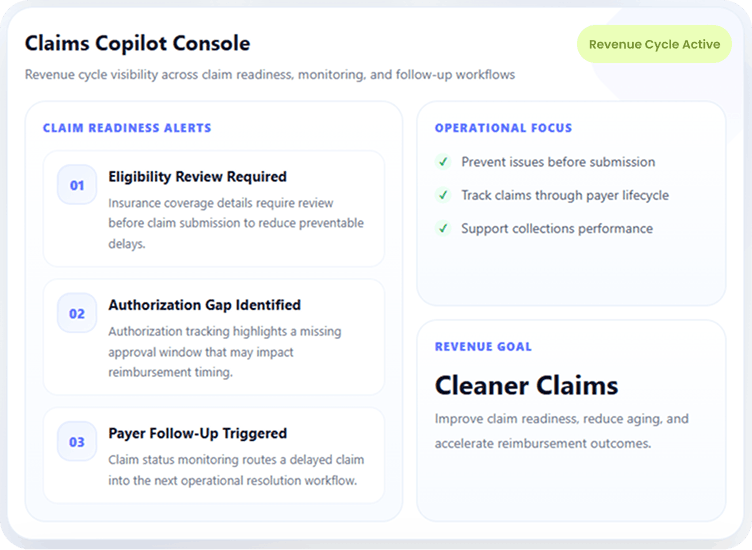
Pre-Submission Readiness
Catch eligibility, authorization, payer, and documentation issues before claims go out.
Lifecycle Claim Monitoring
Track claims after submission with rejection management, status visibility, and aging oversight.
Operational Performance
Support clean claim performance, reduce aged claims, and improve collections visibility.
Behavioral Health Focused
Designed for therapy, medication management, SUD, IOP/PHP, community support, and more.
Built for Behavioral Health
Designed for Behavioral Health
Revenue Cycle Workflows
Whether your organization provides therapy, medication management, IOP,
PHP, SUD treatment, case management, community support, or residential
services, Claims Copilot is built around the operational and reimbursement
realities of behavioral health.

Behavioral health support areas
Claims Copilot is positioned to support behavioral health organizations that need stronger claim readiness, reimbursement visibility, and operational follow-up across complex service lines.
Prevent Problems Before Claims Are Submitted
Address Revenue Cycle Breakdowns
Before They Turn Into Denials or Delays
Most claim problems begin long before a claim is submitted. Claims Copilot helps practices identify and
resolve those issues earlier so reimbursement performance is not undermined later.

Verify Insurance Eligibility
Confirm insurance coverage details early to reduce preventable reimbursement delays and billing confusion.

Review Insurance Information & ID Cards
Validate insurance information and supporting details so claims are built on more accurate payer data.

Track Authorizations
Monitor authorization requirements and approval status to reduce avoidable denials tied to missing coverage approvals.

Monitor Provider Credentialing Requirements
Support awareness of credentialing-related payer requirements that can affect billing and reimbursement workflows.

Identify Claim Issues Before Submission
Catch missing information, workflow gaps, and other claim barriers before the claim enters the payer lifecycle.

Improve Documentation-to-Billing Alignment
Route messages and requests to the appropriate team, department, or follow-up queue.
How Claims Copilot Works
A continuous workflow built to
support prevention, monitoring, and resolution.
Claims Copilot doesn’t stop at submission. It supports the operational work needed before the claim goes out, then continues
tracking activity through the payer lifecycle to help teams reduce delays, aging, and reimbursement bottlenecks.
1
Review claim readiness before submission
Insurance, eligibility, authorization, and workflow details are reviewed to identify claim risks before they become downstream reimbursement problems.
2
Submit claims and monitor payer activity
Once claims are submitted, Claims Copilot supports visibility into rejections, claim status, aging, and other signals that indicate a claim may require action.
3
Route follow-up through the right workflow
Operational tasks can be prioritized based on the issue—whether the next step involves internal follow-up, claim correction, payer research, or payment posting support.
From prevention to reimbursement performance.
Claims Copilot is designed to help organizations manage the full payer journey—not just claim submission. The result is a more proactive revenue cycle process with clearer visibility and fewer avoidable surprises.

Before submission:
improve readiness across insurance, authorizations, and documentation alignment

After submission:
monitor claim status, rejections, denial patterns, and aging across the payer lifecycle.

Operationally:
help teams reduce aging, recover delayed payments, and improve turnaround performance.
Monitor Claims Through the Entire Payer Lifecycle
Submitting claims is only the beginning.
Claims Copilot continuously tracks claim progress and supports the workflows needed to identify
reimbursement issues, respond to payer friction, and keep claims moving toward payment.

Claim Submission & Rejection Visibility
Support clean electronic claim submission while maintaining visibility into rejections and claim issues that need attention after submission.
- Electronic claim submission
- Rejection management support
- Visibility into claim readiness breakdowns

Status Monitoring & Aging Analysis
Track claims after submission to identify delays, payer inactivity, unresolved statuses, and aging trends that can impact collections.
- Claim status monitoring
- Aging analysis and prioritization
- Operational follow-up workflow visibility

Denials, Follow-Up & Payment Support
Improve follow-through on denied or delayed claims by supporting structured next steps across payer follow-up, resolution activity, and payment posting workflows.
- Denial tracking
- Follow-up workflow support
- Payment posting support
Reduce Aging and Improve Collections
Give your organization earlier visibility, better follow-through, and fewer preventable delays.
Many behavioral health organizations struggle with growing accounts receivable because claim issues are discovered too late. Claims Copilot helps teams stay ahead of the work required to keep reimbursement moving.

Reduce aged claims
improve readiness across insurance, authorizations, and documentation alignment.

Recover delayed payments
Identify unresolved payer issues sooner and reduce the amount of time claims spend waiting without meaningful action.

Improve turnaround and clean claim performance
Support stronger revenue cycle performance by reducing preventable breakdowns before and after submission.
A Partnership Approach
Successful revenue cycle management requires operational collaboration.
Many behavioral health organizations struggle with growing accounts receivable because claim issues are discovered too late. Claims Copilot helps teams stay ahead of the work required to keep reimbursement moving.

Before submission:
improve readiness across insurance, authorizations, and documentation alignment.

After submission:
monitor claim status, rejections, denial patterns, and aging across the payer lifecycle.

Operationally:
help teams reduce aging, recover delayed payments, and improve turnaround performance.
Included With DENmaar
Claims Copilot is part of the DENmaar
Behavioral Productivity Platform.
When DENmaar manages your insurance billing, your organization also gains access to the broader operational and clinical
platform that supports scheduling, documentation, reporting, and patient management workflows.

Behavioral Health EHR
Clinical and operational workflows designed around behavioral health documentation and care delivery.

Scheduling
Integrated scheduling workflows to support patient flow, operational visibility, and billing readiness.

Documentation Tools
Clinical notes, treatment plans, and documentation workflows that support stronger operational alignment.

AI-Assisted Notes
Support documentation efficiency while maintaining professional review and oversight workflows.

Treatment Plans
Behavioral health planning tools that connect care planning with documentation and operational workflows.

Clinical Workflows
Support multidisciplinary behavioral health processes with connected operational and clinical workflows.

Reporting
Visibility into productivity, claim performance, and operational trends across the platform.

Patient Management Tools
Connected workflows for patient registration, intake coordination, operational follow-up, and practice support.
Request an
AI Notes Trial
See how DENmaar AI Notes can help your clinicians reduce documentation time while improving
Request a demonstration or pilot program today.
Request Information
TESTIMONIALS
WHAT OUR CLIENTS SAY
On behalf of everyone at Meadowlark Counseling Services, I want to extend our sincere thanks for the continued improvements you and your team have made to the DENMaar EMR platform. We have been consistently impressed with both the functionality and user-friendly design of the system, which has made a meaningful difference in our day-to-day operations. The intuitive layout and ease of use have allowed our staff to spend less time navigating the system and more time focusing on client care. The regular updates and enhancements reflect your commitment to meeting the evolving needs of providers in the behavioral health and substance use treatment fields. We genuinely look forward to the new features introduced each month and appreciate how responsive the platform has been to the demands of clinical workflows. We have been so pleased with our experience that we’ve taken the opportunity to recommend DENMaar to other professionals in Pennsylvania who are working in the SUD field. Thank you again for your ongoing support and partnership. We are grateful to be working with a company that truly understands the needs of its users. KIndly, Becky Parks on behalf of the entire team at Meadowlark Counseling Services
I referred one of my colleagues Dr Aaron to you he is just starting g his psychology private practice and looking at where to start. I told him hands down you guys are the best billers and have a great EMR and team. He said he reached out just wanted to let you know!
FANTASTIC job keeping things rolling along with any and all of our billing concerns as well as responding to other issues which may well have been out of your wheelhouse. We are VERY grateful to have you and the crew in our corner.
I appreciate you all so much and DENmaar has been such a blessing Donna to our overall operations and success as an expanding company—allowing us to ultimately operate more efficiently, get our claims paid more consistently, ad stay on top of the critical credentialing piece, among other things. Teamwork does in fact, make the dream work. I’ll loop Chris/Isabella in on this message thread too, as I want All of your team to be aware of how much we appreciate our working relationship with DENmaar
Thank you for your diligence!! I appreciate it so much. Thank you Edwina…
Thank you so much Amy! I will be referring to DENmaar as often as I am asked about credentialing services.
Our Latest Blogs

AI in Behavioral Health Should Do More Than Write Progress Notes
Artificial intelligence is becoming common in behavioral healthcare, but most of the attention remains focused on one task: generating progress notes.
Documentation is an important use of AI. Providers spend too much time completing notes, updating treatment plans, and ensuring that clinical records support both continuity of care and payer requirements. AI can make that work faster and more consistent.
But documentation represents only one part of operating a behavioral health practice.
Practices also manage patient calls, intake, scheduling, insurance verification, provider responsibilities, claim preparation, billing follow-up, and revenue-cycle exceptions. When AI is limited to progress notes, the practice may save time in one area while continuing to struggle with disconnected systems and manual processes everywhere else.
At DENmaar, our goal is broader: apply AI across the connected work of the practice.
The Problem With Standalone AI Tools
Many AI products are designed to perform one isolated function. One product records a session. Another generates a note. Another answers the telephone. Another review claims.
Each product may be useful, but the practice is still responsible for connecting the information and moving the work forward.
A call must become an intake. The intake must become an appointment. The appointment must lead to completed documentation. The documentation must support a clean claim. The claim must be monitored until it is paid.
If each step takes place in a different system, the organization still depends on staff members to transfer information, recognize problems, and determine what needs to happen next.
Adding more software does not necessarily make the practice easier to operate.
AI in Behavioral Health Works Better Inside a Connected Platform
DENmaar combines the EHR, scheduling, clinical documentation, billing, credentialing, and operational support within one behavioral health platform.
This creates an opportunity to use AI differently.
Instead of treating AI as a separate application, we can introduce it directly into the workflows where clinical, administrative, and financial work already occurs.
Information gathered during patient intake can support scheduling and documentation. Clinical documentation can contribute to claim readiness. Claims data can guide billing follow-up. Operational information can help leadership identify where work is becoming delayed.
The value comes not only from what the AI can generate, but from its ability to help connect one stage of the practice to the next.
AI-Assisted Clinical Documentation
Clinical documentation remains one of the clearest and most immediate uses of AI in behavioral health.
DENmaar uses AI to assist with documentation such as:
- Biopsychosocial assessments
- Individualized treatment plans
- Measurable goals and objectives
- DAP, SOAP, and BIRP progress notes
- Psychiatry and medication-management notes
- Group and multidisciplinary documentation
- Clinical assessments and outcome measures
- Continuity between treatment plans and subsequent notes
The objective is not simply to produce text faster. It is to help providers create documentation that reflects the patient’s treatment, active goals, clinical progress, and applicable assessments.
Providers remain responsible for reviewing, editing, and approving AI-assisted documentation before it becomes part of the signed clinical record. AI supports clinical work; it does not replace clinical judgment.
AI at the Front Door of the Practice
The patient experience often begins before an appointment is ever scheduled.
Prospective patients call with questions about services, provider availability, insurance, locations, and appointment times. When staff members are busy or the office is closed, those opportunities can be lost.
The DENmaar AI Receptionist is designed to support the work surrounding that first contact, including:
- Responding to incoming calls
- Collecting new-patient information
- Handling common practice questions
- Supporting appointment and rescheduling requests
- Collecting preliminary insurance information
- Routing patients by provider, location, or service
- Preparing call summaries
- Identifying the appropriate next step for staff
Because the receptionist is being connected to the DENmaar platform, the information collected can move into the practice workflow instead of remaining inside a separate answering service.
The long-term objective is a smoother path from initial contact to registration, scheduling, insurance review, and care.
AI for Provider Workflow
Providers should not have to search multiple screens to determine what requires their attention.
An upcoming appointment may have an eligibility concern. A patient may be missing an assessment. A note may remain unsigned. A treatment plan may require an update. A supervisor may need to review documentation before a claim can move forward.
DENmaar’s Provider Work Area is being developed to bring these responsibilities into a more organized and prioritized view.
AI can help identify what is incomplete, explain why it matters, and direct the provider toward the appropriate action. Instead of presenting another collection of reports, the system can help answer a much more useful question:
What do I need to do next?
This is where AI can begin to reduce the daily friction providers experience inside traditional EHR systems.
AI in Claims and Billing Operations
Submitting a claim is only the beginning of the revenue cycle.
Billing teams must identify missing information, monitor payer responses, research problems, prioritize follow-up, and determine what action should be taken on each unresolved claim.
DENmaar’s Claims Copilot is designed to bring AI and operational intelligence into that process.
Potential applications include:
- Detecting missing or inconsistent claim information
- Identifying dependencies between documentation and billing
- Flagging claims requiring attention
- Organizing follow-up by urgency and financial impact
- Supporting denial and rejection analysis
- Recognizing recurring payer problems
- Recommending the next appropriate action
- Helping prevent avoidable submission delays
The goal is not to remove experienced billing professionals from the process. It is to give them clearer information, reduce repetitive research, and help them focus their attention where it will have the greatest impact.
Making Insurance Knowledge More Accessible
Healthcare reimbursement requirements are fragmented and constantly changing.
Rules may vary by payer, plan, state, provider type, service, location, and method of delivery. Staff members often search payer manuals, portals, internal notes, and previous claims to find an answer.
DENmaar is building an expanding insurance knowledge resource informed by real behavioral health billing situations.
This knowledge can support questions involving:
- Coding
- Prior authorization
- Medical necessity
- Documentation requirements
- Claim resolution
- Credentialing
- Telehealth
- Payer-specific policies
- Billing best practices
Bringing this knowledge closer to the workflow can help practices make better decisions without repeatedly starting the research process from the beginning.
AI for Practice Leadership
AI also has the potential to help owners and executives understand how the organization is operating.
When scheduling, provider activity, clinical documentation, claims, and collections exist inside a connected platform, leadership can gain better visibility into:
- Provider utilization
- Unfinished clinical work
- Workflow bottlenecks
- Claims waiting on documentation
- Recurring insurance problems
- Revenue-cycle exceptions
- Operational trends requiring intervention
The objective is not another dashboard filled with numbers. It is earlier recognition of the issues that could affect patient access, provider performance, or revenue.
One Patient Journey, Not a Collection of Features
The greatest opportunity for AI in behavioral healthcare is not found in any single feature.
A prospective patient contacts the practice. Information is collected and the patient is directed toward the right provider. Registration, patient insurance management, and assessments are completed. The provider documents the encounter. The documentation supports claim creation. The billing team addresses exceptions. Leadership monitors the performance of the organization.
These are not unrelated activities. They are stages of one connected patient and revenue journey.
That is why DENmaar is applying AI across the platform rather than treating it as a standalone documentation tool.
Building AI Carefully and Practically
AI in healthcare must be introduced with appropriate human review and clear responsibility.
Some DENmaar AI capabilities are available today. Others are in active development or being expanded through controlled pilots. We believe practices should know the difference.
Our approach is to show organizations what is currently working, explain what is being developed, and evaluate whether each workflow fits their actual operational needs.
The future of behavioral health technology is not simply an EHR with an AI button. It is a connected system that helps patients, providers, staff members, billers, and practice leaders move work forward with fewer delays and fewer disconnected steps.
That is the direction DENmaar is building toward: AI throughout the practice, applied where it can make the work clearer, faster, and easier to manage.
See How DENmaar Is Using AI Across Behavioral Healthcare
Learn how DENmaar connects patient access, clinical documentation, provider workflow, insurance knowledge, claims, and revenue-cycle operations within one platform.
Frequently Asked Questions
How is AI used in behavioral health?
AI can support documentation, scheduling, patient intake, insurance, billing, claims, and other behavioral health workflows.
Can AI replace behavioral health providers?
No. AI supports providers with repetitive tasks while clinical decisions and final documentation remain under human review.
How can AI improve behavioral health billing?
AI can flag claim issues, organize follow-ups, analyze denials, and help billing teams resolve problems faster.
Can AI help with patient insurance management?
Yes. AI can help organize insurance information and identify eligibility, authorization, and other coverage-related issues.
What are the benefits of AI in behavioral health?
AI can reduce manual work, connect workflows, improve visibility, and help practices manage patient care and operations more efficiently.
Patient Insurance Management: Why It’s So Difficult
For years, healthcare software treated patient insurance as a relatively simple piece of information: enter the payer, member ID, group number, and subscriber details into the patient record.
That approach no longer reflects reality.
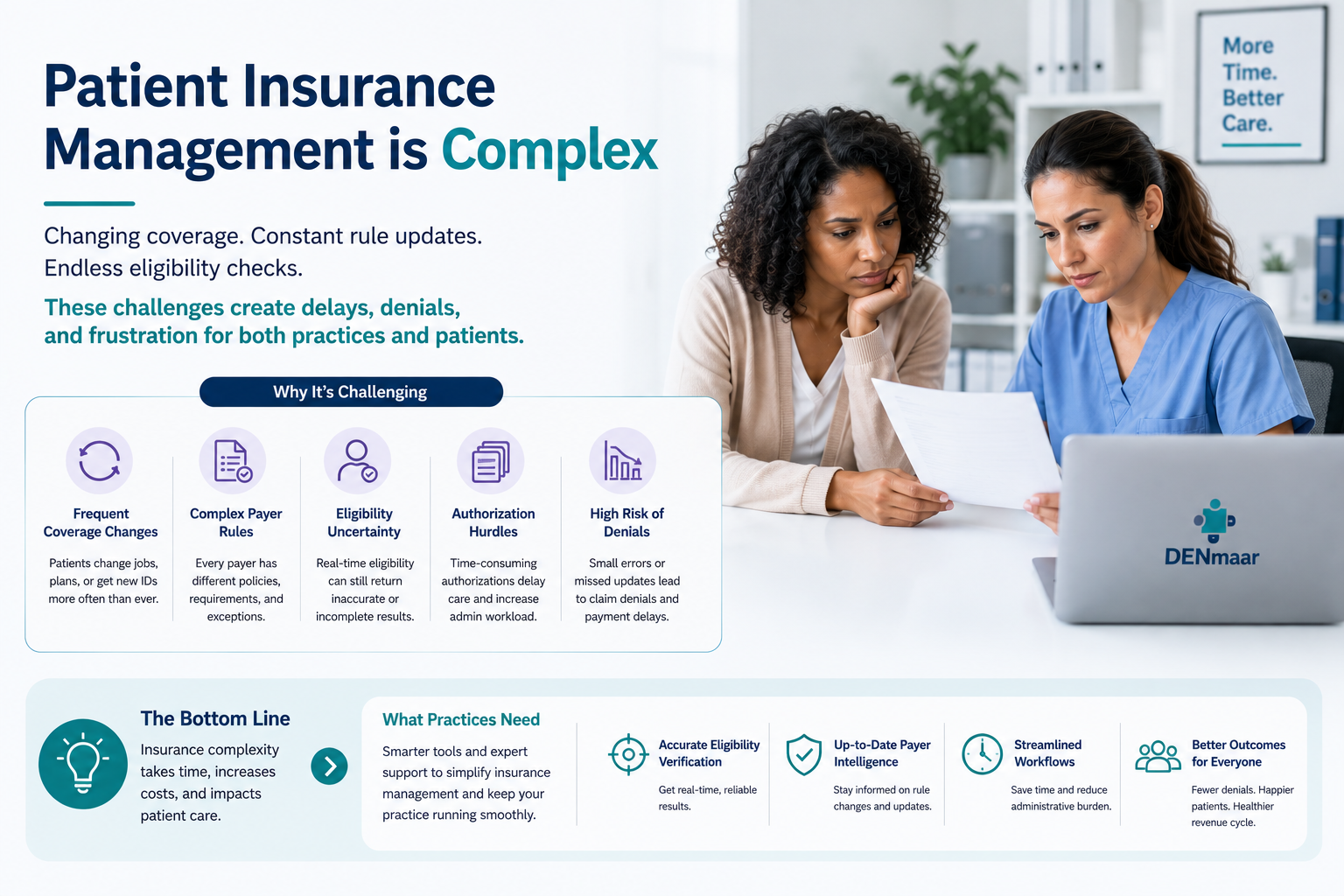
A patient’s insurance is not a static field. It is a changing timeline. Patients move between employer coverage, Medicaid, Medicare, Marketplace plans, and managed-care organizations. A plan may terminate, become secondary, or change administrators. A patient can remain covered by Medicaid while being assigned to a different managed-care plan with a new member number, provider network, and billing requirements.
Sometimes the patient does not know the change occurred. Sometimes the payer’s own records are not current. And sometimes a practice does not discover the problem until weeks after treatment, when the claim is denied.
Building software that can help practices manage this is extraordinarily challenging. It is also increasingly necessary.
Why Patient Insurance Management Is So Difficult
The information is constantly moving
The first difficulty is that there is no single, perfectly reliable source of truth.
The patient may provide an insurance card that appears active. An electronic eligibility response may show different coverage. The payer portal may contain newer information. A Medicaid system may show an assignment to a managed-care organization that has not yet reached every downstream system. Another insurer may claim to be secondary while its coordination-of-benefits records still identify it as primary.
Each source can be correct at one point in time and outdated at another.
Software therefore cannot simply overwrite the old insurance with the new insurance. It must understand effective dates, termination dates, coverage priority, verification dates, and the plan associated with each date of service. It must preserve history because a claim for a visit three months ago may need to be billed differently from a claim for today.
Eligibility Verification Does Not Answer Every Question
Electronic eligibility is essential, but it is not a complete solution.
An eligibility response may confirm that coverage exists without clearly resolving:
- Which plan is primary
- Whether behavioral-health benefits are administered by another company
- Whether the provider is in network
- Whether an authorization is required
- Whether the deductible has been met
- Whether another policy remains listed in the payer’s coordination-of-benefits records
- Whether a recent coverage change has propagated through every payer system
This is why a simple “active” indicator can give a practice false confidence. Coverage may be active while the claim is still directed to the wrong payer or missing information required for payment.
The Consequences Appear After Care Has Been Delivered
Insurance problems are especially damaging because they are often discovered after the appointment.
The provider has already treated the patient. The clinical note has been completed. Payroll may already have been calculated. Then the claim is denied because the patient changed plans, the payer believes another insurer is primary, or the member ID changed.
At that point, the practice must investigate the coverage, contact the patient, obtain a new card, update coordination of benefits, correct the claim, and resubmit it—often while facing a filing deadline.
For a behavioral-health practice providing ongoing weekly care, one unresolved insurance change can affect several visits before anyone recognizes the pattern. What appears to be one denial can quickly become a group of unpaid claims.
The Workflow Involves the Patient, Practice, Payer, and Billing Team
This is not only a data problem. It is a coordination problem.
A complete solution may need to:
- Reverify coverage before upcoming appointments
- Compare the current response with the insurance already on file
- Identify meaningful changes rather than merely displaying raw payer data
- Notify the appropriate practice staff
- Ask the patient to confirm coverage or upload a new card
- Prevent questionable claims from being sent prematurely
- Create a task when coordination of benefits must be corrected
- Track what was requested, who responded, and what remains unresolved
- Apply the corrected coverage to the appropriate dates of service
- Rebill affected claims without losing the original history
Every one of those actions touches a different part of the practice. If they are disconnected, staff end up managing the problem through spreadsheets, sticky notes, portal screenshots, emails, and memory.
That is exactly the operational fragmentation healthcare software should eliminate.
Why DENmaar Is Investing in This Problem
At DENmaar, we do not believe an EHR should merely store insurance information and leave the practice to manage everything that happens afterward.
Because we combine behavioral-health EHR, billing, credentialing, and operational support, we see the full effect of coverage changes. We see how inaccurate insurance information becomes a denied claim, how a denial becomes a patient balance, and how an unresolved coordination issue disrupts both revenue and care.
That experience is guiding the development of a more intelligent patient-insurance work area.
Our goal is to move beyond a static insurance screen toward a system that recognizes insurance as an ongoing operational process. The system should help practices see what changed, understand what action is required, communicate with the patient, protect affected claims, and follow the issue through resolution.
This will not be solved by a single button or one eligibility transaction. It requires thoughtful development, real billing experience, and continuous feedback from practices encountering these problems every day.
Difficult Problems Are Often the Ones Most Worth Solving
Developing this type of software is challenging precisely because healthcare coverage is complicated. Rules vary by payer and state. Data can arrive late. Patients may not understand their coverage. The same insurance issue can require a different response depending on the date of service and the type of plan.
But accepting that complexity as “just part of billing” is not good enough.
Practices should not have to discover insurance changes only after claims deny. Staff should not have to reconstruct coverage history manually. Providers should not be surprised months later that services were delivered under an inactive or incorrectly coordinated plan. Patients should receive timely requests for the information needed to keep their care and claims on track.
The solution will continue to evolve because the insurance environment continues to evolve. That is why DENmaar develops from actual practice and billing needs—not from a theoretical workflow.
We are building toward a system that does more than document care. We are building a system that helps the practice operate, recognize problems earlier, and take the next correct action.
Patient insurance may be one of the hardest areas to solve well. It is also one of the most important.
Frequently Asked Questions
What is patient insurance management?
Patient Insurance Management is the process of tracking coverage, eligibility, payer changes, benefits, and insurance requirements throughout care.
Why does insurance information change so often?
Patients can change employers, plans, payers, or Medicaid managed-care organizations, making insurance information difficult to keep current.
Does eligibility verification confirm everything?
No. Eligibility may confirm active coverage but may not resolve network status, authorization needs, payer priority, or coordination of benefits.
Why are insurance changes a billing problem?
Incorrect or outdated coverage can send claims to the wrong payer, causing denials, delayed reimbursement, rework, and increased administrative costs.
How can technology improve insurance management?
Technology can track coverage changes, identify issues earlier, notify staff, and connect insurance workflows with claims and billing.
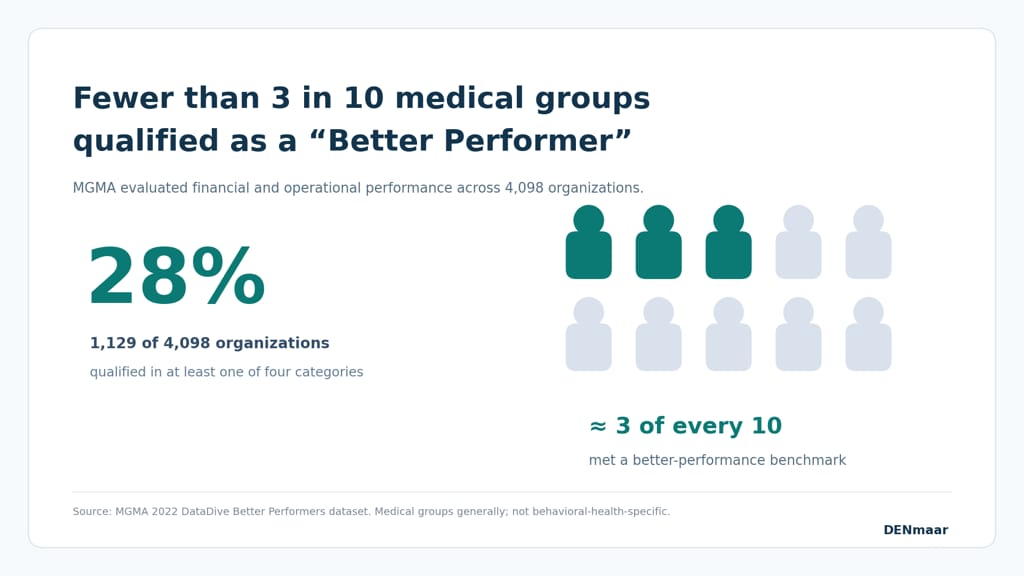
When Good Clinical Care Is Not Enough: Mental Health Practice Needs Better Business Processes
Mental health practices are built around helping people. Their owners are usually clinicians first, not operations executives, insurance specialists, or software designers.
That is understandable. But it also creates a common problem: a mental health practice may deliver excellent care while operating through inconsistent, fragmented, and highly manual business processes.
As the practice grows, those weaknesses become harder to ignore.
Patients wait too long for intake. Insurance information is incomplete. Eligibility is checked inconsistently. Copays are missed. Notes remain unfinished. Claims are delayed. Denials are handled reactively. Staff members spend their days moving between spreadsheets, payer portals, email, and disconnected software.
The practice is busy, but it is not necessarily operating well.
Most Practices Do Not Have a People Problem
In many cases, the staff is working extremely hard. The deeper issue is that the organization lacks a reliable operating process.
Important work may depend on someone remembering what to do next. Policies may exist verbally but not be built into the workflow. A task may be completed one way by one employee and differently by another. When an experienced employee leaves, essential operational knowledge can leave with them.
This produces predictable consequences:
- Patients fall out of the intake process.
- Appointments occur before benefits are properly verified.
- Required authorizations are missed or expire.
- Providers do not know which documentation needs attention.
- Claims are held because information is incomplete.
- Patient balances grow because collection policies are inconsistent.
- Owners lack clear visibility into what is working and what is not.
Hiring another employee may provide temporary relief, but it does not correct a broken process. Adding more technology does not necessarily solve it either, especially when that technology simply creates another place for employees to check.
An EHR Should Do More Than Store Information
Traditional EHR systems were largely designed as electronic filing cabinets. They store patient demographics, appointments, clinical notes, and billing information.
Those functions remain necessary, but they are no longer enough.
A modern behavioral health platform should help the mental health practice operate correctly. It should guide work from one stage to the next, identify exceptions, assign responsibility, and make unfinished work visible before it becomes a financial or patient service problem.
The goal is not to force every practice into an identical model. The goal is to ensure that critical steps do not depend on memory.
For example, a strong intake process should connect:
- The initial patient inquiry
- Demographic and insurance collection
- Eligibility and benefit verification
- Authorization requirements
- Provider matching and scheduling
- Required forms and assessments
- Copay or payment expectations
- Readiness for the first appointment
Each step affects the next. Treating them as separate administrative tasks creates gaps. Managing them as one complete process creates accountability.
The Same Principle Applies Across the Practice
The appointment to claim process should also operate as a connected workflow:
- The appointment occurs.
- The provider completes the required documentation.
- The system confirms that the note supports the service.
- Missing information is identified.
- The claim is released correctly.
- Payment or rejection is monitored.
- Unresolved claims are assigned for follow up.
- The final outcome is documented and visible.
When these steps are disconnected, staff must repeatedly reconstruct what happened. When they are connected, the system can guide the practice toward the next appropriate action.
Other processes deserve the same treatment:
- Copay determination, collection, and reconciliation
- Provider onboarding, credentialing, and payer readiness
- Authorization tracking and renewal
- Clinical supervision and note sign off
- Cancellation and rescheduling follow up
- Denial management and aging claim resolution
- Patient communications and outstanding requests
- Management reporting and staff accountability
Good Policies Must Become Daily Workflows
A written policy has limited value if employees must remember to look for it.
The strongest systems place the policy inside the work itself. They provide prompts at the correct moment, prevent avoidable omissions, route exceptions to the right person, and show managers where work has stalled.
That changes the role of technology. Instead of merely documenting what the practice did, the system helps the practice do it correctly.
It also creates consistency without requiring constant supervision. New employees learn a defined process. Experienced employees spend less time searching for information. Managers can focus on true exceptions instead of checking every routine task.
Better Processes Improve More Than Revenue
Operational discipline is sometimes viewed as a billing concern. In reality, it affects the entire patient and provider experience.
A patient benefits when the practice communicates clearly, understands coverage before treatment, sends forms on time, and follows up consistently. Providers benefit when administrative expectations are visible and documentation tasks are organized. Staff members benefit when responsibilities are clear and they are not forced to solve the same preventable problem repeatedly.
The financial benefits follow naturally: cleaner claims, faster submission, stronger collections, fewer avoidable denials, and less labor spent correcting errors.
Better processes also make growth safer. A practice should not have to multiply administrative confusion every time it adds providers, locations, or new services.
Building the Behavioral Health Operating System
At DENmaar, we believe behavioral health practices need more than separate EHR and billing tools. They need an operating system that connects clinical care, patient administration, insurance, billing, and follow up. A behavioral health technology partner can help bring these workflows together rather than leaving practices to manage disconnected systems.
Our work is increasingly focused on polishing these complete processes, not simply adding isolated features. That means studying how real practices operate, identifying where work breaks down, and building better policies directly into the platform.
For practices dealing with complex payer requirements, this connected approach can also extend to specialized insurance knowledge and payer support through DENmaar’s Insurance Knowledge Team.
It means making the next action clear, giving teams visibility into exceptions, and using automation and artificial intelligence where they can remove repetitive work without removing human judgment.
The future of behavioral health technology is not another screen filled with fields. It is a system that helps practices run well.
Excellent clinical care will always be the purpose of a mental health practice. Strong business processes are what allow that care to remain accessible, sustainable, and scalable.
Frequently Asked Questions
What is a mental health practice?
A mental health practice provides behavioral healthcare services while managing clinical, administrative, insurance, and financial operations.
Why do mental health practices need better processes?
Better processes reduce administrative errors, improve patient access, strengthen collections, and help practices scale more efficiently.
How can technology improve mental health practice operations?
Connected technology can automate repetitive work, guide workflows, identify exceptions, and give teams better visibility into unfinished tasks.
What business processes matter most in mental health practices?
Intake, eligibility, authorizations, documentation, billing, collections, follow up, credentialing, and staff accountability are all critical.
How can a mental health practice improve efficiency?
A practice can improve efficiency by connecting workflows, reducing manual work, standardizing processes, and making responsibilities visible.
Our Partners






Ready to get started?
Feel free to reach out if you have any questions.
