

- Therapy and medication management
- IOP, PHP, and SUD treatment programs
- Case management, community support, and residential services
DENmaar Revenue Cycle Intelligence
Claims Copilot ™
Stop Chasing Claims.
Start Preventing Problems.
Claims Copilot is DENmaar’s behavioral health revenue cycle solution
designed to help practices prevent claim issues before submission, reduce
aging, accelerate reimbursement, and improve operational performance.

Pre-Submission Claim Readiness

Payer Lifecycle Monitoring

Aging & Collections Visibility
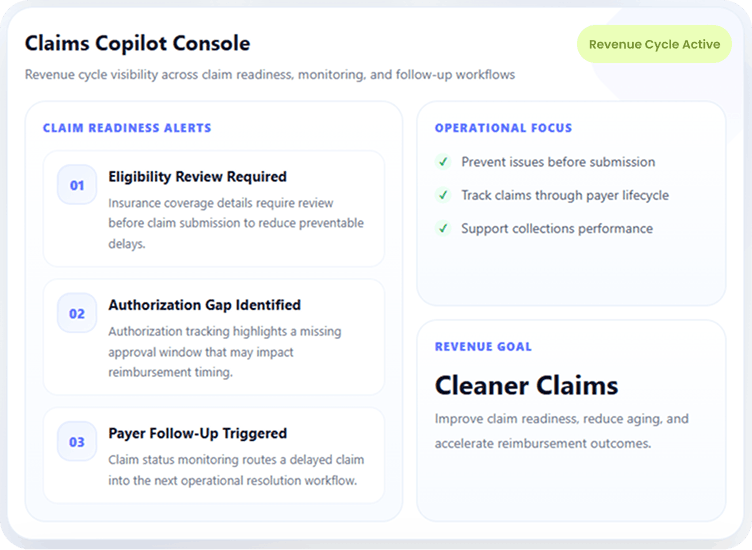
Pre-Submission Readiness
Catch eligibility, authorization, payer, and documentation issues before claims go out.
Lifecycle Claim Monitoring
Track claims after submission with rejection management, status visibility, and aging oversight.
Operational Performance
Support clean claim performance, reduce aged claims, and improve collections visibility.
Behavioral Health Focused
Designed for therapy, medication management, SUD, IOP/PHP, community support, and more.
Built for Behavioral Health
Designed for Behavioral Health
Revenue Cycle Workflows
Whether your organization provides therapy, medication management, IOP,
PHP, SUD treatment, case management, community support, or residential
services, Claims Copilot is built around the operational and reimbursement
realities of behavioral health.

Behavioral health support areas
Claims Copilot is positioned to support behavioral health organizations that need stronger claim readiness, reimbursement visibility, and operational follow-up across complex service lines.
Prevent Problems Before Claims Are Submitted
Address Revenue Cycle Breakdowns
Before They Turn Into Denials or Delays
Most claim problems begin long before a claim is submitted. Claims Copilot helps practices identify and
resolve those issues earlier so reimbursement performance is not undermined later.

Verify Insurance Eligibility
Confirm insurance coverage details early to reduce preventable reimbursement delays and billing confusion.

Review Insurance Information & ID Cards
Validate insurance information and supporting details so claims are built on more accurate payer data.

Track Authorizations
Monitor authorization requirements and approval status to reduce avoidable denials tied to missing coverage approvals.

Monitor Provider Credentialing Requirements
Support awareness of credentialing-related payer requirements that can affect billing and reimbursement workflows.

Identify Claim Issues Before Submission
Catch missing information, workflow gaps, and other claim barriers before the claim enters the payer lifecycle.

Improve Documentation-to-Billing Alignment
Route messages and requests to the appropriate team, department, or follow-up queue.
How Claims Copilot Works
A continuous workflow built to
support prevention, monitoring, and resolution.
Claims Copilot doesn’t stop at submission. It supports the operational work needed before the claim goes out, then continues
tracking activity through the payer lifecycle to help teams reduce delays, aging, and reimbursement bottlenecks.
1
Review claim readiness before submission
Insurance, eligibility, authorization, and workflow details are reviewed to identify claim risks before they become downstream reimbursement problems.
2
Submit claims and monitor payer activity
Once claims are submitted, Claims Copilot supports visibility into rejections, claim status, aging, and other signals that indicate a claim may require action.
3
Route follow-up through the right workflow
Operational tasks can be prioritized based on the issue—whether the next step involves internal follow-up, claim correction, payer research, or payment posting support.
From prevention to reimbursement performance.
Claims Copilot is designed to help organizations manage the full payer journey—not just claim submission. The result is a more proactive revenue cycle process with clearer visibility and fewer avoidable surprises.

Before submission:
improve readiness across insurance, authorizations, and documentation alignment

After submission:
monitor claim status, rejections, denial patterns, and aging across the payer lifecycle.

Operationally:
help teams reduce aging, recover delayed payments, and improve turnaround performance.
Monitor Claims Through the Entire Payer Lifecycle
Submitting claims is only the beginning.
Claims Copilot continuously tracks claim progress and supports the workflows needed to identify
reimbursement issues, respond to payer friction, and keep claims moving toward payment.

Claim Submission & Rejection Visibility
Support clean electronic claim submission while maintaining visibility into rejections and claim issues that need attention after submission.
- Electronic claim submission
- Rejection management support
- Visibility into claim readiness breakdowns

Status Monitoring & Aging Analysis
Track claims after submission to identify delays, payer inactivity, unresolved statuses, and aging trends that can impact collections.
- Claim status monitoring
- Aging analysis and prioritization
- Operational follow-up workflow visibility

Denials, Follow-Up & Payment Support
Improve follow-through on denied or delayed claims by supporting structured next steps across payer follow-up, resolution activity, and payment posting workflows.
- Denial tracking
- Follow-up workflow support
- Payment posting support
Reduce Aging and Improve Collections
Give your organization earlier visibility, better follow-through, and fewer preventable delays.
Many behavioral health organizations struggle with growing accounts receivable because claim issues are discovered too late. Claims Copilot helps teams stay ahead of the work required to keep reimbursement moving.

Reduce aged claims
improve readiness across insurance, authorizations, and documentation alignment.

Recover delayed payments
Identify unresolved payer issues sooner and reduce the amount of time claims spend waiting without meaningful action.

Improve turnaround and clean claim performance
Support stronger revenue cycle performance by reducing preventable breakdowns before and after submission.
A Partnership Approach
Successful revenue cycle management requires operational collaboration.
Many behavioral health organizations struggle with growing accounts receivable because claim issues are discovered too late. Claims Copilot helps teams stay ahead of the work required to keep reimbursement moving.

Before submission:
improve readiness across insurance, authorizations, and documentation alignment.

After submission:
monitor claim status, rejections, denial patterns, and aging across the payer lifecycle.

Operationally:
help teams reduce aging, recover delayed payments, and improve turnaround performance.
Included With DENmaar
Claims Copilot is part of the DENmaar
Behavioral Productivity Platform.
When DENmaar manages your insurance billing, your organization also gains access to the broader operational and clinical
platform that supports scheduling, documentation, reporting, and patient management workflows.

Behavioral Health EHR
Clinical and operational workflows designed around behavioral health documentation and care delivery.

Scheduling
Integrated scheduling workflows to support patient flow, operational visibility, and billing readiness.

Documentation Tools
Clinical notes, treatment plans, and documentation workflows that support stronger operational alignment.

AI-Assisted Notes
Support documentation efficiency while maintaining professional review and oversight workflows.

Treatment Plans
Behavioral health planning tools that connect care planning with documentation and operational workflows.

Clinical Workflows
Support multidisciplinary behavioral health processes with connected operational and clinical workflows.

Reporting
Visibility into productivity, claim performance, and operational trends across the platform.

Patient Management Tools
Connected workflows for patient registration, intake coordination, operational follow-up, and practice support.
Request an
AI Notes Trial
See how DENmaar AI Notes can help your clinicians reduce documentation time while improving
Request a demonstration or pilot program today.
Request Information
TESTIMONIALS
WHAT OUR CLIENTS SAY
On behalf of everyone at Meadowlark Counseling Services, I want to extend our sincere thanks for the continued improvements you and your team have made to the DENMaar EMR platform. We have been consistently impressed with both the functionality and user-friendly design of the system, which has made a meaningful difference in our day-to-day operations. The intuitive layout and ease of use have allowed our staff to spend less time navigating the system and more time focusing on client care. The regular updates and enhancements reflect your commitment to meeting the evolving needs of providers in the behavioral health and substance use treatment fields. We genuinely look forward to the new features introduced each month and appreciate how responsive the platform has been to the demands of clinical workflows. We have been so pleased with our experience that we’ve taken the opportunity to recommend DENMaar to other professionals in Pennsylvania who are working in the SUD field. Thank you again for your ongoing support and partnership. We are grateful to be working with a company that truly understands the needs of its users. KIndly, Becky Parks on behalf of the entire team at Meadowlark Counseling Services
I referred one of my colleagues Dr Aaron to you he is just starting g his psychology private practice and looking at where to start. I told him hands down you guys are the best billers and have a great EMR and team. He said he reached out just wanted to let you know!
FANTASTIC job keeping things rolling along with any and all of our billing concerns as well as responding to other issues which may well have been out of your wheelhouse. We are VERY grateful to have you and the crew in our corner.
I appreciate you all so much and DENmaar has been such a blessing Donna to our overall operations and success as an expanding company—allowing us to ultimately operate more efficiently, get our claims paid more consistently, ad stay on top of the critical credentialing piece, among other things. Teamwork does in fact, make the dream work. I’ll loop Chris/Isabella in on this message thread too, as I want All of your team to be aware of how much we appreciate our working relationship with DENmaar
Thank you for your diligence!! I appreciate it so much. Thank you Edwina…
Thank you so much Amy! I will be referring to DENmaar as often as I am asked about credentialing services.
Our Latest Blogs

Agentic AI in Behavioral Health: Helping Run Better Practices
Behavioral health practices have plenty of software. What they need is more help getting the work done.
An appointment needs confirmation. An intake packet remains incomplete. A provider has unsigned notes. A claim is waiting for information. Each issue may appear somewhere in the system, but someone still has to find it, understand it, and move it forward.
That is where agentic AI could make a meaningful difference in behavioral health.
How far away is it? Our view is that focused assistance is possible today. Dependable support across an entire organization will develop workflow by workflow.
From Answering Questions to Agentic AI Helping Complete Work
A chatbot gives people a conversational way to interact with software. An AI agent adds the ability to use approved tools, take steps toward a goal, check the results, and ask for help when needed.[1]
For a behavioral health practice, that could eventually mean asking:
“Help us prepare for tomorrow’s appointments.”
A connected agent could check for missing intake forms, identify records that need staff review, and prepare a prioritized task list. With the appropriate permissions and review process, it could also help initiate follow-up.
These are potential use cases, rather than capabilities we are announcing with our chatbot launch.
The value would come from reducing the effort between recognizing a problem and resolving it.
The Best Starting Points Are Everyday Tasks
We believe the most useful early applications will be specific, repeatable tasks with clear outcomes:
- Appointment preparation: Identify missing information before a visit.
- Provider workflow: Organize outstanding documentation and follow-up tasks.
- Billing coordination: Surface incomplete information holding up a claim and route it to the right person.
- Practice management: Summarize outstanding work so leaders can see where attention is needed.
Consider an unsigned note. Today, a staff member may discover it, locate the provider, send a reminder, and check again later. A future agent could help coordinate that sequence, while the provider remains responsible for reviewing and signing the documentation.
Small improvements like these could add up across a busy practice.
The Challenge Is Connecting Agentic AI to Real Operations
A convincing conversation is only the beginning.
To act reliably, AI needs access to the right information, permission to perform specific tasks, and a way to verify that its actions succeeded. Staff need to see what happened and intervene when something requires judgment.
A missing form and a clinical decision require different levels of oversight. Our approach is to start with bounded administrative work and expand only as each use case proves useful and dependable.
Success should be measured through fewer manual touches, less outstanding work, and more time available for patient care.
DENmaar’s Next Step Begins This Month
This month, DENmaar will introduce a chatbot feature.
That launch is an initial step toward making interaction with our system more conversational. It will also give us an opportunity to learn which questions and requests matter most to the practices using it.
From there, our direction is to identify specific workflows where AI can provide useful assistance, then build and evaluate those capabilities deliberately.
We see a practical path forward: begin with conversation, connect it to useful information, and progressively enable carefully defined actions.
For practices looking at a broader operating model for behavioral health, the opportunity is to connect AI assistance with the workflows that already move patients and work through the organization.
Behavioral health practices deserve technology that helps work move forward. Agentic AI brings that possibility closer, and everyday practice workflows are where we believe it can earn its place.
Background Source
[1] Anthropic, Trustworthy agents in practice. Supports the distinction between conversational assistance and agents that plan, use tools, check results, and seek human input. The proposed behavioral health use cases and DENmaar development direction above are editorial projections, not claims of currently released agent capabilities.
Frequently Asked Questions
What is agentic AI in behavioral health?
Agentic AI can help complete defined tasks, use approved tools, check results, and escalate work when human judgment is needed.
How can agentic AI help behavioral health practices?
It could help organize appointments, documentation, billing tasks, and other repeatable workflows while keeping staff involved in important decisions.
Is agentic AI available in healthcare today?
Focused AI assistance is already possible, while broader agentic workflows are developing gradually with defined permissions and human oversight.
What is the difference between AI and an AI agent?
AI can generate or analyze information. An AI agent can also use approved tools, take actions, check results, and seek human input.
How should practices adopt agentic AI?
Start with specific, repeatable administrative workflows where outcomes are clear, then expand as each use case proves useful and dependable.

A Connected Operating Model for Behavioral Health Practices: The Patient to Payment Cycle
A behavioral health practice does not operate as a collection of separate departments. A patient enters through a call, a message, a referral, or an online request. That interaction starts a chain of work that continues through scheduling, insurance, care, documentation, billing, and payment.
Most technology divides that chain into separate tools and queues. The front office answers the call. A scheduler books the appointment. Clinical staff document the service. Billers determine whether the claim can be submitted. When information is missing, people send messages, update spreadsheets, and wait for replies.
The problem is not that each person failed to do a task. The problem is that no system owns the complete journey. DENmaar calls that journey the Patient-to-Payment Cycle. It provides one operating model for moving every patient from first contact through completed care and collected revenue.
One Operating Model for Behavioral Health
The Patient-to-Payment Cycle connects patient access, clinical operations, and revenue cycle management. Each step prepares the next one. Information captured during the first conversation should support scheduling. Scheduling should initiate intake and insurance verification. The completed visit should trigger documentation, claim validation, submission, payment posting, and follow-up.
When these functions share the same workflow, staff no longer need to reconstruct what happened. The system can show the current status, identify what is missing, assign the next action, and measure the revenue affected by a delay.
AI Receptionist Begins the Cycle
The AI Receptionist is the front door. Its purpose is broader than answering the telephone. It should recognize the patient’s need, identify whether the practice can serve that patient, match the request to the right provider, schedule the appointment, collect insurance information, and begin intake.
A standalone voice assistant can take a message. An integrated receptionist can act on the practice’s real operating information: provider availability, specialties, state licenses, accepted plans, appointment rules, and service requirements. That difference determines whether automation reduces work or merely creates another queue for staff to review.
The Visit Must Be Ready Before It Begins
An appointment on the calendar is not necessarily ready for care. Eligibility may be inactive. Authorization may be missing. The selected provider may not be enrolled with the patient’s plan. Intake forms or insurance cards may still be incomplete.
A connected system should identify those issues before the appointment. Routine gaps can trigger automated reminders or requests. Only unusual situations should reach staff. This allows the practice to protect the patient’s experience while reducing the manual work that normally surrounds each visit.
Documentation Becomes Part of Revenue Integrity
Clinical documentation is often treated as a separate obligation. In practice, it is one of the conditions required for payment. The provider needs a clear work area showing today’s patients, notes due, treatment plans requiring review, assessments, authorization limits, and supervisor signatures.
AI-enabled practice operating systems can help draft and organize documentation, but the larger benefit comes from placing that assistance inside the operating workflow. The system should know which document is required, why it matters, and whether the encounter is ready to become a claim.
Clean Claims Start Before Submission
Traditional billing processes often discover problems after a payer rejects or denies the claim. The Patient-to-Payment Cycle moves that intelligence earlier. Before submission, the system can check eligibility, authorization, provider enrollment, required documentation, procedure codes, and modifiers, place of service, diagnosis compatibility, duplicates, and filing deadlines.
After submission, the same workflow should monitor acknowledgments, remittances, rejections, denials, underpayments, and stalled claims. When intervention is required, the system should explain the problem, recommend the next action, and route it to the right person.
People Should Manage Exceptions
Reducing administrative work does not require removing people from the process. It requires using their judgment where it has the most value. Routine, high-confidence actions can occur automatically. Unusual situations can be prepared for one-click approval. Complex clinical, payer, or credentialing issues can be escalated with the relevant information already assembled.
This changes the daily question from what work is waiting to what requires human judgment. Practice leaders gain a clearer view of blocked revenue, repeated workflow failures, provider bottlenecks, and the percentage of appointments reaching payment without billing intervention.
The System Improves Through Use
Every completed cycle produces useful operational knowledge. The platform learns which payer rules matter, which documentation gaps delay claims, which rejection patterns recur, and which actions lead to payment. Over time, work can move from manual handling to recommended action and then to automation.
That accumulated payer and workflow knowledge is more durable than any individual AI feature. It reflects the real behavior of behavioral health practices, providers, patients, claims, and insurance plans inside one connected process.
A Simpler Standard for Practice Technology
Behavioral health practices operating system should expect their technology to do more than store records and present task lists. The platform should actively move work forward, complete routine actions, and bring people into the process when their attention is genuinely needed.
The Patient-to-Payment Cycle gives DENmaar a clear standard for every product decision: does this capability help a patient reach care and help the practice collect the revenue earned for that care? When the answer is yes, it belongs in the core operating system.
DENmaar connects patient access, clinical workflow, insurance intelligence, and revenue cycle operations in one behavioral health platform.
Learn how DENmaar can help your practice manage the complete Patient-to-Payment Cycle.
Frequently Asked Questions
What is an operating model for behavioral health?
An operating model for behavioral health connects patient access, clinical care, insurance, billing, claims, and payment in one workflow.
What is the Patient-to-Payment Cycle?
It connects the patient’s first contact with scheduling, care, documentation, billing, claims, and collected revenue.
How can AI improve behavioral health workflows?
AI can automate routine work, identify missing information, organize tasks, and help staff focus on exceptions requiring human judgment.
Why should claims be checked before submission?
Pre-submission checks can identify eligibility, authorization, documentation, coding, and other issues before they cause claim delays or denials.
What should behavioral health technology connect?
It should connect patient access, scheduling, clinical documentation, insurance, billing, claims, credentialing, and revenue cycle operations.
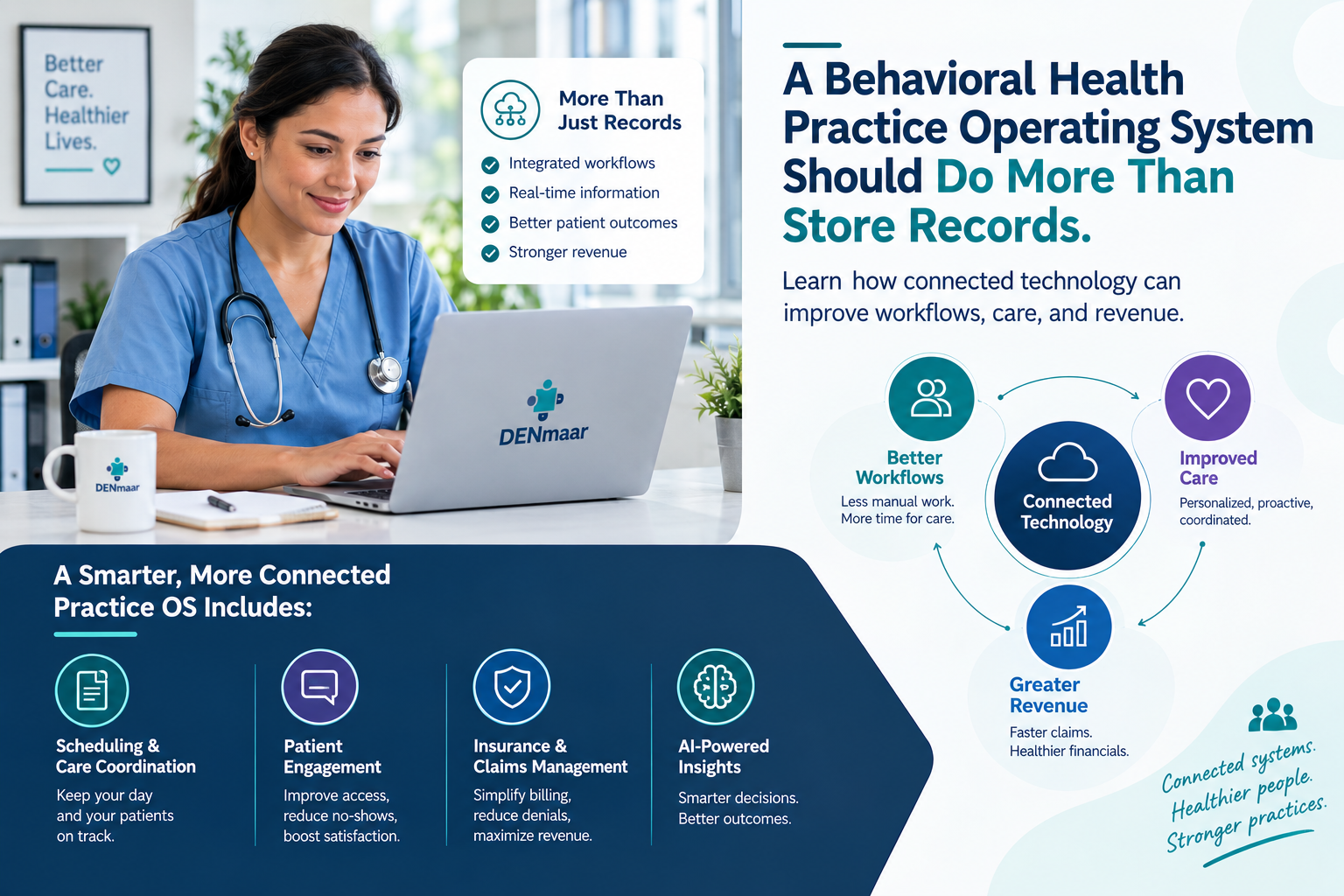
Your EHR Should Help Run the Practice, Not Just Store the Record
For years, electronic health records have been designed primarily as storage systems.
They store patient demographics, appointments, insurance information, assessments, treatment plans, progress notes, and billing records. That was an important improvement over paper charts, but it is no longer enough.
Behavioral health practices don’t simply need a place to keep information. They need a system that understands what the information means, recognizes what needs to happen next, and helps move the practice forward.
The future of the EHR is not a larger database with more menus.
It is an intelligent operating system for the practice.
The Real Work Is Often Invisible
A provider may finish a session, but that does not mean the work is complete.
The progress note may still need to be signed. The treatment plan may require an update. An authorization could be approaching its limit. A supervisor may need to review the documentation. The patient’s insurance may have changed. A claim could be waiting on a correction that no one has identified yet.
Traditional EHRs record each piece of this information, but they rarely connect it into a clear workflow.
As a result, practices rely on spreadsheets, reports, emails, sticky notes, and staff members remembering what must happen next. The information exists, but the system is not helping the practice act on it.
That creates invisible administrative work throughout the organization.
Providers spend time searching for unfinished documentation. Billers investigate problems after claims are rejected. Administrative staff track authorizations manually. Owners look through multiple reports trying to understand the health of the practice.
A modern EHR should bring that work to the right person before it becomes a problem.
From Passive Records to Active Guidance
Imagine a provider starting the day with one intelligent work area that clearly shows:
- Notes that still need to be completed or signed
- Treatment plans that are due for review
- Assessments requiring follow-up
- Authorizations approaching their visit limits
- Documentation returned by a supervisor
- Patients whose clinical information requires attention
- Tasks that could delay billing or reimbursement
Instead of searching through the system, the provider immediately knows what requires attention.
Better yet, the provider should be able to ask the system a simple question:
“What do I need to complete today?”
That is where artificial intelligence becomes genuinely useful.
AI should not merely generate more words. It should understand the provider’s responsibilities, organize the work, identify missing information, and help the provider complete each task efficiently.
The goal is not to replace clinical judgment. The goal is to protect the provider’s time so that more of it can be spent exercising that judgment.
Treatment Plans Should Be Living Clinical Tools
Treatment plans are a good example of how disconnected many EHR workflows remain.
A patient completes standardized assessments. The clinician establishes a diagnosis. Goals and interventions are documented in the treatment plan. Progress is later described in individual notes.
Yet these elements often exist as separate documents with little meaningful connection between them.
An intelligent system should help the clinician create an evidence-based treatment plan using the patient’s diagnosis, presenting concerns, assessment results, and appropriate clinical approaches. It should then help measure progress against that plan over time.
If symptoms improve, the treatment plan should reflect that progress. If assessment scores worsen, the system should bring it to the provider’s attention. If the documentation is no longer aligned with the stated goals, the provider should know before an audit or payer review discovers it.
The treatment plan should guide care, not simply satisfy a documentation requirement.
Clinical Care and Billing Are One Continuous Workflow
Many EHR companies treat clinical documentation and billing as two separate activities.
In reality, they are part of one continuous process.
The appointment affects eligibility and authorization. The service provided determines the documentation requirements. The note supports the diagnosis and procedure code. The completed documentation supports the claim. The claim produces payment, or creates additional work when something is missing.
When these steps are disconnected, problems are discovered too late.
An intelligent practice system should identify potential issues before the claim is submitted. It should recognize missing documentation, incomplete insurance information, authorization concerns, coding inconsistencies, and other conditions that could delay reimbursement.
That is far more valuable than simply reporting a denial after it has occurred.
For practices that need additional support across this process, integrated behavioral health billing can help connect documentation, claims, and revenue-cycle activities.
The System Should Coordinate the Practice
The next generation of behavioral health technology must go beyond recordkeeping.
It should help coordinate:
- Patient intake and communication
- Scheduling and insurance verification
- Clinical assessments and treatment planning
- Provider documentation and supervision
- Authorizations and utilization
- Claims submission and follow-up
- Patient balances and collections
- Credentialing and payer participation
- Operational and financial performance
This does not mean overwhelming users with more dashboards.
It means presenting each person with the specific information and actions relevant to their role. Providers should see provider work. Billing staff should see billing work. Practice leaders should see the few issues and trends that require leadership attention.
The system should reduce complexity, not display it.
Building the Practice Operating System
At DENmaar, we believe the traditional EHR is becoming obsolete.
Behavioral health practices need more than software that documents what already happened. They need a platform that helps determine what should happen next.
That means combining clinical documentation, evidence-based treatment planning, provider workflow, patient communication, insurance knowledge, and revenue-cycle management into one coordinated system.
Our vision is straightforward:
The system should run the practice, not force the practice to run the system.
The behavioral health organizations that thrive will not be the ones with the most software. They will be the ones whose technology quietly organizes the work, protects their providers, strengthens clinical care, and keeps revenue moving.
That is what the EHR should have become long ago.
It is what we are building now.
Frequently Asked Questions
What is a behavioral health practice operating system?
It is a connected system that coordinates clinical, administrative, insurance, billing, and operational workflows.
How can an EHR help run a practice?
An EHR can guide tasks, identify missing information, connect workflows, and show staff what requires attention next.
Why should clinical care and billing be connected?
Connected workflows help identify documentation, authorization, insurance, and coding issues before they delay claim submission or payment.
How can AI support behavioral health providers?
AI can organize responsibilities, identify incomplete work, assist documentation, and reduce repetitive administrative tasks.
What should modern behavioral health technology provide?
Modern technology should connect patient access, documentation, billing, credentialing, insurance, and practice performance without unnecessary complexity.
Our Partners






Ready to get started?
Feel free to reach out if you have any questions.
