

- Therapy and medication management
- IOP, PHP, and SUD treatment programs
- Case management, community support, and residential services
DENmaar Revenue Cycle Intelligence
Claims Copilot ™
Stop Chasing Claims.
Start Preventing Problems.
Claims Copilot is DENmaar’s behavioral health revenue cycle solution
designed to help practices prevent claim issues before submission, reduce
aging, accelerate reimbursement, and improve operational performance.

Pre-Submission Claim Readiness

Payer Lifecycle Monitoring

Aging & Collections Visibility
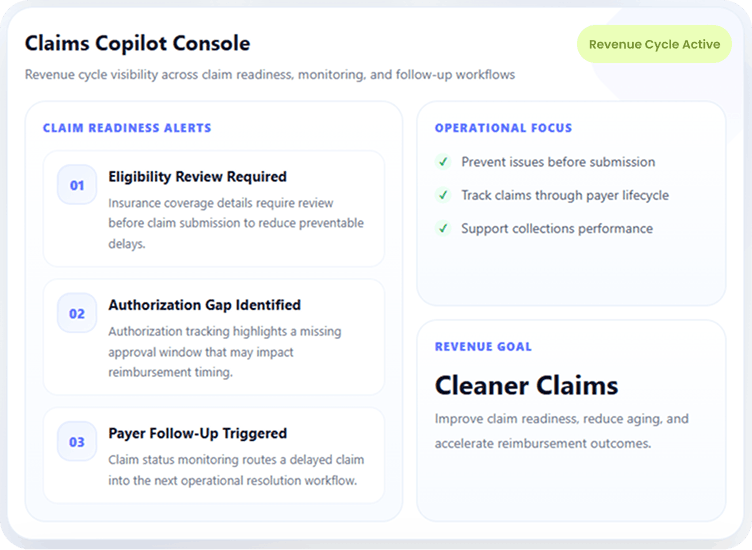
Pre-Submission Readiness
Catch eligibility, authorization, payer, and documentation issues before claims go out.
Lifecycle Claim Monitoring
Track claims after submission with rejection management, status visibility, and aging oversight.
Operational Performance
Support clean claim performance, reduce aged claims, and improve collections visibility.
Behavioral Health Focused
Designed for therapy, medication management, SUD, IOP/PHP, community support, and more.
Built for Behavioral Health
Designed for Behavioral Health
Revenue Cycle Workflows
Whether your organization provides therapy, medication management, IOP,
PHP, SUD treatment, case management, community support, or residential
services, Claims Copilot is built around the operational and reimbursement
realities of behavioral health.

Behavioral health support areas
Claims Copilot is positioned to support behavioral health organizations that need stronger claim readiness, reimbursement visibility, and operational follow-up across complex service lines.
Prevent Problems Before Claims Are Submitted
Address Revenue Cycle Breakdowns
Before They Turn Into Denials or Delays
Most claim problems begin long before a claim is submitted. Claims Copilot helps practices identify and
resolve those issues earlier so reimbursement performance is not undermined later.

Verify Insurance Eligibility
Confirm insurance coverage details early to reduce preventable reimbursement delays and billing confusion.

Review Insurance Information & ID Cards
Validate insurance information and supporting details so claims are built on more accurate payer data.

Track Authorizations
Monitor authorization requirements and approval status to reduce avoidable denials tied to missing coverage approvals.

Monitor Provider Credentialing Requirements
Support awareness of credentialing-related payer requirements that can affect billing and reimbursement workflows.

Identify Claim Issues Before Submission
Catch missing information, workflow gaps, and other claim barriers before the claim enters the payer lifecycle.

Improve Documentation-to-Billing Alignment
Route messages and requests to the appropriate team, department, or follow-up queue.
How Claims Copilot Works
A continuous workflow built to
support prevention, monitoring, and resolution.
Claims Copilot doesn’t stop at submission. It supports the operational work needed before the claim goes out, then continues
tracking activity through the payer lifecycle to help teams reduce delays, aging, and reimbursement bottlenecks.
1
Review claim readiness before submission
Insurance, eligibility, authorization, and workflow details are reviewed to identify claim risks before they become downstream reimbursement problems.
2
Submit claims and monitor payer activity
Once claims are submitted, Claims Copilot supports visibility into rejections, claim status, aging, and other signals that indicate a claim may require action.
3
Route follow-up through the right workflow
Operational tasks can be prioritized based on the issue—whether the next step involves internal follow-up, claim correction, payer research, or payment posting support.
From prevention to reimbursement performance.
Claims Copilot is designed to help organizations manage the full payer journey—not just claim submission. The result is a more proactive revenue cycle process with clearer visibility and fewer avoidable surprises.

Before submission:
improve readiness across insurance, authorizations, and documentation alignment

After submission:
monitor claim status, rejections, denial patterns, and aging across the payer lifecycle.

Operationally:
help teams reduce aging, recover delayed payments, and improve turnaround performance.
Monitor Claims Through the Entire Payer Lifecycle
Submitting claims is only the beginning.
Claims Copilot continuously tracks claim progress and supports the workflows needed to identify
reimbursement issues, respond to payer friction, and keep claims moving toward payment.

Claim Submission & Rejection Visibility
Support clean electronic claim submission while maintaining visibility into rejections and claim issues that need attention after submission.
- Electronic claim submission
- Rejection management support
- Visibility into claim readiness breakdowns

Status Monitoring & Aging Analysis
Track claims after submission to identify delays, payer inactivity, unresolved statuses, and aging trends that can impact collections.
- Claim status monitoring
- Aging analysis and prioritization
- Operational follow-up workflow visibility

Denials, Follow-Up & Payment Support
Improve follow-through on denied or delayed claims by supporting structured next steps across payer follow-up, resolution activity, and payment posting workflows.
- Denial tracking
- Follow-up workflow support
- Payment posting support
Reduce Aging and Improve Collections
Give your organization earlier visibility, better follow-through, and fewer preventable delays.
Many behavioral health organizations struggle with growing accounts receivable because claim issues are discovered too late. Claims Copilot helps teams stay ahead of the work required to keep reimbursement moving.

Reduce aged claims
improve readiness across insurance, authorizations, and documentation alignment.

Recover delayed payments
Identify unresolved payer issues sooner and reduce the amount of time claims spend waiting without meaningful action.

Improve turnaround and clean claim performance
Support stronger revenue cycle performance by reducing preventable breakdowns before and after submission.
A Partnership Approach
Successful revenue cycle management requires operational collaboration.
Many behavioral health organizations struggle with growing accounts receivable because claim issues are discovered too late. Claims Copilot helps teams stay ahead of the work required to keep reimbursement moving.

Before submission:
improve readiness across insurance, authorizations, and documentation alignment.

After submission:
monitor claim status, rejections, denial patterns, and aging across the payer lifecycle.

Operationally:
help teams reduce aging, recover delayed payments, and improve turnaround performance.
Included With DENmaar
Claims Copilot is part of the DENmaar
Behavioral Productivity Platform.
When DENmaar manages your insurance billing, your organization also gains access to the broader operational and clinical
platform that supports scheduling, documentation, reporting, and patient management workflows.

Behavioral Health EHR
Clinical and operational workflows designed around behavioral health documentation and care delivery.

Scheduling
Integrated scheduling workflows to support patient flow, operational visibility, and billing readiness.

Documentation Tools
Clinical notes, treatment plans, and documentation workflows that support stronger operational alignment.

AI-Assisted Notes
Support documentation efficiency while maintaining professional review and oversight workflows.

Treatment Plans
Behavioral health planning tools that connect care planning with documentation and operational workflows.

Clinical Workflows
Support multidisciplinary behavioral health processes with connected operational and clinical workflows.

Reporting
Visibility into productivity, claim performance, and operational trends across the platform.

Patient Management Tools
Connected workflows for patient registration, intake coordination, operational follow-up, and practice support.
Request an
AI Notes Trial
See how DENmaar AI Notes can help your clinicians reduce documentation time while improving
Request a demonstration or pilot program today.
Request Information
TESTIMONIALS
WHAT OUR CLIENTS SAY
On behalf of everyone at Meadowlark Counseling Services, I want to extend our sincere thanks for the continued improvements you and your team have made to the DENMaar EMR platform. We have been consistently impressed with both the functionality and user-friendly design of the system, which has made a meaningful difference in our day-to-day operations. The intuitive layout and ease of use have allowed our staff to spend less time navigating the system and more time focusing on client care. The regular updates and enhancements reflect your commitment to meeting the evolving needs of providers in the behavioral health and substance use treatment fields. We genuinely look forward to the new features introduced each month and appreciate how responsive the platform has been to the demands of clinical workflows. We have been so pleased with our experience that we’ve taken the opportunity to recommend DENMaar to other professionals in Pennsylvania who are working in the SUD field. Thank you again for your ongoing support and partnership. We are grateful to be working with a company that truly understands the needs of its users. KIndly, Becky Parks on behalf of the entire team at Meadowlark Counseling Services
I referred one of my colleagues Dr Aaron to you he is just starting g his psychology private practice and looking at where to start. I told him hands down you guys are the best billers and have a great EMR and team. He said he reached out just wanted to let you know!
FANTASTIC job keeping things rolling along with any and all of our billing concerns as well as responding to other issues which may well have been out of your wheelhouse. We are VERY grateful to have you and the crew in our corner.
I appreciate you all so much and DENmaar has been such a blessing Donna to our overall operations and success as an expanding company—allowing us to ultimately operate more efficiently, get our claims paid more consistently, ad stay on top of the critical credentialing piece, among other things. Teamwork does in fact, make the dream work. I’ll loop Chris/Isabella in on this message thread too, as I want All of your team to be aware of how much we appreciate our working relationship with DENmaar
Thank you for your diligence!! I appreciate it so much. Thank you Edwina…
Thank you so much Amy! I will be referring to DENmaar as often as I am asked about credentialing services.
Our Latest Blogs

Behavioral Health Notes: Types, Formats, and Best Practices
As you are here, you must be starting your mental health practice or working to improve it, and writing behavioral health notes is an important aspect of that.
Therapists, counselors, and mental health practitioners must take these notes when they entertain a patient. These notes help practitioners in providing better service, stay compliant, and develop the required connection with patients.
If you don’t write these notes, you can only work with clients if you are a mnemonist. Otherwise, every time you see the client, you’ll need a recap and shake off your mind to get the details out and progress further.
Before going into much detail, let’s first understand its definition.
What’s Behavioral Health Notes?
Behavioral health notes are clinical records that practitioners document while providing patients with treatment. It contains the patient’s mental, emotional, and behavioral health status, treatment progress, and interventions.
These notes help healthcare providers track patient well-being, assess treatment’s effectiveness, and ensure high-quality care.
According to a study conducted by Psychiatric Services, 49% of patients felt in control of their healthcare due to behavioral health notes. The study also concluded that the notes helped 45% of participants build better trust in their practitioners.
This shows that these notes are exceptionally beneficial. Now, let’s have a deeper look at its importance.
Importance of Behavioral Health Notes
There are several benefits that you can get from documenting behavioral health notes. Some of them are stated here:
- Provide Better Care and Treatment: Mental health progress notes allow you to continuously track a client’s treatment without remembering all the details of every session, which is impossible. Your notes allow you to identify patterns in a client’s thoughts and feelings, which allows you to personalize the treatment and move it in the right direction. Overall, these notes will act as your guiding light in providing effective care.
- Remembering Patient Details: During a session, patients can mention multiple details that they have mentioned before but don’t remember and can’t relate to or understand the situation. Rather than wasting time asking the client to repeat the information, you can find the information from the therapy notes and get an instant understanding.
- Avoid Troubles in Reimbursement: therapy health notes act as proof of the service provided to the patient. Many insurance companies mandate submitting these notes to get reimbursement. And, even if they don’t, it’s always better to be on the safe side and ready to provide the details. You can read the complete guide to Insurance Credentialing to know more about this aspect.
- Unified Healthcare Service: When you take the therapy progress notes and store them in electronic health record (EHR) system, they can be easily shared with the other healthcare professionals whom your patient visits. It help them to check the mental health history, current treatment, and medication, and take an informed decision.
- Evidence in Lawsuits: If any of your patients files a complaint against you, therapy notes can be used as evidence stating the condition of your patient and the treatment you provided.

Behavioral Health Notes are Essential for Insurance Claims
Types of Behavioral Health Notes
There are multiple types of behavioral health notes that practitioners need to document based on the stage of the treatment. These notes can be defined under five different types:
- Assessments: These notes are useful at the initial stage of the treatment when the therapist needs to learn about the clients, understand the medical condition, and form a treatment roadmap. The assessment can be done periodically as well to re-evaluate the condition and edit the roadmap accordingly.
- Psychotherapy Notes: Though these are optional behavioral therapy notes, it is important to document them for perform the treatment better. These notes contain sensitive information about the client’s behavior and must be kept private from the client to avoid their influence on the treatment.
- Progress Notes: These notes are the core notes, containing the details of the session, the client’s treatment, progress, etc. These should be stored in the EHR system and can be shared with relevant parties as and when needed. One must add the progress note during or immediately after the session to ensure the information is accurate and concise.
- Treatment Plan: Though the treatment information can be part of the assessment and progress notes, a dedicated document is recommended. It contains a roadmap starting from the current situation to the goal set during the initial assessment. It also contains general information about the client, the mental health history, and the timeline for the set goal.
- Discharge summary: After the treatment is completed and the goal is achieved, the clinician provides patients with a discharge summary containing the details of the treatment, the condition at the time of discharge, post-discharge instructions, and the follow-up plan.
Common Formats for Behavioral Health Notes
There are different formats for documenting behavioral health notes, such as SOAP, DAP, and BIRP. These formats are developed to record information in a logical and easy-to-comprehend manner. However, there’s no one “right” format to write the therapy notes. You can choose the one that fits your approach and client goals. If required, you can even mix different formats to create a suitable one.

For now, we will discuss the formats which are widely accepted and used.
SOAP Notes
SOAP is one of the widely used formats that’s adopted due to the flexibility it offers. It coves all the key areas of the treatment, making sure that even the minor details get accommodated.
- Subjective (S): It includes the clients’ own assessment of their feelings and behavior since the last visit or while taking the session.
- Objective (O): This includes the clinician’s objective assessment of a client’s behavior, appearance, or any other measurable data.
- Assessment (A): The therapist’s assessment must include the professional evaluation of the subjective and objective aspects to diagnose clients and severity of condition and how it has changed with sessions.
- Plan (P): As the name suggests, it includes the treatment plan as you move forward, the upcoming interventions, tasks, and thoughts to convey to the client.
DAP Notes
DAP format is somewhat similar to SOAP. It is much simplified as it combines subjective and objective aspects into one single category, “Data.”
- Data (D): It includes everything that has happened in a session, combining the subjective information conveyed by the client during the session and objective observations by the clinician.
- Assessment (A): It is similar to SOAP’s assessment. Under this aspect, the clinician conducts the assessment of the data category and concludes the client’s condition, changes in diagnosis, improvements, etc.
- Plan (P): The plan category is always the same in any format. It suggests the actions to be taken while moving forward in diagnosis.
BIRP Notes
BIRP format is a unique approach that allows documentation of much more detailed ones.
- Behavior (B): This is similar to the data stage, which includes the client’s subjective feelings and the therapist’s objective assessment, combined to define the client’s behavior.
- Intervention (I): This section documents the intervention or therapeutic action that the clinician takes during the session to improve the behavior of the client.
- Response (R): This category is used to document the patient’s response to the therapeutic treatment during the session. The response can be connected with the behavior of the next session to understand whether the intervention was helpful or requires certain changes before continuing.
- Plan (P): Plan is the same as it is SOAP and DAP formats. It helps you define the overall treatment plan by understanding the connection between behavior, intervention, and response.
Best Practices in Behavioral Health Notes
Writing these health notes is an essential clinical skill. There are certain best practices a therapist must follow to ensure that the therapy progress notes are accurate, effective, and to the point.
- Document the notes while the therapy session is in progress or just after it ends while details are fresh in your memory, reducing the risk of missing essential information.
- Always stick to observable facts, and don’t let your personal opinion or assumption cause misjudgment.
- Follow a structured format such as SOAP (Subjective, Objective, Assessment, Plan) or DAP (Data, Assessment, Plan) to ensure consistency and clarity in the documentation.
- Ensure compliance with HIPAA and other legal guidelines by keeping the client’s details safe and secure.
- Use neutral tone in the documentation, free from jargon, slang, or emotionally charged wording to ensure professionalism.
- Always document treatment objectives and measurable goals in the plan. After every session mark the progress towards them.
- Keep the notes prepared for legal scrutiny by keeping the documentation well-defined, accurate, and professional as if they could be reviewed in court.
Write Better and Faster Behavioral Health Notes With DENmaar
Using DENmaar can significantly enhance the efficiency, accuracy, and security of health notes. Our tool streamlines the documentation process by providing structured templates, and automation, and ensures compliance.
With DENMaar, you can choose various formats such as SOAP, DAP, and BIRP to ensure consistency in note-taking along with enough customization to fit individual client needs.
Besides that, DENmaar ensures that all records are encrypted, securely stored, and meet legal compliance requirements such as HIPAA.
You can also improve the service by features such as follow-ups and reminders and provide clients with maximum benefits.
Closing
It is essential to effectively document behavioral health notes to provide quality care, ensure continuity, and maintain legal and ethical compliance. By understanding the various therapy note types, and formats (such as SOAP and DAP), and following best practices such as objectivity, timeliness, and confidentiality, therapists can create clear and useful records.
Leveraging technology, such as using DENmaar software, can further enhance efficiency and accuracy in note-taking. Well-documented notes support better client outcomes and build reputation and credibility.
Sign up With DENmaar
Document Behavioral Health Notes With Precision
Frequently Asked Questions
What are mental health notes?
Mental health notes is the documentation done by clinicians during the therapy session where they use different formats to write the details of the session, assessment of the client’s behavior, and treatment plan.
How to write mental health notes?
Follow these steps to write mental health notes:
- Conduct an initial assessment of the client to identify symptoms and perform a diagnosis.
- Devise a treatment plan tailored to the client.
- Select a format (such as SOAP, BIRP, etc) and follow it while taking the session.
- Refine the treatment plan as per the sessions conducted.
What is the DAP note format?
DAP note format stands for data, assessment, and plan. In this format, you first document the subjective behavior input provided by the client and your objective recordings for different aspects. Accordingly, you’ll clinical assessment of the overall client behavior. And finally, you’ll write your treatment plan as moving forward with the client.

How Group Therapy Activities for Adults Work?
As a therapist, you must be familiar with the concept of group therapy activities for adults. You already understand the importance of creating connections and providing a shared space to individuals to help them grow their social skills.
Besides that, these sessions are more engaging and enriching, which helps clients come across new experiences. While it’s beneficial for clients, it also supports therapists in handling their caseloads better by letting them deal with multiple clients in less time.
Rather than having four back-to-back sessions, you can have one session with four clients. It not only saves time but also allows you to take a backseat, and the group becomes the driver of the session.
According to a study published in the European Journal of Psychiatry, group therapy is much more effective than Individual therapy in the long run.
Besides that, the American Psychological Association (APA) concluded that group therapy is more effective for mental conditions such as depression, anxiety, and PTSD. Their research shows that nearly three out of four individuals benefit from group therapy.
There’s no doubt that group therapy is one of the best ways to provide value to your clients. Now, the question is how you can achieve an effective group therapy session. This article not only touches the surface but dives deep into various methods that are tried and tested by therapists all over the world.
Understanding Group Therapy for Adults
You must already know that a group therapy session is more than just a few people sitting in a shared space. The session needs to be productive for the clients without harming their trust and confidentiality.
Therefore, it’s important to be a reliable host who plays the leadership role and regulates the entire session passively without directly controlling its path.
You must also be able to develop an environment where the patients feel safe and ready to share. Of course, it’ll not happen in the first session itself, but if they are ready to go forward with the next group session, the job’s done well.
According to the American Group Psychotherapy Association (AGPA), therapists have four main functions in group therapy:
- Executive Functions: The therapist sets the meeting, members, time, subject, and boundaries, and holds the complete responsibility of creating a stable environment.
- Monitoring: The client must record how the individuals are performing in the group therapy, note down their responses, highlight important behavioral aspects, and use them in one-on-one sessions to improve the client’s mental health condition.
- Emotional stimulation: The therapist should work as a motivator or catalyst that helps individuals in group therapy to encourage their participation and convey their emotions.
Understanding and Awareness: It’s the therapist’s role to introduce and make their clients familiar with each other and the reason why group therapy is introduced in the first place.
Rules to Set Before Beginning Group Therapy Activities for Adults
Apart from playing the above-mentioned roles, it is essential for therapists to set some ground rules before moving forward to the session. Setting rules will allow you to govern the therapy so that it stays on track and benefits both you and the clients.
- Maintaining Confidentiality: Though therapists are legally bound to maintain confidentiality, clients are not. Therefore, you must request all the clients to maintain confidentiality, and at the same time, don’t let them share any information that’s too sensitive.
- Keeping Relationships Professional: Though it is common for people during group therapy to develop close bonds, you must remind them that the best results can only be achieved by keeping it professional and unbiased.
- Respect and Active Listening: Everyone should actively listen to other members, which develops a supportive environment, ensuring that everyone feels heard and valued.
- No Judging and Criticizing: You must remind everyone to be open to everyone’s opinion and not allow passing any judgemental or criticizing comments. Keeping clients with similar problems will be more helpful.
- Participation and Engagement: You should set the rule that everyone gets an equal opportunity to participate, as it helps in making the session engaging for everyone and nobody feels left out.
- Avoid Distractions: People should be encouraged not to use mobile phones or get distracted from the conversation for the maximum benefit. Though you should not a rigid stop to this, setting it as a rule will make patients aware of what not to do.
- Staying on the topic: You should keep a check that people don’t go off topic and lead to discussions that aren’t fruitful and can lead to conflict.
No Substance Abuse: Needless to say, you should not allow anyone in group therapy who is under the influence of alcohol or drugs.
Essential Group Therapy Activities
Now that the basics are set, we’ll let you know about some of the fun group therapy activities for adults that you can conduct during the sessions.
Icebreaker Question
This is an obvious activity that you’d conduct during the first session to create a familiar environment and assist everyone in getting to know each other. Though this activity seems basic, you can make it fun by adding a twist in how you ask questions.
For instance, you can select a theme and ask questions accordingly. You can club it with dice or chits and make it further interesting. The patient will play dice. The number of dice has a respective chit, each having a question written. This is an easy yet playful, engaging, and effective activity.
Storytelling Circle
Many therapist use this activity to bring out the hidden emotions in their patients. In this activity, one person starts the story, or you can do that. Then, the next person adds a line to it. The way the story develops is interesting and brings out the perspective of each individual. It shows whether the emotions are negative or positive, what attracts the person, and a lot more, just by knowing the line added.
Mindfulness Meditation

Not all activities require individuals to interact with each other. Sometimes, they can perform the activities individually in an environment where they feel they belong. Once they get familiar with each other, you can conduct a guided meditation activity for them. It will be more effective than the one-on-one meditation or regular session as they’ll be in a safer environment, knowing that their group members are performing the same activity.
Role-Playing Scenarios
This is one of the most effective ways to leverage group sessions and bring out the insights that stay hidden during one-on-one sessions. You can give different scenarios to individuals and see how they react to them. The scenario can have one or multiple individuals playing their roles and others all stay spectators.
You can make it even further by making it theme-based and clubbing it with other activities such as dancing or questioning. It will help you understand how a person reacts during different situations and improve his self-awareness during one-on-one sessions.
Letter Writing Therapy
This is one of the most powerful therapy techniques to bring our suppressed emotions and improve an individual’s mental health. You can ask people to write letters addressing people who are not with them now and then read them aloud after everyone is done with the task.
However, this is a sensitive activity and if you believe not all individuals are ready for it, then you can ditch it. A less sensitive version is to ask them to write a letter to their younger self or you can have similar scenarios or hypothetical people to whom patients can address their letters.
Group Feedback Session
This is an important step in taking the group’s bonding to the next level. You can ask every individual to give their feedback to other individuals in a constructive way and not in a critical aspect. During such a session, you must keep strong governance over what individuals are speaking and make sure it doesn’t hurt the other patient’s emotions. If you find something negative or judgmental, you must jump into the conversation to keep it positive.
Specialized Group Therapy Techniques

There are several group therapy techniques developed in recent years. However, some of them are found to be more effective than others, and these are the ones we’ll discuss in this section.
Cognitive Behavioral Therapy (CBT) Group Techniques
A study published on the Effectiveness of cognitive behavioral group therapy for depression in routine practice in BMC Psychiatry showed a significant reduction in depression who received group CBT.
The technique aims to identify behavioral patterns and regulate emotions. During the group sessions, members identify distorted or negative thinking patterns and replace them with more balanced and realistic thoughts. During the session, your role is to facilitate conversation, track down the thoughts, and share relevant insights with each patient.
Dialectical Behavior Therapy (DBT) Skills Training
This therapy technique is effective when you have to teach patients how to handle difficult situations, develop tolerance, and improve relationships.
During DBT group therapy sessions, you can introduce mindfulness practices to increase self-awareness, such as focusing on breath or body sensations. Group members can also practice techniques like distraction, self-soothing, or radical acceptance to manage overwhelming emotions.
Psychodrama
This technique is best implemented in group therapy sessions as it focuses on trauma healing and role reversal.
While exercising the Psychodrama technique, you ask individuals to play various roles in different situations from another person’s perspective, which helps them understand other people’s emotions and behaviors.
You can also introduce other role-playing group therapy activities for adults such as improvisational drama and acting out real-life key moments of their lives to express feelings and interact with others in novel ways, facilitating emotional release and growth.
Gestalt Group Therapy
Gestalt group therapy gives a way to self-acceptance and allows individuals to accept who they are. It helps to integrate the thoughts, feelings, and actions.
Under this, participants can perform activities such as the empty chair technique, where they talk to an empty chair that symbolizes a person who is not present there. It helps to get over unfinished business. It’s best done in group therapy technique where patients get external support from other members.
Managing Your Group Therapy for Adults with DENmaar
DENmaar offers tools exclusively created for managing group therapy sessions. With our application, you can easily schedule group therapy sessions for different participants. Besides that, it’s also built to reduce no-shows by sending personalized reminders and managing client relationships.
It helps you improve your therapy sessions by directly requesting feedback and sending follow-up messages, allowing you to consider the patient’s perspective as well.
Rest assured that the application follows HIPAA, state-specific, and payer-specific compliance and rules. Overall, DENmaar is your go-to solution to take your group therapy sessions to the next level.
Take Automated Follow-Ups and Feedback and
Improve Client Relationship Maximize Participation
in Group Therapy Sessions
Frequently Asked Questions
What is group therapy, and how does it work?
Group therapy is a type of psychotherapy technique where a small group of individuals with similar issues meet under the guidance of a trained therapist. During group therapy sessions, the therapist manages the execution, sets the rules, and carries out activities where individuals can open up, engage with everyone, and achieve their therapy goals.
What are the benefits of group therapy over individual therapy?
- It provides a sense of community, allowing individuals to connect with other members.
- Participants get insights from others’ experiences and viewpoints.
- Group therapy helps therapists to manage multiple clients in less time.
- It helps individuals develop new coping strategies, communication skills, and emotional balance.
- Group members can motivate and encourage each other.
What types of group therapy activities are there?
There are various types of activities used in group therapy to encourage engagement, promote self-awareness, and develop connections such as:
- Icebreaker activities are designed to help group members get to know each other and feel comfortable.
- Roleplaying activities where participants act out different scenarios.
- Mindfulness exercises that focus on present-moment awareness, such as guided meditation or breathing exercises.
- Problem-solving activities where members work together to solve hypothetical or real-life problems.
How can therapists enhance group therapy sessions?
Therapists can enhance group therapy sessions by establishing clear ground rules, encouraging Participation, building a safe environment, Using different therapeutic approaches, offering feedback, and setting goals.
How do I choose and lead group activities?
To choose and lead group therapy activities effectively, assess the group’s requirements, participants’ profiles, and goals. Select activities that go well with the group’s current issues, such as communication exercises for interpersonal difficulties or mindfulness activities for stress reduction.
How often should group therapy meet?
Keeping a weekly group therapy session for the best results is advisable.
Can group therapy activities be adapted for virtual sessions?
Yes, telehealth providers conduct virtual group therapy sessions through various online meeting platforms or telehealth apps that facilitate group video calls.
How can I evaluate the effectiveness of group therapy activities?
To evaluate the effectiveness of group therapy activities, it’s important to consider both qualitative and quantitative factors such as participants’ feedback and ranking, behavioral observations, progress towards goals, and change in overall group dynamics.

What is Practice Management Software: All You Need to Know
Since you’re here, it’s likely that you own a practice or work with a practitioner. Now, you must be facing challenges in managing it efficiently. Here enters the practice management software, helping you streamline your business operations, freeing up valuable time to focus on the practice’s growth, and enhancing profitability.
A PMS automates scheduling consultations, manages billing, ensures compliance, and maintains records. Some apps even help you reduce no-shows and build a reputation.
So, how exactly do we define it?
What is Practice Management Software?
It is a software-as-a-service application that helps healthcare practitioners manage their administrative and financial tasks. It automates the tasks, which your staff had to manage manually, improving productivity and reducing errors. Many medical practice management software apps also integrate with electronic health records (EHR), making patient information easily accessible and secure.
Now, let’s have a detailed analysis of how practice management apps help healthcare practitioners.
Why Practice Management Software is Essential for Healthcare Practitioners
Needless to say, implementing technology helps various healthcare domains, and practice management is one of them. Here, we’ll explain why implementing a PMS app is the real deal.
Reduce Paperwork Management
Out of the entire data volume, 30% is generated by healthcare, which is expected to increase by 6% in 2025. When your staff collects and stores hard documents, managing them becomes overwhelming and even increases the error margin.
When there’s a PMS by your side, reducing paperwork can help you in the following ways:
- Forms can be collected and managed digitally
- Medication and treatment info can be stored in a soft copy
- Lesser chance of causing the errors and the option to correct them
- Minimal chance of losing the documents
Assistance in Compliance
You can’t compromise with compliance at any cost, as it can lead to penalties and reputation damage. To this date, the Office of Civil Rights (OCR) imposed a total penalty of $144.9 million in 152 caves. Having a HIPAA-compliant PMS helps you:
- Keep the records secure
- Stay updated with the amendments and new regulations
Ensure Data Consistency
When you use a centralized practice management system, it creates a central hub where all the information is stored. Therefore, if multiple clinics are under your practice or your staff provides home visits, the information can be accessed anywhere, anytime.
- One universal document per patient, eliminating duplication
- Save the practice from conflicting information
- Maintain the patient info accurately
Faster Insurance Claim Settlement
When you manually verify a patient’s health insurance, it becomes a time-consuming and resource-intensive job. Ironically, insurance claims are a priority to avoid any delays in the treatment. A PMS provides exceptional benefits in Insurance claim settlement:
- Rapid verification of patient health insurance details
- Free up your resources from manual communication with the insurance provider.
Besides that, there are several features by which medical practice management software improves the functioning of the practice, which we’ll discuss later.
Now that you know practice management software, let’s move forward with its types.
Types of Practice Management Software
There’s no one way to categorize practice management apps. They can be categorized according to the functionality they provide, how they are deployed, and the size of the practice.
You can choose the one that fits your business by combining the three types. Let’s check them out one by one:
Functionality-Based Types
Different practice management apps are created for specific purposes, having dedicated features and functionality, according to which they are categorized in the following;
- All-in-one Practice Management Applications: These applications come with all the features related to practice management. They are useful practices because they keep the practice simple and let staff manage all the tasks from one place.
- Standalone Practice Management Applications: Comes with focusing on a single feature or a group of features catering to one of the aspects of practice, such as billing, record management, scheduling, etc. These are useful when you want to use different applications for different features and have the best of all.
- ERH-Integrated PMS: This PMS comes under all-in-one and standalone apps. They are connected with electronic health records (EHRs), which provide data that is synchronized for better workflow and information management.
- Medical Billing Software: This type of PMS specializes in billing, invoicing, and managing insurance claims.
Deployment-Based Types
When we categorize MPMS according to deployment type, we focus on how the software will be hosted and accessed by the practitioner and its staff. They are mainly categorized under two types:
- Cloud-based MPMS: It is hosted on a remote server and can be accessed online. The tools are automatically updated by the provider.
- On-Premise MPMS: It can be hosted locally and can be assessed offline. It provides better security for sensitive data but offers limited functionality.
Practice Size and Type Based
When MPMS is categorized as per the practice size, the tool caters to small practices such as clinics or enterprise clients such as large hospital chains. Besides that, there are MPMS that are suitable for specific medical fields, such as mental health specialists, dentists, and chiropractors, with customer templates and workflows suitable for their needs.
Key Features of Practice Management Software

Present-day practice management programs offer a variety of features to enhance the workflow, improve management, and optimize efficiency. Here, we have mentioned some of the important ones:
Appointment Scheduling
It provides the ability to schedule, reschedule, or cancel appointments directly from the application. Many apps also come with the ability to send reminders to patients and reduce no-shows.
Patient Communication
Medical Practice Management Systems have the ability to communicate with patients, provide personalized care, and take follow-ups. It helps you to have better customer retention through improved practice-patient relationships.
Telemedicine Support
Some practice management apps exclusively focus on telemedicine features that allow practitioners to provide remote consultations and prescription services and keep a check on chronic disease patients.
Billing and Revenue Cycle Management
You can generate bills and invoices and pay online through PMS. It also takes care of outstanding payments and sends reminders to patients regarding overdue bills.
Data Security and Compliance
One of the major reasons why practitioners move to practice management systems is because they assure HIPAA compliance. The applications protect sensitive data through robust security through best-grade encryption.
Reporting and Analytics
Various PMS apps provide a variety of reports related to finances, operations, patient behavior, etc. You also get the flexibility of creating customized reports for better decision-making.
Staff Management
It helps you keep a check on staff members’ performance by tracking their hours, tasks they undertook, and their value addition. The applications also provide the ability to manage payrolls and other administrative tasks.
EHR Integration
Needless to say, you must only go for a PMS that integrates seamlessly with EHR systems to maintain accurate patient health information. Besides that, the data must be maintained in real-time and can be fetched without delay.
How to Choose the Right Medical Practice Management Software?
Every practice management system is different. You must go through the factors mentioned below to find out which one suits you the best.

Ease of Use
It’s essential that you go for the PMS, which offers an intuitive user interface and can be used by staff members easily. You must note that when you go for more features, the product tends to become complex. Therefore, you must choose the one that maintains the right balance between ease of use and features.
Scalability
Your practice is going to grow. Perhaps you scale to multi-location, or the volume and type of patients increase. That time, you’ll need features to accommodate the new requirements. Therefore, check whether the product is scalable before going for it.
Compliance and Security
There’s no exception to compliance and security features. Even if the product is robust, but if it lacks the data encryption and access controls, it’s not worth it. It’s also necessary that your PMS follows HIPAA compliance and gets regularly updated as per the change in regulations.
Customer Support
Some practices don’t need 24/7 support, but it’s always good to have the option. So, go for the products with representatives ready to solve any issue immediately. Besides that, if a product offers training resources and onboarding assistance, it becomes easier to have a hack of it.
Cost and ROI
Never think that an expensive PMS system will be better. They could be charging for the features that your practice doesn’t even need. Therefore, go for the one that’s reasonably priced, offers everything you need for your practice, and has a good reputation.
How is DENmaar Different from Other Practice Management Software?
DENmaar is an all-in-one practice management solution tailored to assist mental health practitioners, which automates tasks, creates customized workflows, and optimizes communication. Besides that, DENmaar focuses on a best-in-class patient experience by providing personalized care and managing patients effortlessly.
Whether you are a solo practitioner or a large clinic, DENmaar answers all practice management requirements. It is one of its tools that empowers mental health practitioners while keeping them compliant.
Conclusion
We all know that managing a healthcare practice can be challenging. However, if you have the right practice management software, things get pretty easy. You must choose the aspects of your practice that you find challenging and then match them with the PMS that offers relevant features.
Whether you are a dentist, a chiropractor, or run a small medical practice, investing in the right practice management software will improve your patient care, revenue, and workflow.
Streamline Your Practice Today and Run it Smarter
Automate Tasks and Focus on Patient Care
Frequently Asked Questions
What is a medical practice management system?
A Medical Practice Management System helps a practice manage their patients, administrative tasks, finances, compliance, and security. It can also provide assistance in streamlining procedures and internal and external communications.
What is revenue cycle management in practice?
Revenue cycle management (RCM) is a financial process that is used by practitioners or healthcare providers to track the complete cycle of a patient from registration to billing and payment collection.
What is Electronic Medical Records?
Electronic Medical Records (EMRs) are the digital documents of a patient’s medical history. It contains detailed information regarding a patient’s overall health, diagnoses, treatments, and test results. They are used by practices to provide personalized care to the patient.
Our Partners






Ready to get started?
Feel free to reach out if you have any questions.
