

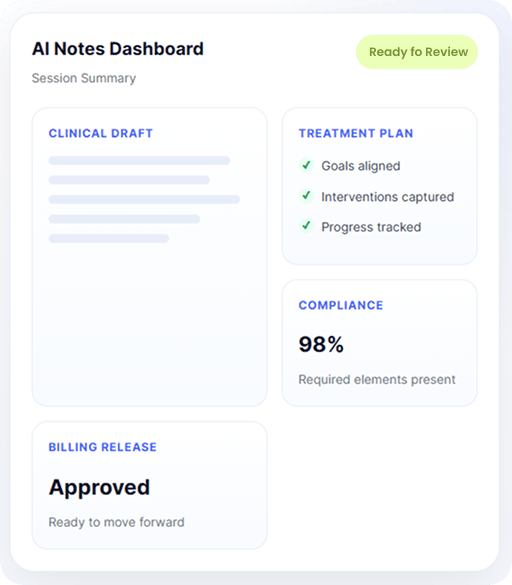
- Presenting problem identified
- Functional impairment documented
- Service is reasonable and necessary
- Treatment is expected to improve condition
AI Notes for Behavioral Health
Spend Less Time Writing Notes.
Spend More Time With Clients
Behavioral health providers face increasing documentation requirements while
trying to maintain quality care. Progress notes, treatment plans, assessments,
supervision documentation, and compliance requirements can consume hours
every week. DENmaar AI Notes helps clinicians complete documentation faster
while maintaining clinical accuracy and professional oversight.

Behavioral Health Focused

Clinical Accuracy & Oversight

Billing Workflow Ready

Reduce Documentation Time
Clinicians save hours each week on documentations.

Improve Note Consistency
AI-powered drafts improve quality and consistency.

Support Compliance Workflows
Build-in guidance for required documentation elements

Connect Notes to billing
Seamless integration with billing and operational workflows.
SUPPORTED DOCUMENTATION
Built Specifically for Behavioral Health
Unlike generic AI scribes, DENmaar AI Notes is designed for behavioral health workflows and
documentation requirements.
Individual Therapy
Family Therapy
Group Therapy
Substance Use Treatment
Case Management
Medication Management
Crisis Intervention
Clinical Supervision
Treatment Plans
Assessments and Reviews
AI NOTES WORKFLOW
How It Works
From captured session details to reviewed, billable documentation.

Record or Capture
Session Information
Patient check-in and
visit completed.

AI Generates a
Clinical Draft
AI Notes generate
structured documentation.

Review and Approve
Claim is created and
scrubbed for accuracy.

Release for Billing
Claim submitted to
the payer
DESIGNED FOR COMPLIANCE
Clinical Documentation with Compliance in Mind
AI Notes helps behavioral health providers document medical necessity, align treatment goals, identify
interventions, and support supervisor review workflows.
Compliance Support
Medical necessity documentation
Goal and treatment plan alignment
Intervention identification
Progress tracking
Required behavioral health documentation elements
Supervisor review workflows
Complete
Medical Necessity Documentation
Documentation supports the medical necessity of services provided and reflects the client’s ongoing treatment needs.
Evidence in Note
Aligned
Goal & Treatment Plan Alignment
Clinical documentation connects session content to active treatment goals and supports continuity across the plan of care.
Evidence in Note
- Active treatment goal referenced
- Session objectives tied to treatment plan
- Interventions support documented goals
- Progress linked back to care plan
Verified
Intervention Identification
Notes clearly identify the therapeutic interventions used during the session and how they relate to the client’s needs.
Evidence in Note
- Therapeutic intervention documented
- Intervention matched to presenting concerns
- Clinician actions clearly described
- Modality or technique identified where appropriate
Reviewed
Progress Tracking
Session documentation captures the client’s response to treatment and tracks change over time to support clinical decision-making.
Evidence in Note
- Client response to intervention documented
- Progress toward goals addressed
- Barriers or setbacks identified
- Ongoing symptoms or improvements noted
Included
Required Documentation Elements
Behavioral health notes include the core documentation elements needed for completeness, consistency, and payer readiness.
Evidence in Note
- Session date, duration, and service type included
- Relevant clinical observations documented
- Risk, safety, or notable concerns addressed when applicable
- Required note structure completed for the encounter
Available
Supervisor Review Workflow
Documentation can support internal review and approval workflows, helping supervisors monitor quality, accuracy, and compliance.
Evidence in Note
- Draft available for supervisor review
- Revisions or feedback can be incorporated
- Approval status is clearly tracked
- Final documentation is released after sign-off
MORE THAN A SCRIBE
Documentation Connected to the Rest of Your Workflow
Documentation can connect directly to scheduling, treatment plans, assessments, billing workflows, claims validation,
and provider productivity reporting.

Scheduling

Assessments

Claims Validation

DENmaar AI
Notes
Notes

Treatment Plans

Billing Workflows

Productivity Reporting
WHY ORGANIZATIONS CHOOSE DENMAAR
Built for Behavioral Health Teams and Organizations
DENmaar AI Notes is designed to support real-world clinical documentation and operational workflows.

Behavioral Health Focused
Customizable behavioral health workflows including therapy, psychiatry, substance use treatment, and multidisciplinary care models.

Scheduling & Operational Workflows
Integrated scheduling designed to support provider productivity, patient flow, authorization tracking, and claims readiness.

Supervisor Workflows
Built-in workflow logic designed to improve claim accuracy before submission through integrated operational checks and billing intelligence.

Eligibility & Insurance Verification
Integrated eligibility workflows designed to support Medicaid, commercial insurance, carve-outs, and behavioral health payer complexity.

Patient Engagement
Patient portal, intake workflows, secure communication, reminders, and measurement-based care tools.

Request an
AI Notes Trial
See how DENmaar AI Notes can help your clinicians reduce documentation time while improving
Request a demonstration or pilot program today.
Request Information
TESTIMONIALS
WHAT OUR CLIENTS SAY
On behalf of everyone at Meadowlark Counseling Services, I want to extend our sincere thanks for the continued improvements you and your team have made to the DENMaar EMR platform. We have been consistently impressed with both the functionality and user-friendly design of the system, which has made a meaningful difference in our day-to-day operations. The intuitive layout and ease of use have allowed our staff to spend less time navigating the system and more time focusing on client care. The regular updates and enhancements reflect your commitment to meeting the evolving needs of providers in the behavioral health and substance use treatment fields. We genuinely look forward to the new features introduced each month and appreciate how responsive the platform has been to the demands of clinical workflows. We have been so pleased with our experience that we’ve taken the opportunity to recommend DENMaar to other professionals in Pennsylvania who are working in the SUD field. Thank you again for your ongoing support and partnership. We are grateful to be working with a company that truly understands the needs of its users. KIndly, Becky Parks on behalf of the entire team at Meadowlark Counseling Services
I referred one of my colleagues Dr Aaron to you he is just starting g his psychology private practice and looking at where to start. I told him hands down you guys are the best billers and have a great EMR and team. He said he reached out just wanted to let you know!
FANTASTIC job keeping things rolling along with any and all of our billing concerns as well as responding to other issues which may well have been out of your wheelhouse. We are VERY grateful to have you and the crew in our corner.
I appreciate you all so much and DENmaar has been such a blessing Donna to our overall operations and success as an expanding company—allowing us to ultimately operate more efficiently, get our claims paid more consistently, ad stay on top of the critical credentialing piece, among other things. Teamwork does in fact, make the dream work. I’ll loop Chris/Isabella in on this message thread too, as I want All of your team to be aware of how much we appreciate our working relationship with DENmaar
Thank you for your diligence!! I appreciate it so much. Thank you Edwina…
Thank you so much Amy! I will be referring to DENmaar as often as I am asked about credentialing services.
Our Latest Blogs
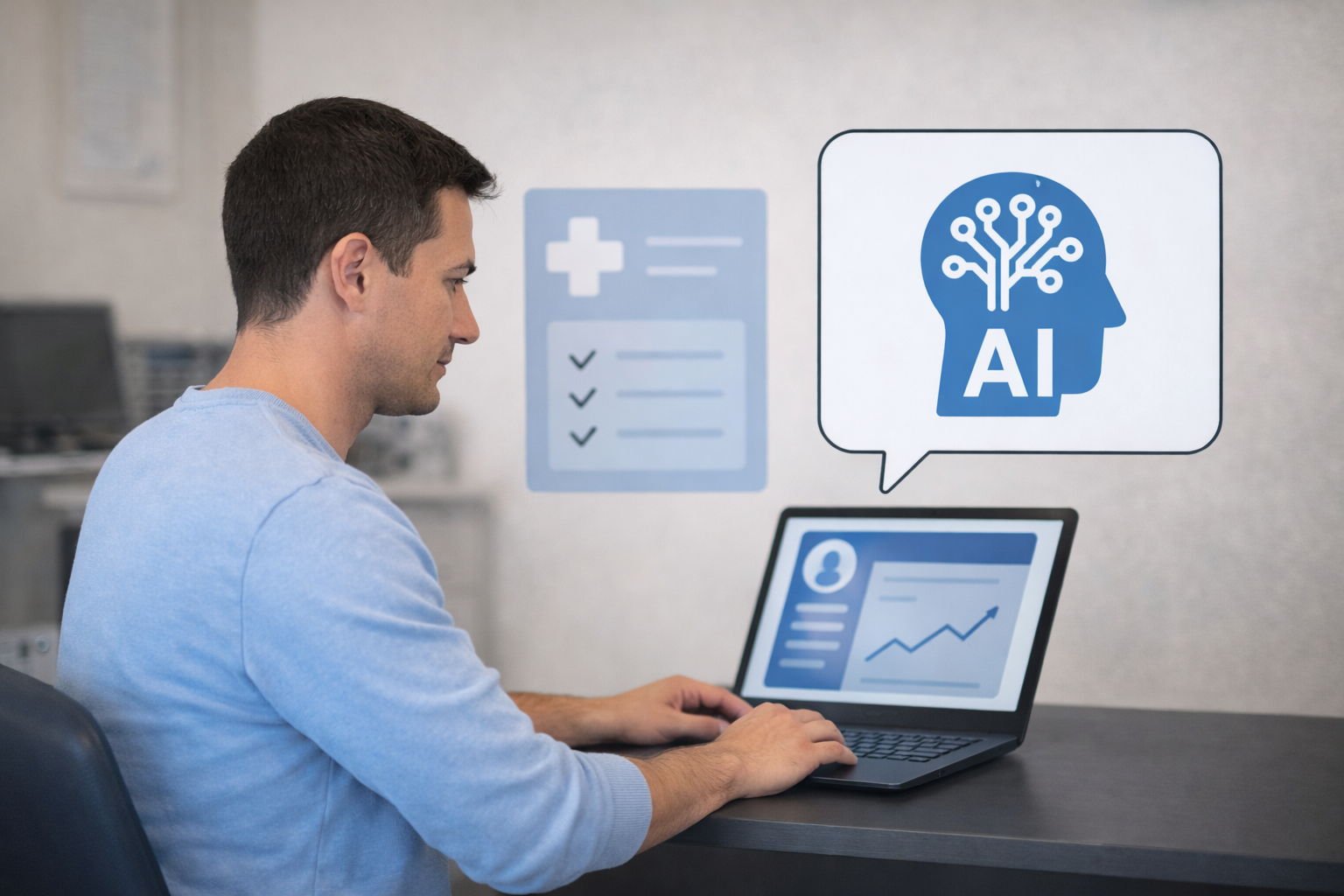
Do Modern Behavioral Health EHRs Use AI for BPS Assessments, Treatment Plans & Progress Notes?
The behavioral health world is changing fast. Providers are burned out by documentation, payers demand tighter clinical alignment, and practices are under more pressure than ever to prove outcomes. This has pushed a new question into the spotlight:
Do any EHR systems actually incorporate AI into biopsychosocial assessments, treatment planning, and progress notes?
The answer is yes — and it’s transforming the way behavioral health organizations operate.
AI-enabled EHRs are becoming the new standard for practices that want to reduce administrative burden, improve clinical quality, and increase reimbursement. Let’s break down what AI-powered documentation looks like — and why the next generation of EHRs is built around it.
Why Traditional EHRs Fall Short
Most behavioral health EHRs were designed 10–20 years ago. They follow the same pattern:
- Long forms
- Manual data entry
- Copy-and-paste notes
- Treatment plans that rarely connect to daily practice
- Documentation that does not support payers’ Golden Thread requirement
The result?
- Providers spend 25–40% of their clinical time documenting instead of treating.
- Practices lose revenue because documentation doesn’t meet payer standards.
- Clinical quality becomes inconsistent.
AI is closing this gap fast.
How AI Is Being Integrated Into Behavioral Health EHRs
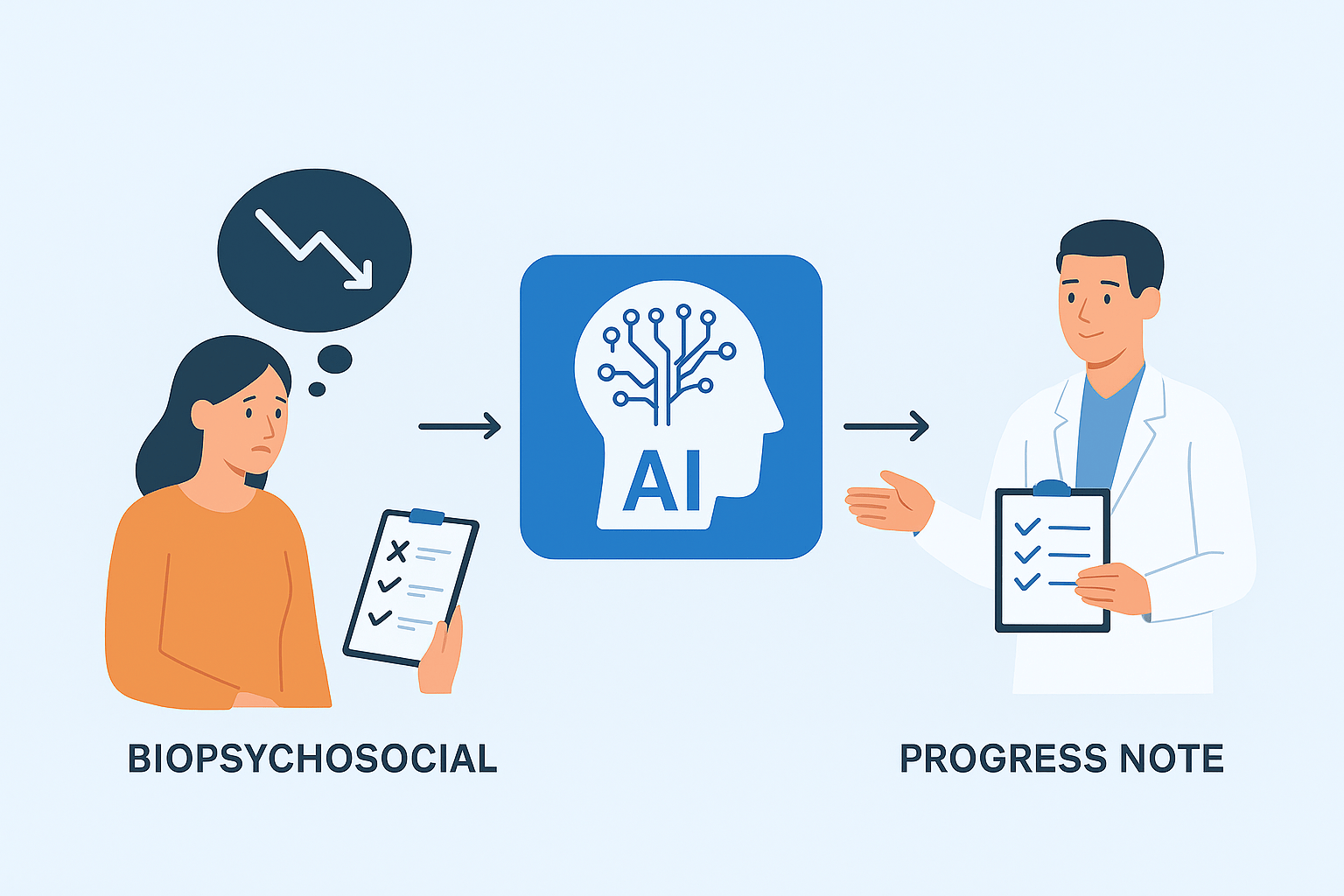
1. AI-Generated Biopsychosocial (BPS) Assessments
With AI, the BPS assessment becomes dynamic instead of rigid. Modern AI-enabled EHRs can:
- Pull patient history forward
- Convert intake responses into structured BPS summaries
- Recommend risk factors, strengths, and key problem areas
- Automatically align the BPS with medical-necessity standards
This eliminates repetitive typing and creates clinically stronger assessments that support authorization and billing.
2. AI-Powered Treatment Planning
This is where AI shines. Advanced EHRs can generate:
- SMART goals based on the BPS
- Linked interventions by specialty (CBT, ACT, EMDR, SUD, Psychiatry, etc.)
- Measurable outcomes tied to MBC
- Suggested frequencies and durations based on payer expectations
- Automatic updates when symptoms change
Instead of manually writing and rewriting plans every 90 days, AI helps clinicians maintain a living treatment plan that stays synchronized with actual care.
3. AI-Enhanced Progress Notes
More practices now rely on AI to generate or accelerate routine note-writing. AI can:
- Auto-populate subjective and objective fields
- Recommend interventions based on treatment-plan goals
- Pull forward prior note themes
- Ensure documentation meets payer requirements
- Reduce note-writing time from 8–12 minutes down to 1–2 minutes
The biggest benefit?
AI maintains the Golden Thread — the alignment between assessment → goals → interventions → progress notes.
This is critical to reducing denials and supporting medical necessity.
Explore AI Progress Notes for Mental Health Providers
4. Measurement-Based Care + AI: A New Standard
Leading EHRs are embedding Measurement-Based Care (MBC) directly into the clinical workflow. AI helps:
- Score PHQ-9, GAD-7, C-SSRS, PTSD scales, and more
- Detect symptom trends
- Recommend treatment-plan updates
- Provide documentation prompts based on severity
- Produce outcomes dashboards for payers and accreditation
Over time, AI builds a clinical profile that helps providers make better decisions with less effort.
See How AI Can Fix Your MBC Workflow
5. Billing and Compliance Tightly Connected to AI Documentation
This is where most EHRs fail — but AI-enabled systems don’t. AI can:
- Flag documentation gaps before claims are sent
- Recommend CPT codes based on session data
- Detect missing treatment-plan links
- Reduce rejection and denial rates
- Provide real-time compliance alerts
For practices, this means:
- Fewer denials
- Cleaner claims
- 10–20% increases in revenue when billing and documentation are integrated
Reduce Administrative Stress with end-to-end Behavioral Health Billing and grow your client base with fast, accurate Insurance Credentialing.
Which EHRs Are Leading This AI Shift?
A handful of modern behavioral health platforms are doing meaningful work with AI:
- Systems with AI-powered progress notes
- Systems with AI-assisted treatment plans
- Systems offering BPS assessment generation
- Platforms integrating MBC + AI insights
- EHRs embedding AI workflows directly into billing and RCM
Most legacy EHRs are still years behind. The future belongs to fully integrated EHRs where AI handles documentation and providers focus on care.
Why AI-Enabled EHRs Are Becoming the New Standard
Behavioral health is entering a new era:
- Payers demand stronger documentation
- Providers demand less administrative burden
- Practices must operate leaner and more efficiently
- Outcomes are becoming a requirement, not a bonus
AI-driven documentation is no longer optional — it is the foundation of the next generation behavioral health EHR.
It reduces burnout. It improves compliance. It increases revenue. And it elevates clinical quality across entire organizations.
Conclusion
Yes — modern EHRs do incorporate AI into biopsychosocial assessments, treatment planning, and progress notes, and the systems that adopt these tools now will have the most clinically efficient and financially successful practices over the next decade.
Frequently Asked Questions
1. What is an AI-powered behavioral health EHR?
An AI-powered behavioral health EHR uses artificial intelligence to streamline documentation, automate treatment planning, enhance progress notes, and improve clinical and billing workflows.
2. How does AI help therapists and psychiatrists with documentation?
AI reduces manual typing, auto-generates clinical summaries, and helps maintain payer-required Golden Thread alignment across assessments, plans, and notes.
3. Can AI improve behavioral health billing and RCM?
Yes. AI flags documentation gaps, recommends CPT codes, reduces denials, and supports clean-claim submission for better revenue capture.
4. Does AI support measurement-based care (MBC)?
Absolutely. AI scores assessments, detects trends, suggests treatment updates, and generates outcomes dashboards for reporting.
5. Is DENmaar EHR an AI-enabled system?
DENmaar integrates AI-driven tools for documentation, progress notes, billing workflows, credentialing, and more, making it one of the most advanced behavioral health EHR options available.
Why Measurement-Based Care Is Failing — And How AI Fixes It
Measurement-Based Care (MBC) was supposed to transform behavioral health. On paper, it made perfect sense: give providers simple tools to measure symptoms, track progress over time, and adjust treatment based on data.
In reality, the industry has spent nearly a decade pushing MBC without solving the core problem: MBC requires time, structure, and technology that most practices simply don’t have.
And because of that mismatch between clinical ideal and operational reality, MBC has quietly been failing.
It isn’t failing because providers don’t want better outcomes. It’s failing because the system around them still runs on clipboards, PDFs, and outdated EHR workflows.
But in 2025, the emergence of AI-driven systems is changing the conversation. What used to be a burden is becoming an automated standard. And this shift is about far more than patient surveys — it’s the beginning of Measurement-Based Services (MBS): a full, end-to-end ecosystem of care powered by intelligent tools.
Let’s break down why MBC has stagnated, and how AI is going to fix it permanently.
-
MBC Has Failed Because It Adds Work — Instead of Removing It
Ask any clinician what gets in the way of MBC and you’ll hear the same answers:
- “I forgot to send the assessments.”
- “Patients don’t complete them.”
- “The scores don’t integrate into my notes.”
- “The EHR doesn’t do anything with the data.”
The truth is simple:
✔ MBC creates work
✘ EHRs don’t automate that work
✘ Billing doesn’t reward the work unless properly documented
✘ Providers don’t have time to manually chase down PHQ-9s and GAD-7s
This turns MBC into a compliance checkbox rather than a real clinical tool.
Legacy EHRs offer MBC as a feature, but not a workflow. That distinction matters.
-
MBC Fails Because Scores Don’t Drive Clinical Decisions
Even when assessments are completed, most systems treat them as data islands.
- The PHQ-9 score sits in one tab.
- The treatment plan sits in another.
- The progress note sits somewhere else entirely.
Nothing connects.
Providers are expected to manually:
- Read the score
- Interpret the change
- Adjust goals
- Update interventions
- Reflect all of that in their clinical note
The cognitive load alone ensures that MBC will never scale manually.
Without automation, MBC is just more paperwork.
-
Billing Doesn’t Align With the Clinical Work Being Done
This is the elephant in the room.
Most practices don’t use MBC because:
- Nobody tells them how to bill for 96127
- They don’t have workflows that document correctly
- They lose money on missed or rejected add-on codes
- The EHR doesn’t push them toward compliant, billable patterns
And yet:
When MBC is done correctly, practices can increase insurance revenue immediately and ethically.
The problem isn’t the clinical model — it’s the infrastructure.
For billing support, see Behavioral & Mental Health Billing Services.
-
AI Turns MBC Into MBS: Measurement-Based Services
This is where the future begins.
AI doesn’t just “score forms.” That’s old news.
AI can now:
- Auto-send assessments before each visit
Based on diagnosis, treatment goals, level of care, or payer requirements. - Auto-interpret the scores
Highlighting risk, change over time, severity thresholds, or clinical deterioration.
- Auto-update the treatment plan
Goals and interventions dynamically shift based on measurable patient response. - Auto-populate the progress note
The AI writes the MBC-aligned section of the note, incorporating PHQ/GAD changes, clinician wording, and new directions in the plan.
- Suggest clinically appropriate codes
Including when to add 96127, when to re-evaluate, and what documentation is required.
This is the foundation of Measurement-Based Services, the next evolution of clinical care.
Instead of assessments floating around in a tab, MBS means: Treatment plans, interventions, notes, billing, authorizations, and payer compliance – all connected to one automated system – this is what DENmaar is building.
Explore related innovations: AI Receptionist for Behavioral Health.
-
AI Fixes What Human Workflow Can’t
AI becomes the “clinical operations layer” that legacy EHRs never built.
It ensures:
- Every patient receives standardized assessments
- Every score is interpreted consistently
- Every note reflects evidence-based practice
- Every billable service is supported
- Every payer requirement is met
- Every clinician keeps their autonomy
AI is not replacing the provider, it is replacing the administrative drag that prevented MBC from ever reaching scale.
-
For Practices, the Impact Is Immediate
- Better Clinical Outcomes
True MBC improves remission rates, reduces crisis events, and improves care continuity. - Faster, Cleaner Billing
When evidence-based documentation is embedded into the workflow, claims become cleaner. (Your 98.1% clean claims rate is a direct reflection of this philosophy.)
- Higher Revenue
The combination of: 96127, documented severity, aligned treatment planning, and accurate coding – translates into 10–20% higher insurance collections for most practices. - Provider Retention
Clinicians stay longer when documentation is simpler and more meaningful. - Scalable Care Models
Group practices can finally standardize care — without endless training or meetings.
-
The Next Frontier: Diagnosis-to-Assessment Mapping
Your newest focus — diagnosis-to-assessment mapping — is where the industry is truly heading.
AI will soon:
- Attach the right assessments to each diagnosis
- Determine when they should recur
- Match severity to interventions
- Update risk stratification automatically
- Feed all of it into treatment plans and progress notes
This is the beginning of AI-powered clinical governance, something no legacy EHR offers.
DENmaar isn’t “adding MBC.”
You’re building the first automated MBS platform designed for real clinical operations.
Conclusion: MBC Didn’t Fail — The Tools Failed It
The vision behind Measurement-Based Care is correct. The execution has been impossible, until now.
AI takes the burden off clinicians, connects the clinical and billing worlds, and turns assessments into actionable, billable, automated workflows.
This is not the future of behavioral health. It’s the present — and DENmaar is building it.
Explore more at www.denmaar.com.
Frequently Asked Questions
1. Why is Measurement-Based Care failing in behavioral health?
MBC fails because practices lack automated workflows, integrated EHR tools, and billing alignment. Without AI, MBC becomes extra work — not better care.
2. How does AI improve Measurement-Based Care?
AI automates assessment delivery, scoring, treatment planning, and documentation, turning MBC into actionable Measurement-Based Services.
3. Can AI support billing for codes like 96127?
Yes. AI can recommend when to bill 96127, generate proper documentation, and align clinical notes with payer requirements.
4. What is Measurement-Based Services (MBS)?
MBS is an AI-powered model where assessments, treatment plans, notes, billing, and authorizations are fully integrated into one automated system.
5. Does DENmaar support automated MBC/MBS workflows?
Yes. DENmaar’s platform integrates AI-driven assessments, treatment planning, billing support, and automated workflows across behavioral health practices.

How AI Will Transform Behavioral Health Calls and Refills in 2026
For all the talk about AI disrupting healthcare, the truth is this:
The first real transformation won’t be clinical — it will be administrative.
- No diagnosis.
- Not therapy.
- Not medical decision-making.
It will be the simple, relentless, daily operations that drain practices of time, energy, and money.
And nothing drains practices more than the phone.
Behavioral health practices are flooded with:
- New patient inquiries
- Cancellations and reschedules
- Medication refill requests
- Insurance and billing questions
- Administrative follow-ups
- Provider messages
- Crisis calls
- Spam robocalls
For years, no system has solved this.
Phone systems got smarter.
EHRs got prettier. But the administration workload never went down — it went up.
That changes in 2026.
What Behavioral Health Receptionists Actually Do
Most people underestimate how much invisible work receptionists carry.
A standard front desk is responsible for:
- Triage
- Data entry
- Eligibility questions
- Location & provider routing
- Patient reminders
- Phone tagging
- Refill coordination
- Rescheduling appointments
- Capturing patient demographics
- Managing insurance questions
For many practices, the front desk is the engine that keeps operations running.
But it’s also the bottleneck.
Most practices can’t scale past 5–10 providers without either:
- Overhiring reception staff, or
- Burning out the ones they have.
That’s where AI is finally mature enough to step in.
AI Receptionists Aren’t Replacing People — They’re Replacing Phone Chaos
Let’s be clear:
The AI Receptionist doesn’t eliminate humans.
It eliminates redundant tasks.
For example:
When someone calls to refill a prescription
A receptionist has to ask 5–7 required questions (name, DOB, medication, dose, pharmacy, last visit, provider).
AI can do this instantly, accurately, without fatigue — and immediately send the structured data to the clinical team.
When someone calls to cancel or reschedule
AI can capture the appointment details, reason, and route the message without interrupting a session or pulling staff away from patients.
When someone calls with an insurance question
AI can identify the caller’s intent, collect documents, and route to billing without a 10-minute phone call.
(For billing workflows, see DENmaar’s behavioral & mental health billing services.)
When a new patient calls
AI can capture name, DOB, email, insurance photos, and reason for visit — and load that directly into intake workflows.
This is not clinician replacement.
It’s administrative liberation.
2026 Will Be the Year AI Handles 60–70% of Behavioral Health Phone Traffic
We are entering the first year where AI can reliably:
- Answer calls with natural human tone
- Detect caller type
- Gather required information
- Route to the correct team
- Log the call with a clean transcript
- Handle refill requests
- Manage cancellations
- Deflect spam
- Capture insurance card images
- Support crisis routing
This is not speculative technology.
This is in-market capability — and practices are asking for it. Every day.
Why Behavioral Health Is the Perfect Place for AI Receptionists
Behavioral health has three unique challenges:
- High call volume per provider: Therapy and psychiatry generate more after-hours questions, refill requests, and admin calls than almost any other outpatient field.
- Higher no-show rates: this means more reschedules, reminders, and cancellations.
- Recurring medication management: Psychotropic meds generate constant refill and pharmacy coordination.
- Understaffed admin departments: Most practices run lean — too lean — and admin burnout is real.
AI reduces this pressure immediately.
Building the AI Receptionist at DENmaar
At DENmaar, we’re building this in phases — and focusing on the highest-value workflows first.
(For context on our AI clinical tools, see AI Treatment Planning and
AI Biopsychosocial, Treatment Planning & Progress Notes.)
Phase 1 (Release 1) — Smart Intake & Triage
- Answering calls
- Detecting intent
- Capturing required data
- Routing to intake, billing, clinical, and admin
- Handling spam
- Reliable transcripts
This alone replaces 40–50% of receptionist workload.
Phase 2 — Refill Engine
AI captures refill requests, validates required info, and routes correctly.
Phase 3 — Scheduling Assistance
AI suggests available openings, offers reschedule options, and syncs with calendars.
Phase 4 — Full Administrative Automation
From pre-auth to follow-up tracking — the receptionist becomes a 24/7 assistant.
(For credentialing workflows, see insurance credentialing services.)
The Future: The Admin-Free Practice
The end state is clear:
Providers practice. AI handles the admin.
That’s the future behavioral health deserves — and one we’re actively building at DENmaar.
If you want to see how the AI receptionist integrates with our billing-optimized EHR, our 98% clean-claims pipeline, and our AI-powered clinical tools, reach out anytime.
2026 won’t just be another year in healthcare. It will be the year practices stop drowning in administrative work — and finally get to focus on patients again.
Frequently Asked Questions
1. What is an AI receptionist in behavioral health?
An AI receptionist uses advanced natural language tools to answer calls, collect patient information, route messages, and automate refill and scheduling workflows for behavioral health practices.
2. Does an AI receptionist replace human staff?
No. It replaces repetitive phone-based tasks so staff can focus on higher-value patient interactions and front-desk management.
3. Can AI handle medication refill requests safely?
Yes. The system collects required information, verifies details, and routes structured data directly to the clinical team for review.
4. Will AI phone systems integrate with DENmaar’s EHR?
Yes. All AI receptionist features are being built directly into DENmaar’s EHR & Billing ecosystem, ensuring seamless workflows.
5. Can AI reduce no-show rates?
AI can manage reminders, reschedules, cancellations, and follow-up outreach — significantly reducing administrative load and no-show risk.
Our Partners






Ready to get started?
Feel free to reach out if you have any questions.
