

Reduce payer friction, improve billing workflows, and support stronger reimbursement performance with behavioral-health-focused insurance knowledge built into the DENmaar platform.
Insurance Knowledge Team
Technology Alone
Doesn't Get Claims Paid.
Knowledge Does
Behavioral health reimbursement is constantly changing. Payer rules, modifiers, priorauthorizations, telehealth requirements, documentation standards, and state-specific billing policies create challenges that software alone cannot solve. DENmaar combines technology with a dedicated Insurance Knowledge Team focused exclusively on behavioral health reimbursement.

Behavioral Health Reimbursement Expertise

Operational support beyond software

Shared knowledge that strengthens outcomes

Built Specifically for Behavioral Health
Reimbursement support that understands
behavioral health complexity.
Our team works alongside providers and billing staff to navigate payer requirements, resolve
reimbursement issues, and continuously improve billing outcomes

Behavioral Health Expertise
Our team specializes exclusively
in behavioral health reimbursement
across all payer types.
in behavioral health reimbursement
across all payer types.

Payer Intelligence
Our team specializes exclusively
in behavioral health reimbursement
across all payer types.
in behavioral health reimbursement
across all payer types.

Continuous Research
Our team specializes exclusively
in behavioral health reimbursement
across all payer types.
in behavioral health reimbursement
across all payer types.

Better Reimbursement
Our team specializes exclusively
in behavioral health reimbursement
across all payer types.
in behavioral health reimbursement
across all payer types.
AREAS OF EXPERTISE

Commercial Insurance

Medicaid managed care

Medicare

Telehealth Billing

Prior Authorizations

Denial Management

Credentialing Support

Documentation Requirements

Behavioral Health Coding
How the Insurance Knowledge Team Works
A practical reimbursement support model that
turns payer complexity into operational clarity.
Every reimbursement issue becomes an opportunity to improve claim outcomes, strengthen workflows,
and make the DENmaar platform smarter over time.
1
Identify barriers
We identify reimbursement
challenges and payer roadblocks.
challenges and payer roadblocks.
2
Research Requirements
We research payer-specific requirements, rules, and policy updates.
3
Develop Strategy
We develop effective resolution strategies and best practices.
4
Share Knowledge
We share insights across the organization and client community.
5
Improve Workflows
We improve workflows to prevent recurring issues and denials.
6
Support Providers
We support providers
and billing teams every step of the way.
and billing teams every step of the way.
Knowledge That Improves the Entire Platform
Every reimbursement issue creates intelligence that strengthens future billing performance.
Every payer issue, denial pattern, workflow challenge, and reimbursement insight contributes to improving the DENmaar platform. The result is a continuously evolving system that becomes smarter over time—not just for one claim, but across operational billing workflows.

Payer issue patterns
Track the recurring payer requirements and billing obstacles that repeatedly affect reimbursement outcomes.

Denial insight loops
Use denial and follow-up experience to improve resolution quality and reduce repeat claim friction.

Workflow refinement
Translate reimbursement knowledge into better operational workflows tied to billing readiness and claim quality.

Shared organizational learning
Knowledge gained through real payer interactions can inform future reimbursement decisions across teams and clients.
Support for Multidisciplinary Organizations
Insurance knowledge support across the services and programs behavioral health organizations actually run.
DENmaar’s Insurance Knowledge Team supports organizations across outpatient therapy, psychiatry, substance use treatment, intensive programs, community behavioral health, and multidisciplinary care environments.

Therapy Practices
Medication Management
Substance Use Treatment Providers
IOP & PHP Programs
Community Behavioral Health Organizations
Multidisciplinary Practices
Why Organizations Choose DENmaar
Technology-supported workflows backed by real reimbursement knowledge.
DENmaar combines behavioral health specialization, reimbursement research, payer insight, and operational workflow support to help organizations improve billing accuracy and financial performance.

Behavioral health specialization
Real-world payer expertise
Continuous reimbursement research
Technology-supported workflows
Shared knowledge across client organizations
Focus on reimbursement accuracy
Request an Insurance Workflow Review
Discover how DENmaar’s Insurance Knowledge Team can strengthen reimbursement operations.
Request Information
TESTIMONIALS
WHAT OUR CLIENTS SAY
On behalf of everyone at Meadowlark Counseling Services, I want to extend our sincere thanks for the continued improvements you and your team have made to the DENMaar EMR platform. We have been consistently impressed with both the functionality and user-friendly design of the system, which has made a meaningful difference in our day-to-day operations. The intuitive layout and ease of use have allowed our staff to spend less time navigating the system and more time focusing on client care. The regular updates and enhancements reflect your commitment to meeting the evolving needs of providers in the behavioral health and substance use treatment fields. We genuinely look forward to the new features introduced each month and appreciate how responsive the platform has been to the demands of clinical workflows. We have been so pleased with our experience that we’ve taken the opportunity to recommend DENMaar to other professionals in Pennsylvania who are working in the SUD field. Thank you again for your ongoing support and partnership. We are grateful to be working with a company that truly understands the needs of its users. KIndly, Becky Parks on behalf of the entire team at Meadowlark Counseling Services
I referred one of my colleagues Dr Aaron to you he is just starting g his psychology private practice and looking at where to start. I told him hands down you guys are the best billers and have a great EMR and team. He said he reached out just wanted to let you know!
FANTASTIC job keeping things rolling along with any and all of our billing concerns as well as responding to other issues which may well have been out of your wheelhouse. We are VERY grateful to have you and the crew in our corner.
I appreciate you all so much and DENmaar has been such a blessing Donna to our overall operations and success as an expanding company—allowing us to ultimately operate more efficiently, get our claims paid more consistently, ad stay on top of the critical credentialing piece, among other things. Teamwork does in fact, make the dream work. I’ll loop Chris/Isabella in on this message thread too, as I want All of your team to be aware of how much we appreciate our working relationship with DENmaar
Thank you for your diligence!! I appreciate it so much. Thank you Edwina…
Thank you so much Amy! I will be referring to DENmaar as often as I am asked about credentialing services.
Our Latest Blogs
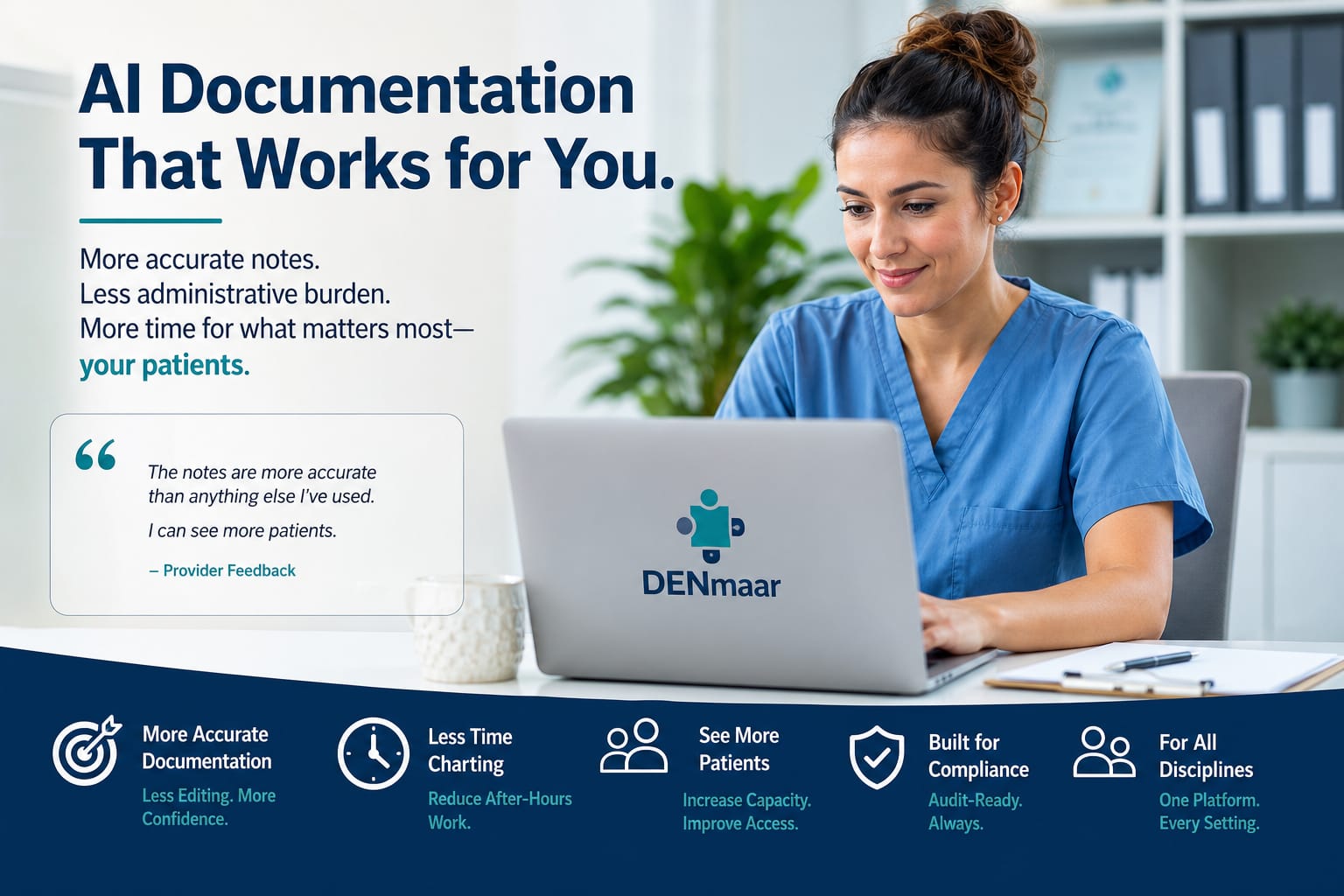
The Next Evolution of AI Documentation: Accuracy, Productivity, and More Time for Patient Care
Artificial intelligence has rapidly become one of the most discussed topics in healthcare technology. Most conversations focus on one promise: creating clinical notes faster.
While speed is important, we believe the real value of AI documentation goes much deeper.
The goal is not simply to generate notes.
The goal is to produce accurate clinical documentation that reduces administrative burden, supports compliance, and gives providers more time to focus on patient care.
Accuracy Matters More Than Speed
One of the most common frustrations providers express about AI documentation solutions is the amount of editing required after a note is generated. If a provider must spend significant time correcting information, rewriting interventions, or restructuring the clinical narrative, much of the promised efficiency disappears.
Recently, a provider using DENmaar shared feedback that stood out:
“The notes are more accurate than anything else I’ve used.”
For us, this is one of the most important measures of success.
Accurate documentation means:
- Less time editing notes.
- Better reflection of the clinical encounter.
- More confidence in the medical record.
- Improved consistency across providers.
- Reduced administrative burden.
When providers trust the documentation being produced, they spend less time correcting it and more time caring for patients.
Better Documentation Creates Clinical Capacity
The impact of accurate AI documentation extends beyond note completion.
The same provider who praised the accuracy of the documentation also shared another important observation:
“I can see more patients.”
This is where AI documentation becomes transformational.
Every minute saved documenting care is a minute that can be redirected toward:
- Additional patient appointments.
- Follow-up care.
- Clinical collaboration.
- Reduced after-hours charting.
- Improved work-life balance.
For behavioral health organizations facing growing demand and provider shortages, increasing clinical capacity without increasing provider burnout is a significant opportunity.
Organizations evaluating new technology solutions often benefit from a structured validation process such as a Claims Submission Pilot Program for behavioral health organizations
Designed for the Realities of Healthcare
Healthcare documentation is not one-size-fits-all.
Each discipline has unique workflows, terminology, compliance requirements, and clinical expectations. A psychotherapy note differs significantly from a psychiatric medication management note. An intensive outpatient program session differs from a community support encounter. Substance use treatment documentation differs from outpatient therapy.
That is why DENmaar is expanding AI documentation across all disciplines served by our platform.
Our vision includes support for:
- Individual Therapy
- Family Therapy
- Group Therapy
- Psychiatric Medication Management
- Intensive Outpatient Programs (IOP)
- Substance Use Disorder Treatment
- Community-Based Services
- Case Management
- Care Coordination
- Residential Programs
- Crisis Services
- Behavioral Health Assessments
- Clinical Supervision Workflows
The goal is to create discipline-specific documentation experiences that understand the unique requirements of each service provided.
For organizations seeking comprehensive behavioral health billing services and revenue cycle support, documentation accuracy plays a critical role in clean claims, compliance, and reimbursement outcomes.
The Future of Healthcare Documentation
The future of AI documentation should not be measured solely by how quickly a note appears on the screen.
It should be measured by:
- Documentation accuracy.
- Provider confidence.
- Reduced administrative burden.
- Improved compliance.
- Increased clinical capacity.
- Better patient access to care.
When providers can trust their documentation and spend less time charting, healthcare organizations become more efficient and patients benefit from increased access to services.
For organizations serving Medicaid populations, accurate documentation is particularly important because it supports Medicaid behavioral health billing compliance, medical necessity requirements, and audit readiness:
At DENmaar, we believe AI documentation should do more than generate notes.
It should help providers practice at the top of their license, reduce burnout, and create more time for what matters most: helping patients.
Frequently Asked Questions
How does AI documentation improve behavioral health workflows?
AI documentation reduces manual charting, improves note consistency, supports compliance requirements, and allows providers to spend more time delivering patient care.
Why is documentation accuracy more important than note generation speed?
Accurate documentation reduces editing time, supports billing compliance, strengthens audit readiness, and improves provider confidence in the clinical record.
Can AI documentation help reduce provider burnout?
Yes. By decreasing after-hours charting and administrative workload, AI-powered documentation can improve provider productivity and work-life balance.
How does AI documentation support behavioral health billing?
Accurate clinical notes help support medical necessity, service documentation requirements, coding accuracy, and clean claims submission for behavioral health reimbursement.
What behavioral health services can benefit from AI documentation?
AI documentation can support therapy, psychiatry, medication management, substance use treatment, intensive outpatient programs, case management, care coordination, crisis services, and behavioral health assessments.

Why We Replaced Free Trials with a Claims Submission Pilot Program
In behavioral healthcare, selecting an EHR and billing partner is one of the most important operational decisions a practice will make.
Unfortunately, many software companies still rely on the traditional “free trial” model. Practices receive access to a system, click around for a few days, and then are expected to make a long-term decision based on limited experience.
We believe there is a better way.
At DENmaar, we replaced traditional free trials with a structured Claims Submission Pilot Program.
Why Free Trials Often Fail
The reality is that most behavioral health practices do not determine success based on whether a scheduler looks attractive or a progress note can be completed.
Success is determined by questions such as:
- Are claims being paid?
- Are providers completing documentation on time?
- Is eligibility being verified correctly?
- Are authorizations being managed effectively?
- Is insurance revenue increasing?
- Is administrative burden decreasing?
A traditional free trial rarely answers these questions.
The Purpose of a Pilot Program
A pilot allows both organizations to determine whether there is a true operational fit.
Instead of evaluating screenshots and demonstrations, practices can evaluate real workflows using real providers, real patients, and real claims.
During a DENmaar pilot, organizations gain access to:
- Behavioral health EHR workflows
- Scheduling and appointment management
- Eligibility and benefits verification
- AI-powered clinical documentation tools
- Claims submission and behavioral health revenue cycle management
- Credentialing support
- Weekly implementation and optimization meetings
The objective is simple: validate results.
Measuring Success
By the conclusion of a pilot, leadership should have clear answers to several critical questions.
Clinical Operations
- Are providers documenting efficiently?
- Are notes being completed on time?
- Is clinical compliance improving?
Revenue Cycle Performance
- Are claims submitting cleanly?
- Are rejection rates decreasing?
- Are billing workflows becoming more efficient?
Organizational Fit
- Does the platform support the organization’s long-term goals?
- Can the system scale as additional providers are added?
- Does the support model align with leadership expectations?
Not Every Organization Is a Fit
One of the most important aspects of our pilot program is qualification.
DENmaar is designed primarily for organizations that are building or operating multi-provider behavioral health practices.
Organizations that are focused on growth, operational discipline, and insurance-based care typically receive the most value from our platform.
For that reason, we do not believe every inquiry should automatically receive a pilot.
We would rather identify strong mutual fit upfront than create unrealistic expectations for either organization.
Why We Built DENmaar
DENmaar was created around a simple belief:
Behavioral health organizations should not have to choose between great software and great billing support.
Most organizations purchase software from one company, credentialing from another, billing services from a third, and then spend countless hours coordinating between them.
We chose a different approach.
DENmaar combines behavioral health technology, revenue cycle management, credentialing, eligibility verification, and operational support into a single platform designed to help organizations improve efficiency and increase insurance revenue.
Organizations looking to strengthen their behavioral health insurance billing infrastructure can learn more about the 3 pillars of successful behavioral health insurance billing.
For practices serving Medicaid populations, understanding Medicaid billing behavioral health requirements is essential for reducing denials and improving reimbursement outcomes.
Many organizations also struggle when determining payer hierarchy and coordination of benefits. Understanding when Medicaid is not primary in behavioral health billing can prevent costly claim delays and rework.
Because at the end of the day, successful behavioral health organizations need more than software.
They need systems that produce measurable results.
Interested in a Pilot?
If your organization is a multi-provider behavioral health practice seeking to improve operations, strengthen revenue cycle performance, and scale efficiently, a DENmaar Claims Submission Pilot may be the right next step.
The goal is not to evaluate software.
The goal is to validate results.
Frequently Asked Questions
What is a Claims Submission Pilot Program?
A Claims Submission Pilot Program allows behavioral health organizations to test real-world workflows, claims submission processes, eligibility verification, provider credentialing, and revenue cycle management before committing to a long-term platform.
How is a pilot different from a free trial?
A free trial typically focuses on software access. A pilot focuses on measurable operational outcomes, including clean claims rates, documentation compliance, reimbursement performance, and administrative efficiency.
Who benefits most from a DENmaar pilot?
Multi-provider behavioral health organizations, psychiatry groups, substance use treatment programs, and insurance-based practices typically receive the greatest value from a structured pilot program.
Does the pilot include Medicaid billing workflows?
Yes. The pilot is designed to support complex behavioral health reimbursement scenarios, including Medicaid billing, eligibility verification, authorization management, provider credentialing, and clean claims submission.
Why is revenue cycle management important when selecting a behavioral health EHR?
A behavioral health EHR should support documentation, scheduling, eligibility verification, claims management, and reimbursement workflows. Without integrated revenue cycle management, practices often experience denials, delayed payments, and lost revenue.
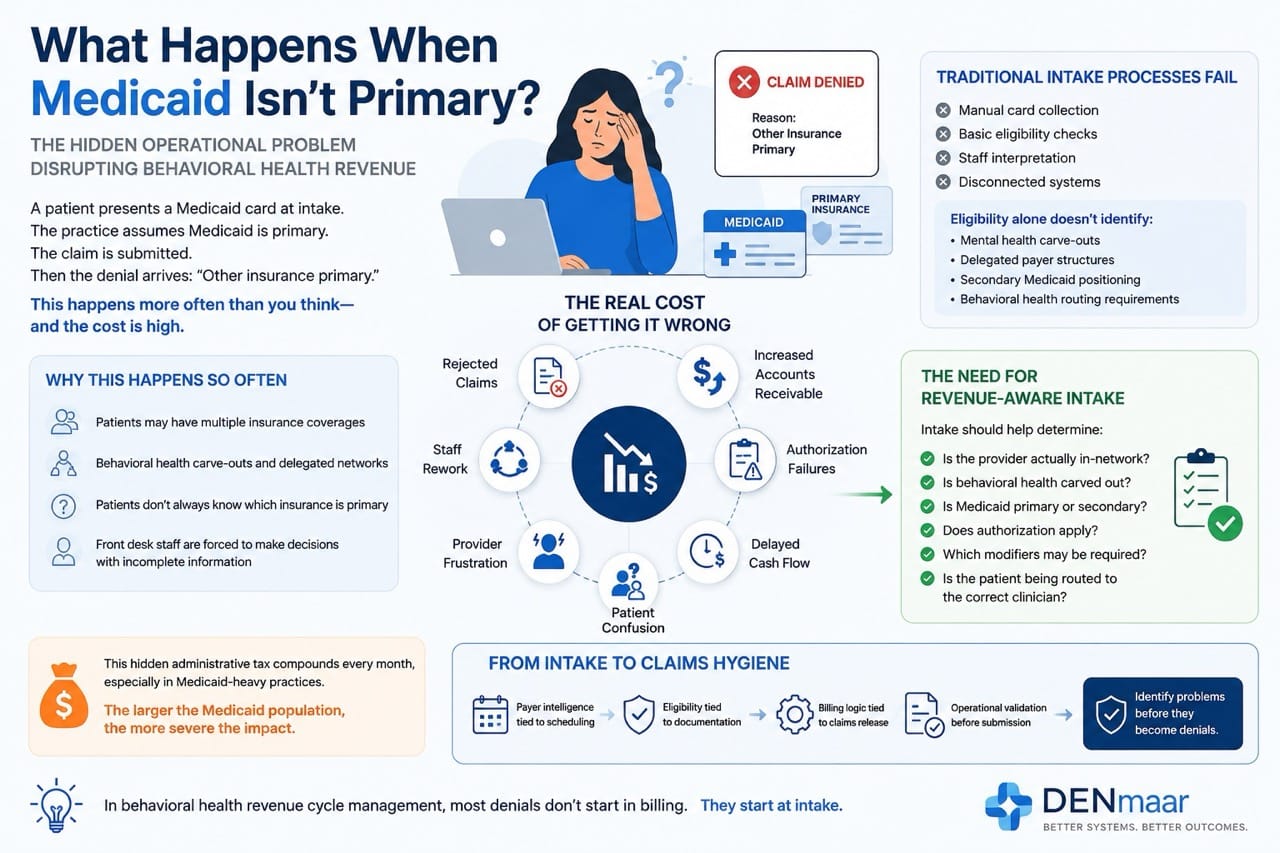
What Happens When Medicaid Isn’t Primary?
The Hidden Operational Problem Disrupting Behavioral Health Revenue
In behavioral health, one of the most common causes of claim delays, denials, and administrative confusion starts before the patient is even seen.
A patient presents a Medicaid card at intake.
The practice assumes Medicaid is primary.
The claim is submitted.
Then the denial arrives:
“Other insurance primary.”
This happens constantly across behavioral health organizations, especially in multidisciplinary practices serving Medicaid populations.
And in many cases, the issue is not billing staff performance.
It is a system failure.
Why This Happens So Often
Behavioral health insurance workflows are uniquely complicated because Medicaid is frequently not the true primary payer.
Patients may have:
- Employer sponsored commercial insurance
- Marketplace plans
- Medicare Advantage
- Managed Medicaid organizations (MCOs)
- Behavioral health carve outs
- Secondary Medicaid eligibility
- County or state funded programs
The challenge is that patients often do not understand:
- Which insurance is primary
- Whether behavioral health is carved out
- Whether a payer delegated services elsewhere
- Whether the provider is actually in network
Front desk teams are then forced to make operational decisions using incomplete information.
The Real Cost of Getting This Wrong
When payer hierarchy is incorrect, the impact spreads across the organization.
Common outcomes include:
- Rejected claims
- Timely filing delays
- Staff rework
- Increased accounts receivable
- Authorization failures
- Provider frustration
- Delayed cash flow
- Patient confusion
In many practices, this creates a hidden administrative tax that compounds every month.
The larger the Medicaid population, the more severe the issue becomes.
Behavioral Health Is Different
Most general healthcare systems were not designed around behavioral health payer complexity.
Behavioral health frequently involves:
- Carve out payers
- Delegated networks
- County plans
- Separate behavioral health administrators
- Program based billing
- Telehealth modifiers
- Medicaid specific requirements
- Mixed institutional and professional claims
A patient’s medical insurance card alone often does not tell the full story.
That means practices need operational workflows capable of identifying:
- The true payer pathway
- Behavioral health delegation
- Provider participation status
- Authorization requirements
- Coordination of benefits
Before claims are released.
Why Traditional Intake Processes Fail
Most intake workflows still rely on:
- Manual card collection
- Basic eligibility checks
- Staff interpretation
- Disconnected systems
But eligibility alone does not always identify:
- Mental health carve outs
- Delegated payer structures
- Secondary Medicaid positioning
- Behavioral health routing requirements
This leaves staff trying to solve payer architecture manually.
At scale, that becomes unsustainable.
The Need for Revenue Aware Intake
The future of behavioral health intake is not simply online scheduling.
It is:
Revenue aware operational intake.
That means intake systems should help determine:
- Is the provider actually in the network?
- Is behavioral health carved out?
- Is Medicaid primary or secondary?
- Does authorization apply?
- Which modifiers may be required?
- Is the patient being routed to the correct clinician?
This is where behavioral health systems must evolve beyond generic scheduling tools.
From Intake to Claims Hygiene
At DENmaar, we believe intake should connect directly into operational claims workflows.
That means:
- Payer intelligence tied to scheduling
- Eligibility tied to documentation
- Billing logic tied to claims release
- Operational validation before submission
We call this approach:
The objective is simple:
Identify problems before they become denials.
Because in behavioral health revenue cycle management, most denials do not start in billing.
They start at intake.
Organizations looking to strengthen payer validation and clean claims performance can also benefit from a behavioral health EHR platform that connects intake, documentation, eligibility, and claims workflows into a unified operational system.
Integrated AI documentation for behavioral health and AI driven claims intelligence further support clean claims behavioral health outcomes and Medicaid behavioral health reimbursement accuracy.
Final Thoughts
Behavioral health organizations do not need more disconnected software.
They need systems designed around the operational realities of behavioral healthcare reimbursement.
As Medicaid complexity continues to grow, practices that modernize intake and payer validation workflows will gain a major operational advantage:
- Fewer denials
- Faster payments
- Lower administrative burden
- Improved patient access
- Stronger financial stability
The future of behavioral health infrastructure will belong to organizations that understand one thing clearly:
Revenue integrity begins before the first appointment is scheduled.
Frequently Asked Questions
Why is Medicaid not always the primary payer?
Many patients have multiple insurance plans. Commercial insurance, Medicare, or managed care plans may be primary while Medicaid serves as a secondary payer. Proper coordination of benefits is essential to prevent claim denials.
What are behavioral health carve outs?
Behavioral health carve outs occur when mental health or substance use treatment services are administered by a separate payer, network, or organization rather than the patient’s primary medical insurer.
How do payer hierarchy errors affect behavioral health billing?
Incorrect payer hierarchy can result in rejected claims, delayed reimbursements, authorization issues, increased accounts receivable, and significant administrative rework.
What is revenue aware intake?
Revenue aware intake is an operational approach that validates payer information, behavioral health carve outs, provider participation status, authorization requirements, and billing pathways before care is delivered.
How does Claims Hygiene improve reimbursement outcomes?
Claims Hygiene identifies eligibility, documentation, payer routing, and billing issues before claims are submitted. This helps reduce denials, improve clean claim rates, and strengthen Medicaid behavioral health reimbursement performance.
Our Partners






Ready to get started?
Feel free to reach out if you have any questions.
