The traditional EHR is. What comes next will run the entire practice.
For decades, electronic health records promised to transform healthcare. In many ways, they did. Paper charts became digital. Records became searchable. Notes could be stored, signed, and retrieved more easily.
But somewhere along the way, the industry confused digitizing the chart with improving the practice.
Most EHRs remain systems of record. They store what has already happened: the appointment, the diagnosis, the clinical note, the claim, and the payment. They document the past, but they do very little to manage what needs to happen next.
That model is reaching the end of its useful life.
The EHR is not disappearing. The patient record will always matter. But the traditional, passive EHR, the electronic filing cabinet, is dead.
Practices do not need another place to enter information
Behavioral health practices are surrounded by disconnected work:
- A patient requests an appointment.
- Insurance must be verified correctly.
- Benefits and patient responsibility must be understood.
- Intake forms and assessments must be completed.
- The provider must document the session accurately and on time.
- The correct claim must be created and submitted.
- Rejections and denials must be identified and corrected.
- Unpaid claims must be followed until resolved.
- Patient balances must be collected and reconciled.
- Management needs to know where revenue is being lost.
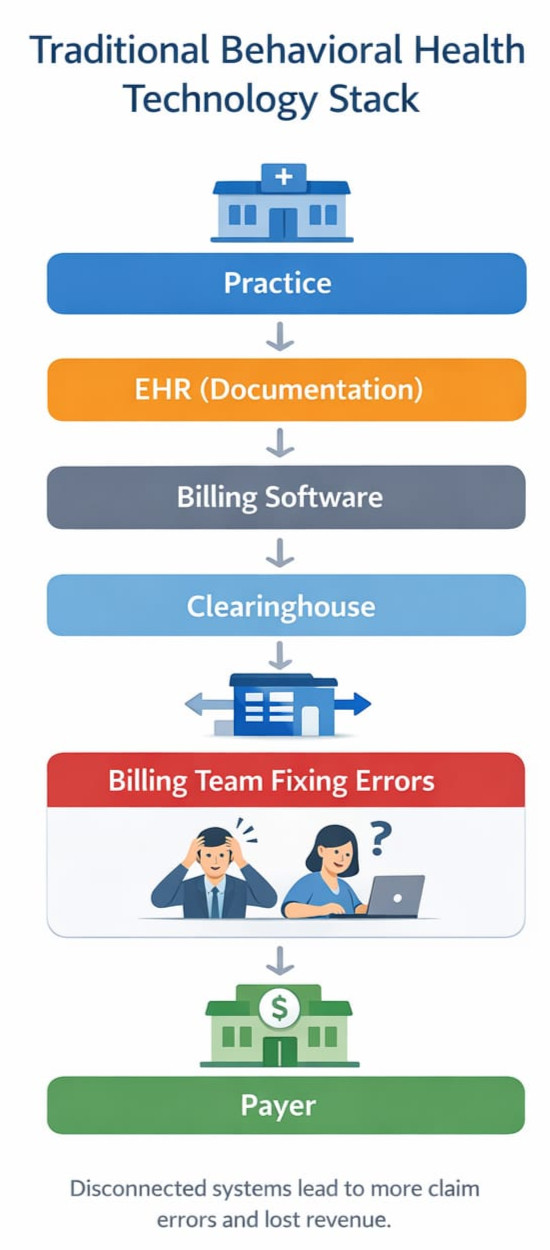
In a traditional EHR, people are responsible for remembering, checking, transferring, and following up on nearly every step. The software holds the information, but the practice still has to run the process manually.
That is why adding another dashboard or another reporting screen is not enough. Practices do not simply need more visibility into unfinished work. They need a system that actively moves the work forward.
The next generation will be a practice operating system
The future is not an EHR with a few AI features attached. It is an intelligent operating system built around the complete administrative, clinical, and financial workflow.
That system should know what needs to happen next—and help make it happen.
It should:
- guide intake and scheduling;
- verify eligibility before the appointment;
- identify benefits and expected patient responsibility;
- help collect the correct amount from the patient;
- prompt providers to complete required documentation;
- assist with compliant clinical notes and assessments;
- create accurate claims from the clinical and scheduling data;
- detect rejected, denied, delayed, or underpaid claims;
- assign follow-up work to the right person;
- track every unresolved dollar through payment;
- give leadership a clear picture of performance and accountability.
Instead of waiting for someone to find a problem, the system should recognize it, surface it, and help resolve it.
AI should reduce work, not create another tool to manage
Artificial intelligence is often presented as a separate feature: an AI note writer, chatbot, or reporting assistant. Those tools can be useful, but isolated AI does not solve the larger problem.
The real value comes when intelligence is built throughout the workflow.
An AI receptionist can help capture a prospective patient, answer common questions, and begin intake. Documentation assistance can help the provider produce a complete, clinically appropriate note. Claims intelligence can compare the appointment, documentation, coding, eligibility, authorization, and payer requirements before submission. Revenue-cycle automation can identify claims that require attention and keep them moving until they are paid.
Each part should strengthen the next. Scheduling data should support documentation. Documentation should support coding. Coding should support clean claims. Payment information should update patient responsibility. Unresolved claims should automatically become visible, assigned work.
That is not a collection of features. It is one connected system.
The measure of an EHR should no longer be whether it stores the chart
The better questions are:
- Does it reduce administrative work?
- Does it make providers’ lives easier?
- Does it prevent revenue from falling through the cracks?
- Does it tell each team member what requires attention?
- Does it connect the clinical record to the financial outcome?
- Does it help management understand what is working, what is stuck, and why?
A modern platform should not merely document the practice. It should help operate the practice.
From software the practice uses to a system the practice runs on
At DENmaar, we believe behavioral health organizations need more than an EHR and more than a billing service. They need a complete system dedicated to improving the journey from the first patient call through clinical care, claim submission, and final payment.
That means connecting scheduling, intake, eligibility, benefits, patient payments, clinical documentation, claims, follow-up, and management visibility. It means combining intelligent automation with experienced revenue-cycle support. And it means giving smaller practices enterprise-level capability without enterprise-level complexity.
So, are EHRs dead?
The electronic patient record is not. But the passive EHR, the system that stores information while people do all the work around it, is already being replaced.
The future belongs to platforms that do more than record the practice.
They help run it.