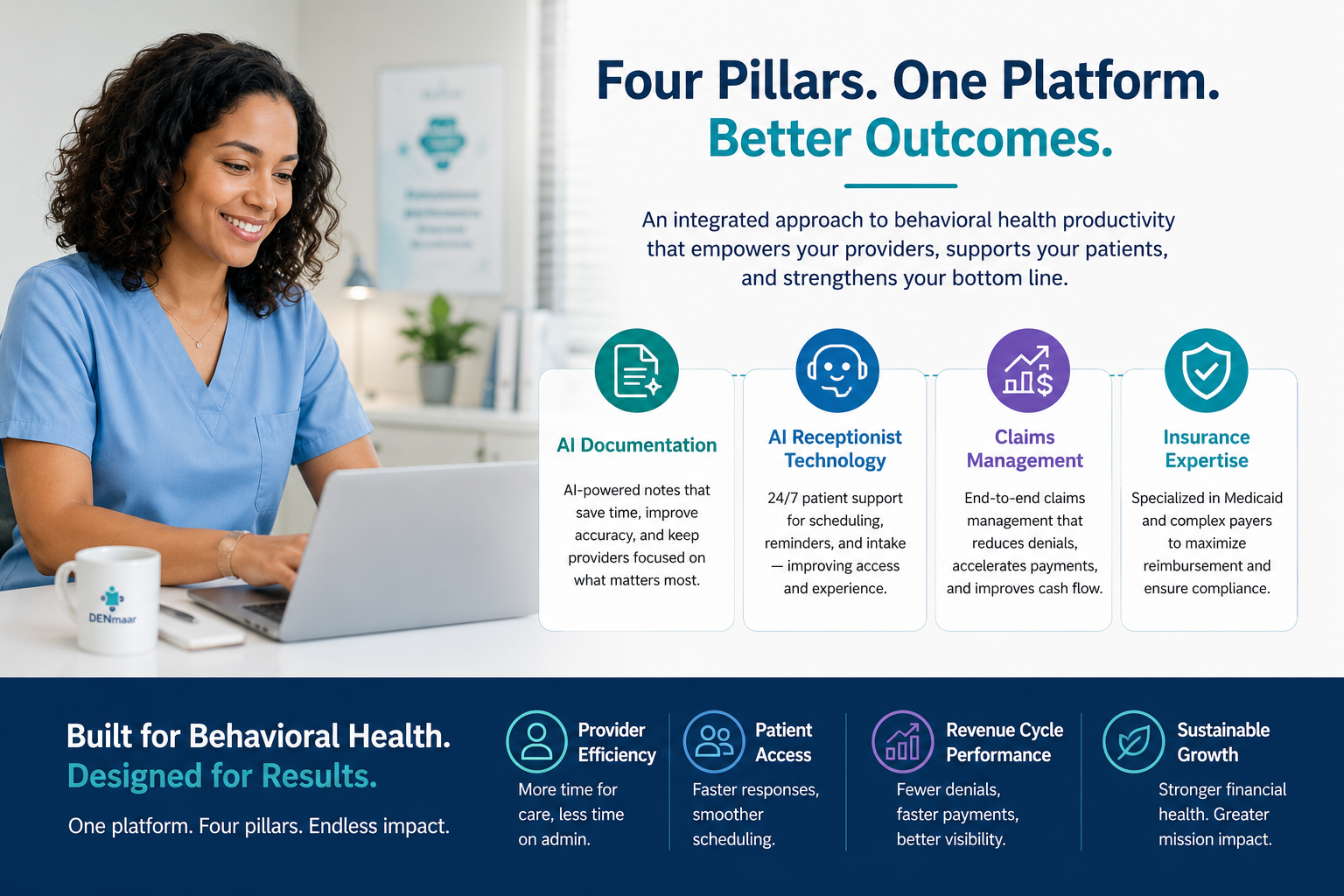
Behavioral health organizations face increasing pressure from staffing shortages, growing documentation requirements, payer complexity, and rising operational costs. While many practices continue to add disconnected software solutions, leading organizations are beginning to build integrated productivity platforms designed to support both clinical and operational success.
At DENmaar, we believe the modern behavioral health practice is built upon four core pillars.
Pillar 1: AI Documentation
Documentation remains one of the largest administrative burdens for providers.
Therapists, psychiatrists, case managers, and community support staff often spend hours each week completing notes, treatment plans, assessments, and other required documentation. This administrative workload contributes to provider burnout and reduces the time available for direct client care.
AI-assisted documentation helps organizations:
- Reduce time spent on progress notes
- Improve consistency and quality
- Support clinical compliance
- Increase provider productivity
- Allow clinicians to focus more on client care
The goal is not to replace the clinician. The goal is to help clinicians spend more time practicing and less time documenting.
Learn more about AI documentation for behavioral health providers and how accurate clinical documentation improves productivity, compliance, and patient care.
Pillar 2: The AI Receptionist
The front office is often the first bottleneck in a behavioral health practice.
Missed calls, scheduling delays, insurance questions, and intake coordination can overwhelm administrative staff and create barriers for prospective clients seeking care.
An AI Receptionist can provide:
- 24/7 call coverage
- Appointment scheduling assistance
- Intake guidance
- Insurance verification support
- Consistent client communication
As behavioral health demand continues to grow, practices need scalable solutions that improve responsiveness without continually increasing staffing costs.
Pillar 3: Claims Copilot
Revenue cycle management has become increasingly complex.
Practices must navigate eligibility verification, prior authorizations, claim status checks, payment posting, denial management, and payer follow-up activities. Even small workflow breakdowns can result in delayed payments and increased accounts receivable.
A Claims Copilot approach focuses on proactive revenue cycle management through:
- Eligibility verification
- Claims tracking
- Payment reconciliation
- Denial prevention
- Automated status monitoring
- Workflow-driven follow-up
The objective is simple: submit cleaner claims, identify issues earlier, and accelerate reimbursement.
Organizations seeking comprehensive behavioral health billing services and revenue cycle management support can strengthen reimbursement performance through integrated operational workflows.
Pillar 4: Insurance Knowledge Team
Technology alone is not enough.
Behavioral health billing requires deep payer knowledge that varies by state, program, and insurance plan. Rules change frequently, and organizations need access to expertise that can help navigate complex reimbursement requirements.
An Insurance Knowledge Team provides:
- Payer-specific expertise
- Billing guidance
- Credentialing support
- Workflow recommendations
- Operational best practices
When combined with modern technology, knowledgeable professionals help organizations maximize reimbursement while maintaining compliance.
Organizations serving Medicaid populations must also understand evolving Medicaid behavioral health billing requirements to improve reimbursement outcomes and reduce denials.
Bringing the Four Pillars Together
The most successful behavioral health organizations of the future will not rely on a single software feature or isolated service. They will build integrated systems that combine clinical efficiency, operational automation, revenue cycle intelligence, and payer expertise.
AI Documentation improves provider productivity.
The AI Receptionist improves access and engagement.
Claims Copilot strengthens financial performance.
The Insurance Knowledge Team provides the expertise needed to navigate an increasingly complex reimbursement environment.
Together, these four pillars create a stronger foundation for sustainable growth.
Looking Ahead
Behavioral healthcare continues to evolve. Organizations that embrace technology while maintaining a focus on clinical excellence will be better positioned to serve clients, support staff, and grow sustainably.
The future belongs to practices that combine people, process, and technology into a unified productivity platform.