

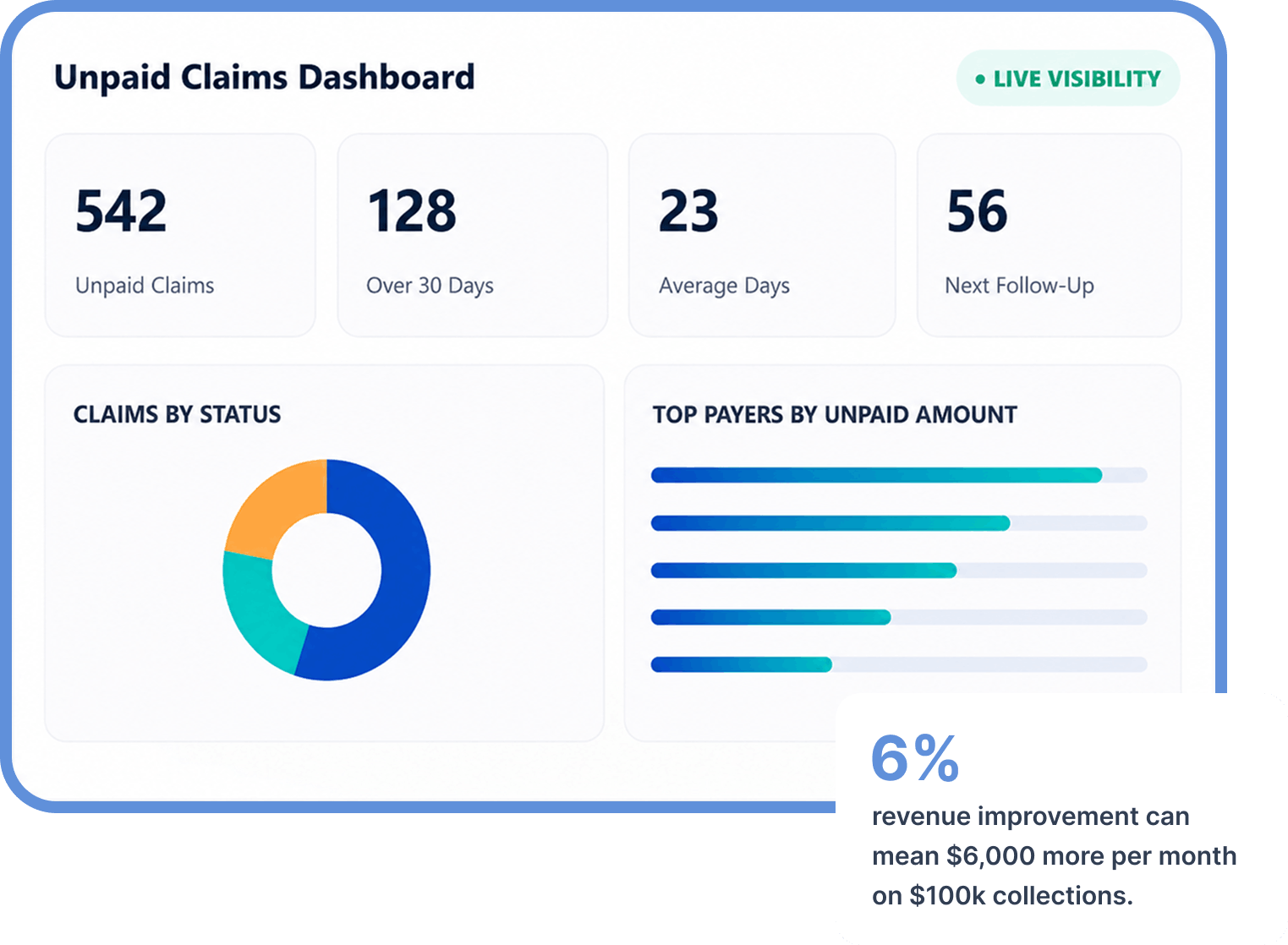
We don’t just submit claims. We create visibility and accountability around every unpaid claim—so management knows what’s being worked, what’s stuck, and why.
Know What’s Happening With Every Unpaid Claim
Behavioral health billing with complete visibility and accountability

98.1%
Clean Claim Rate
1.47%
Rejection Rate
0.32%
Denial Rate
5–10%
Denial Rate
10–20%
Average Revenue
Improvement
$0
EHR Software Fee
With Billing Services
With Billing Services
CLAIMS VISIBILITY
Your Claims May Be Getting
Submitted. But Are They Getting Paid?
Submitting a claim is only the beginning.
Your Claims May Be Getting
Submitted. But Are They Getting Paid?
Revenue is lost when rejected claims aren’t corrected, denials aren’t resolved, authorizations expire, payer requests go unanswered, and unpaid claims disappear into spreadsheets and work queues.
DENmaar gives behavioral health practices a clear view of:
- Which claims remain unpaid
- Why each claim is stuck
- What action has been taken
- Who is responsible for the next step
- When follow-up is due
- What the payer said during the last follow-up
- Which payers and problems are creating the most lost revenue
You no longer have to accept, “We’re working on it.”
You can see exactly what is being worked, what happened and what comes next.
The Improvement in Claims Can Pay for DENmaar
any practices are already losing more money through preventable claim problems than they would spend fixing them.
For a practice collecting $100,000 per month
6% = +$6,000 / month
in realized insurance revenue
That improvement alone could offset the cost of DENmaar’s billing services.
- Behavioral health EHR software at no additional cost
- Claims Copilot
- Eligibility and insurance workflows
- Payment posting
- Rejection and denial management
- Aging-claim follow-up
- Reporting and management visibility
- Support from DENmaar’s Insurance Knowledge Team
Claim Lifecycle
Every Claim Has an Owner, a Status
and a Next Action
DENmaar creates a structured process for managing the entire claim lifecycle—from appointment readiness
through final payment.
01
Prevent Problems Before Submission
Eligibility, payer, authorization, credentialing and documentation issues are identified before they become rejected or denied claims.
02
Submit Clean Claims
Claims are reviewed for common errors and payer requirements before submission.
03
Monitor the Payer Lifecycle
Claims are tracked after submission so unresolved claims don’t quietly disappear into aging.
04
Assign the Next Action
Every problem claim has a clear status, responsible team member and required next step.
05
Document Every Follow-Up
Management can see when follow-up occurred, what the payer said and what must happen next.
06
Escalate Unresolved Claims
Claims receive additional attention before filing limits or appeal deadlines are missed.
07
Measure Performance
Monitor clean claims, rejections, denials and aging by payer, provider, location, service and responsible team member.
Management Visibility
Your Billing Operation Shouldn’t Be a
Black Box
Monthly reports tell you what has already happened. DENmaar provides visibility into
what is happening now.
Visibility creates accountability.
A practice should not have to wait until collections fall to discover that claims aren’t being worked effectively.
- Whether claims are being worked consistently
- Whether follow-up is producing results
- Why claims remain unpaid
- Whether the same errors keep recurring
- Where responsibility for the next action sits
- Which workflows or team members need support
- Which payers are causing the most problems
- How much revenue remains at risk
Visibility creates accountability.
Accountability creates action.
Action moves claims toward payment.
Improve the Team You Have—or Let DENmaar Manage the Process
Some practices already have an internal billing team but lack the technology, payer knowledge and management visibility required to oversee it. Others want an experienced partner to manage the entire revenue cycle.
OPTION 01
Claims Copilot for Your Existing Team
Give your billing staff the structured workflows, claim intelligence and accountability tools needed to manage unpaid claims more effectively. Management gains visibility without immediately replacing the internal team.
OPTION 02
Full Revenue Cycle Management
Let DENmaar manage claim creation and submission, rejection correction, payment posting, denial resolution, insurance follow-up, aging claims, payer escalation, patient balances and revenue-cycle reporting.
Either way, management gains control over the revenue cycle.
Behavioral Health Expertise
Built Specifically for Behavioral Health
Behavioral health billing requires more than generic claim submission.
Mental health therapy
Psychiatry and medication management
Substance-use treatment
Intensive outpatient and partial hospitalization programs
Community behavioral health
Multidisciplinary practices
Telehealth billing
Time and unit requirements
Rejections and denials
Built Specifically for Behavioral Health
- Behavioral health payer carve-outs
- Eligibility and benefit verification
- Prior authorizations
- Provider credentialing
- Therapy and psychiatric coding
- Same-day services
- Telehealth billing
- Missing or incomplete documentation
- Coordination of benefits
- Rejections and denials
- Aging insurance balances
Before Billing Begins
Problems Are Often Created Before Billing Begins
Many claim problems originate before the claim reaches the billing team.
An appointment may be scheduled with the wrong payer. Eligibility may not be verified. An authorization may be missing. Documentation may not support the code or units billed. A provider may not be enrolled correctly.
DENmaar connects scheduling, eligibility, authorizations, documentation and billing in one operational system.
This helps prevent bad claims—not merely work them after they fail.
Prevent the problem upstream.
01
Scheduling
Right payer • right workflow
02
Eligibility & Authorization
Verify before service
03
Documentation
Support code and units
03
Billing
Submit cleaner claims
More Than Billing
Technology, Insurance Expertise and
Human Follow-Through
Most billing companies provide reports. Most software companies provide tools. DENmaar combines:
Technology, Insurance Expertise and
Human Follow-Through
You get a system designed to improve the financial performance of your behavioral health practice.
Enterprise capability with small-practice simplicity.
- Behavioral health EHR technology
- Claims Copilot
- Revenue-cycle services
- Insurance knowledge
- Human payer follow-up
- Management visibility
- Operational accountability
Billing Review
See What Better Claims Performance Could Mean for Your Practice
If too many claims are rejected, denied, aging or simply unexplained, let’s look at the process together.
Current monthly insurance revenue
Baseline performance
Clean-claim rate
Rejection and denial rates
Claims over 30 days
Value of unpaid and aging claims
Follow-up process
Where accountability is breaking down
Let’s Determine Whether There Is Operational Alignment
We begin with a discussion focused on:
- Organizational structure
- Insurance workflows
- Operational goals
- Implementation fit
Request Information
Capterra, Software Advice And Get App 2023 / 25
Best Of Badges Awarded To DENmaar
2023 / 25 “Best of” badge winners = DENmaar Neuro has earned a well-deserved Best Value Badge.
See our reviews for our software being recognized as an impactful solution for your business.





Our Latest Blogs
When Good Clinical Care Is Not Enough: Mental Health Practice Needs Better Business Processes
Mental health practices are built around helping people. Their owners are usually clinicians first, not operations executives, insurance specialists, or software designers.
That is understandable. But it also creates a common problem: a mental health practice may deliver excellent care while operating through inconsistent, fragmented, and highly manual business processes.
As the practice grows, those weaknesses become harder to ignore.
Patients wait too long for intake. Insurance information is incomplete. Eligibility is checked inconsistently. Copays are missed. Notes remain unfinished. Claims are delayed. Denials are handled reactively. Staff members spend their days moving between spreadsheets, payer portals, email, and disconnected software.
The practice is busy, but it is not necessarily operating well.
Most Practices Do Not Have a People Problem
In many cases, the staff is working extremely hard. The deeper issue is that the organization lacks a reliable operating process.
Important work may depend on someone remembering what to do next. Policies may exist verbally but not be built into the workflow. A task may be completed one way by one employee and differently by another. When an experienced employee leaves, essential operational knowledge can leave with them.
This produces predictable consequences:
- Patients fall out of the intake process.
- Appointments occur before benefits are properly verified.
- Required authorizations are missed or expire.
- Providers do not know which documentation needs attention.
- Claims are held because information is incomplete.
- Patient balances grow because collection policies are inconsistent.
- Owners lack clear visibility into what is working and what is not.
Hiring another employee may provide temporary relief, but it does not correct a broken process. Adding more technology does not necessarily solve it either, especially when that technology simply creates another place for employees to check.
An EHR Should Do More Than Store Information
Traditional EHR systems were largely designed as electronic filing cabinets. They store patient demographics, appointments, clinical notes, and billing information.
Those functions remain necessary, but they are no longer enough.
A modern behavioral health platform should help the mental health practice operate correctly. It should guide work from one stage to the next, identify exceptions, assign responsibility, and make unfinished work visible before it becomes a financial or patient service problem.
The goal is not to force every practice into an identical model. The goal is to ensure that critical steps do not depend on memory.
For example, a strong intake process should connect:
- The initial patient inquiry
- Demographic and insurance collection
- Eligibility and benefit verification
- Authorization requirements
- Provider matching and scheduling
- Required forms and assessments
- Copay or payment expectations
- Readiness for the first appointment
Each step affects the next. Treating them as separate administrative tasks creates gaps. Managing them as one complete process creates accountability.
The Same Principle Applies Across the Practice
The appointment to claim process should also operate as a connected workflow:
- The appointment occurs.
- The provider completes the required documentation.
- The system confirms that the note supports the service.
- Missing information is identified.
- The claim is released correctly.
- Payment or rejection is monitored.
- Unresolved claims are assigned for follow up.
- The final outcome is documented and visible.
When these steps are disconnected, staff must repeatedly reconstruct what happened. When they are connected, the system can guide the practice toward the next appropriate action.
Other processes deserve the same treatment:
- Copay determination, collection, and reconciliation
- Provider onboarding, credentialing, and payer readiness
- Authorization tracking and renewal
- Clinical supervision and note sign off
- Cancellation and rescheduling follow up
- Denial management and aging claim resolution
- Patient communications and outstanding requests
- Management reporting and staff accountability
Good Policies Must Become Daily Workflows
A written policy has limited value if employees must remember to look for it.
The strongest systems place the policy inside the work itself. They provide prompts at the correct moment, prevent avoidable omissions, route exceptions to the right person, and show managers where work has stalled.
That changes the role of technology. Instead of merely documenting what the practice did, the system helps the practice do it correctly.
It also creates consistency without requiring constant supervision. New employees learn a defined process. Experienced employees spend less time searching for information. Managers can focus on true exceptions instead of checking every routine task.
Better Processes Improve More Than Revenue
Operational discipline is sometimes viewed as a billing concern. In reality, it affects the entire patient and provider experience.
A patient benefits when the practice communicates clearly, understands coverage before treatment, sends forms on time, and follows up consistently. Providers benefit when administrative expectations are visible and documentation tasks are organized. Staff members benefit when responsibilities are clear and they are not forced to solve the same preventable problem repeatedly.
The financial benefits follow naturally: cleaner claims, faster submission, stronger collections, fewer avoidable denials, and less labor spent correcting errors.
Better processes also make growth safer. A practice should not have to multiply administrative confusion every time it adds providers, locations, or new services.
Building the Behavioral Health Operating System
At DENmaar, we believe behavioral health practices need more than separate EHR and billing tools. They need an operating system that connects clinical care, patient administration, insurance, billing, and follow up. A behavioral health technology partner can help bring these workflows together rather than leaving practices to manage disconnected systems.
Our work is increasingly focused on polishing these complete processes, not simply adding isolated features. That means studying how real practices operate, identifying where work breaks down, and building better policies directly into the platform.
For practices dealing with complex payer requirements, this connected approach can also extend to specialized insurance knowledge and payer support through DENmaar’s Insurance Knowledge Team.
It means making the next action clear, giving teams visibility into exceptions, and using automation and artificial intelligence where they can remove repetitive work without removing human judgment.
The future of behavioral health technology is not another screen filled with fields. It is a system that helps practices run well.
Excellent clinical care will always be the purpose of a mental health practice. Strong business processes are what allow that care to remain accessible, sustainable, and scalable.
Frequently Asked Questions
What is a mental health practice?
A mental health practice provides behavioral healthcare services while managing clinical, administrative, insurance, and financial operations.
Why do mental health practices need better processes?
Better processes reduce administrative errors, improve patient access, strengthen collections, and help practices scale more efficiently.
How can technology improve mental health practice operations?
Connected technology can automate repetitive work, guide workflows, identify exceptions, and give teams better visibility into unfinished tasks.
What business processes matter most in mental health practices?
Intake, eligibility, authorizations, documentation, billing, collections, follow up, credentialing, and staff accountability are all critical.
How can a mental health practice improve efficiency?
A practice can improve efficiency by connecting workflows, reducing manual work, standardizing processes, and making responsibilities visible.

Your Behavioral Health Technology Partner Shouldn’t Leave You on Your Own
Technology should make a behavioral health practice easier to operate, not leave its team alone to connect the pieces.
By Chris Husted, CEO of DENmaar
Behavioral health practices are often told that the right software will solve their operational problems. They implement an EHR, add a billing platform, connect a scheduling tool, and perhaps purchase separate systems for patient communication, eligibility, telehealth, and documentation.
Yet the work rarely becomes simpler. Instead, the practice is left responsible for making all those systems work together and for discovering where the process is breaking down.
That is the problem with treating software as a product that is delivered rather than a working relationship that continues.
A Help Desk Is Not the Same as Behavioral Health Operational Support
Traditional software support usually begins after something goes wrong. A user submits a ticket, describes the issue, and waits for an answer. That model may address technical defects, but many of the hardest problems inside a behavioral health practice do not fit neatly into a support ticket.
A claim may be unpaid because eligibility was not verified correctly, a payer applied an unexpected rule, documentation did not support the service, or responsibility for the next action was unclear. A provider may be falling behind on notes because the workflow creates unnecessary steps. Front office staff may repeatedly request the same information because scheduling, intake, and billing are disconnected.
These are not isolated software problems. They are operational problems that cross clinical, administrative, and financial workflows.
The Software Should Reflect How the Practice Actually Works
Behavioral health practices have distinct workflows, payer requirements, staffing structures, and service lines. They should not have to reorganize their entire operation around a generic system.
A strong Behavioral Health Technology Partner listens to the people doing the work. It identifies repeated friction, determines whether the cause is a process, payer, training, or product issue, and then helps create a practical solution. Sometimes that means improving the software. Sometimes it means clarifying accountability. Often it requires both.
At DENmaar, many of our most useful improvements come directly from working alongside practices. Their real world requests help us build capabilities that are useful not only for one organization, but across the platform.
Clinical and Financial Workflows Belong Together
An EHR should not end its job when the provider signs the note. The clinical record, patient information, eligibility results, authorization requirements, charge release, claim status, and follow up activity are all connected.
When those functions live in separate systems, practices lose visibility. Staff members create spreadsheets, duplicate information, and spend time determining what happened rather than moving the work forward.
Bringing the EHR, billing, and operational workflows together creates a clearer chain of responsibility. A practitioner can see whether documentation is complete, whether a claim was released, what remains unpaid, what action has been taken, and what needs to happen next.
This approach to behavioral health practice management helps connect clinical and financial workflows instead of forcing teams to manage them separately.
Every Problem Should Lead to Greater Visibility
Software should do more than store information. It should help a practice answer basic operating questions quickly: What needs attention today? Which claims are stuck? Why are they stuck? Who is working for them? Which patients need updated insurance information? Which providers have incomplete documentation?
When those answers are visible, management can act earlier. Staff members spend less time searching. Providers receive clearer direction. Problems become work items with owners and next steps instead of unresolved surprises.
Effective behavioral health workflow automation can help organizations improve operational efficiency while giving teams greater visibility into the work that requires attention.
What a True Behavioral Health Technology Partner Looks Like
A true technology partner does not disappear after implementation. It remains involved, learns from the practice, and continues improving the combination of technology and human support.
That close working relationship matters because no two behavioral health practices operate exactly the same way and because payer rules, documentation expectations, and patient needs continue to change.
The goal is not simply to provide more features. The goal is to make the practice easier to operate, give leadership greater control, and allow clinicians and staff to spend more time on work that matters.
This is where behavioral health operational support becomes more than traditional software support. It means helping practices address the operational challenges that exist across technology, workflows, billing, and day to day practice management.
DENmaar Was Built Around That Idea
DENmaar brings behavioral health software, billing, and operational support together in one system. We work closely with practices to solve problems, strengthen workflows, and continually improve the platform based on what is happening in the real world.
For practices looking to improve how they manage patient communication and front office workflows, an AI receptionist for behavioral health can also become part of a more connected operational approach.
Because your software vendor should not leave you on your own. It should help your practice move forward.
DENmaar’s approach focuses on connecting technology with measurable practice outcomes rather than simply adding another system for staff to manage.
Frequently Asked Questions
What is a Behavioral Health Technology Partner?
A Behavioral Health Technology Partner combines software, operational guidance, workflow support, and ongoing improvements for behavioral health practices.
Why does behavioral health need operational support?
Behavioral health practices manage complex clinical, administrative, billing, and payer workflows that often require coordinated operational support.
What should behavioral health software support include?
It should include workflow guidance, technical assistance, billing support, operational improvements, and help connecting clinical and financial processes.
How can technology improve behavioral health operations?
Connected technology can reduce duplicate work, improve visibility, automate repetitive workflows, and help teams identify problems earlier.
What makes a behavioral health technology partner different?
A true partner stays involved after implementation, learns from the practice, improves workflows, and combines technology with human support.

Are EHRs Dead? The Future of Behavioral Health Practice Management
The traditional EHR is. What comes next will run the entire practice.
For decades, electronic health records promised to transform healthcare. In many ways, they did. Paper charts became digital. Records became searchable. Notes could be stored, signed, and retrieved more easily.
But somewhere along the way, the industry confused digitizing the chart with improving the practice.
Most EHRs remain systems of record. They store what has already happened: the appointment, the diagnosis, the clinical note, the claim, and the payment. They document the past, but they do very little to manage what needs to happen next.
That model is reaching the end of its useful life.
The EHR is not disappearing. The patient record will always matter. But the traditional, passive EHR, the electronic filing cabinet, is dead.
Practices do not need another place to enter information
Behavioral health practices are surrounded by disconnected work:
- A patient requests an appointment.
- Insurance must be verified correctly.
- Benefits and patient responsibility must be understood.
- Intake forms and assessments must be completed.
- The provider must document the session accurately and on time.
- The correct claim must be created and submitted.
- Rejections and denials must be identified and corrected.
- Unpaid claims must be followed until resolved.
- Patient balances must be collected and reconciled.
- Management needs to know where revenue is being lost.
In a traditional EHR, people are responsible for remembering, checking, transferring, and following up on nearly every step. The software holds the information, but the practice still has to run the process manually.
That is why adding another dashboard or another reporting screen is not enough. Practices do not simply need more visibility into unfinished work. They need a system that actively moves the work forward.
The next generation will be a practice operating system
The future is not an EHR with a few AI features attached. It is an intelligent operating system built around the complete administrative, clinical, and financial workflow.
That system should know what needs to happen next—and help make it happen.
It should:
- guide intake and scheduling;
- verify eligibility before the appointment;
- identify benefits and expected patient responsibility;
- help collect the correct amount from the patient;
- prompt providers to complete required documentation;
- assist with compliant clinical notes and assessments;
- create accurate claims from the clinical and scheduling data;
- detect rejected, denied, delayed, or underpaid claims;
- assign follow-up work to the right person;
- track every unresolved dollar through payment;
- give leadership a clear picture of performance and accountability.
Instead of waiting for someone to find a problem, the system should recognize it, surface it, and help resolve it.
AI should reduce work, not create another tool to manage
Artificial intelligence is often presented as a separate feature: an AI note writer, chatbot, or reporting assistant. Those tools can be useful, but isolated AI does not solve the larger problem.
The real value comes when intelligence is built throughout the workflow.
An AI receptionist can help capture a prospective patient, answer common questions, and begin intake. Documentation assistance can help the provider produce a complete, clinically appropriate note. Claims intelligence can compare the appointment, documentation, coding, eligibility, authorization, and payer requirements before submission. Revenue-cycle automation can identify claims that require attention and keep them moving until they are paid.
Each part should strengthen the next. Scheduling data should support documentation. Documentation should support coding. Coding should support clean claims. Payment information should update patient responsibility. Unresolved claims should automatically become visible, assigned work.
That is not a collection of features. It is one connected system.
The measure of an EHR should no longer be whether it stores the chart
The better questions are:
- Does it reduce administrative work?
- Does it make providers’ lives easier?
- Does it prevent revenue from falling through the cracks?
- Does it tell each team member what requires attention?
- Does it connect the clinical record to the financial outcome?
- Does it help management understand what is working, what is stuck, and why?
A modern platform should not merely document the practice. It should help operate the practice.
From software the practice uses to a system the practice runs on
At DENmaar, we believe behavioral health organizations need more than an EHR and more than a billing service. They need a complete system dedicated to improving the journey from the first patient call through clinical care, claim submission, and final payment.
That means connecting scheduling, intake, eligibility, benefits, patient payments, clinical documentation, claims, follow-up, and management visibility. It means combining intelligent automation with experienced revenue-cycle support. And it means giving smaller practices enterprise-level capability without enterprise-level complexity.
So, are EHRs dead?
The electronic patient record is not. But the passive EHR, the system that stores information while people do all the work around it, is already being replaced.
The future belongs to platforms that do more than record the practice.
They help run it.
Frequently Asked Questions
What is behavioral health practice management?
Behavioral health practice management coordinates clinical, administrative, and financial workflows to help practices operate efficiently and deliver care.
How is AI changing behavioral health practice management?
AI can automate repetitive workflows, support documentation, identify claims issues, and help teams prioritize work across the practice.
What is a behavioral health practice operating system?
It is an integrated system that connects scheduling, intake, documentation, billing, claims, payments, and operational workflows.
Are traditional EHRs becoming outdated?
Traditional EHRs remain important for patient records, but practices increasingly need systems that actively manage workflows beyond documentation.
Why does behavioral health need integrated technology?
Behavioral health involves complex clinical, administrative, insurance, and billing workflows. Integrated technology helps connect these processes and reduce manual work.
Our Partners






Ready to get started?
Feel free to reach out if you have any questions.
