

We don’t just submit claims. We create visibility and accountability around every unpaid claim—so management knows what’s being worked, what’s stuck, and why.
Know What’s Happening With Every Unpaid Claim
Behavioral health billing with complete visibility and accountability

98.1%
Clean Claim Rate
1.47%
Rejection Rate
0.32%
Denial Rate
5–10%
Denial Rate
10–20%
Average Revenue
Improvement
$0
EHR Software Fee
With Billing Services
With Billing Services
CLAIMS VISIBILITY
Your Claims May Be Getting
Submitted. But Are They Getting Paid?
Submitting a claim is only the beginning.
Your Claims May Be Getting
Submitted. But Are They Getting Paid?
Revenue is lost when rejected claims aren’t corrected, denials aren’t resolved, authorizations expire, payer requests go unanswered, and unpaid claims disappear into spreadsheets and work queues.
DENmaar gives behavioral health practices a clear view of:
- Which claims remain unpaid
- Why each claim is stuck
- What action has been taken
- Who is responsible for the next step
- When follow-up is due
- What the payer said during the last follow-up
- Which payers and problems are creating the most lost revenue
You no longer have to accept, “We’re working on it.”
You can see exactly what is being worked, what happened and what comes next.
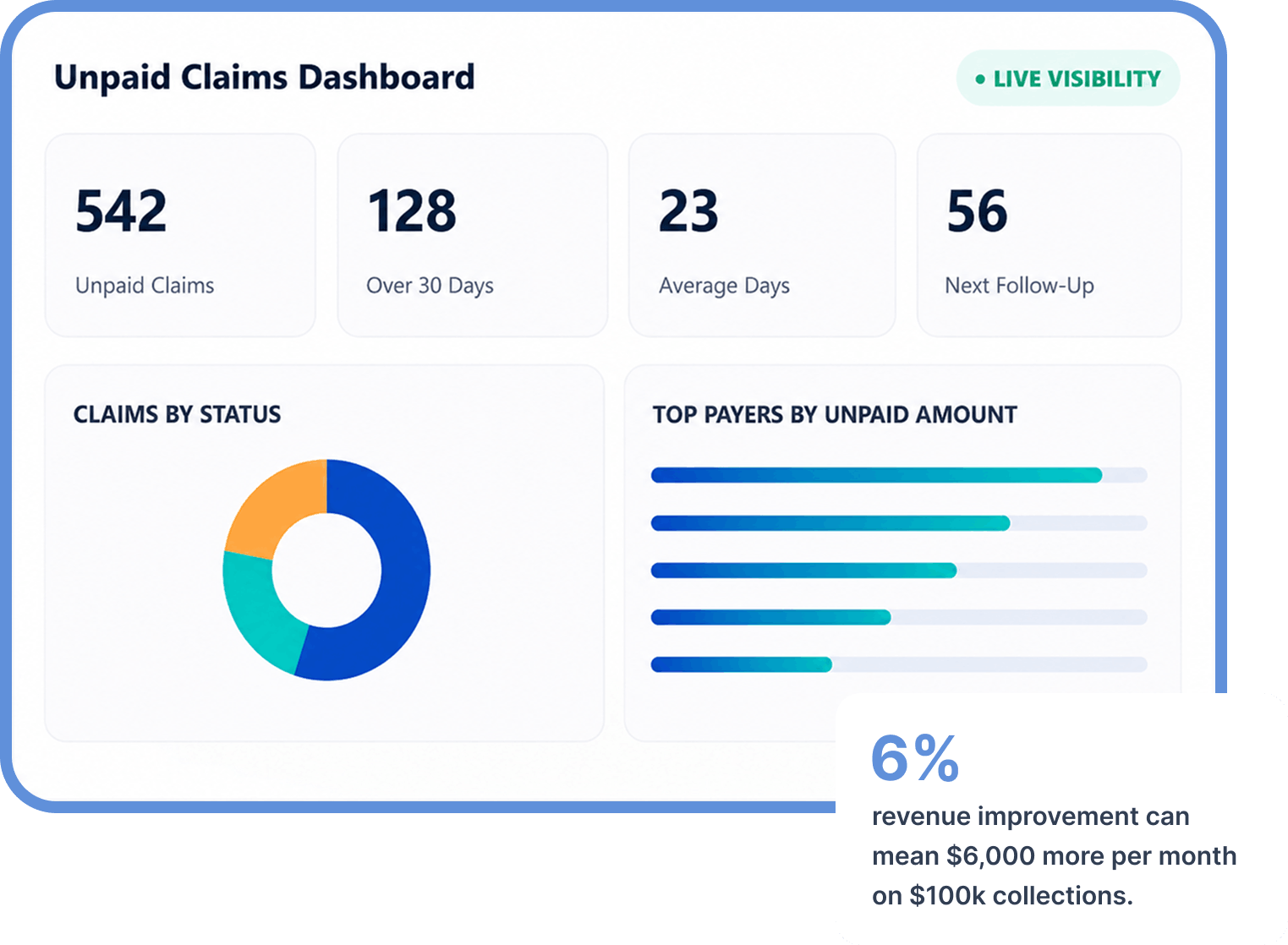
The Improvement in Claims Can Pay for DENmaar
any practices are already losing more money through preventable claim problems than they would spend fixing them.
For a practice collecting $100,000 per month
6% = +$6,000 / month
in realized insurance revenue
That improvement alone could offset the cost of DENmaar’s billing services.
- Behavioral health EHR software at no additional cost
- Claims Copilot
- Eligibility and insurance workflows
- Payment posting
- Rejection and denial management
- Aging-claim follow-up
- Reporting and management visibility
- Support from DENmaar’s Insurance Knowledge Team
Claim Lifecycle
Every Claim Has an Owner, a Status
and a Next Action
DENmaar creates a structured process for managing the entire claim lifecycle—from appointment readiness
through final payment.
01
Prevent Problems Before Submission
Eligibility, payer, authorization, credentialing and documentation issues are identified before they become rejected or denied claims.
02
Submit Clean Claims
Claims are reviewed for common errors and payer requirements before submission.
03
Monitor the Payer Lifecycle
Claims are tracked after submission so unresolved claims don’t quietly disappear into aging.
04
Assign the Next Action
Every problem claim has a clear status, responsible team member and required next step.
05
Document Every Follow-Up
Management can see when follow-up occurred, what the payer said and what must happen next.
06
Escalate Unresolved Claims
Claims receive additional attention before filing limits or appeal deadlines are missed.
07
Measure Performance
Monitor clean claims, rejections, denials and aging by payer, provider, location, service and responsible team member.
Management Visibility
Your Billing Operation Shouldn’t Be a
Black Box
Monthly reports tell you what has already happened. DENmaar provides visibility into
what is happening now.
Visibility creates accountability.
A practice should not have to wait until collections fall to discover that claims aren’t being worked effectively.
- Whether claims are being worked consistently
- Whether follow-up is producing results
- Why claims remain unpaid
- Whether the same errors keep recurring
- Where responsibility for the next action sits
- Which workflows or team members need support
- Which payers are causing the most problems
- How much revenue remains at risk
Visibility creates accountability.
Accountability creates action.
Action moves claims toward payment.
Improve the Team You Have—or Let DENmaar Manage the Process
Some practices already have an internal billing team but lack the technology, payer knowledge and management visibility required to oversee it. Others want an experienced partner to manage the entire revenue cycle.
OPTION 01
Claims Copilot for Your Existing Team
Give your billing staff the structured workflows, claim intelligence and accountability tools needed to manage unpaid claims more effectively. Management gains visibility without immediately replacing the internal team.
OPTION 02
Full Revenue Cycle Management
Let DENmaar manage claim creation and submission, rejection correction, payment posting, denial resolution, insurance follow-up, aging claims, payer escalation, patient balances and revenue-cycle reporting.
Either way, management gains control over the revenue cycle.
Behavioral Health Expertise
Built Specifically for Behavioral Health
Behavioral health billing requires more than generic claim submission.
Mental health therapy
Psychiatry and medication management
Substance-use treatment
Intensive outpatient and partial hospitalization programs
Community behavioral health
Multidisciplinary practices
Telehealth billing
Time and unit requirements
Rejections and denials
Built Specifically for Behavioral Health
- Behavioral health payer carve-outs
- Eligibility and benefit verification
- Prior authorizations
- Provider credentialing
- Therapy and psychiatric coding
- Same-day services
- Telehealth billing
- Missing or incomplete documentation
- Coordination of benefits
- Rejections and denials
- Aging insurance balances
Before Billing Begins
Problems Are Often Created Before Billing Begins
Many claim problems originate before the claim reaches the billing team.
An appointment may be scheduled with the wrong payer. Eligibility may not be verified. An authorization may be missing. Documentation may not support the code or units billed. A provider may not be enrolled correctly.
DENmaar connects scheduling, eligibility, authorizations, documentation and billing in one operational system.
This helps prevent bad claims—not merely work them after they fail.
Prevent the problem upstream.
01
Scheduling
Right payer • right workflow
02
Eligibility & Authorization
Verify before service
03
Documentation
Support code and units
03
Billing
Submit cleaner claims
More Than Billing
Technology, Insurance Expertise and
Human Follow-Through
Most billing companies provide reports. Most software companies provide tools. DENmaar combines:
Technology, Insurance Expertise and
Human Follow-Through
You get a system designed to improve the financial performance of your behavioral health practice.
Enterprise capability with small-practice simplicity.
- Behavioral health EHR technology
- Claims Copilot
- Revenue-cycle services
- Insurance knowledge
- Human payer follow-up
- Management visibility
- Operational accountability
Billing Review
See What Better Claims Performance Could Mean for Your Practice
If too many claims are rejected, denied, aging or simply unexplained, let’s look at the process together.
Current monthly insurance revenue
Baseline performance
Clean-claim rate
Rejection and denial rates
Claims over 30 days
Value of unpaid and aging claims
Follow-up process
Where accountability is breaking down
Let’s Determine Whether There Is Operational Alignment
We begin with a discussion focused on:
- Organizational structure
- Insurance workflows
- Operational goals
- Implementation fit
Request Information
Capterra, Software Advice And Get App 2023 / 25
Best Of Badges Awarded To DENmaar
2023 / 25 “Best of” badge winners = DENmaar Neuro has earned a well-deserved Best Value Badge.
See our reviews for our software being recognized as an impactful solution for your business.





Our Latest Blogs

Behavioral Healthcare Technology for Growing Practices: Enterprise Capability. Small Practice Simplicity
For years, behavioral healthcare technology has forced practices into a difficult choice.
You can buy an enterprise platform with hundreds of features, months of implementation, and a level of complexity that requires dedicated administrators.
Or you can buy software designed for small practices that is easy to use, but quickly becomes limiting as your organization grows.
We believe there should be a better option.
At DENmaar, our vision is simple:
Enterprise capability. Small practice simplicity.
Who We’re Building For with Behavioral Healthcare Technology
We’re not trying to build software for every healthcare organization.
We’re building for growing behavioral healthcare organizations with approximately 2 to 15 providers, including:
- Therapy practices
- Psychiatry practices
- Multidisciplinary behavioral health
- Substance Use Disorder (SUD) programs
- Intensive Outpatient Programs (IOP)
- Community behavioral health organizations
- Integrated behavioral health practices
These organizations face enterprise-level challenges without enterprise-level resources.
They need to manage documentation, scheduling, insurance eligibility, credentialing, billing, denials, patient responsibility, compliance, and provider productivity, all while continuing to care for patients.
Growing Practices Deserve Better
Many practices eventually discover that they have outgrown their software.
As providers are added, workflows become more complicated.
As insurance volume increases, revenue cycle management becomes more demanding.
As services expand into psychiatry, therapy, group treatment, or IOP, disconnected systems create additional work instead of reducing it.
Growing should not require replacing your technology every few years.
Your software should grow with you.
One Platform
Our goal is to eliminate the need for multiple disconnected systems.
Instead of stitching together separate products for documentation, billing, credentialing, eligibility, and workflow management, we believe these functions should work together as one platform.
That means less duplication.
Less administrative work.
Less time searching for information.
More time caring for patients.
Our integrated approach combines AI Notes for Behavioral Health, intelligent workflows, and Claims Copilot to help organizations improve efficiency while delivering better outcomes, rather than simply adding more software.
Learning From Real Practices
We believe the best products are built alongside the people who use them.
Every implementation teaches us something.
Some organizations challenge us with scale.
Others introduce new clinical workflows.
Every improvement we make becomes part of the platform for every future customer.
That’s how software should evolve, not through assumptions, but through real-world experience.
Our Promise
We’re not trying to build the biggest healthcare platform.
We’re focused on building the most practical platform for growing behavioral healthcare organizations.
A platform that combines AI, billing, revenue cycle management, credentialing, scheduling, eligibility, and clinical documentation without unnecessary complexity.
Because growing practices deserve enterprise-level capabilities.
Without enterprise-level complexity.
Enterprise capability. Small practice simplicity.
That’s the future we’re building.
Frequently Asked Questions
What is behavioral healthcare technology?
Behavioral healthcare technology connects clinical, billing, and operational workflows to improve efficiency and patient care.
Why use behavioral healthcare technology?
It helps practices reduce administrative work, improve productivity, and support sustainable growth.
How do AI notes help providers?
AI notes reduce documentation time while improving accuracy and supporting clinical compliance.
What is Claims Copilot?
Claims Copilot helps identify claim issues early and supports faster reimbursement through intelligent workflows.
How can growing practices scale?
Growing practices scale by using connected platforms that simplify operations and improve financial performance.
Behavioral Health Software Should Deliver Outcomes, Not Just Features
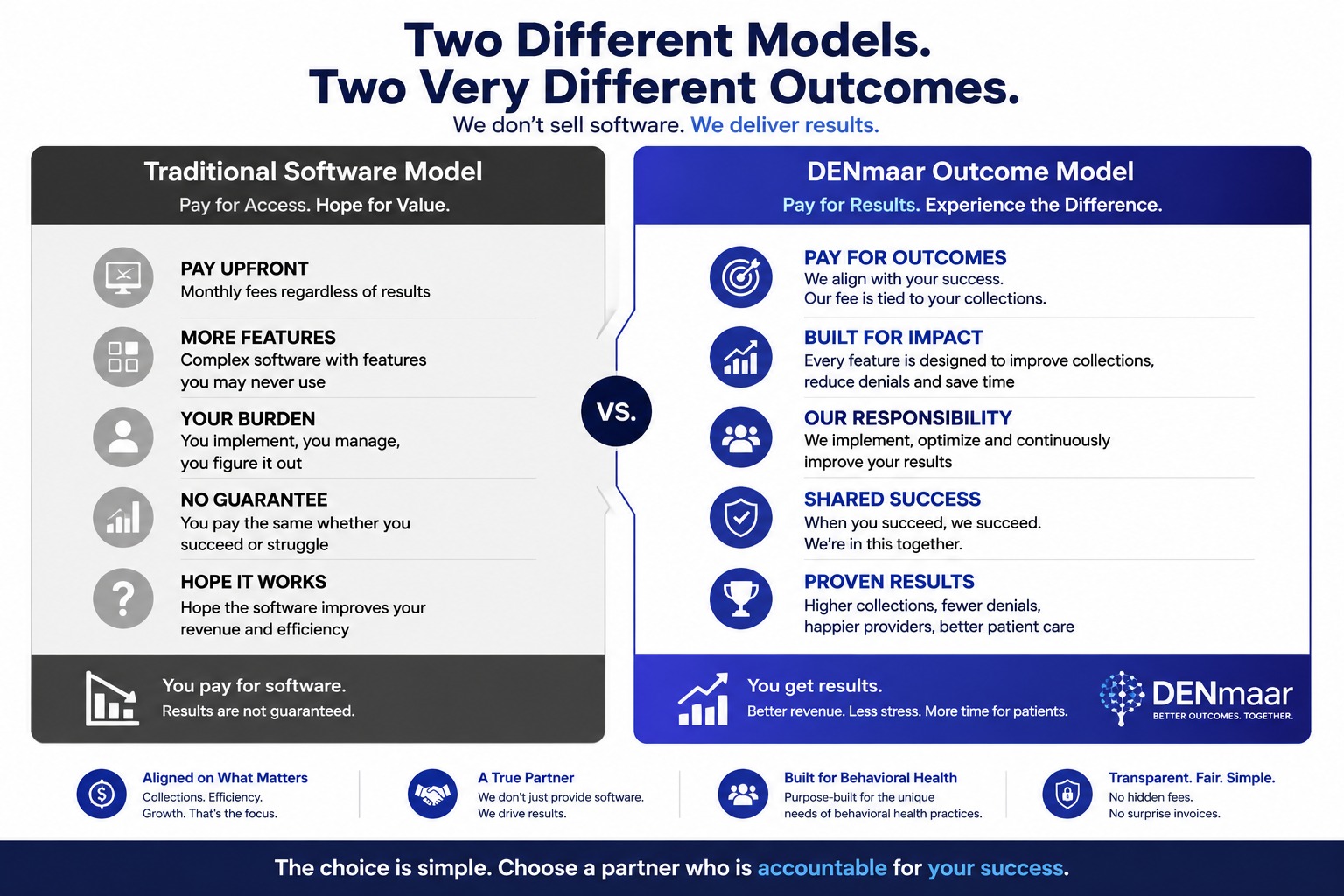
For years, healthcare software has been sold the same way: buy the platform, pay the monthly fee, and hope it delivers value.
That model is changing.
Across the software industry, a new generation of companies is asking a different question:
What if customers paid for results instead of promises?
At DENmaar, we’ve believed that for years.
We don’t just provide behavioral health software. We partner with behavioral health practices to improve financial and operational outcomes.
Behavioral Health Software Should Improve Outcomes
That means helping practices:
- Collect more of the money they’ve earned.
- Reduce claim denials before they happen.
- Keep aging accounts under control.
- Improve documentation quality.
- Eliminate repetitive administrative work through AI.
- Give providers more time with patients instead of paperwork.
Our behavioral health EHR is part of that mission, not the product itself.
The product has better outcomes.
Every feature we build starts with a single question:
Will this measurably improve a behavioral health practice?
If the answer is no, we don’t build it.
Building Technology That Improves Performance
That’s why our roadmap looks different.
Instead of adding features for marketing brochures, we’re building tools that directly affect performance:
- AI Clinical Notes that reduce documentation time.
- AI Receptionist that helps practices never miss an opportunity.
- Claims Copilot that identifies and resolves reimbursement issues faster.
- Automated eligibility verification that catches insurance problems before appointments.
- Intelligent provider task management so nothing falls through the cracks.
Technology should create measurable improvements—not simply create another screen for staff to click through.
Learn how Claims Copilot helps behavioral health organizations resolve reimbursement issues faster.
Practices Want Better Results, Not More Software
Behavioral health practices don’t wake up wanting a new EHR.
They want fewer denials.
Faster payments.
Less stress.
Higher provider productivity.
Better patient care.
Software is simply the vehicle that gets them there.
Practices that prioritize behavioral health provider productivity are better equipped to reduce administrative burden, improve clinician efficiency, and create more time for patient care.
Accountability Is the Future of Behavioral Health Software
The healthcare industry is moving toward accountability.
We believe software companies should be accountable too.
At DENmaar, success isn’t measured by how many features we release.
It’s measured by how much better our clients perform because they use them.
Our dedicated Insurance Knowledge Team works alongside technology to help practices navigate payer requirements and improve operational performance:
That’s the future of healthcare software.
Not selling software.
Delivering results.
Frequently Asked Questions
What is behavioral health software?
Behavioral health software helps providers manage clinical, billing, and operational workflows more efficiently.
How does behavioral health software improve outcomes?
It reduces administrative work, improves documentation, and helps practices increase productivity and reimbursement.
What is Claims Copilot?
Claims Copilot identifies reimbursement issues early and helps billing teams resolve claims faster.
Why is AI important in behavioral health software?
AI automates repetitive tasks, reduces documentation time, and improves provider productivity.
What should practices expect from modern software?
Modern behavioral health software should improve patient care, financial performance, and operational efficiency.
Behavioral Health Provider Productivity Starts with Less Administrative Work
Behavioral health provider productivity has become one of the biggest challenges facing modern healthcare organizations.
Every behavioral health provider entered this profession to help people not to spend evenings chasing authorizations, fixing documentation, or answering insurance questions.
Whether you’re a therapist, psychologist, psychiatrist, nurse practitioner, BCBA, speech therapist, occupational therapist, physical therapist, or community-based clinician, the daily frustrations are remarkably similar.
You finish one patient only to discover:
- An authorization is expiring.
- Insurance changed.
- A treatment plan is overdue.
- Documentation is incomplete.
- A patient has a balance due.
- Eligibility needs to be verified.
- A claim rejected because of a missing modifier.
- Someone needs an updated insurance card.
None of those tasks improve patient care.
They simply interrupt it.
Behavioral Health Provider Productivity Requires One Place to Work
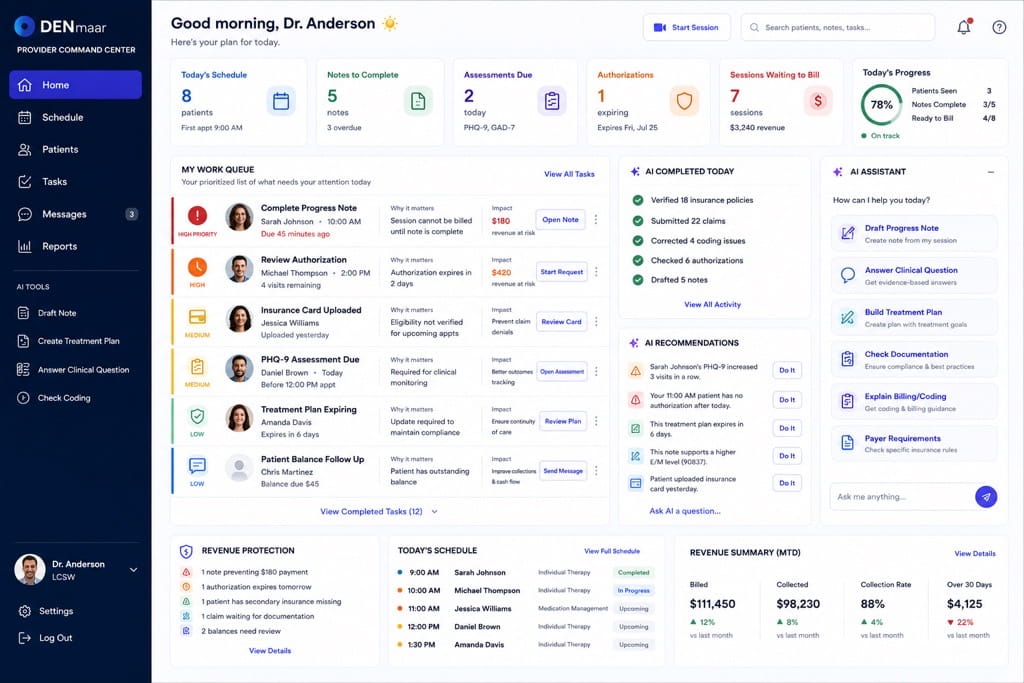
Instead of forcing providers to search through multiple screens, DENmaar is building a Provider To-Do Workspace that becomes the command center for every clinician.
Imagine opening your dashboard each morning and immediately seeing exactly what requires your attention.
Not reports.
Not billing screens.
Not administrative menus.
Just your work.
The system automatically organizes priorities including:
- Notes that need completion
- Treatment plans due
- Assessments due
- Prior authorizations approaching expiration
- Eligibility issues
- Insurance changes
- Requests for updated insurance cards
- Unsigned documentation
- Patient balances requiring discussion
- Credit balances needing review
- Documentation needed before claims can be released
- Messages requiring provider action
Once completed, the task disappears.
No searching.
No guessing.
No forgotten work.
Intelligent workflow automation combined with Claims Copilot helps organizations identify administrative barriers before they affect providers or reimbursement.
Built for Every Behavioral Health Discipline
Behavioral health isn’t one specialty.
It’s many.
That’s why the Provider To-Do Workspace isn’t designed for only therapists.
It’s designed for every discipline DENmaar supports, including:
- Mental Health Therapy
- Psychiatry
- Psychology
- Applied Behavior Analysis (ABA)
- Community Mental Health
- Substance Use Disorder Programs
- Intensive Outpatient Programs (IOP)
- Partial Hospitalization Programs (PHP)
- Speech Therapy
- Occupational Therapy
- Physical Therapy
Each discipline sees the same simple experience while receiving tasks specific to their workflow.
The Goal Isn’t More Software
The goal is less thinking about software.
Providers shouldn’t have to remember dozens of administrative tasks every day.
The system should remember for them.
The Provider To-Do Workspace acts like an intelligent assistant that quietly watches everything happening in the background and simply tells providers what needs attention next.
Nothing more.
Nothing less.
Organizations with strong operational support often pair intelligent technology with an experienced Insurance Knowledge Team that helps navigate payer requirements, eligibility challenges, and reimbursement complexity.
Where AI Creates Real Value for Behavioral Health Provider Productivity
Artificial intelligence shouldn’t replace clinicians.
It should remove administrative friction.
When providers spend less time worrying about paperwork, insurance, and compliance, they gain something much more valuable:
- More time with patients.
- Less stress after hours.
- Better documentation.
- Fewer billing delays.
- Higher collections.
- Greater compliance.
- And ultimately, a better patient experience.
Practices that consistently monitor behavioral health billing performance metrics are also better positioned to reduce claim delays and strengthen revenue cycle outcomes.
The Future of Behavioral Health Provider Productivity
That’s the future we’re building at DENmaar.
Not software that gives providers more work.
Software that gives them their day back.
Frequently Asked Questions
1. What is behavioral health provider productivity?
It measures how efficiently clinicians deliver patient care while minimizing time spent on documentation and administrative tasks.
2. How does AI improve provider productivity?
AI automates documentation, workflows, and routine tasks, giving clinicians more time to focus on patient care.
3. What is a Provider To-Do Workspace?
A centralized dashboard that prioritizes tasks like notes, authorizations, insurance issues, and documentation.
4. What does Claims Copilot do?
Claims Copilot identifies claim issues, prioritizes follow-ups, and helps improve reimbursement and cash flow.
5. Why reduce administrative burden?
Reducing administrative work improves provider productivity, lowers burnout, and increases time for patient care.
Our Partners






Ready to get started?
Feel free to reach out if you have any questions.
