

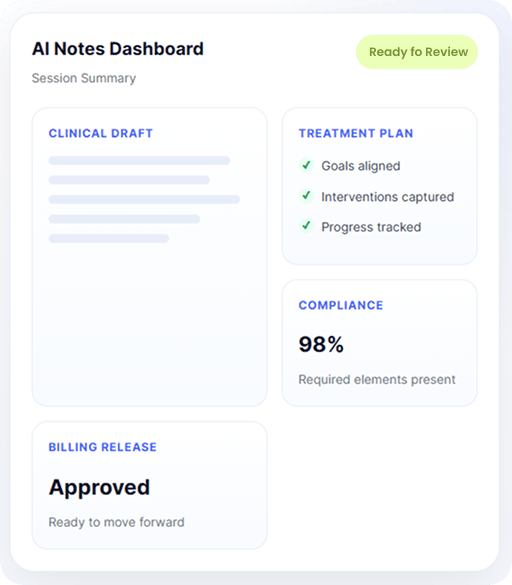
- Presenting problem identified
- Functional impairment documented
- Service is reasonable and necessary
- Treatment is expected to improve condition
AI Notes for Behavioral Health
Spend Less Time Writing Notes.
Spend More Time With Clients
Behavioral health providers face increasing documentation requirements while
trying to maintain quality care. Progress notes, treatment plans, assessments,
supervision documentation, and compliance requirements can consume hours
every week. DENmaar AI Notes helps clinicians complete documentation faster
while maintaining clinical accuracy and professional oversight.

Behavioral Health Focused

Clinical Accuracy & Oversight

Billing Workflow Ready

Reduce Documentation Time
Clinicians save hours each week on documentations.

Improve Note Consistency
AI-powered drafts improve quality and consistency.

Support Compliance Workflows
Build-in guidance for required documentation elements

Connect Notes to billing
Seamless integration with billing and operational workflows.
SUPPORTED DOCUMENTATION
Built Specifically for Behavioral Health
Unlike generic AI scribes, DENmaar AI Notes is designed for behavioral health workflows and
documentation requirements.
Individual Therapy
Family Therapy
Group Therapy
Substance Use Treatment
Case Management
Medication Management
Crisis Intervention
Clinical Supervision
Treatment Plans
Assessments and Reviews
AI NOTES WORKFLOW
How It Works
From captured session details to reviewed, billable documentation.

Record or Capture
Session Information
Patient check-in and
visit completed.

AI Generates a
Clinical Draft
AI Notes generate
structured documentation.

Review and Approve
Claim is created and
scrubbed for accuracy.

Release for Billing
Claim submitted to
the payer
DESIGNED FOR COMPLIANCE
Clinical Documentation with Compliance in Mind
AI Notes helps behavioral health providers document medical necessity, align treatment goals, identify
interventions, and support supervisor review workflows.
Compliance Support
Medical necessity documentation
Goal and treatment plan alignment
Intervention identification
Progress tracking
Required behavioral health documentation elements
Supervisor review workflows
Complete
Medical Necessity Documentation
Documentation supports the medical necessity of services provided and reflects the client’s ongoing treatment needs.
Evidence in Note
Aligned
Goal & Treatment Plan Alignment
Clinical documentation connects session content to active treatment goals and supports continuity across the plan of care.
Evidence in Note
- Active treatment goal referenced
- Session objectives tied to treatment plan
- Interventions support documented goals
- Progress linked back to care plan
Verified
Intervention Identification
Notes clearly identify the therapeutic interventions used during the session and how they relate to the client’s needs.
Evidence in Note
- Therapeutic intervention documented
- Intervention matched to presenting concerns
- Clinician actions clearly described
- Modality or technique identified where appropriate
Reviewed
Progress Tracking
Session documentation captures the client’s response to treatment and tracks change over time to support clinical decision-making.
Evidence in Note
- Client response to intervention documented
- Progress toward goals addressed
- Barriers or setbacks identified
- Ongoing symptoms or improvements noted
Included
Required Documentation Elements
Behavioral health notes include the core documentation elements needed for completeness, consistency, and payer readiness.
Evidence in Note
- Session date, duration, and service type included
- Relevant clinical observations documented
- Risk, safety, or notable concerns addressed when applicable
- Required note structure completed for the encounter
Available
Supervisor Review Workflow
Documentation can support internal review and approval workflows, helping supervisors monitor quality, accuracy, and compliance.
Evidence in Note
- Draft available for supervisor review
- Revisions or feedback can be incorporated
- Approval status is clearly tracked
- Final documentation is released after sign-off
MORE THAN A SCRIBE
Documentation Connected to the Rest of Your Workflow
Documentation can connect directly to scheduling, treatment plans, assessments, billing workflows, claims validation,
and provider productivity reporting.

Scheduling

Assessments

Claims Validation

DENmaar AI
Notes
Notes

Treatment Plans

Billing Workflows

Productivity Reporting
WHY ORGANIZATIONS CHOOSE DENMAAR
Built for Behavioral Health Teams and Organizations
DENmaar AI Notes is designed to support real-world clinical documentation and operational workflows.

Behavioral Health Focused
Customizable behavioral health workflows including therapy, psychiatry, substance use treatment, and multidisciplinary care models.

Scheduling & Operational Workflows
Integrated scheduling designed to support provider productivity, patient flow, authorization tracking, and claims readiness.

Supervisor Workflows
Built-in workflow logic designed to improve claim accuracy before submission through integrated operational checks and billing intelligence.

Eligibility & Insurance Verification
Integrated eligibility workflows designed to support Medicaid, commercial insurance, carve-outs, and behavioral health payer complexity.

Patient Engagement
Patient portal, intake workflows, secure communication, reminders, and measurement-based care tools.

Request an
AI Notes Trial
See how DENmaar AI Notes can help your clinicians reduce documentation time while improving
Request a demonstration or pilot program today.
Request Information
TESTIMONIALS
WHAT OUR CLIENTS SAY
On behalf of everyone at Meadowlark Counseling Services, I want to extend our sincere thanks for the continued improvements you and your team have made to the DENMaar EMR platform. We have been consistently impressed with both the functionality and user-friendly design of the system, which has made a meaningful difference in our day-to-day operations. The intuitive layout and ease of use have allowed our staff to spend less time navigating the system and more time focusing on client care. The regular updates and enhancements reflect your commitment to meeting the evolving needs of providers in the behavioral health and substance use treatment fields. We genuinely look forward to the new features introduced each month and appreciate how responsive the platform has been to the demands of clinical workflows. We have been so pleased with our experience that we’ve taken the opportunity to recommend DENMaar to other professionals in Pennsylvania who are working in the SUD field. Thank you again for your ongoing support and partnership. We are grateful to be working with a company that truly understands the needs of its users. KIndly, Becky Parks on behalf of the entire team at Meadowlark Counseling Services
I referred one of my colleagues Dr Aaron to you he is just starting g his psychology private practice and looking at where to start. I told him hands down you guys are the best billers and have a great EMR and team. He said he reached out just wanted to let you know!
FANTASTIC job keeping things rolling along with any and all of our billing concerns as well as responding to other issues which may well have been out of your wheelhouse. We are VERY grateful to have you and the crew in our corner.
I appreciate you all so much and DENmaar has been such a blessing Donna to our overall operations and success as an expanding company—allowing us to ultimately operate more efficiently, get our claims paid more consistently, ad stay on top of the critical credentialing piece, among other things. Teamwork does in fact, make the dream work. I’ll loop Chris/Isabella in on this message thread too, as I want All of your team to be aware of how much we appreciate our working relationship with DENmaar
Thank you for your diligence!! I appreciate it so much. Thank you Edwina…
Thank you so much Amy! I will be referring to DENmaar as often as I am asked about credentialing services.
Our Latest Blogs

What Psychiatrists Should Actually Look for in an EHR And Why Most Platforms Fall Short
When psychiatrists evaluate an EHR, the checklist is usually the same:
- Documentation templates
- E-prescribing
- Scheduling
- Telehealth
- Patient portal
- Measurement-based care
- Reporting
On paper, most systems claim to offer all of this.
In reality, very few deliver it in a way that actually supports how a psychiatry practice operates, especially once you move beyond a solo provider into a multi-provider, insurance-based model.
This is where the gap starts to show.
The Core Problem: Fragmented Systems in Behavioral Health EHRs
Most behavioral health EHR platforms, including many mental health EHR software solutions, were not designed as operational systems. They are documentation tools with add-ons.
What that leads to:
- Documentation exists separately from billing
- Scheduling is disconnected from clinical workflow
- Measurement-based care is bolted on, not integrated
- Revenue cycle issues surface after claims are submitted
- Providers carry the burden of figuring it out across systems
For a psychiatrist running or joining a growing practice, this creates friction everywhere.
To understand how system gaps impact performance, see how structural instability in behavioral health practices is reshaping operations.
What a Psychiatry-Centered Behavioral Health EHR Should Actually Do
If you look at the workflow from intake to session to documentation to billing to follow-up, the system should function as a single loop.
Here’s what that means in practical terms:
1. Documentation That Drives the Entire Workflow
Psychiatric documentation shouldn’t just be a note.
It should:
- Capture DSM-5 diagnoses in a structured way
- Include MSE and risk assessment components
- Feed directly into billing logic such as CPT, units, and modifiers
- Connect to treatment planning and measurement-based care
Modern systems using AI progress notes for behavioral health and AI documentation for behavioral health can assist here, but only if grounded in structured clinical data, not just free text generation.
2. Measurement-Based Care That Isn’t an Afterthought
Most platforms include tools like PHQ-9 or GAD-7.
Very few actually integrate them.
A true system should:
- Be part of intake and ongoing care
- Flow into progress notes automatically
- Track trends over time
- Inform treatment decisions
This is critical for behavioral health compliance and payer expectations.
3. Scheduling That Acts as a Revenue Control Point
Scheduling isn’t just calendar management.
It should:
- Trigger eligibility and benefits checks
- Flag authorization issues before sessions occur
- Drive documentation workflows
- Feed clean data into billing
If scheduling is passive, errors show up downstream in claims and impact behavioral health revenue cycle management.
4. E-Prescribing That Fits Psychiatric Workflows
EPCS is now expected, but usability matters more than availability.
For psychiatry:
- Controlled substance workflows must be efficient
- Medication history should be easily accessible
- Integration with documentation is critical
If prescribing is clunky, it slows down the entire session.
5. Telehealth That Feels Native
Telehealth should not feel like a separate system.
It should:
- Launch directly from the schedule
- Tie into session tracking
- Feed into documentation automatically
- Be simple for patients
6. Patient Portal That Actually Engages Patients
A portal should do more than store forms.
It should:
- Handle intake and e-signatures
- Deliver rating scales
- Support secure messaging
- Feed structured data into the workflow
Otherwise, staff re-enters everything manually.
7. Multi-Provider and Supervision Workflows
As soon as a practice grows, complexity increases.
The system should support:
- Multiple providers with role-based access
- Supervision structures
- Shared visibility across teams
- Standardized workflows
This is where most therapy practice management software systems break down.
8. Reporting That Connects Clinical and Financial Data
Basic reporting isn’t enough.
You need visibility into:
- Patient volume and utilization
- No-show patterns
- Provider productivity
- Claims performance and revenue trends
This is where clinical operations intersect with behavioral health billing services and revenue.
The Missing Layer: Revenue Cycle Integration
This is the piece most psychiatrists underestimate.
Documentation, scheduling, and billing are not separate functions.
They are interdependent.
If your system does not:
- Validate insurance early
- Enforce clean documentation
- Align notes with billing requirements
- Monitor claims performance
You will lose revenue, even if everything looks fine.
Explore how claims hygiene in behavioral health billing improves clean claims behavioral health performance.
For deeper insight into integrated systems, review behavioral health billing services and AI-driven revenue cycle management.
Where the Industry Is Going
Behavioral health is moving toward:
- Measurement-based care as a standard
- Greater payer scrutiny
- Integrated team-based care
- Automation in documentation and billing
The EHR is no longer just a record system.
It’s becoming the operating system of the practice.
Modern platforms like behavioral health EHR systems and DENmaar are designed to unify clinical and financial workflows.
Final Thought
If you’re evaluating platforms, don’t just ask:
Does it have this feature?
Ask:
How does this feature connect to everything else in the system? Because in psychiatry, efficiency and revenue don’t come from isolated tools. They come from how well the entire workflow is integrated.
Frequently Asked Questions
What is the best EHR for psychiatry practices?
The best psychiatry EHR is one that integrates documentation, scheduling, and billing into a unified system, supports AI documentation, and improves clean claims and revenue cycle management.
Why do most behavioral health EHRs fail at billing?
Most systems treat billing as an add-on instead of integrating it into clinical workflows, leading to errors, denials, and lost revenue.
How does AI improve behavioral health documentation?
AI helps structure notes, align documentation with billing requirements, and improve accuracy, especially when combined with systems like AI progress notes.
What is claims hygiene in behavioral health?
Claims hygiene ensures that all upstream data such as documentation, eligibility, and coding are correct before submission, leading to higher clean claim rates and fewer denials.
Why is revenue cycle management important in psychiatry?
Effective RCM ensures accurate claims, faster reimbursements, and improved financial stability, especially for Medicaid and insurance-based psychiatry practices.
The Biggest Threat to Behavioral Health Practices Isn’t What You Think
Why Structural Instability Is Becoming the Real Risk in Behavioral Health
Most conversations about behavioral health focus on the obvious:
- Staffing shortages
- Burnout
- Reimbursement rates
- Access to care
All real. All important.
But they’re not the biggest threat.
The Real Problem: Structural Instability
Behavioral health practices today are operating in an environment that is becoming:
- Less predictable
- More regulated
- More fragmented
And it’s happening fast.
This isn’t a single issue—it’s a convergence of forces that are reshaping how practices operate.
Medicaid Is Becoming Less Reliable
Behavioral health is heavily dependent on Medicaid.
And right now, Medicaid is changing:
- Eligibility requirements are tightening
- Coverage is fluctuating more frequently
- Provider audits and revalidation are increasing
For practices, this means:
- Patients who were covered last month may not be today
- Eligibility can no longer be assumed
- Claims are more likely to fail due to coverage gaps
This introduces something most practices aren’t designed for:
Constant uncertainty at the point of care
Modern behavioral health EHR software should verify eligibility in real time and reduce Medicaid claims friction.
Funding Is No Longer Stable
Federal and state behavioral health funding has become unpredictable.
Programs expand—and then contract.
Budgets shift.
Policies reverse.
Practices that relied on:
- Grants
- State programs
- Supplemental funding
Are now forced to depend more heavily on:
Consistent, accurate insurance reimbursement
That’s a problem if your system isn’t built for it.
This is why strong mental health billing services and revenue cycle systems matter more than ever.
AI Is Rising—But Not Where It Matters Most
There’s a lot of noise around AI in mental health.
- AI therapists
- Chatbots
- Digital companions
But the real opportunity isn’t replacing clinicians.
It’s fixing operations.
The practices that benefit from AI won’t be the ones using it to simulate therapy.
They’ll be the ones using it to:
- Improve documentation
- Enforce workflows
- Prevent billing errors
- Optimize revenue
Solutions like AI behavioral health billing systems and AI progress notes are where measurable ROI happens.
Compliance Pressure Is Increasing
Behavioral health has historically been loosely structured compared to other areas of healthcare.
That’s changing.
There is growing scrutiny around:
- Credentialing
- Documentation
- Billing accuracy
This means:
- More audits
- More denials
- Greater financial risk for mistakes
The margin for error is shrinking.
Practices need stronger behavioral health compliance systems and provider credentialing controls.
The System Most Practices Use Can’t Handle This
Here’s the underlying issue:
Most practices are still operating with disconnected tools:
- An EHR
- A billing service
- A scheduler
- Manual processes in between
These systems were built for a simpler environment.
They don’t:
- Adapt in real time
- Enforce correct workflows
- Prevent errors before they happen
So when complexity increases, performance breaks down.
Many of these failures are caused by poor claims communication workflows and fragmented processes.
What Needs to Change
The industry doesn’t need another EHR.
It needs a system that functions as a behavioral and financial control layer.
A system that:
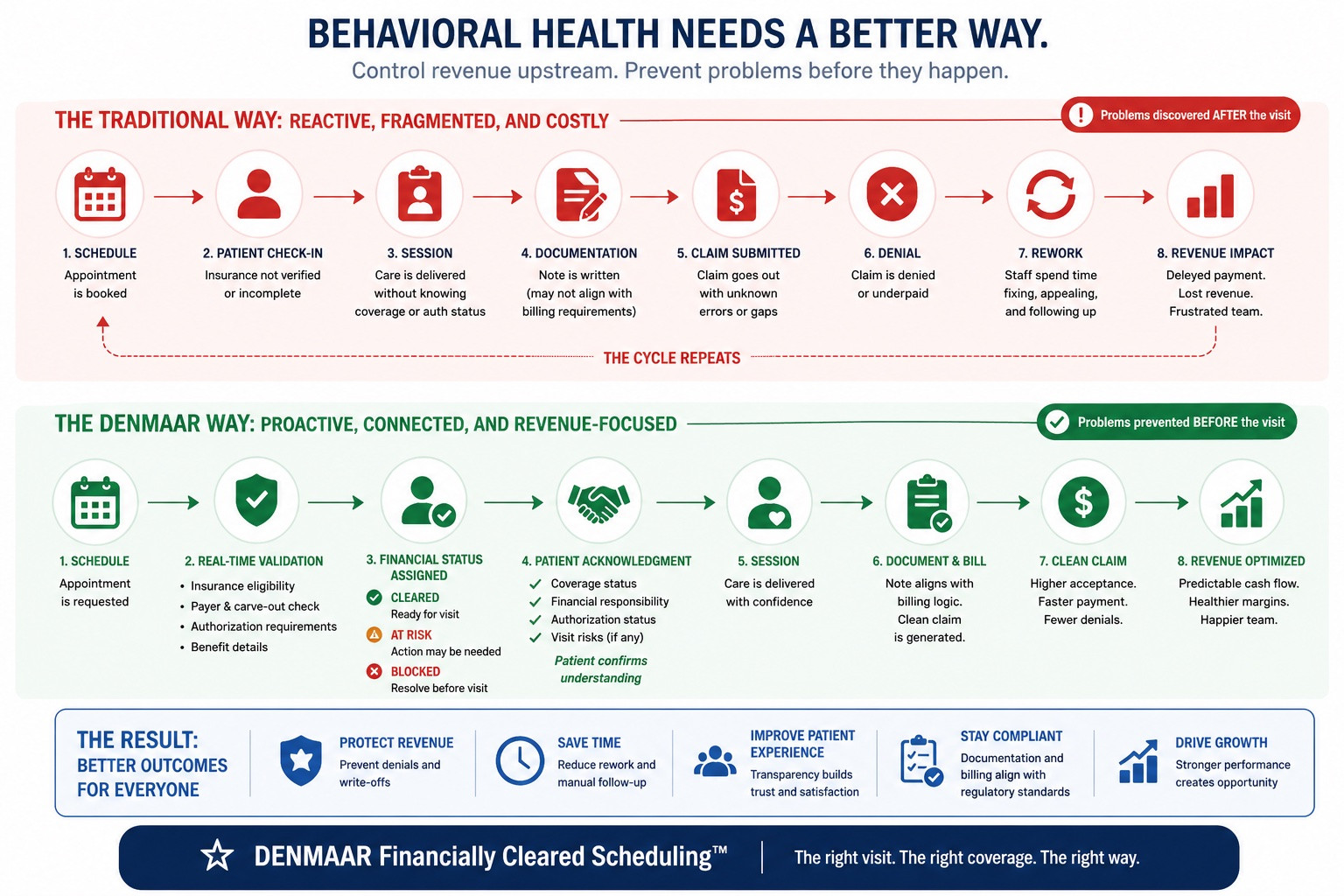
- Validates insurance before the visit
- Detects carve-outs and special workflows
- Confirms authorization requirements
- Aligns documentation with billing logic
- Prevents invalid claims before submission
This is the foundation of claims hygiene in behavioral health billing.
Why the Scheduler Becomes the Most Important Part of the System
If there’s one place to fix this, it’s not billing.
It’s before the session even starts.
At the point of scheduling and check-in.
This is where:
- Coverage can be verified
- Risks can be identified
- Patients can be informed
- Decisions can be made
Once the session happens, the opportunity to prevent errors is gone.
A modern therapy practice management software platform should make scheduling financially intelligent.
A New Standard: Financially Cleared Scheduling
Forward-thinking practices are beginning to adopt a new approach:
Every appointment must be financially validated before care is delivered.
That means:
- Insurance is confirmed
- Authorization is verified
- The correct billing pathway is identified
- The patient acknowledges their financial responsibility
If something isn’t right, it’s addressed before the visit—not after the denial.
Learn how integrated systems like DENmaar make this possible.
The Result
Practices that operate this way see:
- Fewer denials
- Higher clean claim rates
- Faster reimbursement
- More predictable cash flow
Not because they work harder—but because their system enforces the right behavior.
This is true behavioral health revenue cycle management.
Final Thought
Behavioral health isn’t just facing challenges.
It’s entering a more complex, less forgiving operating environment.
The practices that succeed won’t be the ones that react better.
They’ll be the ones that:
Control the system upstream before problems ever occur.
Frequently Asked Questions
What is the biggest threat to behavioral health practices today?
The biggest threat is structural instability caused by Medicaid uncertainty, fragmented billing systems, compliance pressure, and poor revenue workflows.
Why are Medicaid claims harder for behavioral health practices?
Frequent eligibility changes, carve-outs, audits, and authorization complexity make Medicaid behavioral health claims harder to manage.
What is financially cleared scheduling?
It means validating insurance, authorizations, payer routing, and patient responsibility before the appointment occurs.
How can AI help behavioral health organizations?
AI can improve documentation, automate claims hygiene, reduce denials, and optimize billing workflows.
Why do disconnected EHR and billing systems fail?
Because they do not share data efficiently, prevent upstream errors, or adapt quickly to payer and compliance changes.
Why Most Behavioral Health Practices Don’t Have a Billing Problem They Have a Claims Communication Problem
Behavioral Health Revenue Cycle Management Requires Better Claims Communication
Behavioral health leaders often assume their revenue challenges come down to billing performance:
“Our billing team isn’t following up enough.”
“We need better denial management.”
“A/R is creeping up—we need more staff.”
Those assumptions feel logical. They’re also usually wrong.
What most practices actually have is a claims communication problem—and until that’s addressed, no amount of staffing, outsourcing, or software switching will consistently fix revenue.
The Illusion of Billing Issues
On the surface, the symptoms point to billing:
- Denials increasing
- Claims sitting unresolved
- Cash flow lagging
So the response becomes:
- Add more follow-up
- Send more emails
- Hire more billers
But step inside the workflow, and a different pattern emerges.
- A denial comes in.
- Someone interprets it.
- A message gets sent.
- The practice is unsure what to do.
- Time passes.
- The claim stalls.
The issue isn’t effort—it’s translation.
The Real Bottleneck: Fragmented Communication
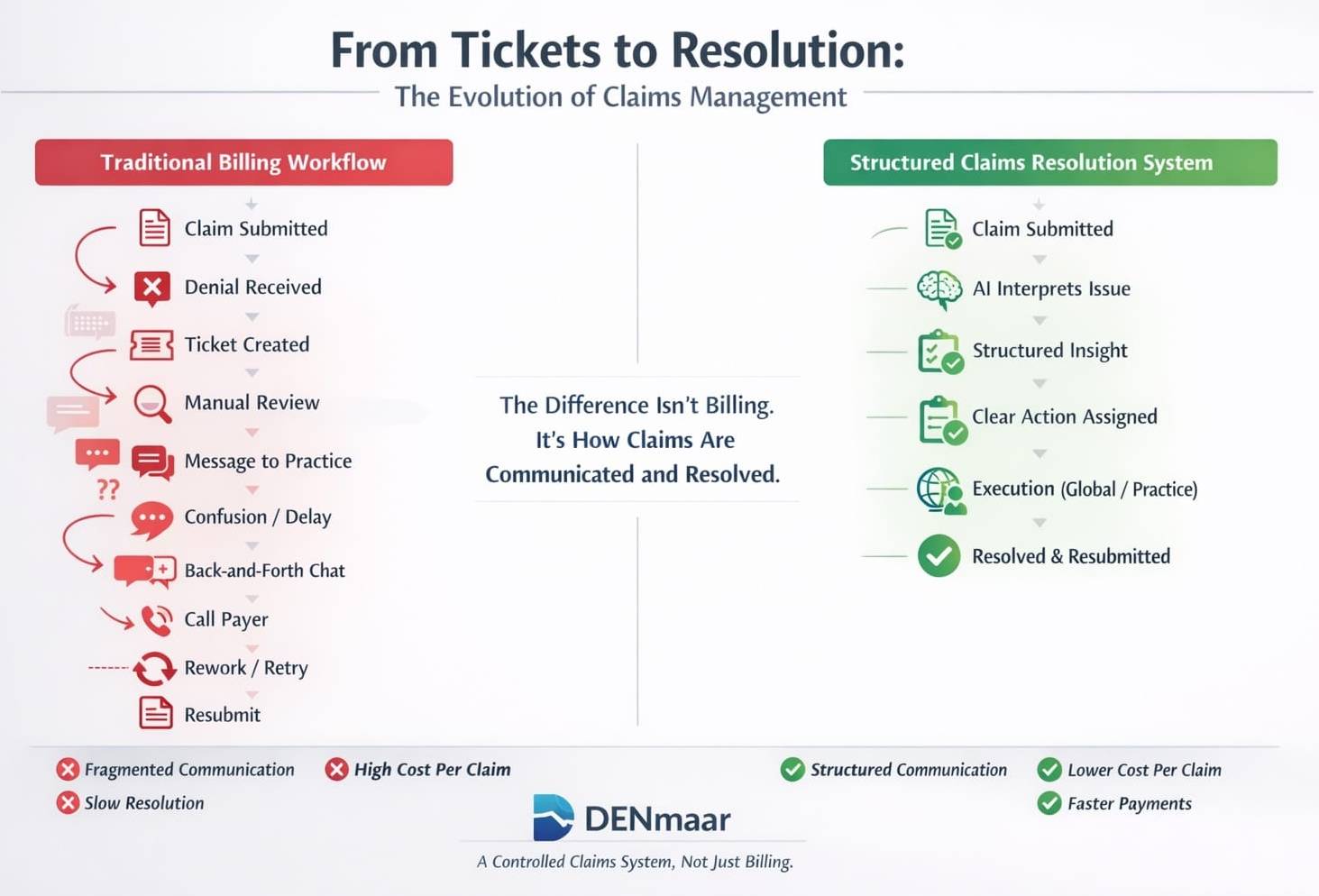
In most systems today, the claims lifecycle looks like this:
- Claim is submitted
- Denial or issue is returned
- A ticket is created
- A team member reviews it
- A message is sent to the practice
- The practice tries to interpret and respond
At each step, context is lost.
A denial code might say one thing—but the actual issue is something else entirely:
- A COB denial that’s really an eligibility sequencing issue
- An authorization denial that should have been caught pre-submission
- A request to “verify insurance” with no explanation of why
So the practice delays, asks questions, or takes the wrong action.
Meanwhile, the claim sits.
Claims don’t stall because they’re complex.
They stall because no one translates them into clear, actionable steps.
The Hidden Cost of Chat and Tickets
Most organizations rely on some combination of:
- Slack or Teams
- Ticketing systems
These tools create the appearance of activity—but they introduce significant inefficiencies:
- Multiple back-and-forth messages per claim
- Repeated explanations of the same issue
- Offshore teams calling payers without full context
- Senior staff acting as translators instead of operators
The result:
- Higher cost per claim
- Slower resolution times
- Increased write-offs
- Frustration across teams
This is where revenue quietly leaks—not from lack of effort, but from lack of structure.
What High-Performance Claims Systems Actually Do
High-performing revenue cycle operations don’t rely on more communication.
They rely on better-structured communication.
That means:
- Every claim has a clear status
- Every issue has a defined root cause
- Every action is explicitly guided
- Every team member sees the same information
Instead of asking:
“What should we do with this claim?”
The system answers:
“Here’s the issue. Here’s why it happened. Here’s the next step.”
From Tickets to Resolution Systems
Consider the difference:
Traditional Ticket
“Please verify insurance.”
Structured Claims Communication
“Secondary insurance detected. Primary payer likely changed.
Action: Contact patient to confirm active plan and update payer sequence before resubmission.”
One creates confusion.
The other drives resolution.
This shift—from vague tickets to structured, claim-specific guidance—is where performance changes.
Where AI Actually Fits in Behavioral Health Billing
There’s a lot of noise around AI in healthcare right now. Most of it misses the point.
AI is not valuable because it replaces people.
It’s valuable because it standardizes interpretation and accelerates decision-making.
In the claims lifecycle, that means:
- Translating denial codes into real-world causes
- Identifying patterns across payer behavior
- Recommending next steps based on historical outcomes
- Reducing unnecessary payer calls
AI becomes the interpreter and guide, not the operator.
Learn how this works in AI behavioral health billing and clean claims systems.
Why This Breaks at Scale
At low volume, teams can “manage through it.”
At higher volume, the cracks widen:
- 500 claims/month → manageable
- 5,000+ claims/month → breakdown
More claims mean:
- More variability
- More payer nuance
- More communication points
Without a structured system, complexity compounds—and revenue suffers.
What works for a small practice doesn’t scale to a growing group.
The Shift: From Billing to Controlled Claims Systems
The most important shift isn’t hiring more staff or switching vendors.
It’s moving from:
Reactive billing workflows
To:
Controlled claims systems with embedded communication logic
At DENmaar, that’s been the focus:
Not just submitting claims—but controlling the entire lifecycle:
From scheduling
To documentation
To claim generation
To post-submission resolution
With structured communication and embedded intelligence at every step.
This includes:
- Behavioral health EHR software
- Mental health billing services
- Claims hygiene workflows
- AI progress notes for behavioral health
- AI front door patient intake systems
Final Thought
If your team is spending more time explaining claims than resolving them,
you don’t have a staffing issue.
You have a system issue.
And fixing that changes everything:
- Faster payments
- Lower cost per claim
- Less friction across teams
- Stronger, more predictable revenue
That’s where the real leverage is.
Frequently Asked Questions
What is a claims communication problem in behavioral health billing?
A claims communication problem happens when denials, payer issues, and claim tasks are poorly explained across teams, causing delays and lost revenue.
How can behavioral health practices reduce claim delays?
Practices can reduce delays by using structured claims workflows, AI-driven billing intelligence, and integrated revenue cycle management systems.
Does AI replace billing teams?
No. AI improves billing team efficiency by translating denial codes, prioritizing actions, and reducing repetitive manual tasks.
Why do claims problems increase as practices grow?
As claim volume rises, payer complexity, denial volume, and communication bottlenecks increase. Manual systems do not scale efficiently.
What helps improve clean claims rates?
Integrated EHR systems, claims hygiene, payer rule validation, structured documentation, and proactive billing workflows all improve clean claims rates.
Our Partners






Ready to get started?
Feel free to reach out if you have any questions.
