

- Therapy and medication management
- IOP, PHP, and SUD treatment programs
- Case management, community support, and residential services
DENmaar Revenue Cycle Intelligence
Claims Copilot ™
Stop Chasing Claims.
Start Preventing Problems.
Claims Copilot is DENmaar’s behavioral health revenue cycle solution
designed to help practices prevent claim issues before submission, reduce
aging, accelerate reimbursement, and improve operational performance.

Pre-Submission Claim Readiness

Payer Lifecycle Monitoring

Aging & Collections Visibility
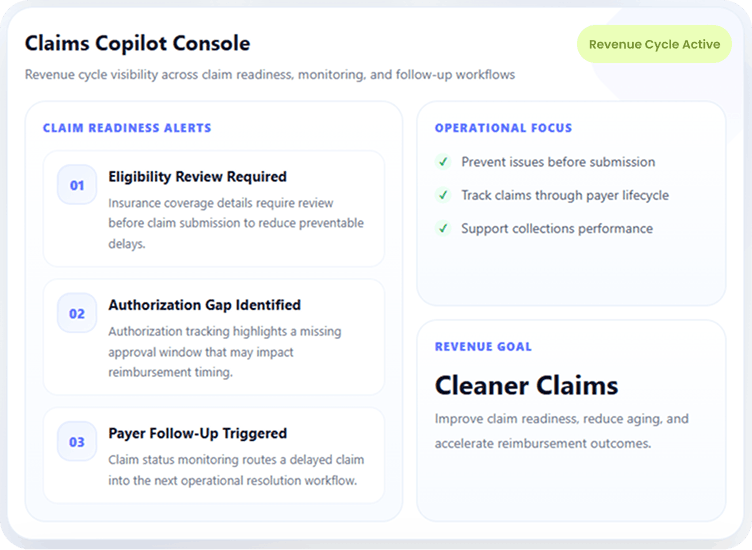
Pre-Submission Readiness
Catch eligibility, authorization, payer, and documentation issues before claims go out.
Lifecycle Claim Monitoring
Track claims after submission with rejection management, status visibility, and aging oversight.
Operational Performance
Support clean claim performance, reduce aged claims, and improve collections visibility.
Behavioral Health Focused
Designed for therapy, medication management, SUD, IOP/PHP, community support, and more.
Built for Behavioral Health
Designed for Behavioral Health
Revenue Cycle Workflows
Whether your organization provides therapy, medication management, IOP,
PHP, SUD treatment, case management, community support, or residential
services, Claims Copilot is built around the operational and reimbursement
realities of behavioral health.

Behavioral health support areas
Claims Copilot is positioned to support behavioral health organizations that need stronger claim readiness, reimbursement visibility, and operational follow-up across complex service lines.
Prevent Problems Before Claims Are Submitted
Address Revenue Cycle Breakdowns
Before They Turn Into Denials or Delays
Most claim problems begin long before a claim is submitted. Claims Copilot helps practices identify and
resolve those issues earlier so reimbursement performance is not undermined later.

Verify Insurance Eligibility
Confirm insurance coverage details early to reduce preventable reimbursement delays and billing confusion.

Review Insurance Information & ID Cards
Validate insurance information and supporting details so claims are built on more accurate payer data.

Track Authorizations
Monitor authorization requirements and approval status to reduce avoidable denials tied to missing coverage approvals.

Monitor Provider Credentialing Requirements
Support awareness of credentialing-related payer requirements that can affect billing and reimbursement workflows.

Identify Claim Issues Before Submission
Catch missing information, workflow gaps, and other claim barriers before the claim enters the payer lifecycle.

Improve Documentation-to-Billing Alignment
Route messages and requests to the appropriate team, department, or follow-up queue.
How Claims Copilot Works
A continuous workflow built to
support prevention, monitoring, and resolution.
Claims Copilot doesn’t stop at submission. It supports the operational work needed before the claim goes out, then continues
tracking activity through the payer lifecycle to help teams reduce delays, aging, and reimbursement bottlenecks.
1
Review claim readiness before submission
Insurance, eligibility, authorization, and workflow details are reviewed to identify claim risks before they become downstream reimbursement problems.
2
Submit claims and monitor payer activity
Once claims are submitted, Claims Copilot supports visibility into rejections, claim status, aging, and other signals that indicate a claim may require action.
3
Route follow-up through the right workflow
Operational tasks can be prioritized based on the issue—whether the next step involves internal follow-up, claim correction, payer research, or payment posting support.
From prevention to reimbursement performance.
Claims Copilot is designed to help organizations manage the full payer journey—not just claim submission. The result is a more proactive revenue cycle process with clearer visibility and fewer avoidable surprises.

Before submission:
improve readiness across insurance, authorizations, and documentation alignment

After submission:
monitor claim status, rejections, denial patterns, and aging across the payer lifecycle.

Operationally:
help teams reduce aging, recover delayed payments, and improve turnaround performance.
Monitor Claims Through the Entire Payer Lifecycle
Submitting claims is only the beginning.
Claims Copilot continuously tracks claim progress and supports the workflows needed to identify
reimbursement issues, respond to payer friction, and keep claims moving toward payment.

Claim Submission & Rejection Visibility
Support clean electronic claim submission while maintaining visibility into rejections and claim issues that need attention after submission.
- Electronic claim submission
- Rejection management support
- Visibility into claim readiness breakdowns

Status Monitoring & Aging Analysis
Track claims after submission to identify delays, payer inactivity, unresolved statuses, and aging trends that can impact collections.
- Claim status monitoring
- Aging analysis and prioritization
- Operational follow-up workflow visibility

Denials, Follow-Up & Payment Support
Improve follow-through on denied or delayed claims by supporting structured next steps across payer follow-up, resolution activity, and payment posting workflows.
- Denial tracking
- Follow-up workflow support
- Payment posting support
Reduce Aging and Improve Collections
Give your organization earlier visibility, better follow-through, and fewer preventable delays.
Many behavioral health organizations struggle with growing accounts receivable because claim issues are discovered too late. Claims Copilot helps teams stay ahead of the work required to keep reimbursement moving.

Reduce aged claims
improve readiness across insurance, authorizations, and documentation alignment.

Recover delayed payments
Identify unresolved payer issues sooner and reduce the amount of time claims spend waiting without meaningful action.

Improve turnaround and clean claim performance
Support stronger revenue cycle performance by reducing preventable breakdowns before and after submission.
A Partnership Approach
Successful revenue cycle management requires operational collaboration.
Many behavioral health organizations struggle with growing accounts receivable because claim issues are discovered too late. Claims Copilot helps teams stay ahead of the work required to keep reimbursement moving.

Before submission:
improve readiness across insurance, authorizations, and documentation alignment.

After submission:
monitor claim status, rejections, denial patterns, and aging across the payer lifecycle.

Operationally:
help teams reduce aging, recover delayed payments, and improve turnaround performance.
Included With DENmaar
Claims Copilot is part of the DENmaar
Behavioral Productivity Platform.
When DENmaar manages your insurance billing, your organization also gains access to the broader operational and clinical
platform that supports scheduling, documentation, reporting, and patient management workflows.

Behavioral Health EHR
Clinical and operational workflows designed around behavioral health documentation and care delivery.

Scheduling
Integrated scheduling workflows to support patient flow, operational visibility, and billing readiness.

Documentation Tools
Clinical notes, treatment plans, and documentation workflows that support stronger operational alignment.

AI-Assisted Notes
Support documentation efficiency while maintaining professional review and oversight workflows.

Treatment Plans
Behavioral health planning tools that connect care planning with documentation and operational workflows.

Clinical Workflows
Support multidisciplinary behavioral health processes with connected operational and clinical workflows.

Reporting
Visibility into productivity, claim performance, and operational trends across the platform.

Patient Management Tools
Connected workflows for patient registration, intake coordination, operational follow-up, and practice support.
Request an
AI Notes Trial
See how DENmaar AI Notes can help your clinicians reduce documentation time while improving
Request a demonstration or pilot program today.
Request Information
TESTIMONIALS
WHAT OUR CLIENTS SAY
On behalf of everyone at Meadowlark Counseling Services, I want to extend our sincere thanks for the continued improvements you and your team have made to the DENMaar EMR platform. We have been consistently impressed with both the functionality and user-friendly design of the system, which has made a meaningful difference in our day-to-day operations. The intuitive layout and ease of use have allowed our staff to spend less time navigating the system and more time focusing on client care. The regular updates and enhancements reflect your commitment to meeting the evolving needs of providers in the behavioral health and substance use treatment fields. We genuinely look forward to the new features introduced each month and appreciate how responsive the platform has been to the demands of clinical workflows. We have been so pleased with our experience that we’ve taken the opportunity to recommend DENMaar to other professionals in Pennsylvania who are working in the SUD field. Thank you again for your ongoing support and partnership. We are grateful to be working with a company that truly understands the needs of its users. KIndly, Becky Parks on behalf of the entire team at Meadowlark Counseling Services
I referred one of my colleagues Dr Aaron to you he is just starting g his psychology private practice and looking at where to start. I told him hands down you guys are the best billers and have a great EMR and team. He said he reached out just wanted to let you know!
FANTASTIC job keeping things rolling along with any and all of our billing concerns as well as responding to other issues which may well have been out of your wheelhouse. We are VERY grateful to have you and the crew in our corner.
I appreciate you all so much and DENmaar has been such a blessing Donna to our overall operations and success as an expanding company—allowing us to ultimately operate more efficiently, get our claims paid more consistently, ad stay on top of the critical credentialing piece, among other things. Teamwork does in fact, make the dream work. I’ll loop Chris/Isabella in on this message thread too, as I want All of your team to be aware of how much we appreciate our working relationship with DENmaar
Thank you for your diligence!! I appreciate it so much. Thank you Edwina…
Thank you so much Amy! I will be referring to DENmaar as often as I am asked about credentialing services.
Our Latest Blogs
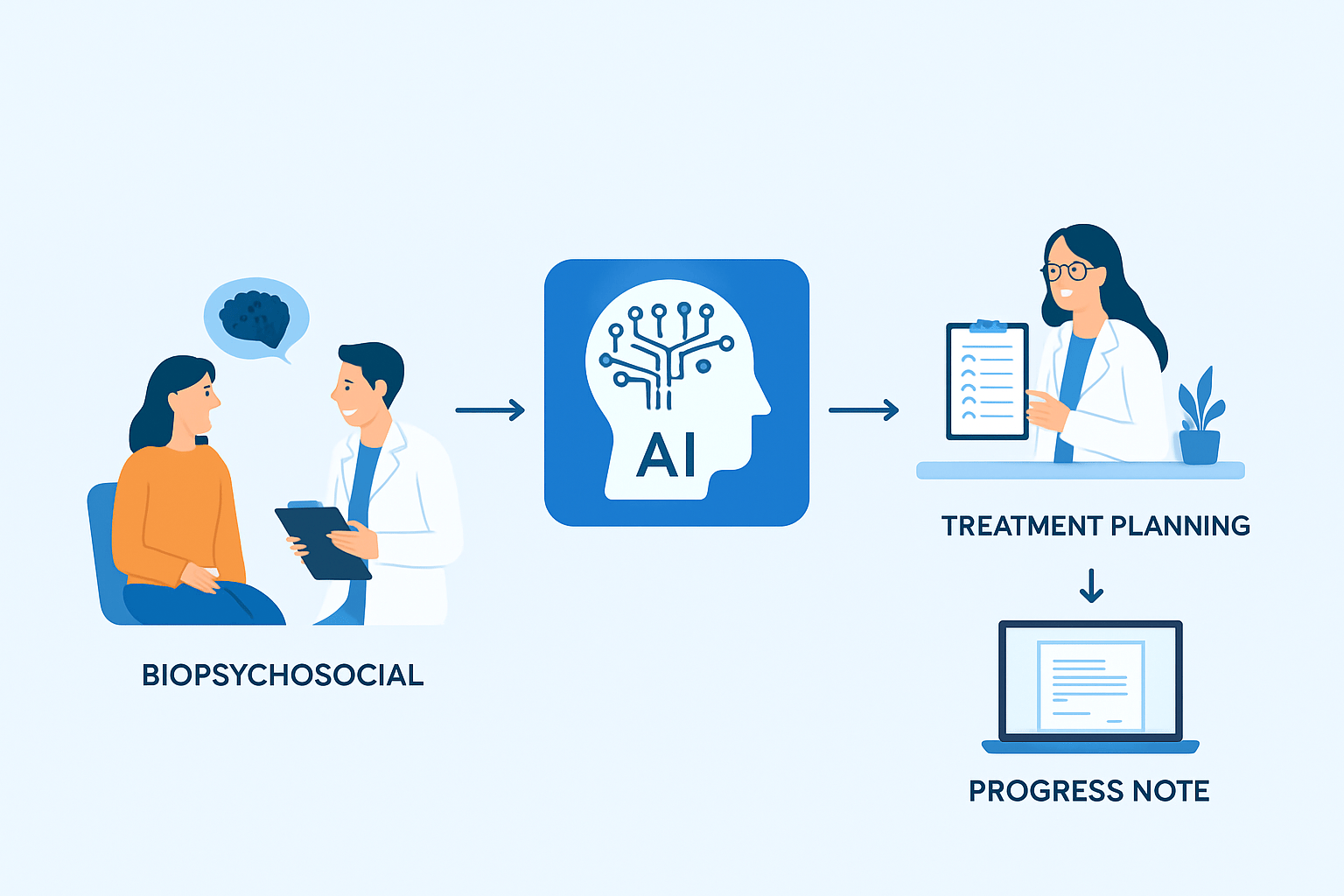
How AI Is Transforming the Biopsychosocial, Treatment Planning, and Progress Note Workflow in Behavioral Health
In behavioral health, documentation is both essential and exhausting. Clinicians spend hours each week completing biopsychosocial assessments, building treatment plans, and writing progress notes — all while balancing packed schedules and rising administrative demands from payers and regulators.
The problem isn’t the work itself.
It’s the friction between each step of the clinical documentation process.
AI is finally solving that.
Today, advanced behavioral-health AI systems are connecting the full clinical workflow into a streamlined, intelligent sequence:
Biopsychosocial → Treatment Plan → Progress Note
— reducing documentation time, improving accuracy, and helping practices stay compliant without burying clinicians in paperwork.
Here’s how.
1. AI Enhances the Biopsychosocial Assessment
The biopsychosocial (BPS) drives the clinical picture — symptoms, history, social factors, risk level, functional impact, and strengths.
But historically, clinicians have faced:
- Repetitive questions
- Manual data entry
- Long narrative sections
- Difficulty synthesizing all information into a clear profile
AI changes this by:
-
Automatically summarizing patient narrative
AI can take the raw client responses and generate accurate, structured summaries that fit Medicaid and CMS expectations.
-
Identifying core clinical themes
AI surfaces common threads across symptoms, history, and psychosocial factors — helping clinicians rapidly understand the case.
-
Pre-populating treatment plan problem areas
Instead of starting from scratch, the clinician begins with a smart draft rooted in the actual BPS data.
Result:
What once took 45–60 minutes is reduced to 10–15 minutes with better accuracy and consistency.
2. AI Bridges Directly Into the Treatment Plan
This is where AI has created the biggest breakthrough.
Historically, treatment plans fail because they are:
- Generic
- Not tied to assessment data
- Not measurable
- Not updated consistently
- Out of alignment with payer expectations
AI now links the treatment plan directly to the BPS.
-
AI suggests problem statements
Based on risk, symptoms, and functioning, AI creates patient-specific problem statements.
-
AI generates measurable goals and objectives
These are tied to best practices for therapy, psychiatric care, or SUD services.
Everything stays in CMS and Medicaid-compliant language.
-
AI matches evidence-based interventions
CBT, ACT, DBT, EMDR, MAT, relapse prevention — whatever fits the case — are auto-suggested with correct phrasing.
-
AI maintains continuity
When the clinician updates a goal, the AI updates related interventions and notes across the chart.
This creates a massive win:
Consistency from intake → goal-setting → progress notes.
For a deeper look at AI-powered treatment planning, explore DENmaar’s article:
AI Treatment Planning in Behavioral Health
3. AI Powers Progress Notes With True Clinical Continuity
Progress notes have always been the most repetitive part of documentation. Clinicians repeat information across dozens of sessions.
AI ends the redundancy by linking directly to the treatment plan and prior notes.
-
AI pulls goals + objectives into the note
The note dynamically displays the relevant treatment plan content.
-
AI suggests interventions based on the plan
Every session stays aligned with measurable objectives.
-
AI creates a first-draft note instantly
Clinicians then edit for accuracy — saving an average of 5–12 minutes per note.
-
AI flags missing elements for compliance
Time, modality, interventions, response, risk — everything required for CMS, Medicaid, and commercial payers is checked automatically.
Accuracy goes up. Time goes down. Compliance becomes easier.
Learn more about compliance-focused AI workflows here:
AI and Compliance in Behavioral Health
4. Speed + Efficiency + Accuracy = Better Care
When AI handles the repetitive structure of documentation, clinicians reclaim time and clarity.
Here’s what practices are reporting:
- 40–60% faster documentation cycle
Especially across progress notes and treatment plans.
- Improved MBC tracking and outcomes
Because goals, symptoms, and notes stay aligned week to week.
- Fewer payer issues
AI reduces documentation errors, improving clean-claim rates and lowering the risk of recoupments.
- Better coordination across providers
Notes, goals, and assessments stay consistent across therapy, psychiatry, and SUD teams.
- Most important: less burnout
Clinicians spend more time with patients and less time typing.
For additional payer-facing improvements, explore DENmaar’s billing solutions:
Behavioral & Mental Health Billing Services
5. The Future: Fully Connected Clinical Documentation
The industry is shifting toward agentic AI — systems that don’t just help clinicians document but actively ensure clinical coherence.
Within the next 24 months, practices will expect:
- Automated assessment scoring
- Reactive updates to treatment plans based on symptoms or risk
- AI-driven continuity that identifies when goals are met
- Intelligent recommendations for level of care changes
- Compliance engines that adjust to state-specific Medicaid rules
This is where platforms like DENmaar are headed:
A completely unified intake → BPS → treatment planning → progress note flow supported by AI.
To keep your practice fully credentialed and payer-ready, explore:
DENmaar Insurance Credentialing Services
Conclusion
AI isn’t replacing clinicians.
It’s replacing the inefficient documentation process that has slowed them down for decades.
By linking the BPS, treatment plan, and progress note into one seamless, intelligent workflow, AI is giving clinicians back time, clarity, and confidence — and helping practices operate at a level of efficiency that simply wasn’t possible before.
This is the future of behavioral health documentation:
Faster. More accurate. Fully connected. And powered by AI.
Frequently Asked Questions
1. Is AI documentation compliant with Medicaid and CMS standards?
Yes. Modern AI systems used in platforms like DENmaar are designed to follow CMS, Medicaid, and commercial payer requirements for language, structure, and measurable objectives.
2. Can AI reduce the time spent on progress notes?
Most clinicians see a 5–12 minute reduction per note, thanks to automated continuity and pre-filled interventions tied to the treatment plan.
3. Does AI replace clinicians in the documentation process?
No. AI drafts, assists, and ensures compliance — but clinicians maintain full control and final sign-off.
4. How does AI help with payer audits and billing accuracy?
AI reduces documentation gaps, strengthens medical necessity, and increases clean-claim rates, supporting audit readiness and revenue protection.
AI Isn’t the Future of Behavioral Health — Compliance Is
Every few months, a new “AI-powered” behavioral health platform promises to revolutionize care. Smarter documentation. Automated billing. Instant insights.
But here’s the truth: AI means nothing without compliance.
In behavioral healthcare, the systems that last aren’t the flashiest; they’re the ones that understand CMS rules, payer schemas, and the actual structure of care delivery. AI doesn’t fix rejected claims, reconcile CPT modifiers, or align documentation with Medicaid billing logic. Compliance does.
At DENmaar, we’ve learned this firsthand. Building automation into credentialing, billing, and clinical documentation isn’t about replacing people, it’s about protecting practices. A compliant system gives providers confidence that what they write, bill, and submit will stand up to audit and payment review.
AI becomes powerful after that foundation is solid.
That’s when it can:
- Identify missing documentation for medical necessity
- Flag claims that don’t align with payer-specific schemas
- Generate clinically sound progress notes without breaking compliance
- Forecast reimbursements and eligibility trends with real data integrity
Most EHRs skip this step. They automate chaos.
But in behavioral health, the future belongs to those who design for accuracy first, and AI second.
That’s how we build trust — with payers, providers, and patients alike.
The Real Connection Between AI and Compliance
AI in behavioral health works best after compliance frameworks are established. Once automation is aligned with payer logic and clinical standards, it can amplify operational efficiency. For example, DENmaar’s AI Treatment Planning system leverages data integrity and compliance-first design to generate clinically aligned, audit-ready documentation.
The same approach extends to insurance credentialing and billing workflows, where AI can predict errors, manage timelines, and improve reimbursement cycles — but only when built on a foundation of accurate, compliant data.
Learn more about:
Why Compliance Will Always Outlast Technology
In healthcare, trends change fast, from EHR updates to AI documentation engines. But compliance is constant. It governs how claims are submitted, how documentation is reviewed, and how patient data is secured.
When behavioral health platforms skip compliance, they create automation that accelerates errors. The future of sustainable AI lies in systems that protect accuracy, not replace it.
A compliance-first model ensures:
- Accurate claim submissions aligned with payer schemas
- Clinical documentation that meets audit standards
- Financial protection against denials and rejections
- Data integrity that enhances future AI training models
Frequently Asked Questions
1. Why is compliance more important than AI in behavioral health?
Because AI only works effectively when it operates within compliant frameworks. Compliance ensures documentation accuracy, audit readiness, and correct billing — all of which AI depends on to perform reliably.
2. How does DENmaar combine AI and compliance?
DENmaar integrates AI within its credentialing, billing, and documentation tools to enhance automation while ensuring CMS, Medicaid, and payer compliance.
3. Can AI alone fix billing errors or claim denials?
No. AI can help flag issues, but only compliance frameworks can prevent claim rejections and ensure documentation meets payer standards.
4. How does AI improve treatment planning once compliance is set?
Once compliance is built in, AI can intelligently connect intake, goals, and documentation — as seen in DENmaar’s AI Treatment Planning solution.
5. What services does DENmaar offer for behavioral health practices?
DENmaar provides insurance credentialing, billing services, and AI-driven solutions built on compliance and accuracy.

The Future of Treatment Planning: How DENmaar’s AI Connects Intake, Progress, and Outcomes
In behavioral healthcare, one of the greatest inefficiencies happens in the gap between a patient’s intake, their treatment plan, and the progress notes that follow. Every provider knows that consistency, documentation accuracy, and clinical compliance are critical — yet many systems silo these steps, forcing clinicians to repeat data entry and lose valuable clinical context along the way.
At DENmaar, we’re changing that with AI-powered treatment planning software designed for behavioral health professionals.
Building Intelligence Into the Golden Thread
Our upcoming AI-driven treatment planning engine bridges the full “Golden Thread” of care — from the initial biopsychosocial assessment to the treatment plan and each progress note thereafter.
When a new patient is onboarded, clinicians or intake staff complete a biopsychosocial that captures the person’s history, risk factors, strengths, and presenting issues.
DENmaar’s AI for behavioral health then translates that information into a clinically structured treatment plan — automatically generating goals, objectives, and interventions tailored to the diagnosis and patient narrative.
Each subsequent progress note intelligently references those treatment goals, allowing providers to document progress with precision while maintaining CMS and insurance compliance.
How AI Treatment Planning Works
1. Intake: From Data to Structure
A patient’s biopsychosocial becomes structured data — not static text. The AI parses key domains such as presenting problems, history, strengths, and risks.
2. Treatment Plan Creation
DENmaar’s AI-powered treatment planning software suggests SMART goals, measurable objectives, and evidence-based interventions that clinicians can review and approve. No more writing plans from scratch — only refining and personalizing them.
3. Progress Note Integration
When writing notes, the system automatically surfaces relevant treatment objectives, MBC scores (like PHQ-9 or GAD-7), and goal progress. Providers can document with full context, reducing note time by over 50%.
Explore how our AI clinical notes system links treatment plans to documentation and supports audit-ready compliance.
4. Continuous Learning & Insights
As more data accumulates, the AI becomes smarter — recommending updated interventions, flagging stalled progress, and syncing insights directly with outcome tracking dashboards.
Rolling Out Across Therapy, Psychiatry, and SUD
We’re implementing this technology in phases to ensure clinical precision and behavioral health compliance:
- Therapy: Automating plan-to-note linkage and embedding Measurement-Based Care (MBC) outcomes tracking.
- Psychiatry: Expanding to include medication management, mental status exams, and outcome correlation.
- Substance Use Disorder (SUD): Integrating ASAM dimensions, relapse-prevention metrics, and group-session analytics.
Each phase builds on the previous one, creating a unified ecosystem that supports multi-provider behavioral health practices from intake to billing.
Check out how DENmaar’s full range of practice management and EHR solutions span intake, billing, documentation and beyond.
Why AI-Driven Treatment Planning Matters
This innovation isn’t just about efficiency — it’s about better patient care.
When clinicians spend less time typing and more time understanding, patients benefit. And when treatment plans are directly tied to measurable outcomes, payers and providers finally share the same language of progress.
At DENmaar, our mission is to create a behavioral health platform where clinical documentation, billing, and AI intelligence work in harmony.
See how our AI-enhanced progress notes help therapists capture and report outcomes with precision and speed.
The result: a faster, smarter, and more connected path to patient success.
Our Partners






Ready to get started?
Feel free to reach out if you have any questions.
