

- Respond to callers when staff are busy or unavailable
- Reduce missed opportunities from after-hours and weekend calls
- Provide a more consistent intake and scheduling experience
- Keep communication workflows moving without depending on office hours alone
AI RECEPTIONIST FOR BEHAVIORAL HEALTH
Never Miss a Call, Intake
Opportunity, or Scheduling
Request.
Behavioral health practices lose potential clients every day because calls go
unanswered, staff are busy, or intake requests arrive after hours. DENmaar AI
Receptionist helps practices capture opportunities, improve responsiveness,
and reduce administrative workload.

Immediate Call Response

Behavioral Health Workflows

Integrated Scheduling & Intake
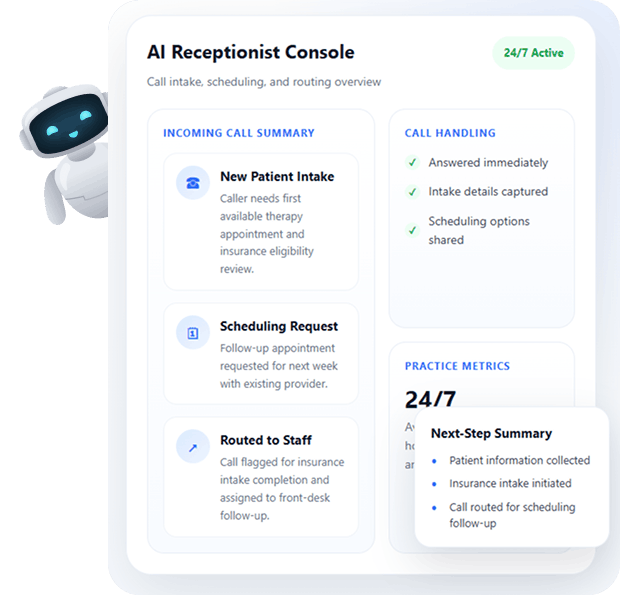
Supported functions include
Built for Behavioral Health Organizations
Unlike generic answering services, DENmaar AI Receptionist is designed specifically for behavioral
health workflows and patient communication needs.
01
New patient intake
Capture initial caller details and support first-contact intake workflows for prospective patients.
02
Appointment Scheduling
Help callers request available appointments and move scheduling requests into the right workflow.
03
Appointment Rescheduling
Support reschedule requests without requiring every call to be handled directly by staff.
04
Frequently Asked Questions
Provide helpful responses to common patient questions about practice operations, locations, or services.
05
Insurance Intake Collection
Collect insurance-related details needed for intake workflows and claims readiness preparation.
06
Message Routing
Route messages and requests to the appropriate team, department, or follow-up queue.
07
After-Hours Call Handling
Respond to callers outside business hours so opportunities are not lost overnight or on weekends.
08
Call Summaries
Provide staff with a concise summary of the call, captured details, and recommended next steps.
09
Provider & Location Routing
Direct patients to the right provider, office, or service line based on their needs and request type.
HOW IT WORKS
From Incoming Call to Actionable Next Step
AI Receptionist helps practices respond quickly, collect the right information, and move requests into
scheduling, routing, or follow-up workflows.

Patient calls your practice

AI Receptionist answers immediately

Information is collected and documented

Calls are routed, scheduled, or assigned for follow-up

Staff receive a summary and next steps
AVAILABLE 24/7
Support Call Handling During Business Hours, Evenings, Weekends, and Holidays
The AI Receptionist can answer calls during business hours, evenings, weekends, and holidays, helping ensure every caller receives a professional response and every opportunity has a better chance of being captured.
Coverage Overview
24/7 Support
Business Hours
Support routine call handling, intake questions, and appointment scheduling requests during the workday.
Evenings
Respond to callers outside traditional office hours when prospective patients are often more available.
Weekends
Capture new opportunities and requests that might otherwise wait until Monday or go unanswered.
Holidays
Maintain a professional first response experience even when the office is closed or staff availability is limited.
INTEGRATED WITH THE DENMAAR PLATFORM
Integrated with the DENmaar Platform
Documentation can connect directly to scheduling, treatment plans, assessments, billing workflows,
claims validation, and provider productivity reporting.

Scheduling

Patient Registration

Insurance Intake

DENmaar AI
Receptionist
Receptionist

Documentation Workflows

Billing Operations

Provider Assignments

WHY ORGANIZATIONS CHOOSE DENMAAR
Built to Improve Responsiveness, Reduce Workload, and Support Better Intake Operations
DENmaar AI Receptionist is designed to help behavioral health organizations respond faster, route requests more effectively, and reduce front-desk strain.
- Immediate Call Response
- Reduced Front Desk Workload
- Improved Patient Experience
- Better Intake Consistency
- Behavioral Health Focused Workflows
- Fully Integrated Platform
Request an
AI Receptionist Demo
Experience how DENmaar AI Receptionist can help your organization capture more opportunities,
- Improve responsiveness
- Streamline intake operations.
Request Information
TESTIMONIALS
WHAT OUR CLIENTS SAY
On behalf of everyone at Meadowlark Counseling Services, I want to extend our sincere thanks for the continued improvements you and your team have made to the DENMaar EMR platform. We have been consistently impressed with both the functionality and user-friendly design of the system, which has made a meaningful difference in our day-to-day operations. The intuitive layout and ease of use have allowed our staff to spend less time navigating the system and more time focusing on client care. The regular updates and enhancements reflect your commitment to meeting the evolving needs of providers in the behavioral health and substance use treatment fields. We genuinely look forward to the new features introduced each month and appreciate how responsive the platform has been to the demands of clinical workflows. We have been so pleased with our experience that we’ve taken the opportunity to recommend DENMaar to other professionals in Pennsylvania who are working in the SUD field. Thank you again for your ongoing support and partnership. We are grateful to be working with a company that truly understands the needs of its users. KIndly, Becky Parks on behalf of the entire team at Meadowlark Counseling Services
I referred one of my colleagues Dr Aaron to you he is just starting g his psychology private practice and looking at where to start. I told him hands down you guys are the best billers and have a great EMR and team. He said he reached out just wanted to let you know!
FANTASTIC job keeping things rolling along with any and all of our billing concerns as well as responding to other issues which may well have been out of your wheelhouse. We are VERY grateful to have you and the crew in our corner.
I appreciate you all so much and DENmaar has been such a blessing Donna to our overall operations and success as an expanding company—allowing us to ultimately operate more efficiently, get our claims paid more consistently, ad stay on top of the critical credentialing piece, among other things. Teamwork does in fact, make the dream work. I’ll loop Chris/Isabella in on this message thread too, as I want All of your team to be aware of how much we appreciate our working relationship with DENmaar
Thank you for your diligence!! I appreciate it so much. Thank you Edwina…
Thank you so much Amy! I will be referring to DENmaar as often as I am asked about credentialing services.
Our Latest Blogs

Is mental health billing obstructing your treatment process?
Mental health services billing is more complex than in other areas of health care due to the type of services, timing, scope, and limitations of mental health treatment.
For instance, if a patient goes to the doctor for a routine checkup, he will almost certainly have a standard series of tests and exams. It usually involves measuring the patient’s height and weight, taking their blood pressure, and listening to their heart. These tests are, for the most part, standardized for all patients, take the same amount of time, and have slight patient-to-patient variation.
Similarly, when providers bill health insurance companies for regular checkups, the billing is uniform, recurring, and often bundled into a single fee. However, the same cannot be applied to mental health treatments.
That’s why a mental health care provider must have a streamlined mental health billing process that permits you to concentrate on what’s essential – caring for patients with the best treatment. Here are some mental health billing challenges in the treatment process and well-proven tips for handling them.
Challenge 1: Denied or delayed claims
Sometimes it can be challenging to collect payments for services rendered. The more insurance companies delay making necessary payments, the harder it will be to collect the money you need. Fortunately, instead of facing the challenges of accepting claims regularly, there are several steps you can take to ensure you continue to receive the claims you deserve in a consistent and continuous stream.
Solution: Identify procrastination and how to avoid it
Learn about potential claims delays, including the most common delays with insurance companies. Insurance companies will mostly not accept a claim exceeding the maximum amount allowed on the policy. If you expect this will be a challenge, you should review how the insurance company is billed to ensure you don’t exceed the limit. Coding problems, which can be easily avoided by working closely with a billing professional specializing in mental health, can help facilitate approval and ensure you receive your payments on time.
At last, consider accepting cash payments from patients who may or may not work with certain insurance providers, which can help facilitate payments and keep your clinic running smoothly.
Challenge #2: Patient Insurance Changes and Pre-Approvals
Patients are seeking mental health care regularly schedule appointments and services. Some people may have the same insurance for years, making providing mental health billing for services relatively easy. Any change in insurance may result in your claim being denied, leaving you with uncollected payments. Similarly, the necessary care will not be provided if an insurance company offers treatment to a patient without prior authorization. It may eventually leave the patient unable to afford these services, resulting in lost appointments and revenue opportunities.
Solution: Check insurance coverage and requirements
When a new patient makes their first visit, check with their insurance company to ensure they don’t need special approval steps. Continue to check your patients’ insurance and coverage at each visit, and remind regular patients to notify you immediately if their insurance changes.
Our state-of-the-art EHR platform can help you quickly and easily determine whether a patient has the necessary coverage to complete an appointment. If your patient does not have the insurance coverage required for the appointment or cannot check insurance, you may need to reschedule.
Suppose you were previously an in-network provider but moved out of the network or to a different network tier for a particular provider. In that case, you may need to notify your patients. Make sure this happens before their appointment to give them enough time to sort through any potential insurance or payment changes.
Challenge #3: Insurance Company Presentation Preferences
Nowadays, most insurance companies utilize a digital billing model. But, this does not mean that every company prefers the same registration method. Your employees may be forced to keep changing preferences — and if you file incorrectly, you may struggle to collect payment from that insurance company.
Solution: Collaborate with a professional medical billing specialist
A dedicated mental health billing specialist can help you stay abreast of the ongoing changes in the insurance industry, including the changes many companies are making. Your mental health billing specialist will grow and change your practice with varying needs, ensuring insurance claims are submitted correctly so you can collect payments more efficiently.
Outsourcing mental health medical billing to a third party
As you can see, a lot of work is involved in adequately filing claims for mental health providers. Thus, it’s not surprising that many providers prefer to use a third-party mental health billing company to handle claims so they can focus on patient care and treatment.
Denmaar works 24/7 with mental health providers to provide pre-authorization, billing, and mental health medical coding, follow up on claims and assist with appeals of insurance claims. Check out our mental health billing and coding services, and contact us immediately if you think this is the best option for your facility.
We, Denmaar, have demonstrated our expertise in various fields by implementing uniform quality and timely strategies to improve multiple practices. They have the best experts who closely monitor the accounts and ensure that all medical bills and coding confusions are addressed with practical solutions. Call us now!

Tips to reduce contradictions of mental and behavioral health
Medical billing is a complex process in which medical billing for mental health services is more complicated than ever and comes with unique challenges. Many services are covered under mental health, such as pre-authorization, anxiety dissipation, size and availability of office staff, and mental and behavioral health bills that cater to more disadvantages.
Mental health bills
One of the best factors is paying more attention to patients to understand the mental and behavioral health billing process. In addition, refusal management is a good reason to increase the importance of medical billing for medical professionals. In this blog, we will look at how and why mental health bills are complex and difficult to handle and what can be done to reduce billing claims rejection.
Why are mental health bills so difficult?
Consider other areas of medical billing. You may see some standard procedures followed due to specific treatment and recovery periods, but this may not be the case with mental and behavioral health. Factors such as time, service variables, scope, and mental health treatment limitations make them more complex and ambiguous.
As counseling and billing vary from patient to patient, providers may have difficulty billing and making claims as the causes may increase in patients.
Best practices for mental health care billing:
While the billing process for mental health services is difficult to handle, providers follow these tips to simplify their approach and system.
# 1: Double-check insurance and coverage for the patients
Since the patients have their insurance cards, providers can quickly check the benefits of their policy and whether the services they use are included in the policy. It also lets the providers know how much the insurance company pays the patient for the service.
# 2: Understanding CPT Code:
If the CPT (Current Procedural Terminology) codes are not specified properly, there is no point in doing the whole process properly. These signs show how much you will have to pay for certain healthcare services delivered to patients. Unlike other medical billing procedures, you will not easily find CPT codes for mental health and billing. Standard CPT codes are not used for cognitive and behavioral health bills; Instead, they should contain specific E / M codes and the corresponding CPT codes.ce coverage considering the status of waived cases; Reclassification of neglected cases; Offer details.
Your payment mental health billing claim form looks in three ways: history, examination, and medical decision-making.
History contains details of current illness, past family and social history, and repetition of rules. The examination section covers the type of tests to be performed, the nature of the problem, and the patient’s history. Finally, the column for medical decision-making includes the number of diagnoses or treatments made by the patient, the complexity of the data, and the risk of complications.
CPT codes play an important role in rejecting mental health bill claims; Therefore, practitioners/hospitals should remember that updating their system quickly with CPT codes can help overcome complaints related to mental health bills.
# 3: Learn how to submit claims properly
Just as the symbols in the claim form are important, it also makes sense to understand how to fill out each column on the claim form. You need to go through the full procedure at the beginning, and before filling out, if in doubt, clarify this with the expert involved in submitting the claim and then proceed to fill out and submit the form.
Conclusion
Outsourcing your medical billing and coding process is a wise choice to make your mental health billing process easier and reimburse you without denying any claims. Contact the best medical billing and coding outsourcing company, “Denmaar,” which offers high quality, support, and maximum refunds in medical billing and coding.he benefits and skills of mental well-being before seeing a patient. The attachment will emphasize the limits of normal division; deductible, visits per year allowed, any membership requirements, and Case Street numbers.
About Denmaar’s medical billing service:
We are a medical billing company that provides medical billing services and supports doctors, hospitals, medical institutions, and group practices through our comprehensive medical billing solutions. We help you earn more through our fast and affordable services. In addition, our customized Revenue Cycle Management (RCM) solutions allow physicians to increase additional revenue and reduce administrative burdens or losses.

What are the benefits of behavioral and mental health billing services?
Behavioral health and mental health billing services play a critical role in helping clinics, psychiatrists, therapists, and social workers manage their revenue cycle efficiently. With increasing administrative complexity and insurance requirements, professional billing support ensures accurate claims processing, reduced denials, and improved cash flow.
This guide explains the key benefits of behavioral health billing services and how they improve practice efficiency and financial performance.
What Are Behavioral and Mental Health Billing Services
Behavioral and mental health billing services involve managing the complete revenue cycle for mental health providers. This includes patient eligibility checks, claims submission, payment posting, denial management, and insurance follow ups.
These services are designed specifically for psychiatry, counseling, psychology, and social work practices to ensure smooth financial operations while providers focus on patient care.
Learn more about our medicaid billing solutions and explore how they improve revenue cycle efficiency.
Key Benefits of Behavioral Health Billing Services
Improved Claims Accuracy
Professional billing teams ensure that all claims are submitted correctly with complete patient and insurance information. This reduces errors and increases approval rates.
Faster Reimbursements
Accurate submissions and timely follow ups help practices receive payments faster, improving overall cash flow and financial stability.
Reduced Claim Denials
Billing specialists identify errors before submission and manage denied claims efficiently, ensuring maximum revenue recovery.
Eligibility and Benefits Verification
Insurance eligibility is verified before patient visits, ensuring that coverage details such as deductibles, co pays, and session limits are clearly understood.
Explore the best EHR and EMR solutions for streamlined healthcare management.
Efficient Patient Onboarding
Billing services support smooth patient registration by handling financial verification, documentation, and insurance communication.
Core Functions of Mental Health Billing Services
Claims Processing
Accurate entry of patient data, submission of electronic claims, and tracking claim status until completion.
Payment Posting
Recording payments received from insurance companies and patients to maintain accurate financial records.
Denial Management
Identifying rejected claims, correcting errors, and resubmitting claims for reimbursement.
Financial Reporting
Generating detailed financial reports to analyze revenue performance, payment trends, and outstanding balances.
Insurance Follow Ups
Consistent communication with insurance providers to resolve pending claims and ensure timely payments.
Learn about our practice management approach at DENmaar for efficient healthcare operations and streamlined workflows.
How Billing Services Improve Practice Management
Mental health billing services support clinics by streamlining administrative operations and reducing workload. Providers gain access to real time financial data, claim tracking, and reporting dashboards that improve decision making.
This allows healthcare professionals to focus more on patient care instead of administrative tasks.
Online Access and Transparency
Modern behavioral health billing systems provide secure online access where providers can track claims, monitor payments, and review financial reports anytime. This improves transparency and operational efficiency across the practice.
Frequently Asked Questions
What is behavioral health billing?
Behavioral health billing is the process of managing insurance claims, payments, and revenue cycle operations for mental health and psychiatric services.
Why is mental health billing important?
It ensures accurate claims submission, reduces denials, improves cash flow, and allows healthcare providers to focus on patient care instead of administrative work.
How do billing services reduce claim denials?
Billing experts verify patient data, check insurance eligibility, and correct errors before claim submission to reduce rejection rates.
What is eligibility verification in billing?
It is the process of confirming a patient’s insurance coverage, benefits, deductibles, and session limits before treatment begins.
Can billing services improve practice revenue?
Yes, professional billing services improve claim accuracy, speed up reimbursements, and recover denied claims, leading to better overall revenue.
Our Partners






Ready to get started?
Feel free to reach out if you have any questions.
