

- Session transcription
- DAP, SOAP, and BIRP progress notes
- Psychiatry and medication-management documentation
- Biopsychosocial assessments
- Individualized treatment plans
- Measurable goals and objectives
- Group and multidisciplinary documentation
- Integration of clinical assessments and outcome measures
- Continuity between the treatment plan and subsequent notes
AI Notes for Behavioral Health
AI Built Into the
Work of the Practice.
From the first patient call through documentation, claims, and payment.
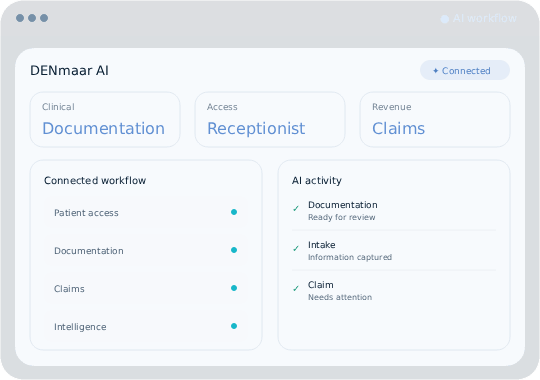
DENmaar applies AI across the connected workflow of a behavioral health practice—not only to generate progress notes.
Because DENmaar brings the EHR, scheduling, billing, credentialing, and operational support into one platform, AI can help move work forward across the entire organization.
One platform. One connected workflow. AI where the work actually happens.

Behavioral Health Focused

Clinical Accuracy & Oversight

Billing Workflow Ready
AI Notes
More Than an AI Note Generator
Most healthcare AI products solve one isolated task. They may transcribe a session, generate a note, answer a call, or analyze a claim—but the practice is still responsible for connecting those tools.
DENmaar takes a different approach.
We are building AI directly into the clinical, administrative, and financial workflows already used by the practice.
Information collected during intake can support documentation. Documentation can help prepare the claim. Claim information can guide billing follow-up. Operational data can help leadership see where work is becoming delayed.
The result is not simply more AI features. It is a more connected practice.
How DENmaar Uses AI
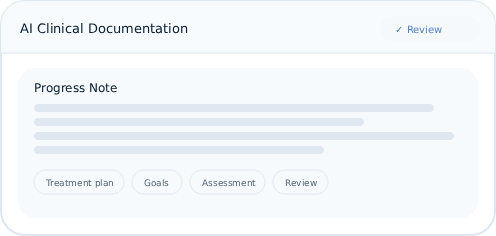
AI Clinical Documentation
Create behavioral health documentation using information already available within the patient record.
Providers remain in control. AI-generated content can be reviewed, edited, and approved by the clinician before it becomes part of the signed record.
How DENmaar Uses AI
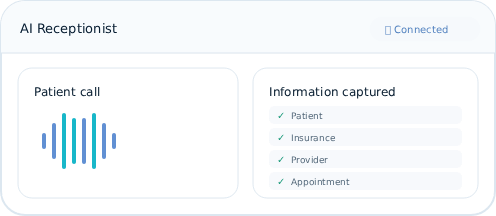
AI Receptionist
Respond to patients and prospective patients even when staff members are unavailable.
The DENmaar AI Receptionist is being designed around the real intake and scheduling needs of behavioral health organizations.
- Immediate call response
- New-patient information collection
- Appointment requests
- Rescheduling requests
- Common practice questions
- Insurance-information collection
- Provider and location routing
- After-hours coverage
- Call summaries and recommended follow-up
Because the AI Receptionist is connected to the DENmaar platform, the information it collects can become part of the practice workflow instead of remaining inside a separate answering service.
How DENmaar Uses AI
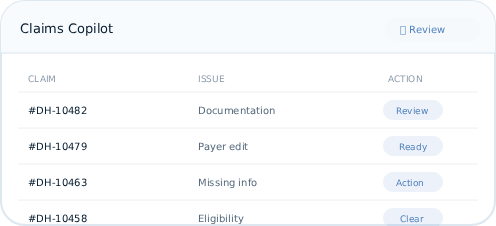
Claims Copilot
Help staff identify potential claim problems before they become lost revenue.
Claims Copilot brings AI and operational intelligence into the revenue-cycle workflow. It is designed to help billing teams understand what needs attention, why it needs attention, and what should happen next.
- Reviewing claims for missing or inconsistent information
- Identifying documentation and billing dependencies
- Highlighting claims that require follow-up
- Organizing work by urgency and financial impact
- Supporting denial and rejection analysis
- Recommending the next action
- Surfacing recurring payer or workflow problems
- Helping prevent avoidable delays before submission
Claims Copilot does not replace billing judgment. It gives the billing team better information and a clearer path through the work.
How DENmaar Uses AI
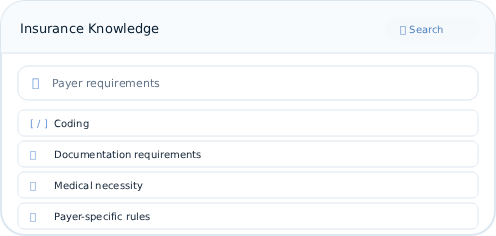
Insurance Knowledge
Turn years of behavioral health billing experience into accessible guidance.
Insurance requirements change constantly and often vary by payer, plan, state, provider type, and service. DENmaar is developing an expanding insurance knowledge resource informed by real behavioral health billing situations.
It can support questions involving:
- Coding
- Prior authorization
- Medical necessity
- Documentation requirements
- Claim resolution
- Credentialing
- Telehealth requirements
- Payer-specific rules
- Billing best practices
Instead of leaving practices to search scattered payer manuals or depend on disconnected information, DENmaar brings insurance knowledge closer to the workflow where decisions are made.
How DENmaar Uses AI
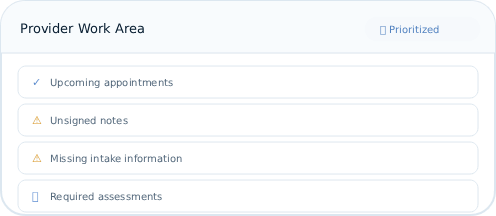
Intelligent Provider Workflow
Help every provider understand what requires attention next.
DENmaar’s Provider Work Area is being developed to organize clinical and administrative responsibilities into a single, prioritized view.
It will help providers identify:
- Upcoming appointments
- Missing intake information
- Eligibility or insurance concerns
- Incomplete documentation
- Unsigned notes
- Required assessments
- Treatment-plan updates
- Supervisor review requirements
- Other actions that could delay care or billing
The goal is simple: providers should not have to search through multiple screens to discover what they need to do.
How DENmaar Uses AI
Practice and Revenue Intelligence
Give leadership a clearer view of how the organization is operating.
By bringing scheduling, clinical documentation, provider activity, claims, and collections together, DENmaar can help practice leaders identify:
- Provider utilization
- Unfinished clinical work
- Workflow bottlenecks
- Claims waiting on documentation
- Recurring insurance problems
- Revenue-cycle exceptions
- Operational trends requiring attention
AI becomes most valuable when it helps the organization recognize problems earlier and take action before those problems affect patients, providers, or revenue.
Connected Patient Journey
One Patient Journey.
One Connected System.
The value of DENmaar’s AI is not limited to any single feature.
ONE CONNECTED WORKFLOW
AI working across the practice, from first contact through revenue-cycle operations.
01
PATIENT ACCESS
A prospective patient contacts the practice.
02
AI RECEPTIONIST
The AI Receptionist collects information and helps move the request into the appropriate scheduling or follow-up workflow.
03
INTAKE
The patient completes registration, insurance information, and assessments.
04
DOCUMENTATION
The provider uses those records and the session information to prepare clinical documentation.
05
BILLING READINESS
The completed documentation supports claim creation and billing readiness.
06
CLAIMS COPILOT
Claims Copilot helps identify exceptions and directs the billing team toward the next action.
07
PRACTICE INTELLIGENCE
Practice leadership can see where clinical, administrative, or financial work is becoming delayed.
THE CONNECTED OUTCOME
That is AI working across the practice—not another application working by itself.
Practice & Revenue Intelligence
AI That Helps the Organization
See What's Next
Connected data gives DENmaar more context about where work is happening, where it is delayed, and where
attention can have the greatest operational impact.
Prioritize Work
Surface the tasks and exceptions that need attention instead of making staff hunt for them.
Find Bottlenecks
Identify recurring workflow problems across clinical, administrative, and revenue-cycle operations.
Act Earlier
Recognize patterns before unfinished work becomes a patient-access, billing, or revenue problem.
Support Providers
Give clinicians a clearer view of documentation and administrative responsibilities.
Keep Humans in Control
AI assists the work while clinicians and staff retain responsibility for decisions.
Connect the Workflow
Use information already present in the DENmaar platform rather than recreating it in another tool.
Behavioral Healthcare
Designed for Behavioral Healthcare
DENmaar’s AI capabilities are built around the needs of behavioral health organizations, including:
Therapy
Psychiatry
Substance use disorder treatment
Group services
Multidisciplinary care
Multi-provider and multi-location practices
AI assists the work, but clinicians and staff retain responsibility for reviewing information and making clinical, administrative, and billing decisions.
DENmaar AI
Built Today. Expanding Continuously.
DENmaar is introducing AI carefully across the platform. Some capabilities are available today, while others are in development or being expanded through controlled pilots.
During a demonstration, we will show you what is currently available, explain what is being developed, and evaluate which DENmaar workflows fit the needs of your organization.
No inflated promises. No disconnected AI tools. A practical path toward a more intelligent behavioral health practice.
Available today
Controlled pilots
Expanding continuously
Request an
AI Notes Trial
See how DENmaar AI Notes can help your clinicians reduce documentation time while improving
Request a demonstration or pilot program today.
Request Information
TESTIMONIALS
WHAT OUR CLIENTS SAY
On behalf of everyone at Meadowlark Counseling Services, I want to extend our sincere thanks for the continued improvements you and your team have made to the DENMaar EMR platform. We have been consistently impressed with both the functionality and user-friendly design of the system, which has made a meaningful difference in our day-to-day operations. The intuitive layout and ease of use have allowed our staff to spend less time navigating the system and more time focusing on client care. The regular updates and enhancements reflect your commitment to meeting the evolving needs of providers in the behavioral health and substance use treatment fields. We genuinely look forward to the new features introduced each month and appreciate how responsive the platform has been to the demands of clinical workflows. We have been so pleased with our experience that we’ve taken the opportunity to recommend DENMaar to other professionals in Pennsylvania who are working in the SUD field. Thank you again for your ongoing support and partnership. We are grateful to be working with a company that truly understands the needs of its users. KIndly, Becky Parks on behalf of the entire team at Meadowlark Counseling Services
I referred one of my colleagues Dr Aaron to you he is just starting g his psychology private practice and looking at where to start. I told him hands down you guys are the best billers and have a great EMR and team. He said he reached out just wanted to let you know!
FANTASTIC job keeping things rolling along with any and all of our billing concerns as well as responding to other issues which may well have been out of your wheelhouse. We are VERY grateful to have you and the crew in our corner.
I appreciate you all so much and DENmaar has been such a blessing Donna to our overall operations and success as an expanding company—allowing us to ultimately operate more efficiently, get our claims paid more consistently, ad stay on top of the critical credentialing piece, among other things. Teamwork does in fact, make the dream work. I’ll loop Chris/Isabella in on this message thread too, as I want All of your team to be aware of how much we appreciate our working relationship with DENmaar
Thank you for your diligence!! I appreciate it so much. Thank you Edwina…
Thank you so much Amy! I will be referring to DENmaar as often as I am asked about credentialing services.
Our Latest Blogs
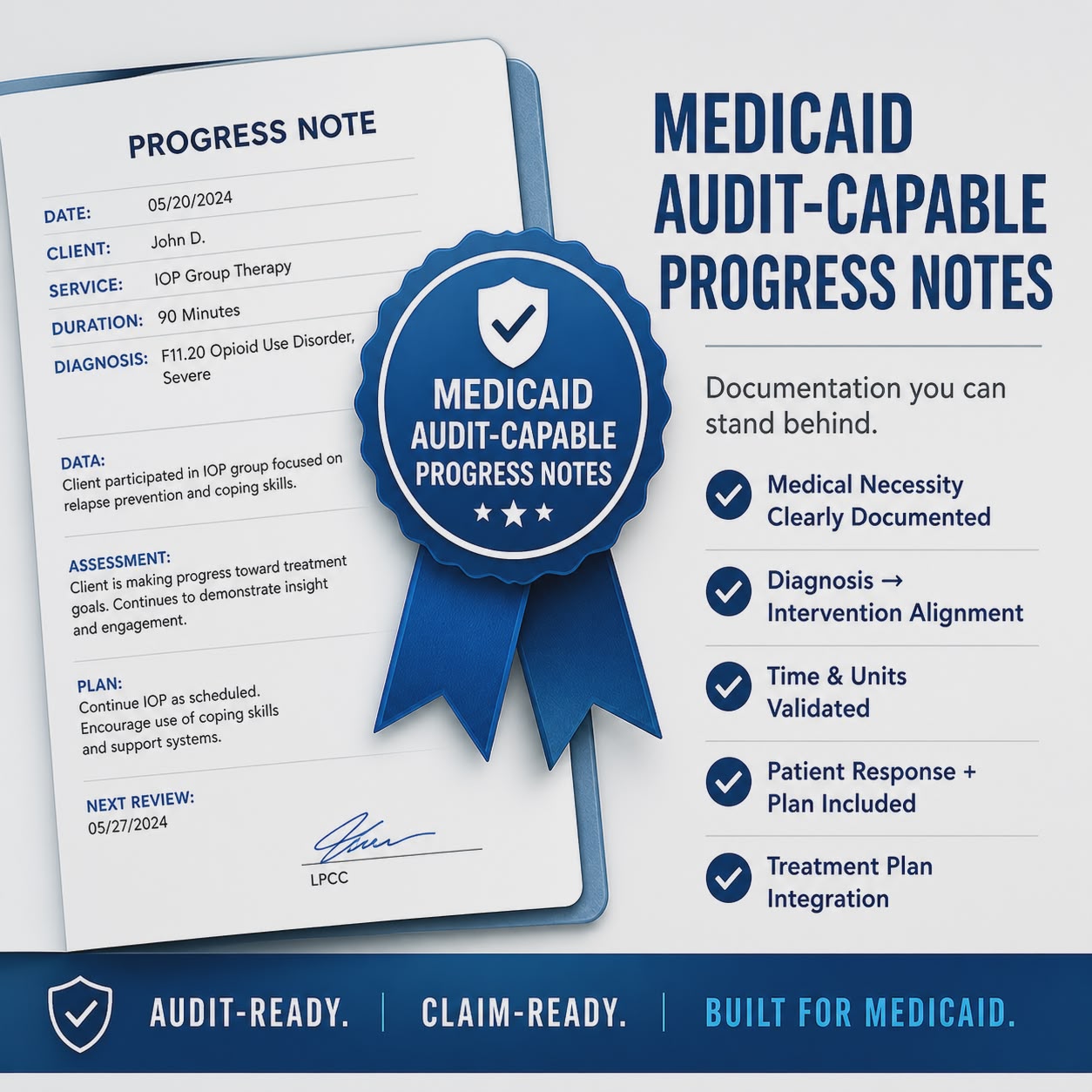
Why We Took Our Time to Build the Best Medicaid Focused Progress Notes
In behavioral health, progress notes are often treated as a formality.
- Something to complete.
- Something to store.
- Something to “get done.”
That approach is exactly why so many practices struggle with denials, audits, and inconsistent revenue.
We took a different path. We slowed down and built progress notes the right way.
The Problem: Most Progress Notes Aren’t Built for Medicaid
Medicaid is not forgiving.
Unlike many other payers, Medicaid programs expect:
- Clear medical necessity
- Tight alignment between diagnosis, intervention, and outcome
- Accurate time and unit reporting
- Consistency across providers and services
- Documentation that supports program-level care such as IOP, SUD, and community-based services
The issue isn’t that clinicians don’t know how to document. It’s that most systems don’t guide them to do it in a way that holds up under scrutiny.
That gap creates:
- Denials
- Recoupments
- Audit exposure
- Revenue leakage
This is one reason many organizations struggle with Medicaid billing behavioral health workflows and long-term compliance.
Our Approach: Documentation as a System, Not a Template
We didn’t start with templates. We started with the full lifecycle:
Scheduler → Session → Note → Daysheet → Claim → Payment
Then we asked a simple question:
What does the note need to contain to ensure the claim gets paid and survives an audit?
And that changed everything.
By integrating documentation directly into behavioral health revenue cycle management workflows, the system supports both compliance and reimbursement performance.
What We Built Differently
1. Structured for Medical Necessity
Every note enforces:
- Diagnosis linkage
- Symptom documentation
- Targeted interventions
- Patient response
- Forward plan
Not as optional fields, but as a guided clinical workflow.
This creates stronger behavioral health compliance and improves Medicaid behavioral health reimbursement outcomes.
2. Aligned With Billing Logic
Clinical documentation and billing cannot be separate systems.
Our notes are built to reflect:
- Service requirements
- Time thresholds and unit logic
- Program and payer expectations
This creates what we call Claims Hygiene, which helps generate clean claims behavioral health workflows before claims are ever submitted.
Integrated documentation also supports RCM for behavioral health by reducing rework and denied claims.
3. Consistency Across Providers
In multi-provider practices, inconsistency leads to risk.
We designed notes to:
- Standardize documentation quality
- Guide providers without slowing them down
- Reduce variability that leads to denials or audit issues
This is especially important for organizations using therapy practice management software and managing multiple clinicians across locations.
4. Built for Real Medicaid Workflows
We didn’t design for ideal scenarios. We designed for reality:
- Multiple services in a single day
- Group and individual sessions
- Program-based care such as IOP, SUD, ACT, and more
- State-specific requirements
This is where most systems break.
We built for it from the start.
Unlike traditional systems, modern behavioral health EHR platforms must support real Medicaid workflows tied directly to billing and operational logic.
The Result: Real World Validation
During a recent Medicaid site visit, a state representative reviewing one of our partner practices said:
“These are the best progress notes I’ve seen.”
That’s not marketing language.
That’s what happens when documentation is engineered with compliance, billing, and clinical care in mind at the same time.
This level of structure is critical for practices managing psychiatry billing Medicaid, substance use treatment workflows, and complex behavioral health programs.
Why This Matters
Progress notes are not just records. They directly impact:
- Revenue through clean versus denied claims
- Compliance and audit readiness
- Operational efficiency with less rework and fewer corrections
When documentation and billing are disconnected, practices often lose 10–20% of potential insurance revenue.
When they’re aligned, performance improves across the board.
Learn how integrated systems improve outcomes through AI behavioral health billing and clean claims workflows and connected documentation systems.
Where This Is Going
This foundation enables what comes next:
- AI-assisted notes that are actually audit-ready
- Measurement-Based Care integrated directly into documentation
- Diagnosis-to-intervention mapping
- Real-time validation before claims submission
The future isn’t faster note-taking.
It’s smarter, enforceable documentation that drives outcomes.
This is where AI progress notes and AI documentation for behavioral health become valuable when integrated into the clinical and billing workflow.
Final Thought
We didn’t rush this.
Because in Medicaid, shortcuts don’t show up immediately. They show up later in denials, audits, and lost revenue.
So we took our time.
And built progress notes that hold up under pressure.
Practices looking for scalable systems should evaluate how their psychiatry EHR and behavioral health billing workflows connect documentation, compliance, and reimbursement into one operational system.
Explore more about the benefits of behavioral and mental health billing services at DENmaar.
Frequently Asked Questions
Why are Medicaid progress notes important in behavioral health?
Medicaid progress notes support medical necessity, billing compliance, audit readiness, and accurate reimbursement. Poor documentation often leads to denials and revenue leakage.
How do AI progress notes improve behavioral health billing?
AI progress notes help standardize documentation, improve coding alignment, support claims hygiene, and reduce billing errors before claim submission.
What is claims hygiene in behavioral health billing?
Claims hygiene refers to creating accurate, audit-ready claims by aligning documentation, diagnosis, coding, eligibility, and billing workflows before submission.
How does structured documentation reduce denials?
Structured documentation ensures that required billing and compliance elements are captured consistently, reducing claim rejections, denials, and audit exposure.
What should a behavioral health EHR support for Medicaid billing?
A behavioral health EHR should support diagnosis linkage, time and unit validation, payer-specific workflows, AI documentation, and integrated revenue cycle management.

What Psychiatrists Should Actually Look for in an EHR And Why Most Platforms Fall Short
When psychiatrists evaluate an EHR, the checklist is usually the same:
- Documentation templates
- E-prescribing
- Scheduling
- Telehealth
- Patient portal
- Measurement-based care
- Reporting
On paper, most systems claim to offer all of this.
In reality, very few deliver it in a way that actually supports how a psychiatry practice operates, especially once you move beyond a solo provider into a multi-provider, insurance-based model.
This is where the gap starts to show.
The Core Problem: Fragmented Systems in Behavioral Health EHRs
Most behavioral health EHR platforms, including many mental health EHR software solutions, were not designed as operational systems. They are documentation tools with add-ons.
What that leads to:
- Documentation exists separately from billing
- Scheduling is disconnected from clinical workflow
- Measurement-based care is bolted on, not integrated
- Revenue cycle issues surface after claims are submitted
- Providers carry the burden of figuring it out across systems
For a psychiatrist running or joining a growing practice, this creates friction everywhere.
To understand how system gaps impact performance, see how structural instability in behavioral health practices is reshaping operations.
What a Psychiatry-Centered Behavioral Health EHR Should Actually Do
If you look at the workflow from intake to session to documentation to billing to follow-up, the system should function as a single loop.
Here’s what that means in practical terms:
1. Documentation That Drives the Entire Workflow
Psychiatric documentation shouldn’t just be a note.
It should:
- Capture DSM-5 diagnoses in a structured way
- Include MSE and risk assessment components
- Feed directly into billing logic such as CPT, units, and modifiers
- Connect to treatment planning and measurement-based care
Modern systems using AI progress notes for behavioral health and AI documentation for behavioral health can assist here, but only if grounded in structured clinical data, not just free text generation.
2. Measurement-Based Care That Isn’t an Afterthought
Most platforms include tools like PHQ-9 or GAD-7.
Very few actually integrate them.
A true system should:
- Be part of intake and ongoing care
- Flow into progress notes automatically
- Track trends over time
- Inform treatment decisions
This is critical for behavioral health compliance and payer expectations.
3. Scheduling That Acts as a Revenue Control Point
Scheduling isn’t just calendar management.
It should:
- Trigger eligibility and benefits checks
- Flag authorization issues before sessions occur
- Drive documentation workflows
- Feed clean data into billing
If scheduling is passive, errors show up downstream in claims and impact behavioral health revenue cycle management.
4. E-Prescribing That Fits Psychiatric Workflows
EPCS is now expected, but usability matters more than availability.
For psychiatry:
- Controlled substance workflows must be efficient
- Medication history should be easily accessible
- Integration with documentation is critical
If prescribing is clunky, it slows down the entire session.
5. Telehealth That Feels Native
Telehealth should not feel like a separate system.
It should:
- Launch directly from the schedule
- Tie into session tracking
- Feed into documentation automatically
- Be simple for patients
6. Patient Portal That Actually Engages Patients
A portal should do more than store forms.
It should:
- Handle intake and e-signatures
- Deliver rating scales
- Support secure messaging
- Feed structured data into the workflow
Otherwise, staff re-enters everything manually.
7. Multi-Provider and Supervision Workflows
As soon as a practice grows, complexity increases.
The system should support:
- Multiple providers with role-based access
- Supervision structures
- Shared visibility across teams
- Standardized workflows
This is where most therapy practice management software systems break down.
8. Reporting That Connects Clinical and Financial Data
Basic reporting isn’t enough.
You need visibility into:
- Patient volume and utilization
- No-show patterns
- Provider productivity
- Claims performance and revenue trends
This is where clinical operations intersect with behavioral health billing services and revenue.
The Missing Layer: Revenue Cycle Integration
This is the piece most psychiatrists underestimate.
Documentation, scheduling, and billing are not separate functions.
They are interdependent.
If your system does not:
- Validate insurance early
- Enforce clean documentation
- Align notes with billing requirements
- Monitor claims performance
You will lose revenue, even if everything looks fine.
Explore how claims hygiene in behavioral health billing improves clean claims behavioral health performance.
For deeper insight into integrated systems, review behavioral health billing services and AI-driven revenue cycle management.
Where the Industry Is Going
Behavioral health is moving toward:
- Measurement-based care as a standard
- Greater payer scrutiny
- Integrated team-based care
- Automation in documentation and billing
The EHR is no longer just a record system.
It’s becoming the operating system of the practice.
Modern platforms like behavioral health EHR systems and DENmaar are designed to unify clinical and financial workflows.
Final Thought
If you’re evaluating platforms, don’t just ask:
Does it have this feature?
Ask:
How does this feature connect to everything else in the system? Because in psychiatry, efficiency and revenue don’t come from isolated tools. They come from how well the entire workflow is integrated.
Frequently Asked Questions
What is the best EHR for psychiatry practices?
The best psychiatry EHR is one that integrates documentation, scheduling, and billing into a unified system, supports AI documentation, and improves clean claims and revenue cycle management.
Why do most behavioral health EHRs fail at billing?
Most systems treat billing as an add-on instead of integrating it into clinical workflows, leading to errors, denials, and lost revenue.
How does AI improve behavioral health documentation?
AI helps structure notes, align documentation with billing requirements, and improve accuracy, especially when combined with systems like AI progress notes.
What is claims hygiene in behavioral health?
Claims hygiene ensures that all upstream data such as documentation, eligibility, and coding are correct before submission, leading to higher clean claim rates and fewer denials.
Why is revenue cycle management important in psychiatry?
Effective RCM ensures accurate claims, faster reimbursements, and improved financial stability, especially for Medicaid and insurance-based psychiatry practices.
The Biggest Threat to Behavioral Health Practices Isn’t What You Think
Why Structural Instability Is Becoming the Real Risk in Behavioral Health
Most conversations about behavioral health focus on the obvious:
- Staffing shortages
- Burnout
- Reimbursement rates
- Access to care
All real. All important.
But they’re not the biggest threat.
The Real Problem: Structural Instability
Behavioral health practices today are operating in an environment that is becoming:
- Less predictable
- More regulated
- More fragmented
And it’s happening fast.
This isn’t a single issue—it’s a convergence of forces that are reshaping how practices operate.
Medicaid Is Becoming Less Reliable
Behavioral health is heavily dependent on Medicaid.
And right now, Medicaid is changing:
- Eligibility requirements are tightening
- Coverage is fluctuating more frequently
- Provider audits and revalidation are increasing
For practices, this means:
- Patients who were covered last month may not be today
- Eligibility can no longer be assumed
- Claims are more likely to fail due to coverage gaps
This introduces something most practices aren’t designed for:
Constant uncertainty at the point of care
Modern behavioral health EHR software should verify eligibility in real time and reduce Medicaid claims friction.
Funding Is No Longer Stable
Federal and state behavioral health funding has become unpredictable.
Programs expand—and then contract.
Budgets shift.
Policies reverse.
Practices that relied on:
- Grants
- State programs
- Supplemental funding
Are now forced to depend more heavily on:
Consistent, accurate insurance reimbursement
That’s a problem if your system isn’t built for it.
This is why strong mental health billing services and revenue cycle systems matter more than ever.
AI Is Rising—But Not Where It Matters Most
There’s a lot of noise around AI in mental health.
- AI therapists
- Chatbots
- Digital companions
But the real opportunity isn’t replacing clinicians.
It’s fixing operations.
The practices that benefit from AI won’t be the ones using it to simulate therapy.
They’ll be the ones using it to:
- Improve documentation
- Enforce workflows
- Prevent billing errors
- Optimize revenue
Solutions like AI behavioral health billing systems and AI progress notes are where measurable ROI happens.
Compliance Pressure Is Increasing
Behavioral health has historically been loosely structured compared to other areas of healthcare.
That’s changing.
There is growing scrutiny around:
- Credentialing
- Documentation
- Billing accuracy
This means:
- More audits
- More denials
- Greater financial risk for mistakes
The margin for error is shrinking.
Practices need stronger behavioral health compliance systems and provider credentialing controls.
The System Most Practices Use Can’t Handle This
Here’s the underlying issue:
Most practices are still operating with disconnected tools:
- An EHR
- A billing service
- A scheduler
- Manual processes in between
These systems were built for a simpler environment.
They don’t:
- Adapt in real time
- Enforce correct workflows
- Prevent errors before they happen
So when complexity increases, performance breaks down.
Many of these failures are caused by poor claims communication workflows and fragmented processes.
What Needs to Change
The industry doesn’t need another EHR.
It needs a system that functions as a behavioral and financial control layer.
A system that:
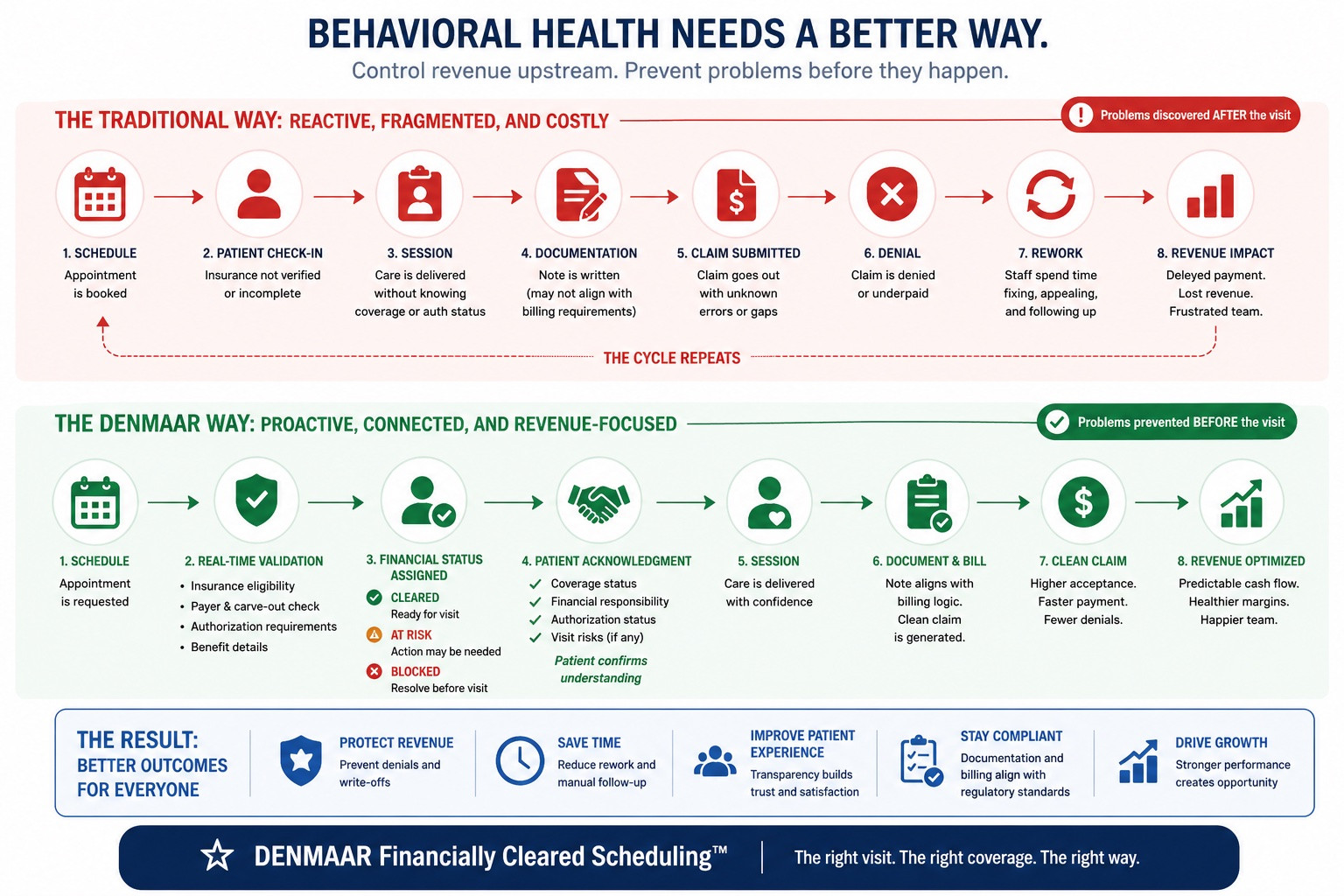
- Validates insurance before the visit
- Detects carve-outs and special workflows
- Confirms authorization requirements
- Aligns documentation with billing logic
- Prevents invalid claims before submission
This is the foundation of claims hygiene in behavioral health billing.
Why the Scheduler Becomes the Most Important Part of the System
If there’s one place to fix this, it’s not billing.
It’s before the session even starts.
At the point of scheduling and check-in.
This is where:
- Coverage can be verified
- Risks can be identified
- Patients can be informed
- Decisions can be made
Once the session happens, the opportunity to prevent errors is gone.
A modern therapy practice management software platform should make scheduling financially intelligent.
A New Standard: Financially Cleared Scheduling
Forward-thinking practices are beginning to adopt a new approach:
Every appointment must be financially validated before care is delivered.
That means:
- Insurance is confirmed
- Authorization is verified
- The correct billing pathway is identified
- The patient acknowledges their financial responsibility
If something isn’t right, it’s addressed before the visit—not after the denial.
Learn how integrated systems like DENmaar make this possible.
The Result
Practices that operate this way see:
- Fewer denials
- Higher clean claim rates
- Faster reimbursement
- More predictable cash flow
Not because they work harder—but because their system enforces the right behavior.
This is true behavioral health revenue cycle management.
Final Thought
Behavioral health isn’t just facing challenges.
It’s entering a more complex, less forgiving operating environment.
The practices that succeed won’t be the ones that react better.
They’ll be the ones that:
Control the system upstream before problems ever occur.
Frequently Asked Questions
What is the biggest threat to behavioral health practices today?
The biggest threat is structural instability caused by Medicaid uncertainty, fragmented billing systems, compliance pressure, and poor revenue workflows.
Why are Medicaid claims harder for behavioral health practices?
Frequent eligibility changes, carve-outs, audits, and authorization complexity make Medicaid behavioral health claims harder to manage.
What is financially cleared scheduling?
It means validating insurance, authorizations, payer routing, and patient responsibility before the appointment occurs.
How can AI help behavioral health organizations?
AI can improve documentation, automate claims hygiene, reduce denials, and optimize billing workflows.
Why do disconnected EHR and billing systems fail?
Because they do not share data efficiently, prevent upstream errors, or adapt quickly to payer and compliance changes.
Our Partners






Ready to get started?
Feel free to reach out if you have any questions.
