

- Session transcription
- DAP, SOAP, and BIRP progress notes
- Psychiatry and medication-management documentation
- Biopsychosocial assessments
- Individualized treatment plans
- Measurable goals and objectives
- Group and multidisciplinary documentation
- Integration of clinical assessments and outcome measures
- Continuity between the treatment plan and subsequent notes
AI Notes for Behavioral Health
AI Built Into the
Work of the Practice.
From the first patient call through documentation, claims, and payment.
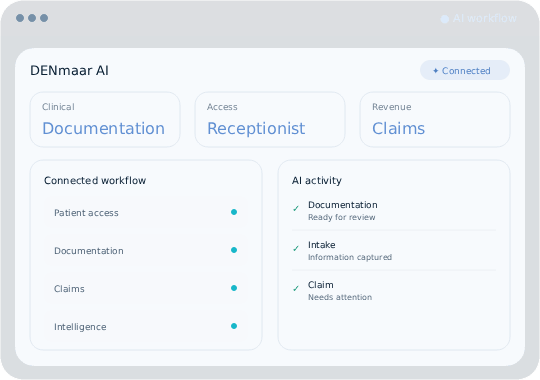
DENmaar applies AI across the connected workflow of a behavioral health practice—not only to generate progress notes.
Because DENmaar brings the EHR, scheduling, billing, credentialing, and operational support into one platform, AI can help move work forward across the entire organization.
One platform. One connected workflow. AI where the work actually happens.

Behavioral Health Focused

Clinical Accuracy & Oversight

Billing Workflow Ready
AI Notes
More Than an AI Note Generator
Most healthcare AI products solve one isolated task. They may transcribe a session, generate a note, answer a call, or analyze a claim—but the practice is still responsible for connecting those tools.
DENmaar takes a different approach.
We are building AI directly into the clinical, administrative, and financial workflows already used by the practice.
Information collected during intake can support documentation. Documentation can help prepare the claim. Claim information can guide billing follow-up. Operational data can help leadership see where work is becoming delayed.
The result is not simply more AI features. It is a more connected practice.
How DENmaar Uses AI
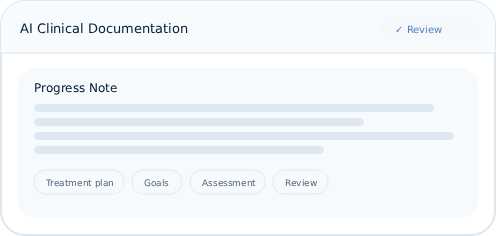
AI Clinical Documentation
Create behavioral health documentation using information already available within the patient record.
Providers remain in control. AI-generated content can be reviewed, edited, and approved by the clinician before it becomes part of the signed record.
How DENmaar Uses AI
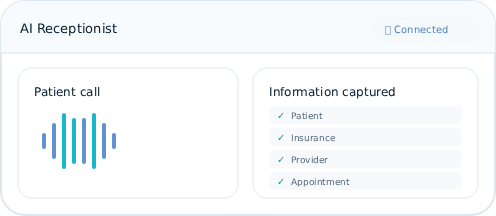
AI Receptionist
Respond to patients and prospective patients even when staff members are unavailable.
The DENmaar AI Receptionist is being designed around the real intake and scheduling needs of behavioral health organizations.
- Immediate call response
- New-patient information collection
- Appointment requests
- Rescheduling requests
- Common practice questions
- Insurance-information collection
- Provider and location routing
- After-hours coverage
- Call summaries and recommended follow-up
Because the AI Receptionist is connected to the DENmaar platform, the information it collects can become part of the practice workflow instead of remaining inside a separate answering service.
How DENmaar Uses AI
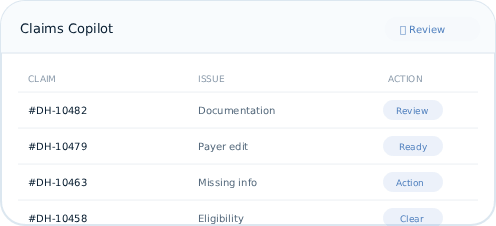
Claims Copilot
Help staff identify potential claim problems before they become lost revenue.
Claims Copilot brings AI and operational intelligence into the revenue-cycle workflow. It is designed to help billing teams understand what needs attention, why it needs attention, and what should happen next.
- Reviewing claims for missing or inconsistent information
- Identifying documentation and billing dependencies
- Highlighting claims that require follow-up
- Organizing work by urgency and financial impact
- Supporting denial and rejection analysis
- Recommending the next action
- Surfacing recurring payer or workflow problems
- Helping prevent avoidable delays before submission
Claims Copilot does not replace billing judgment. It gives the billing team better information and a clearer path through the work.
How DENmaar Uses AI
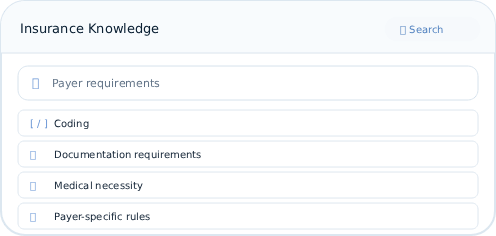
Insurance Knowledge
Turn years of behavioral health billing experience into accessible guidance.
Insurance requirements change constantly and often vary by payer, plan, state, provider type, and service. DENmaar is developing an expanding insurance knowledge resource informed by real behavioral health billing situations.
It can support questions involving:
- Coding
- Prior authorization
- Medical necessity
- Documentation requirements
- Claim resolution
- Credentialing
- Telehealth requirements
- Payer-specific rules
- Billing best practices
Instead of leaving practices to search scattered payer manuals or depend on disconnected information, DENmaar brings insurance knowledge closer to the workflow where decisions are made.
How DENmaar Uses AI
Intelligent Provider Workflow
Help every provider understand what requires attention next.
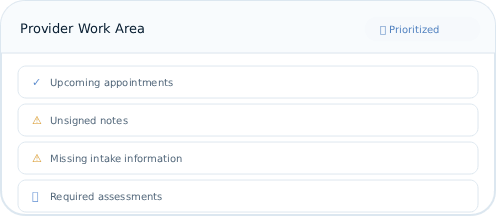
DENmaar’s Provider Work Area is being developed to organize clinical and administrative responsibilities into a single, prioritized view.
It will help providers identify:
- Upcoming appointments
- Missing intake information
- Eligibility or insurance concerns
- Incomplete documentation
- Unsigned notes
- Required assessments
- Treatment-plan updates
- Supervisor review requirements
- Other actions that could delay care or billing
The goal is simple: providers should not have to search through multiple screens to discover what they need to do.
How DENmaar Uses AI
Practice and Revenue Intelligence
Give leadership a clearer view of how the organization is operating.
By bringing scheduling, clinical documentation, provider activity, claims, and collections together, DENmaar can help practice leaders identify:
- Provider utilization
- Unfinished clinical work
- Workflow bottlenecks
- Claims waiting on documentation
- Recurring insurance problems
- Revenue-cycle exceptions
- Operational trends requiring attention
AI becomes most valuable when it helps the organization recognize problems earlier and take action before those problems affect patients, providers, or revenue.
Connected Patient Journey
One Patient Journey.
One Connected System.
The value of DENmaar’s AI is not limited to any single feature.
ONE CONNECTED WORKFLOW
AI working across the practice, from first contact through revenue-cycle operations.
01
PATIENT ACCESS
A prospective patient contacts the practice.
02
AI RECEPTIONIST
The AI Receptionist collects information and helps move the request into the appropriate scheduling or follow-up workflow.
03
INTAKE
The patient completes registration, insurance information, and assessments.
04
DOCUMENTATION
The provider uses those records and the session information to prepare clinical documentation.
05
BILLING READINESS
The completed documentation supports claim creation and billing readiness.
06
CLAIMS COPILOT
Claims Copilot helps identify exceptions and directs the billing team toward the next action.
07
PRACTICE INTELLIGENCE
Practice leadership can see where clinical, administrative, or financial work is becoming delayed.
THE CONNECTED OUTCOME
That is AI working across the practice—not another application working by itself.
Practice & Revenue Intelligence
AI That Helps the Organization
See What's Next
Connected data gives DENmaar more context about where work is happening, where it is delayed, and where
attention can have the greatest operational impact.
Prioritize Work
Surface the tasks and exceptions that need attention instead of making staff hunt for them.
Find Bottlenecks
Identify recurring workflow problems across clinical, administrative, and revenue-cycle operations.
Act Earlier
Recognize patterns before unfinished work becomes a patient-access, billing, or revenue problem.
Support Providers
Give clinicians a clearer view of documentation and administrative responsibilities.
Keep Humans in Control
AI assists the work while clinicians and staff retain responsibility for decisions.
Connect the Workflow
Use information already present in the DENmaar platform rather than recreating it in another tool.
Behavioral Healthcare
Designed for Behavioral Healthcare
DENmaar’s AI capabilities are built around the needs of behavioral health organizations, including:
Therapy
Psychiatry
Substance use disorder treatment
Group services
Multidisciplinary care
Multi-provider and multi-location practices
AI assists the work, but clinicians and staff retain responsibility for reviewing information and making clinical, administrative, and billing decisions.
DENmaar AI
Built Today. Expanding Continuously.
DENmaar is introducing AI carefully across the platform. Some capabilities are available today, while others are in development or being expanded through controlled pilots.
During a demonstration, we will show you what is currently available, explain what is being developed, and evaluate which DENmaar workflows fit the needs of your organization.
No inflated promises. No disconnected AI tools. A practical path toward a more intelligent behavioral health practice.
Available today
Controlled pilots
Expanding continuously
Request an
AI Notes Trial
See how DENmaar AI Notes can help your clinicians reduce documentation time while improving
Request a demonstration or pilot program today.
Request Information
TESTIMONIALS
WHAT OUR CLIENTS SAY
On behalf of everyone at Meadowlark Counseling Services, I want to extend our sincere thanks for the continued improvements you and your team have made to the DENMaar EMR platform. We have been consistently impressed with both the functionality and user-friendly design of the system, which has made a meaningful difference in our day-to-day operations. The intuitive layout and ease of use have allowed our staff to spend less time navigating the system and more time focusing on client care. The regular updates and enhancements reflect your commitment to meeting the evolving needs of providers in the behavioral health and substance use treatment fields. We genuinely look forward to the new features introduced each month and appreciate how responsive the platform has been to the demands of clinical workflows. We have been so pleased with our experience that we’ve taken the opportunity to recommend DENMaar to other professionals in Pennsylvania who are working in the SUD field. Thank you again for your ongoing support and partnership. We are grateful to be working with a company that truly understands the needs of its users. KIndly, Becky Parks on behalf of the entire team at Meadowlark Counseling Services
I referred one of my colleagues Dr Aaron to you he is just starting g his psychology private practice and looking at where to start. I told him hands down you guys are the best billers and have a great EMR and team. He said he reached out just wanted to let you know!
FANTASTIC job keeping things rolling along with any and all of our billing concerns as well as responding to other issues which may well have been out of your wheelhouse. We are VERY grateful to have you and the crew in our corner.
I appreciate you all so much and DENmaar has been such a blessing Donna to our overall operations and success as an expanding company—allowing us to ultimately operate more efficiently, get our claims paid more consistently, ad stay on top of the critical credentialing piece, among other things. Teamwork does in fact, make the dream work. I’ll loop Chris/Isabella in on this message thread too, as I want All of your team to be aware of how much we appreciate our working relationship with DENmaar
Thank you for your diligence!! I appreciate it so much. Thank you Edwina…
Thank you so much Amy! I will be referring to DENmaar as often as I am asked about credentialing services.
Our Latest Blogs
A “Game Changer” in Clinical Documentation: How AI Notes Are Saving Time and Elevating Compliance
When behavioral health practices describe a tool as a “game changer,” it’s not because of hype — it’s because it changes their daily reality.
That’s exactly what we’ve heard from teams using DENmaar’s Structured Progress Note 3.0 (AI version).
“The note is very sophisticated and references the objectives. We’ve gotten very positive feedback. It’s been described as a game changer and is working very well.”
— Dr. Erin Jenkins Baker, Licensed Psychologist, HSPP, Auxilium Psychological Services
AI That Understands the Clinical Flow
Denmaar AI note doesn’t just generate text — it mirrors how clinicians actually think and document:
- Structured to CMS guidelines: The note follows a logical, CMS-compliant progression of Assessment → Intervention → Progress → Plan, incorporating required medical necessity and measurable objectives.
- Objective-referenced narrative: Each section dynamically references active treatment objectives, ensuring continuity and compliance with supervision and audit standards.
Time-coded alignment: The AI calculates and aligns documentation with CPT-based service parameters, eliminating common audit risks.
The result: notes that are clinically valid, auditor-friendly, and take a fraction of the time.
Explore how our AI-powered EHR software supports compliant, audit-ready documentation.
Saving Hours, Protecting Compliance
Clinicians spend an average of 25–35% of their week on documentation. With AI-driven notes, that time drops by more than half — while accuracy and compliance go up.
DENmaar AI Notes are trained to:
- Recognize clinically relevant interventions based on the session’s type and goals
- Flag missing or inconsistent data points (e.g., objective not referenced, plan not updated)
- Auto-populate recurring patient details while prompting for unique updates required by CMS and payer audits
- Maintain audit-ready structure without sacrificing clinical voice
This means clinicians can sign off faster — and confidently.
CMS Compliance Built In
Unlike generic AI tools, DENmaar’s documentation engine is rooted in CMS compliance standards for medical necessity, continuity of care, and measurable progress.
Each note includes:
- Objective alignment: Ensuring interventions tie directly to measurable goals
- Medical necessity justification: Automatically summarized in context
- Plan progression tracking: Carrying forward treatment adjustments per CMS’s “ongoing care” expectation
- Supervision-ready structure: Supporting licensed oversight and trainee review requirements
These are the same standards that protect clinicians during audits and sustain payer confidence — without extra effort.
See how DENmaar’s credentialing and billing services help ensure end-to-end compliance.
The New Standard of Throughput
For a growing practice, compliance and efficiency are not opposites. They’re the same goal.
The AI note is not replacing clinicians — it’s removing friction:
- Less typing, more clinical judgment
- Less time explaining compliance, more time delivering care
- Less rework, more revenue through clean documentation
Building Toward $100M in Annual Revenue
Every automation at DENmaar ties back to one mission:
To make behavioral health self-sustaining through intelligent systems that eliminate waste.
AI documentation is one of the most powerful levers toward that future — saving hours per clinician, improving compliance confidence, and accelerating revenue flow.
That’s how we’ll reach $100M:
Not by selling software, but by engineering systems that multiply provider time and compliance integrity.
Conclusion: The Future of Documentation in Behavioral Health
With AI-powered clinical documentation, measurement-based care, and EHR automation, compliance becomes effortless — and productivity thrives.
DENmaar continues to set the standard for mental health EHR software, helping clinicians focus on what matters most: better outcomes and sustainable practice growth.

Clinical Documentation Compliance in Behavioral Health
The New Compliance Reality
In behavioral health, clinical documentation has always been the backbone of care, but today, it’s also the backbone of insurance compliance.
Payers are tightening audit criteria, requiring EHR documentation that clearly demonstrates medical necessity, progress toward measurable treatment goals, and evidence of ongoing outcome assessment.
For many mental health practices, that means treatment plans and progress notes can no longer be purely narrative, they must tie directly into quantifiable, data-driven outcomes supported by measurement-based care (MBC).
1. The Shift: From Clinical to Clinically Compliant
During a recent discussion with a partner clinic, the conversation turned toward treatment plan design and how it must now align with insurance compliance requirements.
The reality is:
- Insurers want clear, quantifiable goals.
- They want evidence of progress toward those goals.
- And they want it in a consistent, audit-ready format.
That’s where many EHR software systems fail — they are designed for data storage, not data compliance.
The need now is for behavioral health documentation software that integrates measurement-based care, turning every note into a compliance-ready record.
2. Where Measurement-Based Care (MBC) Changes Everything
Measurement-Based Care (MBC) brings structure and defensibility to clinical documentation.
When you connect outcome measures (like PHQ-9, GAD-7, ASRS, etc.) directly to the treatment plan, every progress note and goal update becomes measurable, defensible, and audit-ready.
This transforms compliance from an afterthought into a built-in system:
- Assessments inform treatment goals.
- Treatment goals flow into progress notes.
- Notes link directly to payer-recognised outcomes through your mental health EHR software.
With MBC, documentation does not just prove care was delivered; it proves care was effective. It is the foundation of data-driven behavioral health practice management.
3. The AI Advantage: Audit-Ready Without the Burden
At DENmaar, we’re extending Measurement-Based Care into AI-powered clinical documentation to make compliance seamless and efficient:
- AI-assisted treatment planners that recommend measurable objectives based on diagnosis and level of care.
- Automated progress note generation that ties interventions and outcomes to those objectives.
- Real-time compliance alerts that flag missing or outdated assessments before audits do.
The result: clinicians can document faster, stay insurance-compliant, and focus on patient care — not paperwork.
Our mental health practice management software blends AI, MBC, and compliance tools to keep practices efficient and audit-ready by default.
Why This Matters for Practice Growth
Practices that master documentation compliance are not just avoiding denials, they are building credibility with payers and scalability in operations.
Insurance-compliant documentation reduces rework, protects revenue, and strengthens trust that accelerates credentialing and reimbursement cycles.
MBC-driven compliance is no longer optional, it is the new framework for sustainable practice management in behavioral health.
Conclusion: Turning Compliance Into Confidence
The best systems do not just collect data — they use it to prove clinical and financial integrity.
At DENmaar, we’re aligning Measurement-Based Care (MBC), AI automation, and EHR documentation design to make every treatment plan and note insurance-compliant by default — not by extra effort.
With DENmaar’s mental health EHR software, compliance becomes confidence, and every documentation step becomes a driver of growth.
The Future of Behavioral Health Billing: How AI and Integrated EHRs Are Transforming Practice Revenue
Behavioral health practices are under pressure
Rising patient demand, complex payer rules, and shrinking margins have made it harder than ever to maintain profitability while delivering high-quality care. At the heart of the problem lies billing and revenue cycle management (RCM)—the critical link between services delivered and payments collected.
The good news? A new generation of AI-powered, integrated EHR systems is rewriting the rules of behavioral health billing. These platforms not only streamline operations but also unlock revenue growth that was previously out of reach.
The Challenges With Traditional Behavioral Health Billing
Most behavioral health practices still wrestle with:
- Slow reimbursements: Manual workflows and payer complexities lead to weeks—or months—of waiting for payments.
- High denial rates: Missing documentation, eligibility errors, and claim coding mistakes drive down clean claim percentages.
- Administrative overload: Staff spend hours reworking claims, chasing authorizations, and tracking down credentialing paperwork.
The result? A system that strains your team and leaves revenue on the table.
How AI Is Changing Behavioral Health Billing
AI isn’t just a buzzword—it’s becoming a mission-critical tool for behavioral health revenue cycle management. Modern platforms now use machine learning and predictive analytics to:
- Boost claim accuracy: AI detects coding inconsistencies before claims ever leave your system, reducing rejections.
- Predict and prevent denials: Predictive models flag claims likely to be denied so staff can address issues proactively.
- Automate eligibility and authorizations: AI agents instantly verify patient coverage and track authorizations without endless phone calls.
This shift means fewer errors, faster payments, and better use of your team’s time.
The Role of Integrated EHRs in Revenue Cycle Management
An integrated EHR with built-in billing and credentialing transforms the way practices manage revenue:
- Single Source of Truth: From scheduling to progress notes to claims submission, every step lives in one unified platform.
- Embedded Measurement-Based Care (MBC): Auto-scored PHQ-9s, GAD-7s, and outcome dashboards support both clinical quality and payer compliance.
- 24/7 Credentialing Automation: AI-powered credentialing agents monitor payer enrollments and compliance timelines, reducing onboarding delays.
With everything connected, providers can focus on care while the system handles the financial back-end.
Real-World Results: Revenue Gains With Modern Solutions
Behavioral health practices adopting integrated, AI-powered billing platforms report:
- 10–20% insurance revenue growth due to fewer denials and faster reimbursements
- 98%+ clean claim rates that outpace industry averages
- Significant time savings for admin staff, freeing them to focus on patient care
Behavioral health practices adopting integrated, AI-powered billing platforms report:
• 10–20% insurance revenue growth due to fewer denials and faster reimbursements
• 98%+ clean claim rates that outpace industry averages
• Significant time savings for admin staff, freeing them to focus on patient care
At DENmaar, our behavioral health partners consistently achieve:
- 98.1% clean claims
- 1.47% rejection rate
- 0.32% denial rate
These metrics put practices in the top 1–2% nationally for claims performance.
Preparing Your Practice for the Future
If your billing and RCM processes still rely on legacy systems or disconnected tools, now is the time to upgrade. Look for solutions that:
- Combine EHR, billing, and credentialing into one integrated platform
- Offer AI-powered automation for eligibility, claims, and denials
- Provide real-time revenue dashboards so you always know where you stand
The practices embracing these tools aren’t just surviving—they’re scaling faster and collecting more revenue with less effort.
Conclusion
Behavioral health billing doesn’t have to be a bottleneck. With AI-driven, integrated EHR systems, practices can finally align clinical excellence with financial health.
Ready to see how automation and AI can transform your revenue cycle? Schedule a Walkthrough with DENmaar Today and learn why the future of behavioral health billing starts here.
Our Partners






Ready to get started?
Feel free to reach out if you have any questions.
