

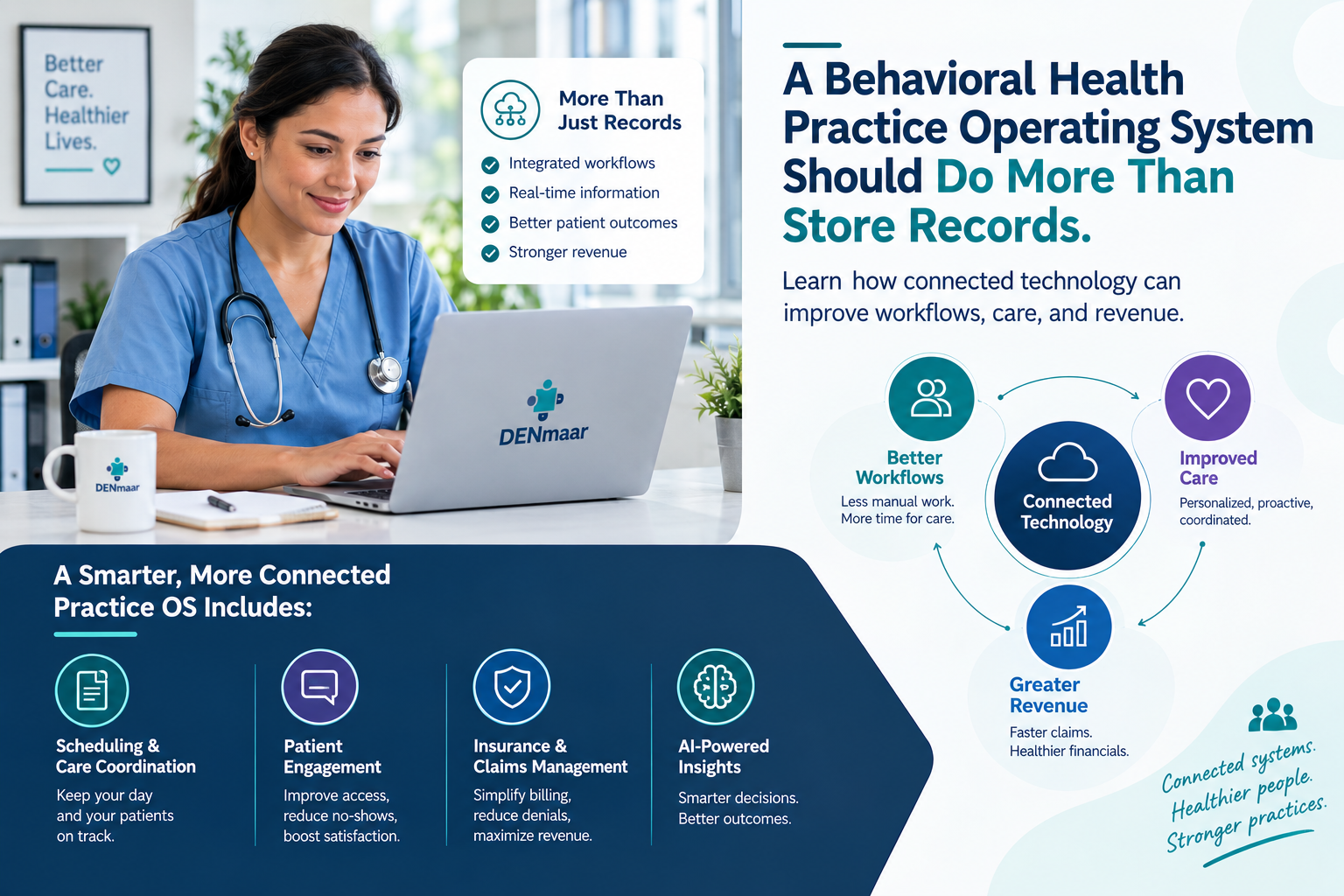
For years, electronic health records have been designed primarily as storage systems.
They store patient demographics, appointments, insurance information, assessments, treatment plans, progress notes, and billing records. That was an important improvement over paper charts, but it is no longer enough.
Behavioral health practices don’t simply need a place to keep information. They need a system that understands what the information means, recognizes what needs to happen next, and helps move the practice forward.
The future of the EHR is not a larger database with more menus.
It is an intelligent operating system for the practice.
The Real Work Is Often Invisible
A provider may finish a session, but that does not mean the work is complete.
The progress note may still need to be signed. The treatment plan may require an update. An authorization could be approaching its limit. A supervisor may need to review the documentation. The patient’s insurance may have changed. A claim could be waiting on a correction that no one has identified yet.
Traditional EHRs record each piece of this information, but they rarely connect it into a clear workflow.
As a result, practices rely on spreadsheets, reports, emails, sticky notes, and staff members remembering what must happen next. The information exists, but the system is not helping the practice act on it.
That creates invisible administrative work throughout the organization.
Providers spend time searching for unfinished documentation. Billers investigate problems after claims are rejected. Administrative staff track authorizations manually. Owners look through multiple reports trying to understand the health of the practice.
A modern EHR should bring that work to the right person before it becomes a problem.
From Passive Records to Active Guidance
Imagine a provider starting the day with one intelligent work area that clearly shows:
- Notes that still need to be completed or signed
- Treatment plans that are due for review
- Assessments requiring follow-up
- Authorizations approaching their visit limits
- Documentation returned by a supervisor
- Patients whose clinical information requires attention
- Tasks that could delay billing or reimbursement
Instead of searching through the system, the provider immediately knows what requires attention.
Better yet, the provider should be able to ask the system a simple question:
“What do I need to complete today?”
That is where artificial intelligence becomes genuinely useful.
AI should not merely generate more words. It should understand the provider’s responsibilities, organize the work, identify missing information, and help the provider complete each task efficiently.
The goal is not to replace clinical judgment. The goal is to protect the provider’s time so that more of it can be spent exercising that judgment.
Treatment Plans Should Be Living Clinical Tools
Treatment plans are a good example of how disconnected many EHR workflows remain.
A patient completes standardized assessments. The clinician establishes a diagnosis. Goals and interventions are documented in the treatment plan. Progress is later described in individual notes.
Yet these elements often exist as separate documents with little meaningful connection between them.
An intelligent system should help the clinician create an evidence-based treatment plan using the patient’s diagnosis, presenting concerns, assessment results, and appropriate clinical approaches. It should then help measure progress against that plan over time.
If symptoms improve, the treatment plan should reflect that progress. If assessment scores worsen, the system should bring it to the provider’s attention. If the documentation is no longer aligned with the stated goals, the provider should know before an audit or payer review discovers it.
The treatment plan should guide care, not simply satisfy a documentation requirement.
Clinical Care and Billing Are One Continuous Workflow
Many EHR companies treat clinical documentation and billing as two separate activities.
In reality, they are part of one continuous process.
The appointment affects eligibility and authorization. The service provided determines the documentation requirements. The note supports the diagnosis and procedure code. The completed documentation supports the claim. The claim produces payment, or creates additional work when something is missing.
When these steps are disconnected, problems are discovered too late.
An intelligent practice system should identify potential issues before the claim is submitted. It should recognize missing documentation, incomplete insurance information, authorization concerns, coding inconsistencies, and other conditions that could delay reimbursement.
That is far more valuable than simply reporting a denial after it has occurred.
For practices that need additional support across this process, integrated behavioral health billing can help connect documentation, claims, and revenue-cycle activities.
The System Should Coordinate the Practice
The next generation of behavioral health technology must go beyond recordkeeping.
It should help coordinate:
- Patient intake and communication
- Scheduling and insurance verification
- Clinical assessments and treatment planning
- Provider documentation and supervision
- Authorizations and utilization
- Claims submission and follow-up
- Patient balances and collections
- Credentialing and payer participation
- Operational and financial performance
This does not mean overwhelming users with more dashboards.
It means presenting each person with the specific information and actions relevant to their role. Providers should see provider work. Billing staff should see billing work. Practice leaders should see the few issues and trends that require leadership attention.
The system should reduce complexity, not display it.
Building the Practice Operating System
At DENmaar, we believe the traditional EHR is becoming obsolete.
Behavioral health practices need more than software that documents what already happened. They need a platform that helps determine what should happen next.
That means combining clinical documentation, evidence-based treatment planning, provider workflow, patient communication, insurance knowledge, and revenue-cycle management into one coordinated system.
Our vision is straightforward:
The system should run the practice, not force the practice to run the system.
The behavioral health organizations that thrive will not be the ones with the most software. They will be the ones whose technology quietly organizes the work, protects their providers, strengthens clinical care, and keeps revenue moving.
That is what the EHR should have become long ago.
It is what we are building now.
