A behavioral health practice does not operate as a collection of separate departments. A patient enters through a call, a message, a referral, or an online request. That interaction starts a chain of work that continues through scheduling, insurance, care, documentation, billing, and payment.
Most technology divides that chain into separate tools and queues. The front office answers the call. A scheduler books the appointment. Clinical staff document the service. Billers determine whether the claim can be submitted. When information is missing, people send messages, update spreadsheets, and wait for replies.
The problem is not that each person failed to do a task. The problem is that no system owns the complete journey. DENmaar calls that journey the Patient-to-Payment Cycle. It provides one operating model for moving every patient from first contact through completed care and collected revenue.
One Operating Model for Behavioral Health
The Patient-to-Payment Cycle connects patient access, clinical operations, and revenue cycle management. Each step prepares the next one. Information captured during the first conversation should support scheduling. Scheduling should initiate intake and insurance verification. The completed visit should trigger documentation, claim validation, submission, payment posting, and follow-up.
When these functions share the same workflow, staff no longer need to reconstruct what happened. The system can show the current status, identify what is missing, assign the next action, and measure the revenue affected by a delay.
AI Receptionist Begins the Cycle
The AI Receptionist is the front door. Its purpose is broader than answering the telephone. It should recognize the patient’s need, identify whether the practice can serve that patient, match the request to the right provider, schedule the appointment, collect insurance information, and begin intake.
A standalone voice assistant can take a message. An integrated receptionist can act on the practice’s real operating information: provider availability, specialties, state licenses, accepted plans, appointment rules, and service requirements. That difference determines whether automation reduces work or merely creates another queue for staff to review.
The Visit Must Be Ready Before It Begins
An appointment on the calendar is not necessarily ready for care. Eligibility may be inactive. Authorization may be missing. The selected provider may not be enrolled with the patient’s plan. Intake forms or insurance cards may still be incomplete.
A connected system should identify those issues before the appointment. Routine gaps can trigger automated reminders or requests. Only unusual situations should reach staff. This allows the practice to protect the patient’s experience while reducing the manual work that normally surrounds each visit.
Documentation Becomes Part of Revenue Integrity
Clinical documentation is often treated as a separate obligation. In practice, it is one of the conditions required for payment. The provider needs a clear work area showing today’s patients, notes due, treatment plans requiring review, assessments, authorization limits, and supervisor signatures.
AI-enabled practice operating systems can help draft and organize documentation, but the larger benefit comes from placing that assistance inside the operating workflow. The system should know which document is required, why it matters, and whether the encounter is ready to become a claim.
Clean Claims Start Before Submission
Traditional billing processes often discover problems after a payer rejects or denies the claim. The Patient-to-Payment Cycle moves that intelligence earlier. Before submission, the system can check eligibility, authorization, provider enrollment, required documentation, procedure codes, and modifiers, place of service, diagnosis compatibility, duplicates, and filing deadlines.
After submission, the same workflow should monitor acknowledgments, remittances, rejections, denials, underpayments, and stalled claims. When intervention is required, the system should explain the problem, recommend the next action, and route it to the right person.
People Should Manage Exceptions
Reducing administrative work does not require removing people from the process. It requires using their judgment where it has the most value. Routine, high-confidence actions can occur automatically. Unusual situations can be prepared for one-click approval. Complex clinical, payer, or credentialing issues can be escalated with the relevant information already assembled.
This changes the daily question from what work is waiting to what requires human judgment. Practice leaders gain a clearer view of blocked revenue, repeated workflow failures, provider bottlenecks, and the percentage of appointments reaching payment without billing intervention.
The System Improves Through Use
Every completed cycle produces useful operational knowledge. The platform learns which payer rules matter, which documentation gaps delay claims, which rejection patterns recur, and which actions lead to payment. Over time, work can move from manual handling to recommended action and then to automation.
That accumulated payer and workflow knowledge is more durable than any individual AI feature. It reflects the real behavior of behavioral health practices, providers, patients, claims, and insurance plans inside one connected process.
A Simpler Standard for Practice Technology
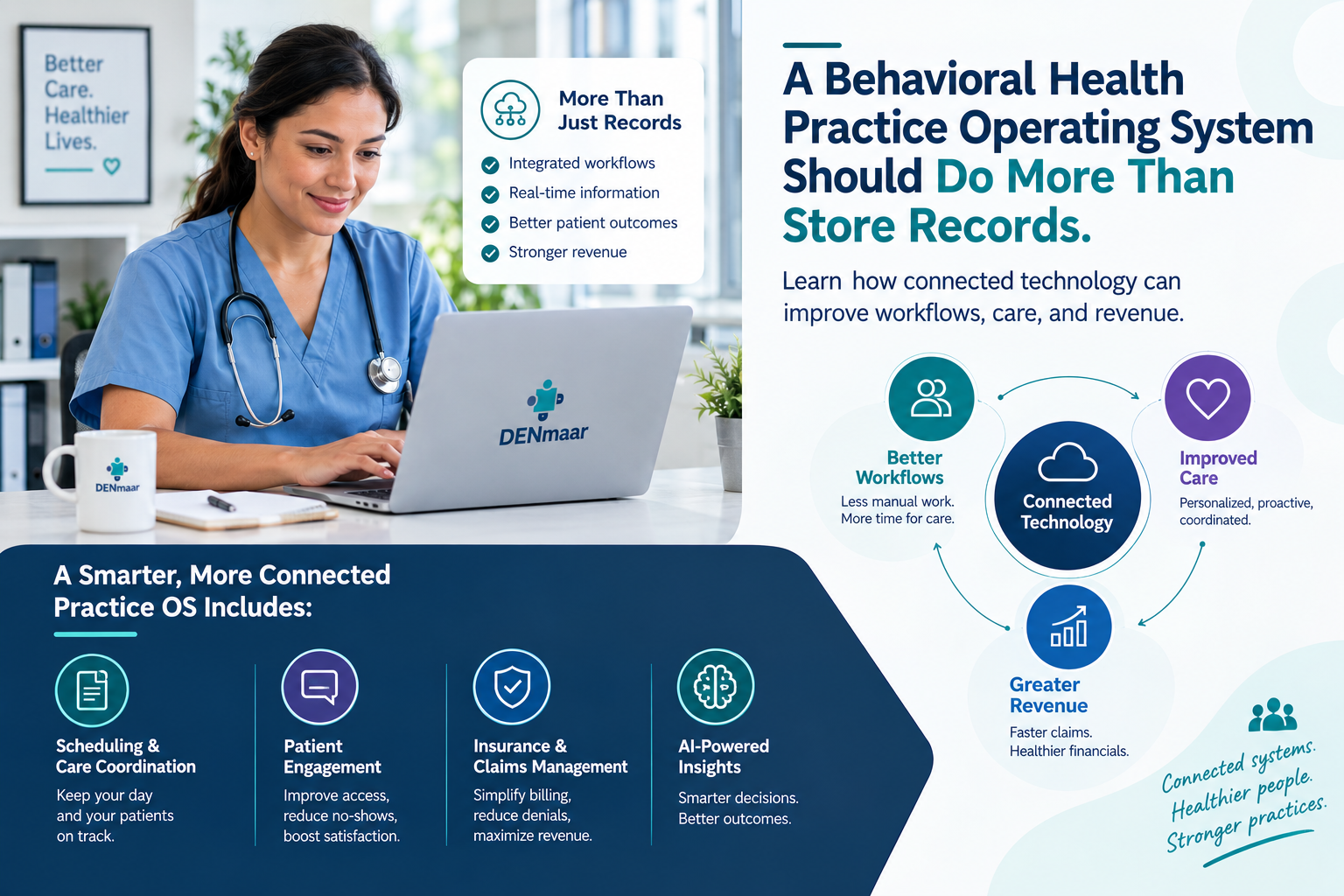
Behavioral health practices operating system should expect their technology to do more than store records and present task lists. The platform should actively move work forward, complete routine actions, and bring people into the process when their attention is genuinely needed.
The Patient-to-Payment Cycle gives DENmaar a clear standard for every product decision: does this capability help a patient reach care and help the practice collect the revenue earned for that care? When the answer is yes, it belongs in the core operating system.
DENmaar connects patient access, clinical workflow, insurance intelligence, and revenue cycle operations in one behavioral health platform.
Learn how DENmaar can help your practice manage the complete Patient-to-Payment Cycle.