

- Therapy and medication management
- IOP, PHP, and SUD treatment programs
- Case management, community support, and residential services
DENmaar Revenue Cycle Intelligence
Claims Copilot ™
Stop Chasing Claims.
Start Preventing Problems.
Claims Copilot is DENmaar’s behavioral health revenue cycle solution
designed to help practices prevent claim issues before submission, reduce
aging, accelerate reimbursement, and improve operational performance.

Pre-Submission Claim Readiness

Payer Lifecycle Monitoring

Aging & Collections Visibility
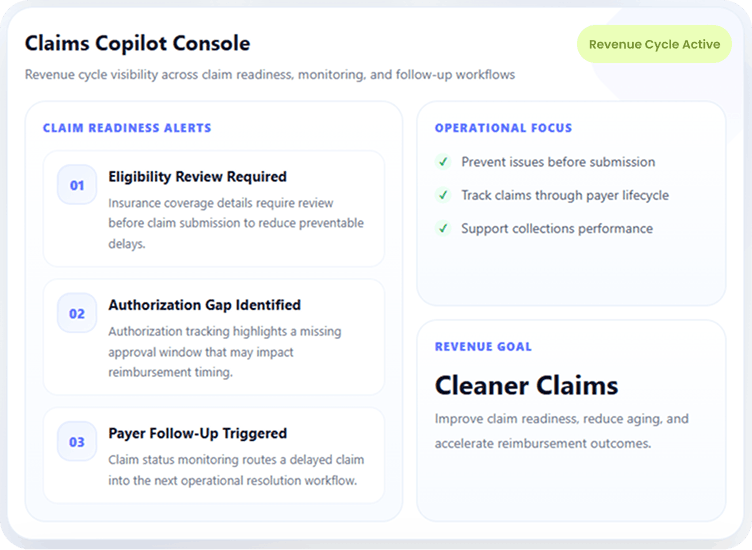
Pre-Submission Readiness
Catch eligibility, authorization, payer, and documentation issues before claims go out.
Lifecycle Claim Monitoring
Track claims after submission with rejection management, status visibility, and aging oversight.
Operational Performance
Support clean claim performance, reduce aged claims, and improve collections visibility.
Behavioral Health Focused
Designed for therapy, medication management, SUD, IOP/PHP, community support, and more.
Built for Behavioral Health
Designed for Behavioral Health
Revenue Cycle Workflows
Whether your organization provides therapy, medication management, IOP,
PHP, SUD treatment, case management, community support, or residential
services, Claims Copilot is built around the operational and reimbursement
realities of behavioral health.

Behavioral health support areas
Claims Copilot is positioned to support behavioral health organizations that need stronger claim readiness, reimbursement visibility, and operational follow-up across complex service lines.
Prevent Problems Before Claims Are Submitted
Address Revenue Cycle Breakdowns
Before They Turn Into Denials or Delays
Most claim problems begin long before a claim is submitted. Claims Copilot helps practices identify and
resolve those issues earlier so reimbursement performance is not undermined later.

Verify Insurance Eligibility
Confirm insurance coverage details early to reduce preventable reimbursement delays and billing confusion.

Review Insurance Information & ID Cards
Validate insurance information and supporting details so claims are built on more accurate payer data.

Track Authorizations
Monitor authorization requirements and approval status to reduce avoidable denials tied to missing coverage approvals.

Monitor Provider Credentialing Requirements
Support awareness of credentialing-related payer requirements that can affect billing and reimbursement workflows.

Identify Claim Issues Before Submission
Catch missing information, workflow gaps, and other claim barriers before the claim enters the payer lifecycle.

Improve Documentation-to-Billing Alignment
Route messages and requests to the appropriate team, department, or follow-up queue.
How Claims Copilot Works
A continuous workflow built to
support prevention, monitoring, and resolution.
Claims Copilot doesn’t stop at submission. It supports the operational work needed before the claim goes out, then continues
tracking activity through the payer lifecycle to help teams reduce delays, aging, and reimbursement bottlenecks.
1
Review claim readiness before submission
Insurance, eligibility, authorization, and workflow details are reviewed to identify claim risks before they become downstream reimbursement problems.
2
Submit claims and monitor payer activity
Once claims are submitted, Claims Copilot supports visibility into rejections, claim status, aging, and other signals that indicate a claim may require action.
3
Route follow-up through the right workflow
Operational tasks can be prioritized based on the issue—whether the next step involves internal follow-up, claim correction, payer research, or payment posting support.
From prevention to reimbursement performance.
Claims Copilot is designed to help organizations manage the full payer journey—not just claim submission. The result is a more proactive revenue cycle process with clearer visibility and fewer avoidable surprises.

Before submission:
improve readiness across insurance, authorizations, and documentation alignment

After submission:
monitor claim status, rejections, denial patterns, and aging across the payer lifecycle.

Operationally:
help teams reduce aging, recover delayed payments, and improve turnaround performance.
Monitor Claims Through the Entire Payer Lifecycle
Submitting claims is only the beginning.
Claims Copilot continuously tracks claim progress and supports the workflows needed to identify
reimbursement issues, respond to payer friction, and keep claims moving toward payment.

Claim Submission & Rejection Visibility
Support clean electronic claim submission while maintaining visibility into rejections and claim issues that need attention after submission.
- Electronic claim submission
- Rejection management support
- Visibility into claim readiness breakdowns

Status Monitoring & Aging Analysis
Track claims after submission to identify delays, payer inactivity, unresolved statuses, and aging trends that can impact collections.
- Claim status monitoring
- Aging analysis and prioritization
- Operational follow-up workflow visibility

Denials, Follow-Up & Payment Support
Improve follow-through on denied or delayed claims by supporting structured next steps across payer follow-up, resolution activity, and payment posting workflows.
- Denial tracking
- Follow-up workflow support
- Payment posting support
Reduce Aging and Improve Collections
Give your organization earlier visibility, better follow-through, and fewer preventable delays.
Many behavioral health organizations struggle with growing accounts receivable because claim issues are discovered too late. Claims Copilot helps teams stay ahead of the work required to keep reimbursement moving.

Reduce aged claims
improve readiness across insurance, authorizations, and documentation alignment.

Recover delayed payments
Identify unresolved payer issues sooner and reduce the amount of time claims spend waiting without meaningful action.

Improve turnaround and clean claim performance
Support stronger revenue cycle performance by reducing preventable breakdowns before and after submission.
A Partnership Approach
Successful revenue cycle management requires operational collaboration.
Many behavioral health organizations struggle with growing accounts receivable because claim issues are discovered too late. Claims Copilot helps teams stay ahead of the work required to keep reimbursement moving.

Before submission:
improve readiness across insurance, authorizations, and documentation alignment.

After submission:
monitor claim status, rejections, denial patterns, and aging across the payer lifecycle.

Operationally:
help teams reduce aging, recover delayed payments, and improve turnaround performance.
Included With DENmaar
Claims Copilot is part of the DENmaar
Behavioral Productivity Platform.
When DENmaar manages your insurance billing, your organization also gains access to the broader operational and clinical
platform that supports scheduling, documentation, reporting, and patient management workflows.

Behavioral Health EHR
Clinical and operational workflows designed around behavioral health documentation and care delivery.

Scheduling
Integrated scheduling workflows to support patient flow, operational visibility, and billing readiness.

Documentation Tools
Clinical notes, treatment plans, and documentation workflows that support stronger operational alignment.

AI-Assisted Notes
Support documentation efficiency while maintaining professional review and oversight workflows.

Treatment Plans
Behavioral health planning tools that connect care planning with documentation and operational workflows.

Clinical Workflows
Support multidisciplinary behavioral health processes with connected operational and clinical workflows.

Reporting
Visibility into productivity, claim performance, and operational trends across the platform.

Patient Management Tools
Connected workflows for patient registration, intake coordination, operational follow-up, and practice support.
Request an
AI Notes Trial
See how DENmaar AI Notes can help your clinicians reduce documentation time while improving
Request a demonstration or pilot program today.
Request Information
TESTIMONIALS
WHAT OUR CLIENTS SAY
On behalf of everyone at Meadowlark Counseling Services, I want to extend our sincere thanks for the continued improvements you and your team have made to the DENMaar EMR platform. We have been consistently impressed with both the functionality and user-friendly design of the system, which has made a meaningful difference in our day-to-day operations. The intuitive layout and ease of use have allowed our staff to spend less time navigating the system and more time focusing on client care. The regular updates and enhancements reflect your commitment to meeting the evolving needs of providers in the behavioral health and substance use treatment fields. We genuinely look forward to the new features introduced each month and appreciate how responsive the platform has been to the demands of clinical workflows. We have been so pleased with our experience that we’ve taken the opportunity to recommend DENMaar to other professionals in Pennsylvania who are working in the SUD field. Thank you again for your ongoing support and partnership. We are grateful to be working with a company that truly understands the needs of its users. KIndly, Becky Parks on behalf of the entire team at Meadowlark Counseling Services
I referred one of my colleagues Dr Aaron to you he is just starting g his psychology private practice and looking at where to start. I told him hands down you guys are the best billers and have a great EMR and team. He said he reached out just wanted to let you know!
FANTASTIC job keeping things rolling along with any and all of our billing concerns as well as responding to other issues which may well have been out of your wheelhouse. We are VERY grateful to have you and the crew in our corner.
I appreciate you all so much and DENmaar has been such a blessing Donna to our overall operations and success as an expanding company—allowing us to ultimately operate more efficiently, get our claims paid more consistently, ad stay on top of the critical credentialing piece, among other things. Teamwork does in fact, make the dream work. I’ll loop Chris/Isabella in on this message thread too, as I want All of your team to be aware of how much we appreciate our working relationship with DENmaar
Thank you for your diligence!! I appreciate it so much. Thank you Edwina…
Thank you so much Amy! I will be referring to DENmaar as often as I am asked about credentialing services.
Our Latest Blogs

AI Workflow Automation in Behavioral Health: The Most Valuable AI Might Be Boring
Nobody gets excited about an unsigned note.
Until it holds up payment for three weeks.
Nobody applauds when an intake gets completed, a treatment plan gets reviewed, or an attendance discrepancy gets caught before billing.
But ask the person who spends Friday afternoon chasing those things. They might have a different definition of exciting.
Much of the conversation about healthcare AI centers on what it can generate: a note, an answer, a summary. Those capabilities have a place. Yet a particularly useful opportunity sits in the everyday work surrounding patient care.
The work that someone still has to remember.
AI Workflow Automation in Behavioral Health Starts With Follow-Through
Consider an ordinary day in a behavioral health practice.
A prospective patient starts an intake but never finishes. A provider completes a session but leaves documentation unfinished. A treatment plan needs review. A supervisor has a note waiting for a signature. A billing specialist needs one missing detail before moving a claim forward.
Each item looks small on its own. Together, they create a second workload: checking, reminding, searching, and asking whether something got done.
Often, an experienced staff member becomes the practice’s unofficial memory. They know which screen to check, whom to remind, and what will fall through the cracks if they take a day off.
That is a lot to ask of one person’s memory.
Give AI a Useful Job
Imagine AI helping identify an unfinished note and bringing it into the provider’s work queue with the relevant appointment attached.
Or surfacing a treatment plan due for review alongside the patient’s recent assessments, so the clinician can decide what needs to change.
Or flagging a difference between scheduled group time and recorded attendance, allowing staff to verify what happened before billing review.
Or identifying an incomplete intake and preparing a follow-up for staff to review.
These are practical opportunities for AI-enabled workflows. Their value depends on accurate information, clear rules, and appropriate human oversight. Clinical decisions belong with clinicians, and billing decisions must account for the applicable payer requirements.
The goal is to make the next necessary action easier to see and complete.
Another Alert Is Not Enough
A reminder that sends someone searching through five screens still leaves plenty of work behind.
Useful automation needs context. Which task needs attention? Who is responsible? What is the next step? Is there a dependency that must be resolved first?
A better behavioral health documentation workflow makes outstanding work easier to identify and helps providers, supervisors, and billing teams understand where responsibility moves next.
AI should support this process, not replace professional judgment. Clinical decisions remain with clinicians, and staff should retain appropriate oversight of administrative and financial actions.
The goal is not more alerts. It is fewer unresolved tasks.
Less Chasing. More Room to Work.
For a provider, the benefit might be ending the day with fewer loose ends. For billing staff, it might be receiving documentation ready for review. For an owner, it might be seeing where work is stalled without personally investigating every case.
For patients, better follow-through could mean an intake that keeps moving or a review that happens when it is due.
These are the outcomes worth designing for, and measuring. How long does work sit unfinished? How many times must the staff touch it? Are issues resolved earlier? Do people spend less time chasing one another?
What We Are Building Toward at DENmaar
At DENmaar, this thinking is shaping our development direction: connecting the scheduler, clinical documentation, treatment planning, work areas, and billing so that information supports the next step in the practice’s work.
Our aim is to make AI useful within those everyday workflows, with people able to review, decide, and act.
The most valuable AI in healthcare might be boring.
But getting home with fewer unfinished tasks on your mind? That sounds pretty good.
Want to explore how DENmaar could support your practice workflows? Contact our team to discuss your needs or request a conversation.
Frequently Asked Questions
What is AI workflow automation in behavioral health?
It uses AI to help identify, organize, and move routine practice tasks forward while keeping people involved in decisions.
How can AI reduce administrative work in behavioral health?
AI can help surface unfinished notes, incomplete intakes, pending reviews, and follow-up tasks so staff can address them sooner.
Can AI automate clinical documentation?
AI can assist with documentation tasks, but clinicians remain responsible for reviewing and approving clinical records.
How can workflow automation help behavioral health billing?
It can help flag missing information and documentation issues before billing review, subject to payer requirements and staff verification.
What should practices measure when adopting AI workflows?
Track task completion time, repeated staff touches, unresolved work, and how quickly issues are identified and resolved.
Behavioral Health Documentation Workflow: The Work After Each Session
Behavioral Health Documentation Workflow
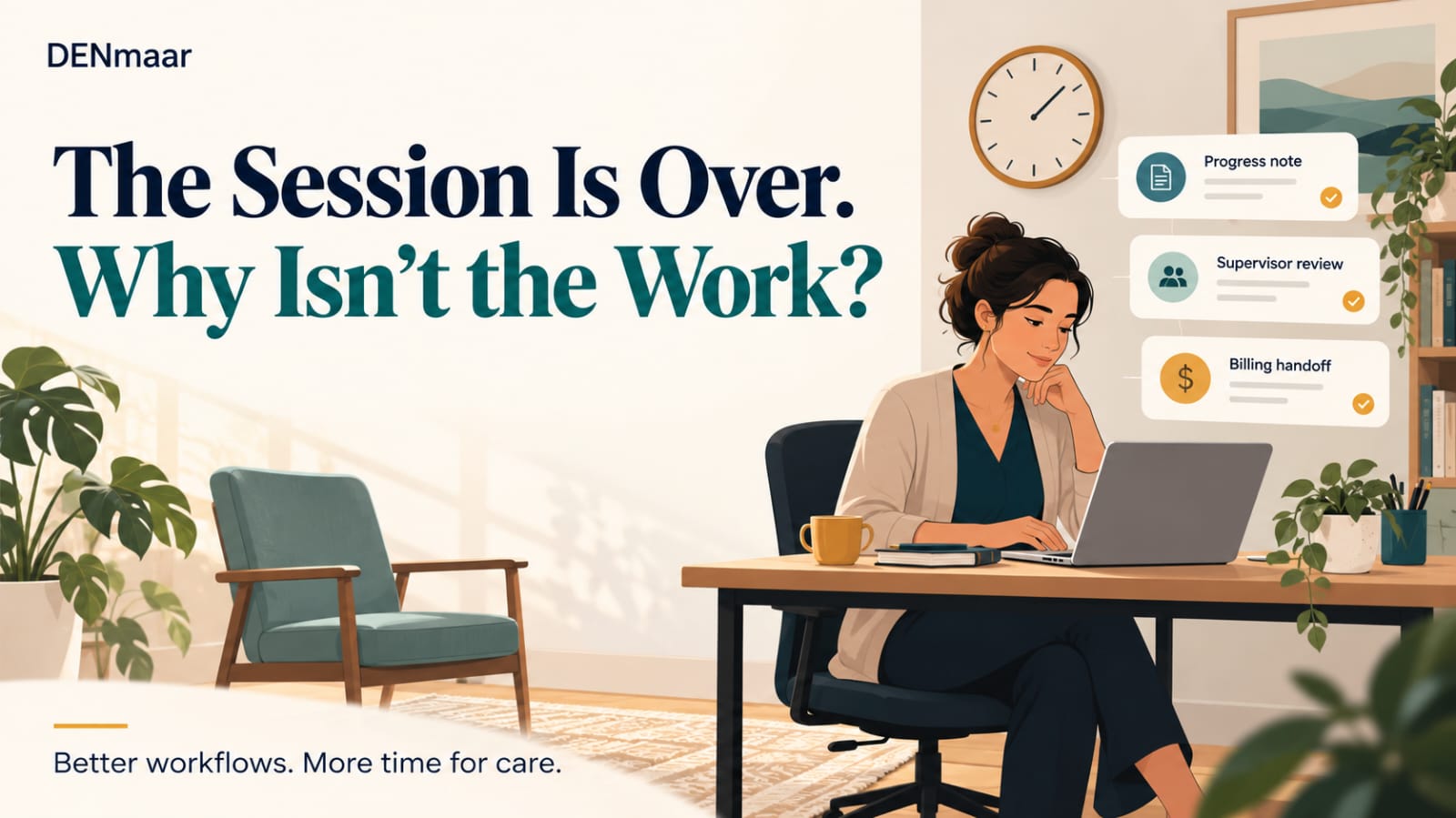
The Session Is Over. Why Isn’t Work?
The patient leaves. The next appointment is about to begin. But the work from the last session is still waiting.
There is a progress note to complete, a treatment plan to review, perhaps a supervisor signature to obtain, and information the billing team needs before a claim can move forward.
For behavioral health providers, the appointment is only one part of the job. What happens afterward can determine how much work follows them home—and how smoothly the practice operates.
Behavioral Health Documentation Workflow: The Gap Between Seeing a Patient and Finishing the Work
Consider a familiar situation: a provider finishes a session, returns to the schedule, opens the patient chart, finds the correct note, and begins documenting. An interruption comes. The note stays unfinished.
Later, someone must identify what is missing. A supervisor may need to review it. Billing may need clarification. Each person spends time finding the next step before they can take it.
Repeated across a busy practice, these small delays accumulate.
The opportunity for better software starts here: make the next step easier to see and complete.
Put the Next Action Within Reach
After a session, the provider should be able to move directly into the relevant documentation, with the patient and appointment context already connected.
An unfinished note should remain visible. A required signature should reach the right reviewer. A billing issue should have a clear owner.
These connections matter because a practice’s work passes through several hands. Providers, supervisors, front-office staff, and billing teams each need a clear view of their responsibilities—and a reliable way to hand work to the next person.
Give AI a Useful Place in the Process
AI has potential to help with documentation and administrative work. Its value depends on where it fits into the day.
Can it help a provider complete the task already in front of them? Can it surface relevant information without creating another search? Can it support a handoff while keeping the responsible person in control?
Those are the questions guiding DENmaar’s approach to AI-enabled workflows.
What DENmaar Is Building Toward
DENmaar’s upcoming Provider Work Area is being developed around a practical goal: bring providers’ daily responsibilities together so they can see what needs attention and move through their work more easily.
The planned integration of DENbot supports that direction, bringing AI assistance closer to the work providers are doing.
Our broader focus connects clinical documentation, practice operations, and insurance billing. Improving those connections can help work move from the completed appointment toward a completed note, the appropriate review, and billing readiness.
A useful measure of progress is simple:
When the last patient leaves, how much work is still waiting?
At DENmaar, that question helps guide what we build next.
Want to see how DENmaar connects clinical workflows and billing? Schedule a conversation with our team.
Learn more about AI in EHR and revenue cycle management and how AI could help move approved workflows forward.
Frequently Asked Questions
What is a behavioral health documentation workflow?
It covers the steps needed to complete clinical notes, treatment plans, reviews, signatures, and related billing requirements after a session.
Why does documentation remain unfinished after sessions?
Interruptions, manual handoffs, unclear responsibilities, and separate workflows can delay documentation and follow-up tasks.
How can AI improve clinical documentation workflows?
AI can help organize documentation tasks, surface relevant information, and support follow-up while keeping providers responsible for clinical decisions.
How can practices reduce post-session administrative work?
Connecting documentation, review tasks, and billing requirements can make outstanding work easier to identify, assign, and complete.
How does software support behavioral health practice operations?
Connected workflows help providers, supervisors, and billing teams track responsibilities and move work toward completion with fewer manual handoffs.
Chatbots vs Agentic AI in EHR and RCM Systems: Understanding the Difference
Artificial intelligence is becoming part of the conversation around electronic health records (EHRs) and revenue cycle management (RCM). But answering a question and completing a workflow are different capabilities.
For a behavioral health practice, that difference matters. A useful answer can save time. A system that helps move work toward completion can change how the practice operates.
Agentic AI in EHR and RCM Systems
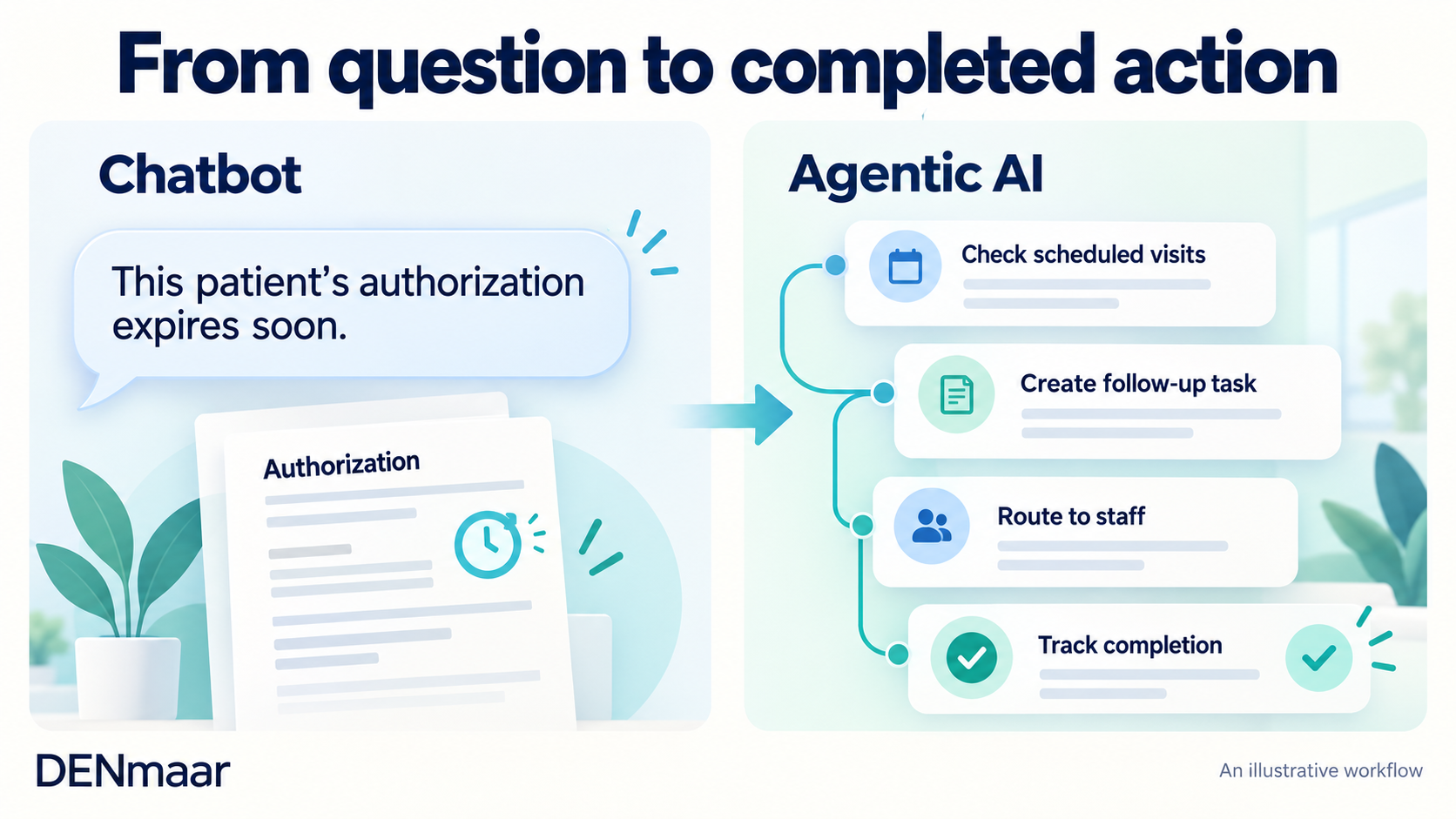
A chatbot provides a conversational interface. Depending on its connections and permissions, it may answer questions, explain information, summarize records, or draft content.
A provider might ask, “What documentation is still incomplete?” A billing specialist might ask, “What does this denial reason mean?”
An assistant connected to the appropriate data could identify unsigned notes or explain a denial. Staff would then take the next steps.
Instead of only explaining an authorization issue, an agent could check the authorization record, compare it with upcoming appointments, create a follow-up task, and route it to the appropriate employee.
Agentic AI can use connected tools to pursue a defined goal through multiple steps. It can select an available action, examine the result, and determine what should happen next within its permissions.
Instead of only explaining an authorization issue, an agent could check the authorization record, compare it with upcoming appointments, create a follow-up task, and route it to the appropriate employee.
These are illustrative possibilities, not claims that every EHR or RCM platform offers them today. For a broader look at agentic AI in behavioral health, the focus is on how carefully defined AI assistance could support everyday practice workflows.
Chatbots and Agentic AI: The Capability Difference
The distinction is also more nuanced than “chatbots talk, agents act.” A chatbot can be the interface through which a user directs an agent. What matters is the capability behind the conversation: which records it can access, which tools it can use, and how its work is controlled.
For provider documentation, conversational assistance could list incomplete notes and summarize what needs attention. An agentic workflow could prioritize outstanding work, open the relevant items, and route reminders or review tasks.
For authorization tracking, conversational assistance could explain recorded visit limits and dates. An agentic workflow could compare authorization data with scheduled services and assign exceptions for review.
For claim denials, conversational assistance could summarize a denial and suggest possible next steps. An agentic workflow could retrieve related claim details, prepare a follow-up task or draft correction, and route it for approval.
For patient billing, conversational assistance could explain a balance using available account information. An agentic workflow could check unresolved insurance activity and prepare an approved outreach workflow for staff review.
The benefit is fewer manual handoffs between identifying an issue and addressing it.
Agentic AI in EHR Workflows Needs More Than Automation
However, a scheduled reminder or a fixed rule is ordinary automation. It does not become agentic simply because a vendor adds an AI label. Agentic behavior involves selecting next steps based on the goal, available information, and results.
In an EHR or billing system, action needs accountability.
A practical design should limit access by role, record what the AI did, and clearly show what was completed, what failed, and what still requires attention. Missing or conflicting information should trigger review rather than a confident guess.
Clinical decisions, note signatures, coding changes, claim submissions, and financial adjustments need controls appropriate to their consequences. An agent may prepare work while a qualified person retains approval authority.
Eligibility results also should not be presented as a guarantee of payment. Moving faster does not remove the need to verify the underlying information.
Agentic AI in EHR: A Practical Starting Point for DENmaar
For DENmaar, the Provider Work Area is a practical place to connect conversational assistance with the work providers need to complete.
A useful first step is helping a provider see what needs attention and reach it more easily. Further development can focus on specific workflows where AI can prepare, route, or complete approved steps.
Success should be measured through everyday results: fewer clicks, fewer unresolved tasks, less duplicate work, and more timely completion.
The question practices should ask is simple: Does the AI only describe the work, or can it help move the work forward with clear permissions and visible results?
That is the difference that matters.
The healthcare workflow examples above are proposed applications, not documented DENmaar product capabilities.
Background Sources
OpenAI Agent definitions-> https://developers.openai.com/api/docs/guides/agents/define-agents
OpenAI Running agents-> https://developers.openai.com/api/docs/guides/agents/running-agents
OpenAI Guardrails and human review-> Guardrails and human review | OpenAI API
Frequently Asked Questions
What is Agentic AI in EHR systems?
Agentic AI in EHR systems can use approved tools and information to help complete defined workflows while keeping human oversight.
How is a chatbot different from Agentic AI?
A chatbot mainly provides conversational assistance, while Agentic AI can pursue defined goals through multiple approved workflow steps.
Can Agentic AI automate EHR workflows?
Agentic AI can potentially prepare, route, or complete approved workflow steps, depending on system access, permissions, and controls.
Can Agentic AI replace healthcare staff?
Agentic AI is designed to reduce repetitive work. Clinical decisions and other consequential actions should retain appropriate human oversight.
Why does Agentic AI matter for RCM?
It can help connect issue identification with follow-up, reducing manual handoffs and helping billing teams focus on unresolved revenue-cycle work.
Our Partners






Ready to get started?
Feel free to reach out if you have any questions.
